Average Lifespan of Car Engines – UK Data & Realistic Expectations

Gradual wear vs critical failure • UK driving conditions • Repair or replace decision framework
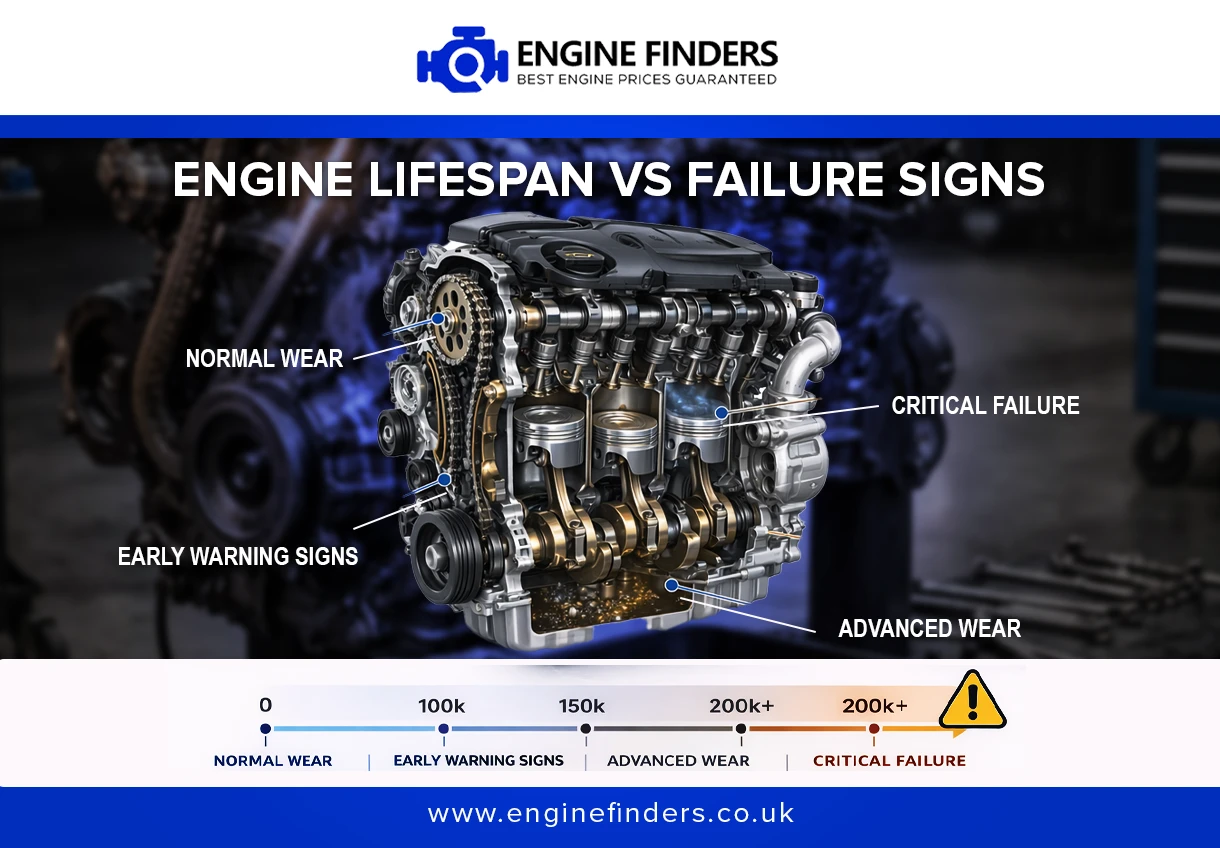
Car engine lifespan UK guide

FAULT

Gradual mechanical wear, combustion degradation, or ancillary system failure masking as core engine lifespan exhaustion

URGENCY

Medium (escalates to High if oil pressure drops, timing components fail, or excessive blow-by is present)

LIKELY COST BAND (UK)

£800–£4,500+

Top-end refresh, full reconditioning, or block replacement

BEST NEXT STEP

Confirm mileage pattern, pull oil pressure data at operating temperature, verify your engine code

Introduction

Engine Lifespan: When Gradual Wear Becomes Critical

Engine lifespan is rarely a sudden event. It usually announces itself through a slow loss of compression, creeping oil consumption, or a cascade of secondary component failures. The real cost risk lies in misdiagnosing wear patterns as total engine failure. Acting too early wastes money on unnecessary work. Waiting too long risks crankshaft scoring, bearing seizure, or cylinder wall scoring that turns a manageable refresh into a write-off scenario.

Analysis of LSE and MOT data shows the average UK car reaches retirement around 18 years or 150,000–180,000 miles. However, engineering philosophy and maintenance culture create significant variation; you can compare average engine lifespan by brand to see where your vehicle sits. The raw mileage number does not capture mechanical reality. UK driving cycles combine damp storage conditions, frequent cold starts, and heavy stop-start traffic. These conditions accelerate wear on ancillaries and oil circulation pathways long before the core block reaches its structural limit.

A common finding is that owners replace engines at 120,000 miles due to a single failed subsystem, while the actual crankshaft and cylinder bores remain within service tolerances. This guide breaks down what actually determines engine longevity in UK conditions. It separates normal degradation from critical failure signs. It maps out realistic UK repair versus replacement costs. The aim is to remove guesswork, prevent overspend, and give a clear decision framework when an engine begins showing its age. For a broader perspective on longevity, read our full guide to extending engine life.

Problem Overview: What Engine Lifespan Actually Means

Lifespan is rarely dictated by the block itself. It is typically limited by the surrounding ecosystem

Average UK Retirement

Around 18 years or 150,000–180,000 miles based on LSE and MOT data analysis.

Diesel vs Petrol

Diesel: 250,000–400,000 miles. Petrol direct-injection turbo: ~150,000 miles before attention needed.

Ecosystem Failure

Timing chains, turbos, VVT actuators, oil pumps, and gaskets typically fail before the block.

Engine codes and variant histories matter. Euro 5 and Euro 6 diesel iterations introduced complex EGR and DPF systems. These do not shorten core life but alter failure patterns. Complaints of "engine failure" often trace back to restricted oil galleries, degraded tensioners, or collapsed hydraulic lifters rather than fundamental block damage. Verify your engine code before assuming terminal failure.
For the owner, the practical question is simple: is the ecosystem failing, or is the core block structurally compromised? Understanding this distinction is the first step toward a rational financial decision.

Granular Warning Signs: When to Act Now

Match your symptoms to likely causes and recommended actions. These patterns reflect common UK driving conditions and workshop findings.

UK Driving ScenarioLikely CauseRecommended Action
Cold start rattles lasting 2–3 seconds on damp morningsOil drainback or worn timing chain tensioners; oil viscosity dropping in low ambient tempsCheck oil level and spec. Book oil pressure test if rattling extends beyond 4 seconds.
Power loss and hesitation during short urban commutesCarbon buildup on direct injection valves or restricted air/fuel mixture; DPF/EGR regeneration interruptionVerify live fuel trims and intake vacuum. Consider professional decarbonising before assuming turbo failure. For Mini owners, N14/N18 carbon buildup patterns are particularly relevant.
Intermittent limp mode on motorway slip roadsOverheating intercooler pipes, degraded MAP/MAF sensors, or turbo wastegate actuator stickingScan for stored boost deviation codes. Check intercooler pipework and turbo shaft play.
Blue-tinted exhaust smoke under steady cruisingValve guide seal degradation or piston ring wear allowing oil into combustion chamberPerform dry/wet compression test and inspect PCV valve. Do not ignore if oil consumption exceeds 1 litre per 1,000 miles.
Knocking or metallic tapping during school run trafficLow oil pressure, collapsed hydraulic lifters, or early bearing clearance expansionStop driving if noise changes pitch or increases with RPM. Check oil pressure mechanically before clearing codes.

Many warning signs mimic terminal engine wear. A technician will typically isolate them to secondary systems first. Addressing the correct root cause often extends usable life significantly.

Why This Happens: The Mechanical Reality Behind the Wear

UK operating conditions introduce specific stressors that accelerate certain failure modes

Thermal Cycling & Seal Degradation

Short cold-start trips common in UK urban areas prevent oil from reaching stable operating temperatures. Water condensation remains suspended in the sump, diluting the lubricant and accelerating additive breakdown. Over time, this promotes sludge formation in cam followers and oil pickup strainers.

Direct Injection Carbon Build-Up

Without fuel washing over the valves, deposits accumulate. This disrupts airflow and creates hot spots in the combustion chamber. The thermal imbalance stresses piston crowns and exhaust valves. This pattern affects many modern direct-injection turbo petrol engines. Explore warranty-backed reconditioned options for specific cleaning approaches.

Turbocharger Oil Film Integrity

Modern turbos spin at extreme RPMs with lean tolerances. Cutting the engine immediately after high-load running traps heat in the bearing housing. Oil coking occurs. The first sign is often boost lag that escalates into shaft play. Diesel engines tolerate sustained load better, explaining their higher mileage ceiling. Performance variants like the BMW S58B30B twin-turbo M engine require particularly careful thermal management.

UK Damp Climate & Sensor Degradation

Moisture intrusion into crankshaft position sensors, lambda probes, and coolant temperature gauges creates intermittent faults. The engine control unit compensates by retarding timing or enriching mixture, masking the true mechanical state. Clearing codes without addressing moisture ingress gives a false sense of resolution.

decision framework

Repair vs Replace: A Practical Framework

Deciding between refurbishment and full replacement requires separating emotional attachment from mechanical economics.

Repair when: valve stem seal leakage, carbonised intake ports, degraded turbo seals, or worn timing chain assemblies. Cylinder bores and crankshaft journals remain within tolerance.
Replace when: structural damage is present: scored cylinder walls, spun main bearings, cracked oil galleries, or severely warped blocks.

💰 Common rule of thumb:

If repair costs approach 40–60% of the vehicle's current realistic trade value, replacement or warranty-backed reconditioned options are worth comparing on purely financial grounds. This threshold accounts for labour multipliers, ancillary parts, and warranty differences.

Decision Factor Table
FactorFavour RepairFavour Replacement
Core IntegrityBores and journals within toleranceScored walls or spun bearings
Labour AccessTop-end accessible without subframe dropEngine-out required; labour exceeds 12–14 hours
WarrantyParts-only refresh with short turnaroundFull unit with bench test and long warranty
DowntimeRepairable within 2–3 daysReplacement unit faster when machining is backlogged
Vehicle ValueHigh relative to repairLow relative to repair

UK Cost Guide: Realistic Ranges and Hidden Variables

Costs vary by region, garage type, and parts sourcing strategy. Figures reflect typical UK market ranges as of 2026.

Service / Component
  • Diagnostic Assessment: £60–£120 (fault code readout + live data)
  • Minor / Top-End Refresh: £180–£950 (valve cover gasket, timing chain kit, decarbonising, turbo seal)
  • Major Repair: £900–£2,400 (head gasket, cylinder de-glazing, ring replacement)
  • Labour Rates: £85–£120/hr (Independents) / £150+ (Main Dealers)
  • Reconditioned Engine (supply only): £1,800–£3,500 (bench tested)
  • Used Engine Fitting: £900–£2,200 (unit) + £700–£1,400 (labour, fluids, coding)
Hidden Costs That Surprise Owners
  • Coolant, oil, filters, belts, tensioners: £180–£350
  • Seals, gaskets, one-time fasteners: £120–£250
  • ECU coding / adaptation reset: £100–£220
  • Regional variation: London/Southeast premiums add 15–25%
  • VAT: Many independent quotes exclude VAT initially. Always confirm.

Always request itemised quotes separating labour, VAT, and parts. This prevents ancillary markups from masking transparent pricing. Compare verified supplier quotes to ensure competitive pricing.

Expert Ownership & Prevention Advice: Protecting Your Investment

Longevity depends less on manufacturer claims and more on consistent thermal and lubrication management. The following habits directly influence how close a unit gets to its mechanical ceiling. read our full guide to extending engine life for comprehensive prevention strategies.

Servicing Priorities & Intervals

Oil and filter changes must follow severity schedules. Fixed 18,000-mile intervals rarely suit UK urban cycles. Switching to 7,500–9,000 mile or annual changes significantly reduces sludge risk. Always verify manufacturer oil specification, not just viscosity. Incorrect ACEA/MB/VW approvals degrade timing tensioners and VVT actuators.

Coolant concentration must be checked annually. Diluted coolant reduces thermal capacity and promotes aluminium head warping under sustained load. Timing components should be inspected proactively around 70,000–90,000 miles. Chain stretch and plastic guide degradation are often silent until rattle appears.

Warning Signs Owners Often Miss

  • Gradual power loss attributed to "age" often traces to restricted airflow or delayed ignition timing.
  • Slight idle roughness in damp weather frequently indicates moisture-affected crankshaft sensors.
  • Oil level dropping 0.3–0.5 litres between services is acceptable. Exceeding 0.8 litres warrants immediate investigation.
  • Coolant top-ups that increase in frequency signal early sealing degradation before visible leaks appear.

What to Ask a UK Garage

"Are you measuring mechanical oil pressure at operating temperature, or only reading the dashboard sensor?"

"Can you provide live fuel trim and ignition timing data under load before recommending timing component replacement?"

"If a used or reconditioned engine is fitted, will you perform a compression verification, ECU adaptation reset, and run-in service interval schedule?"

These questions filter out parts-changers from diagnostic specialists. They ensure the recommendation matches the actual wear pattern. For deeper insight into regional failure drivers, read our mechanic's breakdown of why UK engines fail early. When sourcing replacement units, look for verified used engines with compression certificates to guarantee quality.

What NOT To Do Next: Critical Mistakes to Avoid

Do not ignore persistent oil pressure warnings. Dashboard lights often activate after pressure has already fallen below safe bearing clearance thresholds. Continuing to drive risks scored journals and spun inserts.

Do not clear fault codes and resume driving without addressing the root trigger. Control units store adaptive values based on failure patterns. Resetting without correction masks symptoms until structural damage occurs.

Do not accept "just change the whole engine" as the first solution. Technicians should demonstrate compression results, oil pressure figures, or bore scope imagery before recommending full replacement.

Do not source the cheapest used engine online without verifying crank codes, ancillary mounting points, and flywheel compatibility. Mismatched reluctor wheels create installation nightmares and calibration failures. Always verify your engine code before purchasing.

Common Buyer Mistakes: Learning from Others' Experience

Delaying action until drivability collapses is the most costly pattern. Early compression loss or oil consumption is far cheaper to address than waiting for bearing failure.

Accepting vague garage advice without data leaves owners vulnerable. Request printed compression figures, leak-down percentages, or live data screenshots. Transparent workshops provide them willingly.

Choosing the cheapest supplier often results in short-run units, missing ancillaries, or incorrect calibration. Quality replacement units include bench testing, updated gaskets, and oil pump verification. Consider warranty-backed reconditioned options for peace of mind.

Ignoring compatibility matrices causes installation delays. Engine codes share housings but differ in mounting bosses, sensor placements, and harness pinouts. Cross-reference V5C codes and VIN derivatives. Compare verified supplier quotes to ensure correct fitment.

When to Seek Help / MOT Implications: Knowing the Tipping Point

Seek immediate assessment if:

  • Oil pressure warnings persist after topping up
  • Compression drops below manufacturer minimums
  • Metallic knocking changes frequency with RPM

MOT fail risks include:

  • Excessive blue or black exhaust smoke (emissions failure)
  • Coolant leaks reaching hot components (safety hazard)
  • Repeated advisories for oil leaks or abnormal noises without intervention

Emissions compliance is critical:

Degraded oxygen sensors, restricted EGR passages, and worn valve guides increase hydrocarbon output. Vehicles operating near ULEZ boundaries must maintain clean combustion to avoid penalty charges while ageing. Addressing intake sealing and sensor function restores compliance without engine replacement. VW direct injection carbon solutions can help restore emissions compliance in affected models.

FAQ Section: Real Questions, Practical Answers

How accurate are online engine mileage estimates?

Mileage is only one variable. Service history, operating temperature stability, and oil specification adherence matter more. A well-maintained engine at 140,000 miles often outlasts a neglected unit at 90,000. Compression data and oil pressure readings provide far more reliable condition indicators than dashboard odometers alone.

Can a reconditioned engine match original lifespan?

Quality replacement units typically use updated metallurgy and revised gasket materials. When machined within original tolerances and paired with correct ancillaries, they commonly reach or exceed original service life. Bench testing, oil gallery flushing, and new bearings are minimum expectations. Budget rebuilds skipping internal machining rarely deliver consistent longevity. Look for warranty-backed reconditioned options with full documentation.

What does DVLA require if I replace my engine?

The DVLA does not require notification for a like-for-like engine replacement. You only need to update records if displacement, fuel type, or emissions category changes significantly. Keep receipts, engine code documentation, and installation invoices for future MOT or insurance queries. Always verify engine code compatibility before installation.

Do I need to inform my insurer after an engine swap?

Policies vary by provider. Most insurers require disclosure of major mechanical replacements that alter vehicle value or specification. Failing to declare a like-for-like engine usually carries minimal impact, but transparency prevents claim disputes. Provide the supplier invoice and confirm the engine code matches original specifications. Source verified used engines with compression certificates for complete documentation.

Will a new engine reset my MOT emissions baseline?

A properly installed unit with fresh sensors and clear fuel trims typically improves emissions output. However, MOT stations record historical data and test current output against manufacturer thresholds. Running a 50–100 mile break-in period before testing allows fuel adaptations to stabilise, reducing the chance of premature failure flags.

How do I verify oil consumption is normal or excessive?

Track top-up volume over a fixed mileage window. Manufacturers generally define up to 0.5 litres per 1,000 miles as acceptable under severe cycles. Consumption exceeding 1 litre per 1,000 miles typically indicates valve seal degradation, piston ring wear, or PCV malfunction. Combine consumption data with a compression test for accurate diagnosis. Read our full guide to extending engine life for more diagnostic tips.

Final Thought: Clarity Before Commitment

Getting a clear picture of the numbers early often makes the difference between a manageable repair and an avoidable write-off. Comparing specialist options can help make that decision clearer. When you understand compression results, labour requirements, and parts availability, choosing between a targeted refresh or a verified replacement becomes straightforward.

Compare verified supplier quotes to remove guesswork and highlight where value actually sits. No pressure. Just clarity.

UK Flag

No pressure. Just the information you need to decide with confidence. Browse our range of verified used engines with compression certificates or warranty-backed reconditioned options.