OM651 timing chain • M271 camshaft adjusters • Recon vs used • Hidden labour
FAULT
Major engine failure – timing chain, turbo, bearing wear
URGENCY
High (knocking/oil pressure = stop immediately)
LIKELY COST BAND (UK)
£2,500 – £5,500
Reconditioned engine fitted (C/E-Class)
BEST NEXT STEP
Verify engine code, get itemised quote, check core charge policy
Replacing a Mercedes-Benz engine is one of the most significant financial decisions an owner can face. It is not merely a repair; it is a major mechanical intervention that defines the remaining lifespan and value of the vehicle.
For many UK drivers, the immediate reaction to a blown engine is panic. The fear of being quoted exorbitant sums by main dealerships is real. Conversely, the risk of buying a cheap, unverified used engine from an online marketplace is equally dangerous.
This guide strips away the sales rhetoric. It provides a clear, technical, and financial breakdown of what replacing a Mercedes engine actually entails in the UK market today.
We will cover realistic costs, the hidden labour complexities specific to German engineering, and how to distinguish between a repairable fault and a terminal engine failure. The goal is to help you make a confident, informed decision without paying for unnecessary work or falling victim to poor-quality parts.
In the UK automotive trade, "engine replacement" can refer to three distinct scenarios
Pulled from a written-off vehicle. Sold "as seen" or with 30-90 day warranty. Risk: High – unknown internal wear state.
Best for: Older models (pre-2010) where budget is primary constraint.
Stripped, cleaned, inspected. Worn components replaced. Risk: Medium/Low – depends on rebuilder skill.
Best for: Most owners keeping car 2+ years – best balance of cost and reliability.
Built to original manufacturer specs with updated components. Risk: Very Low – premium cost.
Best for: Late-model vehicles under warranty or high-value classics.
Identifying the severity of an engine issue is crucial. Not every noise requires a full replacement, but some signs indicate imminent catastrophe. Mercedes C-Class engine problems like excessive oil consumption can be early indicators.
| UK Driving Scenario | Likely Cause | Recommended Action |
|---|---|---|
| Rattling on Cold Start (2-3 seconds) | Timing chain tensioner bleed-down or worn guides. OM651/M271 common. | Medium urgency – inspect immediately |
| Blue/Grey Smoke from Exhaust | Burning oil. Worn valve stem seals, piston rings, or turbo seals. | High urgency – check oil levels daily, plan compression test. A failing turbocharger is often the culprit. |
| White Sweet-Smelling Smoke | Coolant entering combustion chamber. Blown head gasket or cracked block. | Critical – stop driving immediately |
| Metallic Knocking/Ticking Under Load | Bottom end bearing failure or connecting rod issues. | Critical – immediate stop. Engine replacement inevitable. |
| Limp Mode + Loss of Power | Turbo failure, EGR blockage, or sensor fault. A faulty injector can also cause this. | Medium urgency – diagnostic scan required |
| Oil Pressure Warning Light | Low oil level, failed pump, or excessive bearing clearance. | Critical – stop engine immediately |
Mercedes engines are robust, but they have specific Achilles' heels
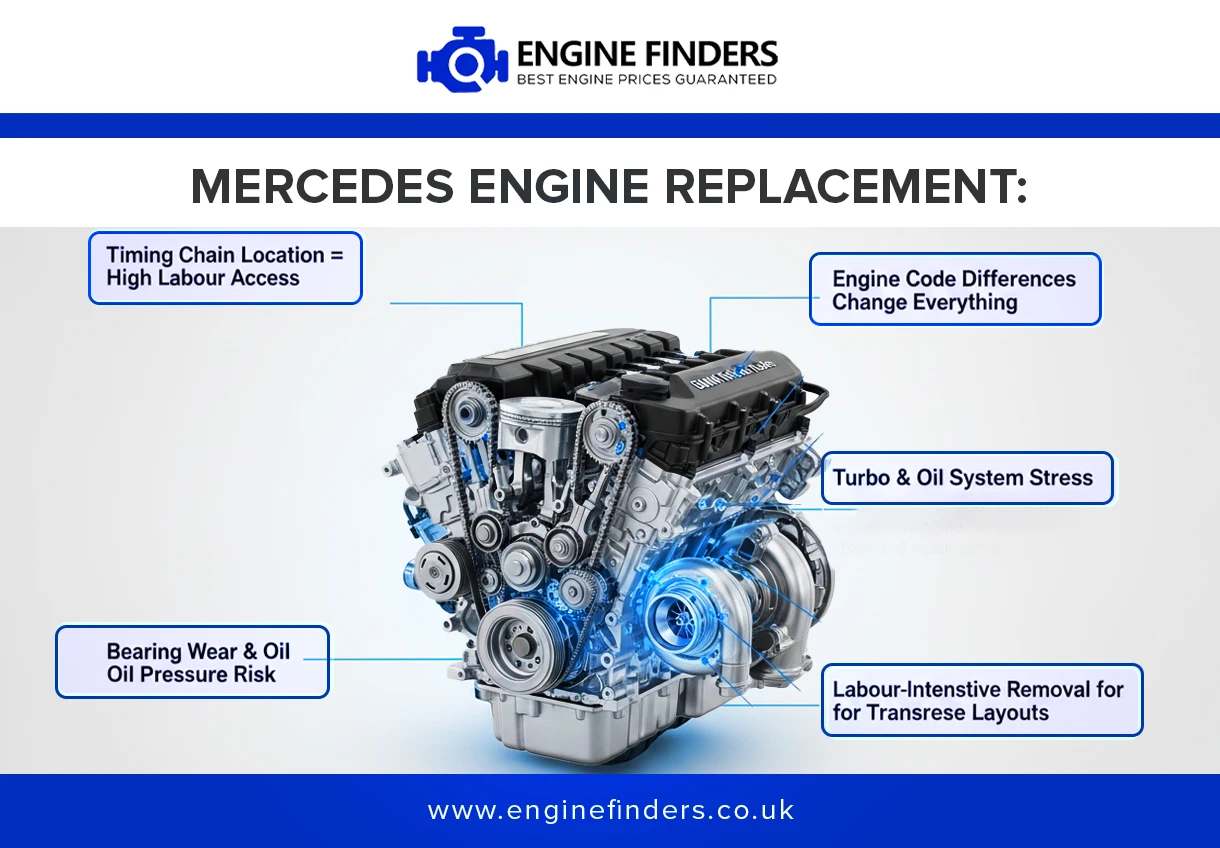
The 2.1L OM651 places the primary timing chain at the rear of the engine, against the firewall. Plastic tensioner guides become brittle. Access requires removing the engine or transmission – labour costs are disproportionately high. Early chain kit replacement is far cheaper than a new engine.
Short journeys prevent DPF regeneration. Soot builds up, oil becomes contaminated with diesel fuel (oil dilution), lubrication quality drops – accelerating wear on bearings and turbos. Using incorrect oil or failing to change it every 10k-15k miles leads to sludge buildup.
The 1.8L/2.0L M271 engines suffer from camshaft adjuster (phasor) failure. Internal gears wear out, causing timing inaccuracies. Engine runs rough, loses power, and timing can jump – leading to piston-valve interference. Updated metal adjusters are available – ensure supplier uses them.
Mercedes specifies specific oil grades (MB 229.5). Using incorrect oil or ignoring intervals leads to sludge buildup, blocking oil galleries and starving critical components of lubrication.
Deciding whether to repair your current engine or replace it entirely depends on damage extent, vehicle value, and labour accessibility. A thorough cost versus car value analysis is essential.
💰 Common rule of thumb:
If repair costs approach 40–60% of the vehicle's current realistic trade value, compare engine quotes and explore reconditioned options on purely financial grounds.
Example: 2014 C-Class worth £8,000. Repair quote £4,500 = over 50%. A reconditioned engine swap at £3,500-£4,000 resets the mechanical clock.
On many Mercedes models, ancillaries (turbo, injectors, HPFP, EGR, alternator) are reused from the old engine. If your old engine failed due to oil starvation, the turbo is likely damaged too. Reusing it risks contaminating the new engine with metal shards.
Expert advice: Always budget for replacing the turbocharger and flushing intercooler pipes when swapping an engine that failed due to lubrication or turbo issues.
Costs vary by location, garage type, and model. Prices include VAT where applicable.
Always request an itemised quote separating parts, labour, and consumables before authorising work. Confirm if VAT is included.
Preventing engine failure is far cheaper than curing it. Mercedes engines are tolerant, but not invincible. For models commonly specified in Mercedes-Benz C-Class variants, following manufacturer service schedules is essential.
1. Oil Change Intervals: Ignore "Assyst Plus" 20k+ mile claims. Change oil and filter every 10,000 miles or 12 months. Use exact Mercedes spec (e.g., MB 229.51 for diesels with DPF).
2. Warm-Up and Cool-Down: Diesel – idle 30 seconds before driving, 1 minute after motorway runs. Petrol – avoid high RPM until oil temp reaches 90°C.
3. Fuel Quality: Use premium fuels (Shell V-Power, BP Ultimate) occasionally. Detergents keep injectors clean and aid DPF health.
“Will you perform a compression test and leak-down test on the replacement engine before installation?” — Verifies health of replacement unit before fitting.
“Does the quote include updating the ECU software and adapting the new engine to the transmission?” — Prevents harsh or erratic gear shifts.
“What are the Warranty explained terms regarding labour vs. parts?” — Look for comprehensive "parts and labour" warranty for at least 12 months.
Do not ignore oil pressure warnings. If the red oil can light illuminates, stop immediately. Driving 30 seconds can score crankshaft journals.
Do not clear fault codes and keep driving. Clearing a code hides the symptom but does not fix the problem.
Do not buy the cheapest used engine online without verification. A £600 engine is a gamble. Always Check your engine code against the donor unit.
Do not skip the ancillaries. Reusing a 10-year-old water pump or thermostat is false economy – you'll pay labour again.
Delaying action hoping a rattle will go away. On timing chain issues, it never does – it gets worse until the engine jumps time.
Accepting vague advice "It needs a new engine" is not a diagnosis. Ask why – compression loss? Bearing failure?
Ignoring compatibility. Mercedes engines have subtle variations. Match the Engine Code exactly (found on V5C or under-bonnet sticker).
Overlooking the warranty fine print. Some warranties void if you miss first service after swap or use a specific garage.
Legal consequence:
Driving a car with a known serious engine fault is illegal under Road Traffic Act provisions regarding vehicle condition. It poses a safety risk if the engine seizes on a motorway.
Technically yes, but not recommended. Modern Mercedes require specialised tools for timing alignment, ECU coding, and electronic diagnostics. Incorrect installation leads to immediate failure.
No. The DVLA records the VIN, not the engine number. However, keep receipts and documentation for future resale and warranty purposes.
Generally no. An engine replacement is a repair/maintenance item, not a modification. However, inform your insurer to ensure policy validity.
Typically 2-4 days. Day 1: Removal and prep. Day 2: Installation. Day 3: Testing, coding, and road testing.
A professionally reconditioned engine replaces all wear items (bearings, seals, chains). It is mechanically superior to a used engine and more reliable than original if design flaws are corrected – a true reset of mechanical life.
It is usually returned to the supplier as a "core" for rebuilding. Ensure you get a receipt for its return to claim any core deposit refund.
Getting a clear picture of the numbers early often makes the difference between a manageable repair and an avoidable write-off. Comparing specialist options can help make that decision clearer.
At EngineFinders, we connect you with vetted UK suppliers who specialise in Mercedes powertrains. By comparing quotes for reconditioned engine options and used units, you can find a solution that fits your budget and restores your vehicle's reliability.
No pressure. Just the information you need to decide with confidence.