Used vs reconditioned • N47/N57 timing chain • Transparent quotes
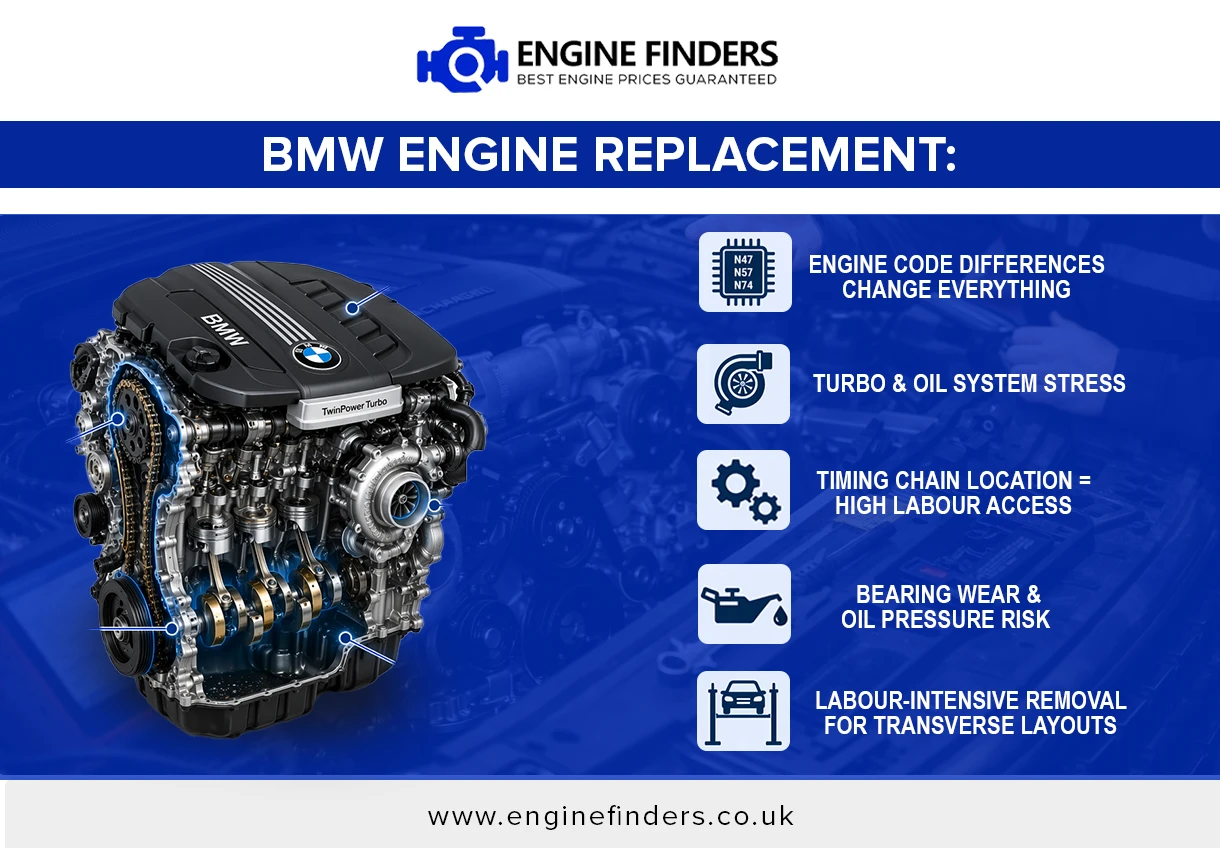
FAULT
Serious engine warning signs – timing chain, turbo, bearing wear
URGENCY
High (metallic rattle = stop driving)
LIKELY COST BAND (UK)
£2,450 (used 535d) – £21,609 (N74 V12)
Reconditioned or new unit
BEST NEXT STEP
Confirm engine code, get itemised quote, verify timing chain access scope
If your BMW is showing serious engine warning signs, the numbers can feel overwhelming. A used engine fitted to a 535d might land around £2,450. A complex N74 V12 unit, new or professionally reconditioned, can reach £21,609. That range is not a typo.
Owners often delay action because the stakes feel high and the options unclear. Will a repair hold? Is a used engine a gamble? What exactly should a quote include?
This guide cuts through the noise. It translates workshop reality into clear cost and risk assessments. You will learn what drives the price, how to spot urgent warnings, and the specific questions that protect you from poor workmanship or hidden costs.
When a garage suggests an engine replacement, they could mean several things
Sourced from a donor vehicle. Lowest upfront cost, highest uncertainty.
Professionally rebuilt with new bearings and seals. Balanced cost and reliability.
Partial rebuild. Labour often exceeds part costs on N47/N57 engines.
Match what you are experiencing with likely causes and sensible next steps. These patterns reflect common UK owner reports and workshop findings.
| UK Driving Scenario | Likely Cause | Recommended Action |
|---|---|---|
| Metallic rattle on cold start, fades after 2-3 seconds | N47/N57 timing chain tensioner wear | Stop driving. Request chain stretch diagnostic. See N47 timing chain replacement cost UK for typical pricing. |
| Power loss on motorway + blue-ish smoke from exhaust | Turbo seal failure or piston ring wear | Compression test and oil consumption check. Avoid hard acceleration. |
| Limp mode in traffic, fault codes for VANOS or boost | Solenoid failure, sensor fault, or vacuum leak | Read live data. Do not simply clear codes and drive on. |
| Excessive white smoke on cold start, sweet smell | Head gasket breach or EGR cooler leak (common on N47) | Pressure test cooling system. Check for oil/coolant mixing. |
| Deep knocking from bottom end, oil pressure warning | Bearing wear or oil starvation | Immediate stop. Tow to specialist. Do not restart. |
A technician will typically find that the warning signs owners dismiss as "just a rattle" or "a bit smoky" are the earliest indicators of failures that become exponentially costlier if ignored.
Root causes rarely appear in isolation – BMW-specific weak points drive costs
Short, cold-start school runs prevent diesel particulate filters from completing regeneration cycles. This leads to fuel dilution in the oil, which accelerates wear on timing components and bearings.
Damp UK weather affects electrical connectors and sensors. A faulty mass airflow sensor can cause incorrect fuelling, raising exhaust temperatures and stressing the turbo.
The N47 diesel engine, fitted to many 1/3/5 Series models, has a rear-mounted timing chain. Access requires removing or significantly lowering the engine. Labour for this job commonly runs 8-12 hours. At UK workshop rates of £85-£120 per hour, that is £680 to £1,440 in labour before any parts are fitted. BMW engine failure patterns show N47 chain issues are the most common cause of early replacement.
On the N47, even a "simple" chain replacement becomes a major labour event because of the design. A quote that looks cheap may have excluded the full scope of engine removal. Always confirm what access method the garage plans to use.
When does it make sense to repair, and when is replacement the smarter financial move?
💰 Common rule of thumb:
If repair costs approach 40–60% of the vehicle's current realistic trade value, compare reconditioned BMW engines and explore reconditioned options on purely financial grounds.
Costs vary by model, engine code, garage type, and location. Figures reflect typical UK market ranges as of 2026.
Always request an itemised quote separating parts, labour, and consumables before authorising any work.
Prevention is always cheaper than cure. For BMW diesel owners in the UK, a few habits make a measurable difference. BMW engines including the 5 Series and 3 Series benefit from strict maintenance schedules.
Allow the engine to idle for 30-60 seconds after a cold start. Similarly, after a hard motorway run, let the engine idle briefly before switching off to protect the turbo bearings.
Stick to the correct oil specification. For N47/N57 engines, BMW Longlife-04 5W-30 is typically required.
Consider oil changes every 10,000 miles maximum, regardless of the on-board computer's suggestion.
“Can you confirm the engine code and ensure the replacement unit matches exactly?” — BMW engine codes explained helps verify compatibility.
“Does your quote include all ancillaries that should be replaced while the engine is out, such as the water pump and engine mounts?”
“What warranty do you offer on both parts and labour, and is it verified?”
Do not ignore oil pressure warnings or knocking sounds. These indicate imminent mechanical failure.
Do not clear fault codes and keep driving. This often masks developing issues and leads to repeated limp mode.
Do not buy the cheapest used engine online without verifying the exact engine code, donor history, and used engine warranty terms. Read what to check when buying a used BMW engine before committing.
Do not accept a quote that does not specify parts origin. Know if you are getting genuine, OEM, reconditioned, or used parts.
Delaying action until catastrophic failure occurs is the most expensive mistake.
Accepting vague garage advice like "it needs a new engine" without a detailed diagnostic report.
Choosing the cheapest supplier without checking reputation, return policy, or warranty terms.
Ignoring compatibility goes beyond engine codes. The Specific B58B30O0 petrol engine guidance shows that even within the same family, variants differ significantly.
Emissions compliance is critical:
If you replace the engine, the replacement must match the original emissions specification for your vehicle's registration date.
A properly reconditioned engine from a reputable supplier should reliably deliver 50,000+ miles, provided maintenance is strict.
Full documentation of the replacement, including the engine code and donor mileage, can actually support value by providing certainty.
Yes. Most policies require notification of major repairs or modifications. Failure to disclose could invalidate cover.
Reconditioned: Fully stripped and worn components replaced to factory spec.
Rebuilt: Major failed components are replaced, but not a full strip-down.
Used: Removed from a donor vehicle with minimal intervention.
Getting a clear picture of the numbers early often makes the difference between a manageable repair and an avoidable write-off. Comparing specialist options can help make that decision clearer.
Gather three itemised quotes. Ask the technical questions listed above. Verify the engine code and warranty terms. With that information, you can decide with confidence.
No pressure. Just the information you need to decide with confidence.