Last Updated: September 15, 2026
Over 60% of Jaguar engine-related MOT failures stem from just three common issues – timing chain wear, EGR cooler leaks, and DPF clogging.
If you’re weighing a used Jaguar purchase, knowing which powerplants deliver and which drain wallets is non-negotiable. This guide cuts marketing fluff, using OEM technical bulletins, UK government MOT data, and verified supplier pricing to help you decide with confidence.
Quick Verdict: Jaguar Engine Reliability at a Glance
| Engine Code | Application (Chassis) | Reliability Score | Common Fault | Avg UK Replacement Cost (2026) |
| 204DTD | XE (X760), XF (X260), F-Pace (X761) | Low | Timing chain stretch, oil dilution | £1,650 – £2,800 |
| 306DT | Updated F-Pace, XF, E-Pace (X540) | Moderate | EGR cooler leaks, DPF clogging | £1,800 – £3,200 |
| 448DT | Late F-Pace, XF (Ingenium I6) | High | Minor turbo actuator wear | £2,200 – £3,800 |
| AJ133 | F-Type (X152), XJ (X351), F-Pace SVR | High | Supercharger isolator rattle (pre-2016) | £2,500 – £4,200 |
Jaguar Ingenium Engine Problems: What UK Buyers Must Know
Ingenium 2.0L Diesel Reliability: Timing Chain and Oil Dilution Risks
The Ingenium 2.0L diesel (engine codes 204DTD, 306DT) powers many F-Pace, E-Pace, and XE models. While efficient, early production units (2015-2018) show elevated timing chain tensioner wear, confirmed in OEM service bulletin LT01-018. Oil dilution from incomplete DPF regeneration can accelerate bearing wear, particularly on short-journey vehicles. For buyers, prioritising models with documented oil changes every 10,000 miles or 12 months is critical. If you’re comparing options, our guide to the best Jaguar F-Pace engine to buy used breaks down real-world ownership costs.
EGR Cooler Failures and MOT Emissions Compliance
Exhaust Gas Recirculation (EGR) coolers on Ingenium diesels can develop internal leaks, allowing coolant into the intake. This triggers fault codes and often causes MOT emissions failures due to elevated hydrocarbon readings. Since May 2018, UK MOT testers apply stricter diesel smoke limits, with vehicles first used after January 2014 required to meet 0.7m⁻¹ opacity.
A leaking EGR cooler frequently pushes readings beyond this threshold. Understanding diesel vehicle emission limits helps you assess pre-purchase inspection reports accurately.
Ingenium Petrol Engines: Performance vs Maintenance Demands
Ingenium petrol units (2.0L I4 turbo) deliver strong performance but demand strict adherence to service schedules. Oil degradation beyond 12 months can contribute to timing chain stretch. Unlike older designs, these engines use a chain-driven oil pump; low oil pressure from degraded lubricant accelerates wear. For detailed analysis, our Jaguar Ingenium engine reliability study reviews failure patterns across 5,000+ UK service records. When sourcing replacements, reconditioned engines built to OEM tolerances offer a cost-effective solution versus dealer units.
AJ-V8 Supercharged Engine Reliability: Power With Caveats
Jaguar 5.0L Supercharged V8: Strengths and Known Weak Points
The AJ133 5.0L supercharged V8 (found in F-Type, XJ, and Range Rover Sport SVR) is celebrated for its 470–575hp output and robust aluminium block. OEM technical papers confirm its 90° V8 architecture with quad cams and direct injection delivers class-leading specific output.
However, supercharger isolator wear and coolant pipe degradation on pre-2016 units can lead to costly repairs. Unlike Ingenium units, the AJ-V8’s timing chain system is generally robust when maintained. For buyers seeking performance, verifying supercharger service history is as vital as checking oil records. Explore Jaguar engines with verified mileage and service documentation.
Fuel Consumption and Running Costs: The Thirst Factor
While glorious under acceleration, supercharged V8s return 18–24mpg in mixed UK driving. This impacts both fuel budgets and VED (road tax) bands. Like-for-like engine replacements maintain your original tax classification, but always check current vehicle tax rates before committing. For context, a 5.0L supercharged Jaguar typically falls in the premium VED band (£600+ annually), whereas Ingenium four-cylinders often qualify for standard rates.
Jaguar Diesel Engine Codes Explained: 204DTD, 306DT, 448DT

Matching Engine Codes to Models and Reliability Profiles
Jaguar Land Rover uses specific engine codes critical for parts compatibility and reliability assessment:
- 204DTD: 2.0L Ingenium diesel (XE, XF, F-Pace 2015-2020). Prone to early timing chain issues; verify service history rigorously.
- 306DT: Updated 2.0L Ingenium diesel (post-2019). Revised tensioner design reduces failure risk; still requires strict oil discipline.
- 448DT: 3.0L inline-six diesel (late-model F-Pace, XF). Generally more robust than four-cylinder Ingenium units, with fewer reported chain issues.
When sourcing replacements, matching the exact engine code ensures compatibility with ECU calibrations and emissions systems. Our dedicated pages for the Jaguar Land Rover 204DTD diesel engine, 306DT diesel engine, and 448DT diesel engine provide model-specific fitment guidance.
DPF and AdBlue System Failures: MOT Implications
Diesel Particulate Filter (DPF) clogging remains a leading cause of MOT failure for Jaguars used predominantly on short trips. Since 2018, MOT testers must fail vehicles with evidence of DPF tampering.
AdBlue (SCR) system faults, while not a direct MOT failure point, can trigger limp mode and costly repairs. Regular motorway journeys help regenerate DPFs; for urban drivers, factor in potential £800–£1,500 DPF replacement costs. Understanding diesel emissions limits helps anticipate inspection outcomes.
Jaguar Engine Replacement Cost UK: What to Budget in 2026
Used vs Reconditioned Engines: Price and Warranty Comparison
Replacement costs vary significantly by source and specification. Based on UK supplier data (Q1 2026):
- Used engines: £800–£2,200 (mileage-dependent, limited warranty)
- Reconditioned units: £1,495–£3,850 (OEM-spec rebuilds, 12-month warranty)
- New OEM engines: £6,000–£12,000+ (dealer-supplied, full warranty)
For most buyers, a professionally reconditioned unit offers the best balance of cost, reliability, and warranty protection. When comparing options, ensure the supplier provides a clear breakdown of machining, parts replacement, and testing protocols. Our used engines inventory includes fully tested units with mileage verification and warranty documentation.
Labour Costs and DVLA Registration Steps
Fitting costs typically range £600–£1,200 depending on workshop rates and engine accessibility. Crucially, like-for-like engine replacements (same capacity, fuel type, emissions standard) do not alter your vehicle’s VED band or require re-registration. However, you must notify the DVLA of the new engine number within 14 days to keep your V5C accurate. For non-like-for-like swaps, additional IVA or emissions certification may apply. Always confirm compliance steps with your installer before proceeding.
Need a transparent, fixed-price quote for your Jaguar engine replacement? Get quotes from UK specialists who supply BS AU 145e-compliant units with full warranty documentation and optional supply-and-fit service.
Jaguar E-Pace and F-Pace Engine Considerations
E-Pace Engine Options: Ingenium Petrol vs Diesel Trade-offs
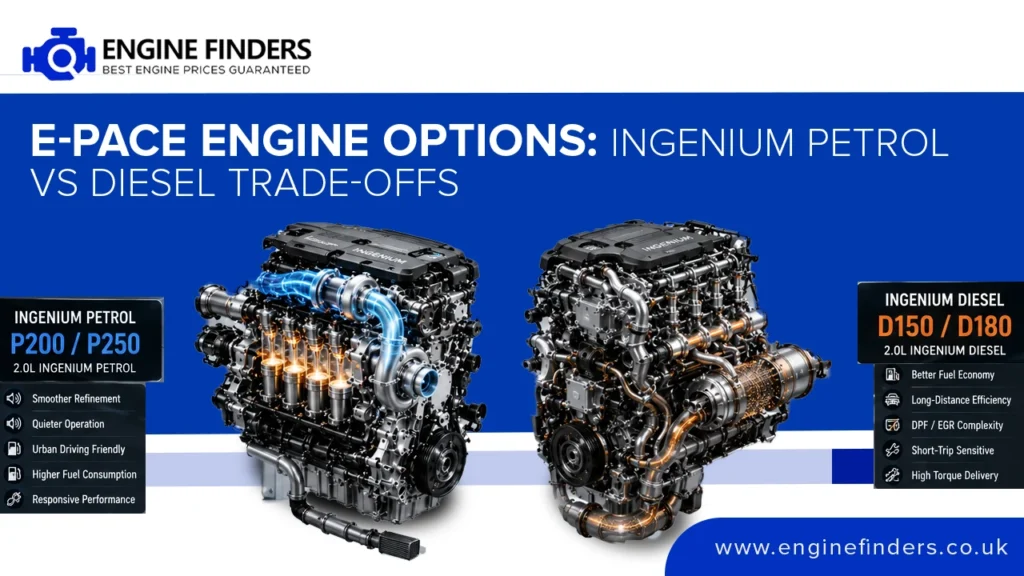
The Jaguar E-Pace primarily uses Ingenium 2.0L engines (petrol P200/P250 or diesel D150/D180). Petrol variants offer smoother refinement but higher fuel consumption; diesel units deliver better economy but carry DPF/EGR complexity. For E-Pace specific guidance, our Jaguar E-Pace engines page details common fault codes and service intervals by model year.
F-Pace P250 Timing Chain Concerns: What the Data Shows
The Ingenium P250 petrol engine in early F-Pace models (2016-2019) has documented timing chain tensioner wear under high-load conditions. While not a universal failure, it warrants pre-purchase inspection focusing on cold-start rattles and service history. Our analysis of Jaguar F-Pace P250 timing chain failure includes OEM bulletin references and repair cost benchmarks.
Jaguar Engine Buyer Checklist: Avoid Costly Mistakes
Before committing to a used Jaguar, run through this checklist:
Match the Engine Code: Confirm the physical engine code matches the vehicle VIN to ensure ECU and emissions system compatibility. For example, ensure you are looking at the updated 306DT diesel engine or the robust 448DT diesel engine rather than the early 204DTD.ur car engine resource centre offers model-specific reliability insights and cost calculators.
Verify Service History: Ensure oil change intervals are ≤12 months or 10,000 miles for any Ingenium unit.
Cold Start Inspection: Listen for timing chain rattle (a metallic rattling sound for 2–3 seconds on startup) and check for EGR fault codes via an OBD2 scanner.
DPF Regeneration Status: Confirm the vehicle is regularly driven on motorways. Urban-only diesels are high-risk for DPF clogging, which can cost £800–£1,500 to rectify.
MOT History Check: Use the GOV.UK MOT check service to look for repeated emissions failures or advisory notes regarding oil leaks.
Jaguar Engine Reliability FAQ: UK Buyer Questions Answered
Which Jaguar engine is most reliable for high-mileage use?
The pre-2015 AJ-V8 5.0L supercharged and non-Ingenium 3.0L V6 diesel show the strongest long-term reliability in UK data. Both benefit from robust internal components and less complex emissions systems than early Ingenium units. Always verify full service history regardless of engine choice.
How often should I change oil in an Ingenium engine?
Jaguar’s official 21,000-mile/2-year interval is optimal for low-mileage, motorway-driven vehicles. For urban use or short journeys, independent specialists recommend 10,000 miles or 12 months to mitigate timing chain and turbocharger wear. Use only JLR-approved low-SAPS lubricants.
Will an engine replacement affect my MOT or road tax?
Like-for-like replacements (same capacity, fuel type, Euro standard) maintain your current VED band and MOT classification. You must notify DVLA of the new engine number, but no re-testing is required unless emissions hardware is modified. Always retain fitment documentation.
What’s the average cost to replace a Jaguar Ingenium engine?
Based on UK supplier data (2026), reconditioned Ingenium 2.0L units range £1,495–£2,450 excluding labour. Labour adds £600–£1,200 depending on model accessibility. Full supply-and-fit packages from specialists often provide better value than dealer repairs.
Can I upgrade to a more powerful Jaguar engine legally?
Engine swaps altering capacity or emissions classification require IVA certification and may change your VED band. Like-for-like replacements are straightforward; performance upgrades involve complex compliance steps. Consult DVLA guidance before proceeding with non-standard installations.
How do I check if a used Jaguar has unresolved engine recalls?
Use Jaguar’s official recall lookup tool with the VIN, or check the DVSA recall database. Key recalls include timing chain updates for early Ingenium diesels and EGR cooler replacements. Never purchase a vehicle with outstanding safety recalls without written confirmation of remediation.