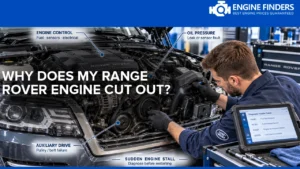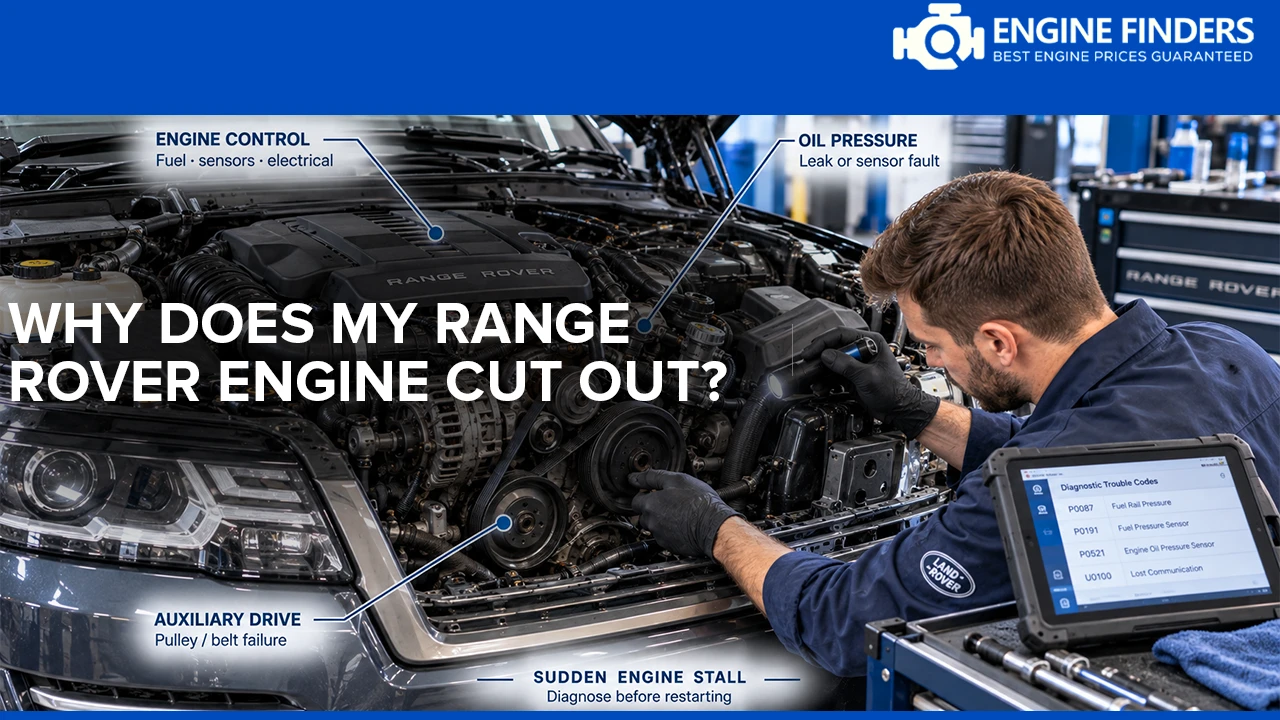
Your Range Rover cutting out mid-drive is more than an inconvenience – it’s a safety concern that demands immediate attention. A 2024–2026 Land Rover recall affecting over 7,100 vehicles confirms that a manufacturing defect in the front-end auxiliary drive belt idler pulley can damage the oil pressure sensor, causing oil leaks and sudden engine stalling. While that specific recall covers newer models, older Range Rovers have their own well-documented culprits.
Below, we break down the seven most common reasons your Range Rover engine cuts out, what it typically costs to fix in the UK, and when replacement makes more sense than repair.
Quick Summary
| Cause | Typical Symptom | UK Cost Range |
|---|---|---|
| Fuel pump failure | Engine dies at speed or idle; won’t restart | £781 part (OEM) |
| EGR valve sticking | Rough idle, sudden shutdown, engine light | £200–£330 fitted |
| Turbo boost actuator | Power loss, black smoke, cutting out | £234–£432 part |
| Timing chain stretch | Rattle on start, misfire, sudden stop | £2,000–£3,500 |
| Engine harness chafing | Intermittent cut-out, multiple warning lights | Dealer recall (free) |
| Crankshaft bearing wear | Engine knock, oil pressure loss | Rebuild/replace territory |
| PHEV battery degradation | PHEV models only; power loss | Dealer recall (free) |
Fuel Pump Failure: The Most Common Range Rover Cut-Out Cause
When your Range Rover dies without warning and restarts after a few minutes, the fuel pump is often the prime suspect. The low-pressure pump inside the tank supplies fuel to the high-pressure injection system – when it weakens, the engine starves under load or at idle.
Symptoms to watch for:
- Engine cuts out during acceleration or when coming to a stop
- Sluggish starting or extended cranking
- Power loss and vibration at higher speeds
- No fault codes stored in some cases
A forum member with a 2013 Range Rover Sport reported exactly this pattern: occasional shutdowns with no relevant error messages, though a P0232 code (fuel pump secondary circuit) eventually surfaced. Another owner of a 2019 SVR spent “a couple grand” at a main dealer for a low-pressure fuel pump replacement – only for symptoms to return days later, pointing to the high-pressure pump or a clogged filter. For the component itself, see our high-pressure fuel pump replacement service.
If you’re weighing up whether to repair or replace, start with our Range Rover engines range for replacement options. And if you’ve already confirmed the pump is the issue, you can request quotes for a replacement engine matched to your specific model year and engine code.
UK parts cost: An OEM fuel pump for the L405 3.0 TDV6 retails around £781. Independent fitting typically adds 2–4 hours labour.
EGR Valve Sticking: Diesel Range Rover’s Hidden Shutdown Trigger
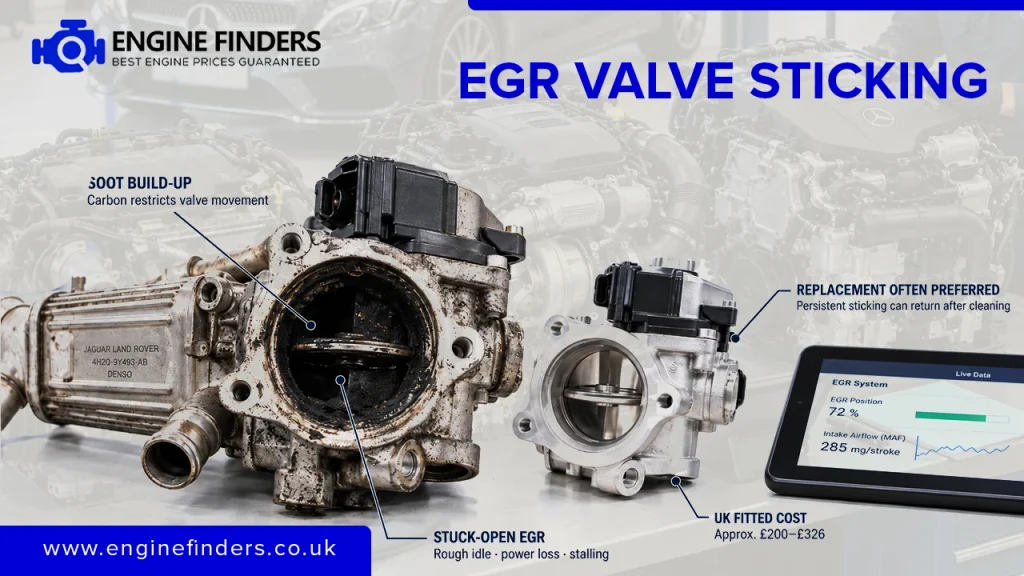
Exhaust Gas Recirculation (EGR) valves recirculate exhaust gases to reduce NOx emissions. On diesel Range Rovers – especially those used for short urban journeys – the valve cokes up with soot and begins to stick. A stuck-open EGR valve can cause the engine to stall or shut down unexpectedly.
A 2022 diesel Range Rover owner described “unexpected shutdowns, power loss, rough idle, and a strong diesel smell” before diagnosis confirmed a stuck EGR valve. Replacement, rather than cleaning, resolved the issue permanently.
For a broader look at common faults across the family, see our Common Range Rover Engine Problems and How to Fix Them blog. For replacement options, see our Range Rover Sport engines page, which covers model-specific engine availability.
UK replacement cost: Independent garages quote £200–£230 fitted for older 3.0 diesel models; franchised dealers charge £288–£326. Aftermarket EGR valves for the Evoque TD4 start around £177.
Turbo Boost Actuator and Wiring Harness Failure
The turbocharger’s boost pressure actuator controls wastegate operation. When the actuator itself fails – or the wiring harness feeding it corrodes – boost pressure becomes erratic. The ECU may cut fuel delivery entirely to protect the engine, causing a sudden shutdown.
A 2016 Range Rover Sport TDV6 owner reported black smoke, power loss, whistling noises, and jerking before the engine cut out. The root cause was a damaged wiring harness to the boost actuator, with corroded wires causing intermittent connections.
The Range Rover Sport L494 SDV6 Engine Problems & Replacement Cost UK blog is also relevant to this generation-specific failure pattern. For Sport-specific replacement options, see the Range Rover Sport L319/L494 engine page. If the turbo system itself needs replacing, our turbocharger replacement service covers the component replacement route.
Parts pricing:
- Turbo actuator (aftermarket): £234 inc. VAT
- Genuine Land Rover actuator (LR065510A): £432 inc. VAT
Timing Chain Stretch on Ingenium Diesel Engines
The 2.0 Ingenium diesel (engine codes 204DTD / 204DTA / AJ200D) fitted to Velar, Evoque, and Discovery Sport models from 2017 onward is notorious for timing chain stretch. As the chain elongates, valve timing drifts, causing misfires, rough running, and eventually engine shutdown.
Warning signs:
- Rattle on cold start that fades as oil pressure builds
- P0016 camshaft/crankshaft correlation code
- Intermittent misfire escalating to complete stall
For model-specific replacement options, see the Range Rover Velar engine page for Velar applications and the Range Rover Evoque L538 engine page for the earlier Evoque generation.
Repair economics: Independent timing chain replacement costs £2,000–£3,500. If valve or piston damage has occurred, reconditioned engines can be a more practical replacement route when repair costs approach the vehicle’s value.
Engine Harness Chafing: A Known Recall Issue
One of the most overlooked causes of Range Rover engine cut-out is physical wiring damage. A 2017 recall (affecting certain 2016–2017 model year vehicles) identified that the engine harness could contact the EGR casting bracket, wearing through wire insulation and causing short circuits. The recall notice explicitly warns this “could result in a range of vehicle failure modes, including engine cut out whilst in motion”.
What to do: Check your VIN against the DVSA recall database or contact a Land Rover dealer. Recall repairs are performed free of charge. If your vehicle falls outside the recall but exhibits similar symptoms, a visual inspection of harness routing near the EGR cooler is worthwhile.
Crankshaft Bearing Wear: The Catastrophic Scenario

A lower-end engine knock combined with oil pressure loss and sudden shutdown points to crankshaft bearing failure. This is more common on high-mileage 306DT diesels that have suffered oil starvation or extended service intervals.
Bearing shell rotation – where the bearing spins in its housing – can seize the crankshaft, instantly stopping the engine. This is an engine-out repair, and often means the block is scrap.
The Discovery 4 engine page is relevant to this 3.0 diesel platform. For the 306DT specifically, see the 306DT diesel engine page when checking replacement compatibility.
Decision point: If your Range Rover is worth under £10,000 and the diagnosis confirms crankshaft damage, a used engine is usually more economical than rebuilding. A 3.0 diesel reconditioned engine fitted costs £3,500–£6,500.
PHEV Battery Cell Degradation (2018–2019 Models)
If your Range Rover or Range Rover Sport is a plug-in hybrid built between July and November 2018, a recall (R/2025/491) addresses high-voltage battery cell degradation. Cathode damage introduced during manufacturing can cause sudden power loss and engine shutdown.
The PHEV battery issue is a recall matter rather than a standard engine replacement problem; owners should follow the manufacturer’s recall instructions and confirm their vehicle’s eligibility.
Action required: Land Rover will extract battery data and replace the traction battery pack free of charge. Check your VIN and quote recall number R/2025/491 via the GOV.UK recall checker.
When to Repair vs Replace Your Range Rover Engine
Use this framework based on UK market data (2026):
| Scenario | Repair Route | Indicative Cost | Verdict |
|---|---|---|---|
| Fuel pump / EGR / actuator | Component replacement | £200–£800 | Always repair |
| Timing chain (caught early) | Chain kit + labour | £2,000–£3,500 | Repair if vehicle >£12k |
| Timing chain (valve damage) | Reconditioned engine | £5,000–£8,500 | Compare against vehicle value |
| Crankshaft bearing failure | Rebuild or replace | £3,000–£8,000 | Replace if block damaged |
| PHEV battery recall | Dealer recall | Free | Immediate action |
For vehicles valued above £15,000, a quality reconditioned engine with 12-month warranty preserves the investment. Below that threshold, the economics may favour replacement.
What to Check Before Buying a Replacement Engine
If diagnosis confirms engine replacement is necessary, verify:
- Engine code match: 306DT, 448DT, 508PS, or Ingenium codes must match your V5C
- Warranty terms: 6–12 months minimum on reconditioned units
- DVLA notification: Engine changes must be reported; V5C updates are free
- ECU compatibility: Some 2013+ models require coding for injector calibration
Before buying, compare warranty coverage, supplier credentials, engine-code compatibility and any fitting or coding costs so you are comparing like-for-like replacement options.
Get matched with UK suppliers who stock your specific engine code with verified mileage and warranty coverage through our quote service.
Enter Your REG to Get a Free Engine Quote

Frequently Asked Questions
Why does my Range Rover cut out only when stopping?
This pattern typically indicates low fuel pressure from a failing in-tank pump. When you lift off the throttle, the pump cannot maintain rail pressure, and the ECU cuts injection. A fuel pressure test will confirm.
Can a bad EGR valve cause the engine to shut off completely?
Yes. A severely stuck EGR valve can cause combustion instability severe enough for the ECU to initiate a protective shutdown, especially on diesel models.
Is engine cut-out covered under Land Rover warranty?
If your vehicle is subject to an active safety recall (such as R/2025/491 or the harness chafing recall), repairs are free regardless of warranty status. For non-recall faults, warranty coverage depends on age and mileage terms.
How much does a Range Rover fuel pump replacement cost in the UK?
OEM low-pressure pumps run £700–£850 for the part alone. Independent fitting adds £150–£300 labour. High-pressure pumps cost significantly more.
Can I drive with an engine that cuts out intermittently?
No. Sudden power loss disables brake vacuum assistance and power steering. This is a safety-critical fault. Have the vehicle recovered to a garage for diagnosis.
What engine codes are most prone to cut-out issues?
The 306DT 3.0 diesel (fuel pump, crankshaft bearings), 204DTD Ingenium diesel (timing chain), and AJ20-P6 petrol (oil filter housing, per recall R/2024/255) feature most frequently in cut-out reports and recall notices.
How do I check if my Range Rover has an outstanding recall?
Enter your registration on the DVSA recall checker or contact a Land Rover dealer with your VIN. Recall work is performed free of charge at franchised dealers.