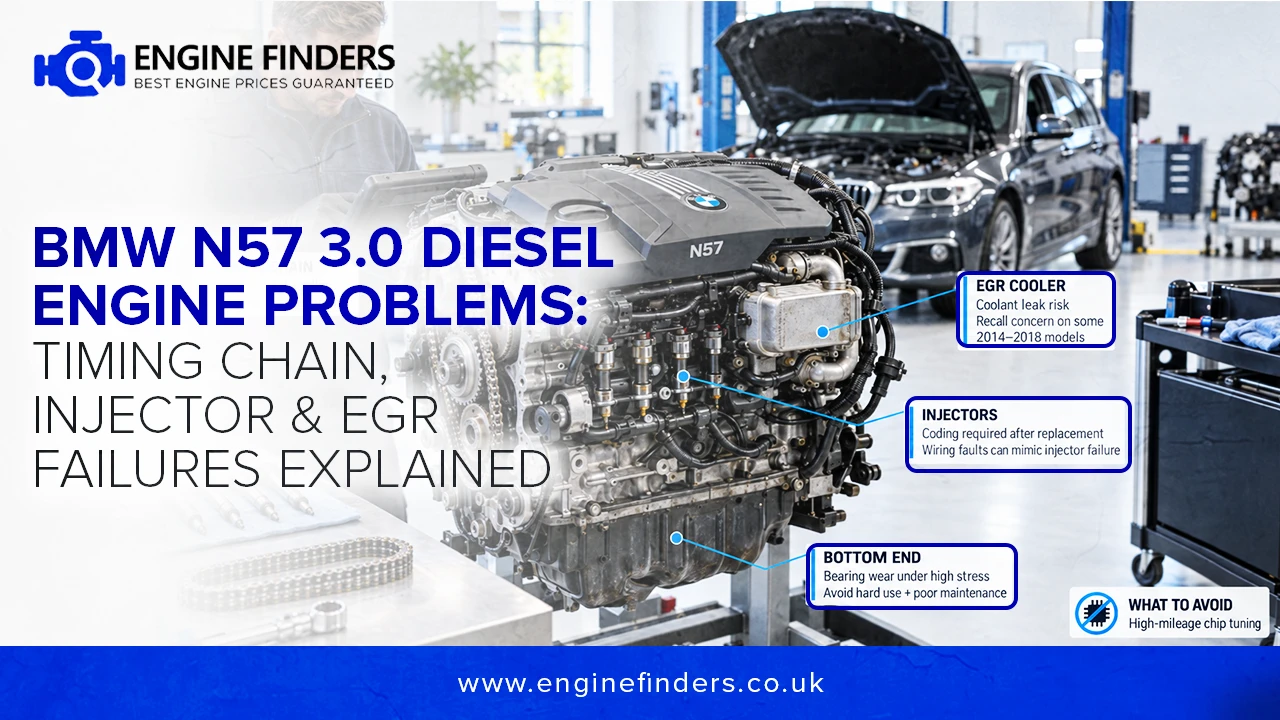
The BMW N57 engine can fail catastrophically before 100,000 miles — and many owners only discover the problem when a rattle on cold start becomes a snapped timing chain or a coolant leak turns into an engine fire risk. If you drive a 330d, 530d, X3, X5, or any BMW with the 3.0-litre straight-six diesel, understanding the timing chain, EGR cooler, and injector failure patterns is essential for protecting your investment.
Quick Summary: What N57 Owners Must Know
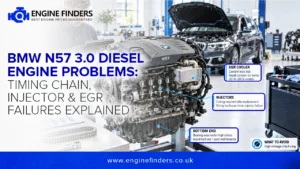
- Timing chain: No service schedule, but failure risk starts after 50,000 miles; average replacement cost from £1,599
- EGR cooler: Subject to a voluntary safety recall (2014–2018 models) due to internal coolant leaks that can cause intake manifold melting and, in worst cases, fire
- Injectors: Common-rail units require coding after replacement; electrical faults (P0205/P0206) often originate in wiring, not the injector itself
- Bottom end bearings: Police fleet data linked high-stress operation to crankshaft bearing failure and oil sump punctures
- What to avoid: Chip tuning on a high-mileage N57 increases rail pressure and accelerates injector and bearing wear
Why the BMW N57 Engine Has a Reputation Problem
The N57 replaced the legendary M57 in 2008 and powered everything from the 330d to the X6 40d. On paper, it was an improvement: lighter, more efficient, and Euro 5 compliant. In practice, it introduced a rear-mounted timing chain design that proved vulnerable to wear, and an EGR cooler that became the subject of a major safety recall.
BMW’s official position has been that civilian cars are not affected by the failures seen in police fleets — but the voluntary recall for EGR coolers tells a different story. Independent specialists now treat N57 timing chain replacement as preventative maintenance, not a repair. For a broader view of BMW diesel reliability, our guide to the best BMW diesel engine to buy in 2026 compares N47, B47, and M57 options side by side.
BMW N57 Timing Chain Failure Symptoms and Replacement Cost (UK)
How to Recognise a Stretched or Failing Timing Chain
The N57’s timing chain is located at the rear of the engine, making inspection difficult without major disassembly. Warning signs include:
- Metallic rattle on cold start that fades as oil pressure builds
- Change in engine note as the chain contacts the guides
- Rough idle or misfire in advanced stages
- No warning at all — some chains snap without prior symptoms
There is no BMW service interval for the timing chain. It is classed as “lifetime,” but specialists report that the chain and guides are typically worn by 100,000 miles — and failures have occurred from as low as 50,000 miles.
What a Timing Chain Replacement Involves on an N57
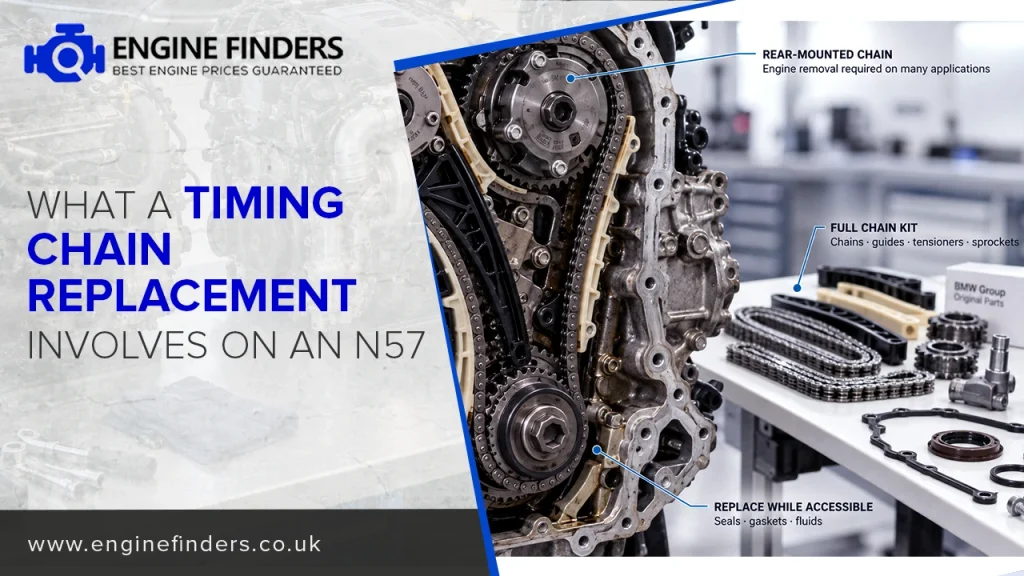
The job requires engine removal for most 3, 4, 5, 6, and 7 Series applications. Independent specialists use genuine IWIS chain kits (BMW’s OEM supplier), which include upper and lower chains, guides, tensioners, and sprockets. Lower-quality aftermarket chains have been observed failing within 10,000–30,000 miles.
A complete replacement typically also includes:
- Rocker cover gasket
- Fuel injector seals
- Rear main oil seal
- Engine oil and filter
- Coolant and air conditioning service
UK cost: From £1,599 at independent specialists. Main dealer pricing is substantially higher.
Should You Replace Bottom End Bearings at the Same Time?
With the engine removed, it is the logical moment to address the N57’s other known weakness: rod and main bearing wear. Police fleet failures involved crankshaft bearings puncturing the oil sump, leading to oil loss and fire. BMW advised police forces to shorten oil change intervals to 10,000 miles and use upgraded oil — advice that applies equally to civilian owners who drive their cars hard.
If you plan to keep your N57 long-term, replacing bearings and the oil pump during a timing chain job is a cost-effective insurance policy. If you’re weighing up whether to repair or replace the entire engine, our guide to engine replacement vs rebuild breaks down the cost-benefit analysis.
BMW N57 EGR Cooler Recall and Coolant Leak Risk Explained
What the Official BMW Recall (2014–2018 N57T) Covers
BMW issued a voluntary safety recall (21V-907) in November 2021 covering certain 2014–2018 models with the N57T engine produced between February 2013 and June 2018. The problem: the EGR cooler can leak coolant internally, mixing glycol with diesel soot. This creates smouldering particles that can melt the plastic intake manifold and, in rare cases, cause an engine bay fire.
Affected models include the 535d, 740Ld, X3, and X5. The remedy is replacement of the EGR cooler and inspection of the intake manifold, with manifold replacement if integrity testing fails. For specific model guidance, see our BMW X5 xDrive30d engine guide and BMW 5 Series 530d engine page.
Symptoms of a Failing EGR Cooler on an N57
- Unexplained coolant loss without visible external leaks
- Poor cabin heating performance (intermittent hot/cold)
- Sweet-smelling exhaust odour
- White smoke from the exhaust
- Engine management light or loss of power
Post-Recall Repairs and What to Expect
If your vehicle falls outside the recall window (pre-LCI models are commonly excluded), a replacement EGR cooler is still advisable if symptoms appear. Aftermarket and used OEM coolers range from £120 to £435 depending on source and whether the vehicle has an SCR system. BMW’s procedure requires resetting EGR adaptations and registering the new cooler using diagnostic equipment. For a detailed breakdown of EGR and DPF-related repair costs, see our DPF filter replacement guide.
BMW N57 Injector Problems: P0205, P0206, and Coding Requirements
Why N57 Injectors Fail and What Fault Codes Reveal
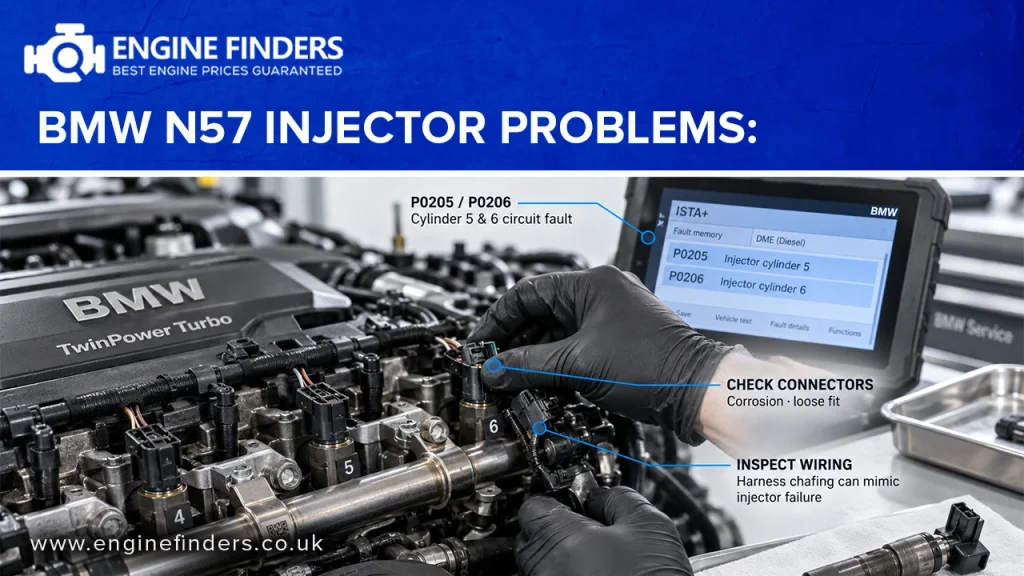
The N57 uses common-rail diesel injectors that operate under extreme pressure. Unlike petrol injectors, diesel injectors are coded to the ECU for precise fuel delivery. Fault codes P0205 (cylinder 5) and P0206 (cylinder 6) indicate an electrical circuit fault — not necessarily a failed injector.
Common causes include:
- Corroded or loose injector connectors
- Chafed wiring in the harness
- Injector solenoid failure
- ECU driver fault
For a detailed cost comparison across brands, our diesel injector replacement price comparison covers parts and labour for common-rail systems.
The Cost of N57 Injector Replacement (UK)
Diesel common-rail injectors for the N57 are expensive components. Each injector must be coded using BMW ISTA, Carly, or equivalent diagnostic tools after installation. If you are comparing replacement options, reconditioned BMW engines may offer better value than rebuilding a high-mileage unit with multiple failing injectors.
Walnut Blasting and Carbon Buildup on N57 Intake Valves
Direct injection means fuel does not wash over intake valves, so carbon accumulates on the valve ports and EGR cooler. By 75,000 miles, most N57 engines benefit from walnut blasting — a process using crushed walnut shells to remove carbon without damaging metal surfaces. This restores lost power, smooths idle, and improves fuel economy. Our BMW X5 G05 B58 carbon buildup guide explains the process and costs in detail.
N57 vs M57: Is the Older BMW Diesel Engine More Reliable?
The M57 has a reputation for bulletproof reliability and is often cited as one of BMW’s best diesel engines. The N57 improved emissions and power but introduced the rear-mounted timing chain and EGR cooler vulnerabilities.
| Factor | M57 | N57 |
| Timing chain location | Front | Rear |
| Chain failure risk | Low | Moderate to high after 80k |
| EGR cooler issues | Less common | Major recall subject |
| Injector accessibility | Easier | More complex |
| Emissions compliance | Euro 3/4 | Euro 5/6 |
For buyers considering a used BMW diesel, our guide to the most reliable BMW engine ever made ranks N57 against other BMW diesel and petrol units based on UK owner data.
When to Replace vs Rebuild Your BMW N57 Engine
If your N57 has suffered timing chain failure with valve contact, bottom end bearing damage, or a cracked cylinder head from EGR cooler coolant ingress, replacement is often more cost-effective than repair.
Signs replacement may be the better option:
- Timing chain has snapped (piston-to-valve contact likely)
- Metal debris found in oil sump (bearing failure)
- Coolant has mixed with oil (head gasket or cracked block)
- Multiple injectors failing on a high-mileage unit
Timing chain replacement alone typically costs £1,599 to £2,000. A complete engine replacement with a quality used or reconditioned unit can range from £2,500 to £5,000 depending on model and mileage. For a clear comparison, see our guide to new vs reconditioned vs used engines.
When sourcing a replacement N57, used BMW engines from verified suppliers with documented mileage are the most economical option. For long-term reliability, a reconditioned engine with updated components is worth the premium. You can also browse BMW 3 Series engines and BMW 5 Series 530d engines for model-specific options.
UK Legal and MOT Considerations for N57 Engine Replacement
Replacing your N57 with a like-for-like unit does not change your vehicle’s tax band or require immediate DVLA notification — provided engine displacement and fuel type remain unchanged. However, you should inform your insurer. For full guidance on registering engine changes, GOV.UK‘s INF318 guidance on vehicle modifications covers the documentation requirements.
For diesel emissions compliance, the MOT now includes stricter Particle Number (PN) testing for Euro 5b and younger vehicles (registered from January 2013). A healthy N57 with functioning EGR and DPF should pass without issue. DPF or EGR deletion is illegal for road use and will fail MOT. The DVLA’s guidance on vehicle registration and modifications provides further information on keeping your V5C updated. For technical guidance on emissions standards, the UK government’s MOT inspection manual outlines the specific requirements for diesel particulate filters and emissions testing.
How to Source a Replacement BMW N57 Engine in the UK
When your N57 reaches the point of uneconomical repair, sourcing the right replacement requires careful verification:
- Confirm engine code — N57D30A, N57D30B, N57D30C, or N57T variants are not interchangeable across all models
- Check service history — a donor engine with documented oil changes at 10,000-mile intervals is preferable
- Verify mileage — low-mileage units from rear-end collisions are often better than high-mileage fleet cars
- Warranty — reputable suppliers offer 3–6 month warranties on used units
If you’re unsure whether your engine can be saved, our engine repair vs replacement guide helps you make an informed decision. For a full breakdown of costs by model, see our BMW engine replacement cost guide.
Get competitive quotes for a replacement N57 engine from Engine Finders and compare options from vetted UK suppliers in your area. For a comprehensive look at BMW 3 Series diesel reliability, our BMW 320d N47 vs B47 comparison covers common failure points and buying advice.
Enter Your REG to Get a Free Engine Quote

Frequently Asked Questions
How long does a BMW N57 timing chain last?
There is no factory service interval. Specialists report average wear requiring replacement around 100,000 miles, but failures have occurred from 50,000 miles on poorly maintained examples. Preventative replacement is recommended if you plan to keep the car beyond 80,000 miles.
Is the BMW N57 EGR cooler recall still active?
The voluntary recall (21V-907) covered 2014–2018 N57T models. Check with a BMW dealer using your VIN to confirm if your vehicle was included and whether the recall work has been completed.
Can I drive with a rattling N57 timing chain?
No. A rattling chain indicates guide or tensioner wear. Continued driving risks chain jump or snap, which causes catastrophic valve and piston damage. Book inspection immediately.
How much does N57 injector replacement cost in the UK?
Each common-rail injector costs £200–£400 for the part alone, plus coding and labour. Replacing all six with diagnosis can exceed £2,500 at main dealer rates.
Does chip tuning damage the N57 engine?
Tuning increases rail pressure and cylinder stress. On a high-mileage N57 with worn bearings or chain, this accelerates failure. Police fleet data linked high-stress operation to bearing failures.
Is a reconditioned N57 better than a used one?
A quality reconditioned N57 with updated timing chain components and new bearings offers better long-term reliability than an unknown used unit. The cost difference is typically £800–£1,500.
What should I do if my N57 has coolant loss but no visible leak?
Suspect the EGR cooler. Internal leaks are difficult to detect visually. A pressure test and exhaust gas analysis in the coolant can confirm. If confirmed, replacement is required — sealing products are not a permanent solution.