Engine Replacement vs Rebuild – Cost & Risk Comparison

Major engine failure • Rebuild or replace decision • UK costs and workshop-level clarity
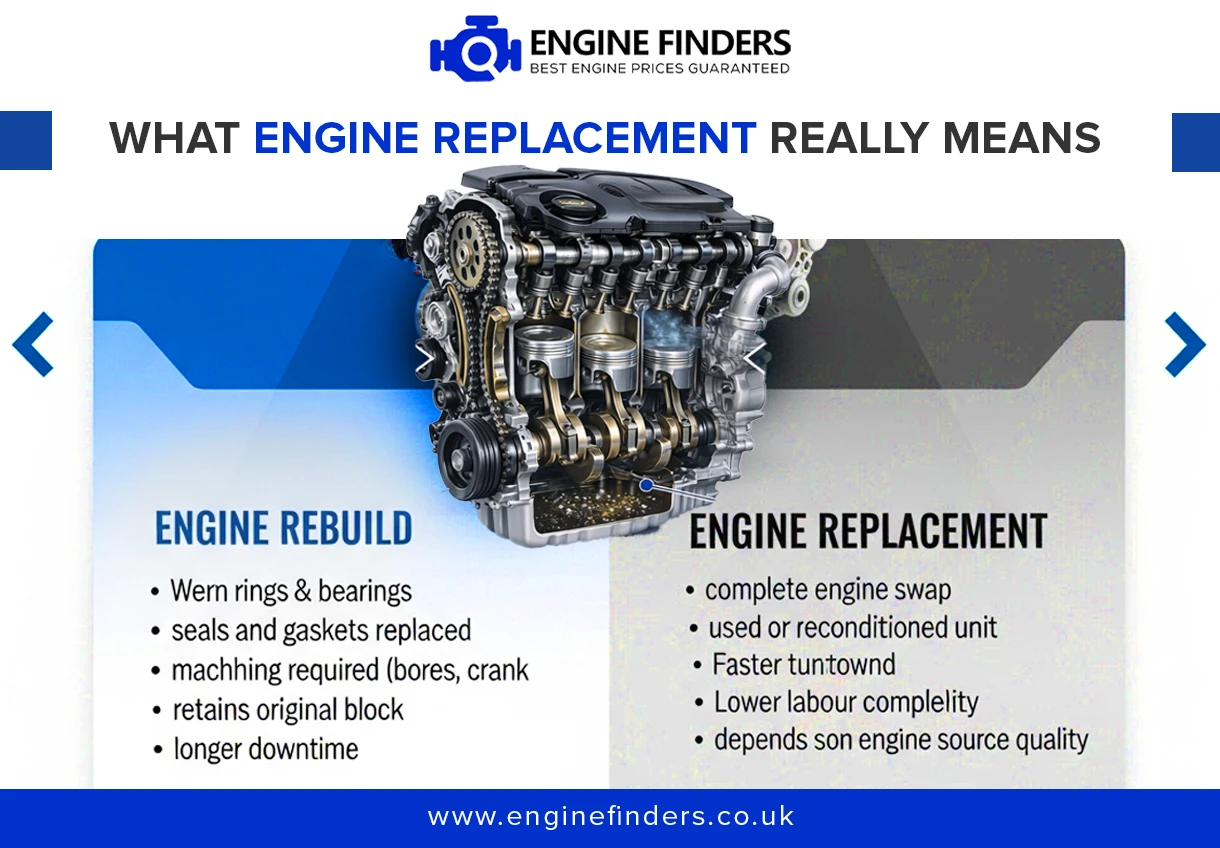
Engine replacement vs rebuild UK guide

FAULT

Major engine failure requiring rebuild or replacement decision. Check our engine replacement cost by mileage guide.

URGENCY

Medium-High (depends on symptoms; ignore at your peril). Follow our step-by-step engine replacement guide.

LIKELY COST BAND (UK)

£700–£2,000 (rebuild) | £2,500+ (replacement fitted) | Used swap from ~£1,200. See our UK engine rebuild cost analysis.

BEST NEXT STEP

Get 3 like-for-like quotes from vetted suppliers before committing to any garage work. Compare quotes properly to avoid hidden costs.

Introduction

The Decision That Saves (or Costs) Thousands

When an engine shows serious signs of failure, the clock starts ticking. Every mile driven risks turning a repairable issue into a write-off. Yet many UK owners delay action, hoping the rattle will disappear or the warning light will reset.

The common finding in this scenario is simple: uncertainty about cost and outcome paralyses decision-making. You're not just choosing between two mechanical options. You're weighing financial exposure, downtime, and long-term reliability. Compare cost-effective replacements across popular models to benchmark your options.

This guide cuts through the noise. It explains, in plain English, what a rebuild actually involves versus a replacement, where the hidden costs sit, and how to assess which path makes sense for your vehicle's value and your driving needs. Explore our full engine replacement process walkthrough for a complete overview. Ignore the wrong advice, and you could spend £2,000 on a rebuild that fails in six months - or pay £3,500 for a replacement that wasn't necessary.

The goal isn't to sell you anything. It's to give you the workshop-level clarity needed to ask the right questions, compare quotes properly, and make a confident choice.

Problem Overview: What "Engine Failure" Actually Means

"Engine failure" covers a wide spectrum – from worn rings to cracked blocks

Worn Rings

Excessive oil consumption and blue smoke from burning oil in combustion chamber.

Timing Failure

Failed tensioner or guides leading to valve-piston contact on interference engines.

Bearing Wear

Oil starvation causing knocking sounds from main or big-end bearings.

Cracked Head

Overheating damage causing cracks and coolant loss with white smoke.

Engine codes matter. A Ford 1.6 Ti-VCT (code XTDA) has different failure modes and parts availability than a VAG 2.0 TDI (code CFFB). Always confirm your engine code from the V5C or engine bay plate before seeking quotes. Learn how to verify your engine code for accurate sourcing.
Understanding your specific engine's reputation matters – some engines have known weaknesses that influence whether rebuild or replacement is the smarter long-term choice. For example, Jaguar Land Rover AJ300D diesel engine patterns and Land Rover Defender 110 engine details illustrate how model-specific knowledge influences repair strategy.

Granular Warning Signs: When to Act Immediately

Not all symptoms carry equal urgency. The table below helps you triage based on real UK driving scenarios.

UK Driving ScenarioLikely CauseRecommended Action
Cold-start rattle lasting 2-3 seconds, then quietTiming chain tensioner bleed-down or worn guidesBook diagnostic within 1-2 weeks; avoid high RPM until checked
Persistent blue smoke from exhaust, worse on accelerationWorn piston rings or valve stem sealsCompression test ASAP; continued driving risks catalytic converter damage
Knocking sound from engine bay, speed-sensitiveMain or big-end bearing wearStop driving immediately; tow to specialist. Further use can destroy crankshaft
Loss of power on motorway overtakes, no warning lightsCarbon buildup (direct injection) or turbo actuator faultDiagnostic scan first; may not require engine-out work
White smoke + coolant loss, no overheatingHead gasket failure or cracked linerPressure test cooling system; do not ignore - can lead to hydro-lock
Limp mode triggered in traffic, resets after restartIntermittent sensor fault or oil pressure dropCheck oil level/quality first; if persistent, diagnostic essential before long journeys

Noises that change with engine speed (not road speed) usually indicate internal issues. Smoke colour tells a story: blue = oil burning, white = coolant, black = fuel. If in doubt, stop and get professional assessment.

Why This Happens: The Mechanical Reality Behind Failure

Engines don't just "give up". Failure is typically the endpoint of a chain of events.

Oil-Related Issues

The single biggest factor. Extended service intervals, incorrect oil grade, or chronic short trips preventing oil from reaching operating temperature lead to sludge, varnish, and accelerated wear. Modern low-viscosity oils demand precise maintenance.

Cooling System Neglect

A stuck thermostat or failing water pump can cause localised overheating, warping cylinder heads. UK winters see many owners delay coolant changes, leading to corrosion.

Timing Component Wear

Chains stretch, tensioners weaken. On interference engines, a skipped tooth means valves hit pistons. Labour to access timing components varies wildly - some engines require subframe removal, others are relatively straightforward.

Turbocharger Fallout

A failing turbo can send metal debris into the inlet tract, contaminating the entire engine. Replacing the turbo without flushing the system risks immediate re-failure.

UK Driving Cycle Effect

Frequent short journeys are particularly harsh. The engine spends most of its time in the high-wear, low-temperature phase. Condensation forms in the oil, fuel doesn't burn completely, and the DPF never gets hot enough to regenerate.

Known Weaknesses

Some engines have known issues: certain 1.2L PureTech engines have timing belt-in-oil problems, while some earlier 2.0L diesels suffered from injector seal leaks washing down bores. The Jaguar Land Rover AJ300D diesel engine has specific failure modes worth understanding. Land Rover Defender 110 engine details provide further context on model-specific vulnerabilities.

decision framework

Repair vs Replace: The 40–60% Rule

This is where financial pragmatism meets mechanical reality.

Rebuild when: The block and crankshaft are undamaged; wear is limited to rings, bearings, or seals. You plan to keep the vehicle long-term (3+ years). The engine has sentimental value or is rare/hard to source as a replacement. Your quote includes machining and new components.
Replace when: The block is cracked, the crank is scored beyond repair, or there's major collateral damage. Downtime is critical. The vehicle's realistic trade value is low, and a rebuild would exceed the 40–60% threshold.

💰 The 40–60% rule of thumb:

If repair costs approach 40–60% of the vehicle's current realistic trade value, replacement or reconditioned options are often worth comparing on purely financial grounds. For example, if your car is worth £3,000 privately, spending £1,800+ on a rebuild may not be prudent unless you're keeping it indefinitely. Compare cost-effective replacements across popular models to benchmark fair pricing.

⏱️ Unique UK nuance – the short-trip penalty:

For vehicles predominantly used for urban, sub-10-mile journeys, a rebuild using standard components may repeat the same failure pattern within 20,000 miles. In these cases, a technician might recommend upgraded oil separators, revised PCV systems, or even a replacement engine that's been modified to address known weaknesses. This isn't about upselling - it's about matching the solution to the usage pattern.

Rebuild vs Replacement Decision Table
FactorFavour RebuildFavour Replacement
Core IntegrityBlock & crank undamagedCracked block or scored crank
Vehicle ValueHigh relative to rebuild costLow relative to rebuild cost
DowntimeCan afford 5-10 days off roadNeed vehicle back in 1-2 days
WarrantyAccept workshop warrantyWant 12-month supplier warranty
Long-term PlanKeeping vehicle 3+ yearsShort-term ownership
Labour AccessEngine accessible without major disassemblyEngine-out labour exceeds 12-14 hours

UK Cost Guide: Realistic Ranges and Hidden Variables

Costs vary by region, garage type, and engine complexity. Figures reflect typical UK market rates as of 2026.

Service / Component
  • Diagnostic Assessment: £80–£150 + VAT
  • Minor Repair (gasket, sensor): £300–£900 + VAT
  • Major Repair / Partial Rebuild: £700–£2,000 + VAT
  • Full Professional Rebuild: £1,800–£3,500 + VAT
  • Used Engine Supply Only: £400–£1,500
  • Used Engine Fitted: £1,200–£2,800 + VAT
  • Reconditioned/Replacement Fitted: £2,500–£4,500+
Hidden Costs That Surprise Owners
  • Fluids (oil, coolant, gear oil): £150–£300
  • Seals, gaskets, full gasket kit: £120–£350
  • ECU adaptation / coding: £100–£220
  • VAT: Many quotes exclude VAT initially. Always confirm.
  • Regional labour variation: London/Southeast £80–£120/hr; North £55–£85/hr
  • MOT retest if emissions affected: £25–£50

Warranty comparison – a critical differentiator: Rebuilds from accredited specialists often come with 12-month/12,000-mile warranty covering parts and labour. A used engine from a breaker might only offer 30–90 days, parts-only. Always get warranty terms in writing. See our UK engine rebuild cost analysis for detailed comparisons.

Expert Ownership & Prevention Advice: Extend Engine Life

Prevention is always cheaper than cure. These habits, drawn from workshop experience, make a measurable difference.

Prevention Habits That Work

  • Warm up gently: Avoid high RPM until oil temperature is normal. Modern engines don't need long idling, but they do need gentle load in the first 5–10 minutes.
  • Respect oil specifications: Use the exact grade and approval listed in your handbook. "Compatible" isn't always good enough.
  • Change oil more frequently if you do short trips: Consider halving the manufacturer's interval if most journeys are under 10 miles.
  • Address warning lights immediately: An oil pressure warning isn't a "check next week" item.
  • Keep cooling system maintained: Replace coolant at recommended intervals. Corrosion inside the block is irreversible.

Warning Signs Owners Often Miss

  • Slight increase in oil consumption between services
  • Minor coolant loss with no visible leak (could be head gasket)
  • Slight change in engine note under load
  • Intermittent limp mode that resets

What to Ask a UK Garage Before Committing

"Can you provide a written breakdown showing labour hours, parts list (with part numbers), and whether machining is included?" – This prevents vague quotes and hidden extras.

"If you're supplying a replacement engine, what testing has been done (compression, leak-down, dyno), and can I see the report?" – Reputable suppliers test before dispatch.

"What ancillary components do you recommend replacing while the engine is out, and why?" – A trustworthy garage will explain the preventative logic, not just upsell.

Asking these questions separates specialists from generalists. If a garage hesitates to provide detail, that's a red flag.

What NOT To Do Next: Critical Mistakes to Avoid

Do not ignore oil pressure warnings. The oil pressure light means immediate, severe risk. Continuing to drive can destroy bearings in seconds.

Do not clear fault codes and keep driving. Clearing a code without fixing the root cause is like turning off a smoke alarm while the house burns.

Do not buy the cheapest used engine online without matching engine code and warranty. A mismatch can cause ECU errors, MOT failure, or immediate damage. Learn how to verify your engine code before purchasing.

Do not assume a "reconditioned" engine means the same thing everywhere. The term isn't legally defined. One supplier's "recon" might be a clean and paint; another's includes new pistons and machining.

Do not delay action hoping the problem will resolve itself. A small knock today is a seized engine next week.

Common Buyer Mistakes: Lessons from the Workshop Floor

Delaying action: The most expensive mistake. A £500 timing chain job can become a £3,000 valve repair if the chain skips. Follow our step-by-step engine replacement guide to act before costs escalate.

Accepting vague garage advice: "It needs a new engine" without explanation is a red flag. A reputable technician will show you the evidence.

Choosing the cheapest supplier: The lowest quote often excludes machining, uses pattern parts, or offers minimal warranty. Compare cost-effective replacements across popular models to benchmark fair pricing.

Ignoring warranty terms: A 30-day warranty on a used engine may expire before you've driven enough to uncover a latent fault.

Ignoring compatibility: Swapping engines isn't always plug-and-play. ECU compatibility, immobiliser pairing, and emissions hardware must align. Explore our full engine replacement process walkthrough for compatibility guidance.

When to Seek Help / MOT Implications: Knowing the Tipping Point

Seek immediate assessment if:

  • Any knocking or rattling that changes with engine speed
  • Visible metal flakes in oil (check dipstick)
  • Persistent white smoke with coolant loss
  • Oil pressure warning light illuminated

Continuing to drive risks safety and increases cost exponentially.

MOT fail risks include:

  • Excessive smoke: Blue or black smoke can result in an MOT failure
  • Oil leaks onto exhaust components are a fail
  • Engine mounting damage causing excessive movement
  • Misfire causing high emissions beyond limits

Emissions and safety consequences:

A failing engine can produce hazardous levels of CO. In extreme cases, oil leaks onto hot exhaust components pose a fire risk. These aren't just MOT issues - they're safety issues. If your vehicle is due for MOT and you suspect engine issues, get a pre-test inspection. Check our engine replacement cost by mileage guide to plan financially.

FAQ Section: Real Questions, Practical Answers

How long should a rebuilt engine last?

A professionally rebuilt engine using quality components and correct machining should last 80,000–100,000 miles with proper maintenance. The key is the rebuild standard, not just the fact it was "done".

Is a used engine a false economy?

Not necessarily. A low-mileage used engine from a reputable breaker, with a decent warranty, can be excellent value. The risk is unknown history. Always ask for mileage verification and test results. Compare cost-effective replacements across popular models to understand market rates.

Can I swap a petrol engine for a diesel (or vice versa)?

Technically possible but legally complex. You'd need to notify DVLA, potentially re-register the vehicle, and ensure emissions compliance. Insurance would also need updating. For most owners, like-for-like replacement is the only practical route.

Do I need to inform my insurance company if I replace the engine?

Yes. While a like-for-like replacement may not change your premium, failing to disclose a major modification could invalidate your policy. Always check with your insurer first.

What paperwork do I need for a DVLA engine change?

If the engine number changes (which it usually does with replacement), you must notify DVLA using form V62 or online via your government account. Keep invoices and the old engine's details as proof. Follow our step-by-step engine replacement process walkthrough for DVLA requirements.

Will a replacement engine affect my car's value?

A documented, professionally fitted replacement with warranty can maintain value better than a car with a known faulty engine. However, buyers may be cautious. Full service history and receipts are essential.

How do I verify a supplier's claim about a "reconditioned" engine?

Ask for: 1) A detailed spec sheet of work done, 2) Evidence of testing (compression reports, dyno sheets), 3) Warranty terms in writing, 4) Core return policy. Reputable suppliers provide these willingly. See our UK engine rebuild cost analysis for quality benchmarks.

Making Your Decision: Next Steps Without Pressure

Getting a clear picture of the numbers early often makes the difference between a manageable repair and an avoidable write-off. Comparing specialist options can help make that decision clearer.

If you're weighing quotes, focus on like-for-like comparisons: same warranty terms, same inclusion of ancillaries, same labour assumptions. The cheapest headline price often hides the most risk. Compare cost-effective replacements across popular models to benchmark your options. Explore our full engine replacement process walkthrough for complete context.

Take your time to ask the right questions. The extra hour spent researching could save thousands and months of hassle.

UK Flag

Ready to move forward? Get your personalised engine replacement quotes from vetted UK suppliers in minutes – no obligation, just clear, comparable options to help you choose with confidence.