BMW N57 case study • High-mileage diesel/petrol • Repair vs replace decision framework
FAULT
Premature wear or catastrophic failure in high-mileage diesel/petrol engines
URGENCY
Medium to High. Ignoring early signs turns £1,500 repair into £4,500+ replacement
LIKELY COST BAND (UK)
£2,800 – £5,200
fully fitted, depending on unit source and ancillary transfers
BEST NEXT STEP
Obtain compression and leak-down test. Compare at least three reconditioned unit quotes
For many UK drivers, the engine is the last thing they think about until it stops working. When it does, the immediate reaction is often shock at the quoted price. A common scenario we see involves vehicles with between 60,000 and 160,000 miles on the clock. Owners assume that lower mileage automatically equals higher value and lower risk. However, in the modern automotive landscape, this is not always true.
Consider the BMW N57 3.0L diesel engine specifications. Data suggests that a unit with 60,000-65,000 miles may command a price of approximately £4,500 for a quality reconditioned replacement, while a unit with 160,000+ miles might drop to around £4,300. This counter-intuitive pricing reflects the reality of modern engine rebuilding: the cost of labour and precision machining often outweighs the residual value of the core block itself. The difference in price is marginal because the rebuild process is largely fixed-cost.
Delaying action when symptoms first appear is the most expensive mistake an owner can make. A minor oil leak or a faint rattle on cold starts can indicate failing timing chain tensioners or bearing wear. If ignored, these issues lead to catastrophic internal damage. By the time the car enters limp mode or refuses to start, the damage has spread from a single component to the crankshaft, camshafts, and cylinder walls.
This guide is designed to remove the guesswork. It explains why mileage bands matter less than maintenance history, how UK labour rates impact your final bill, and how to decide whether to repair or replace. We aim to provide the clarity needed to make a confident financial decision, avoiding the stress of unexpected garage bills. For broader market context, read our comprehensive UK engine replacement cost guide.
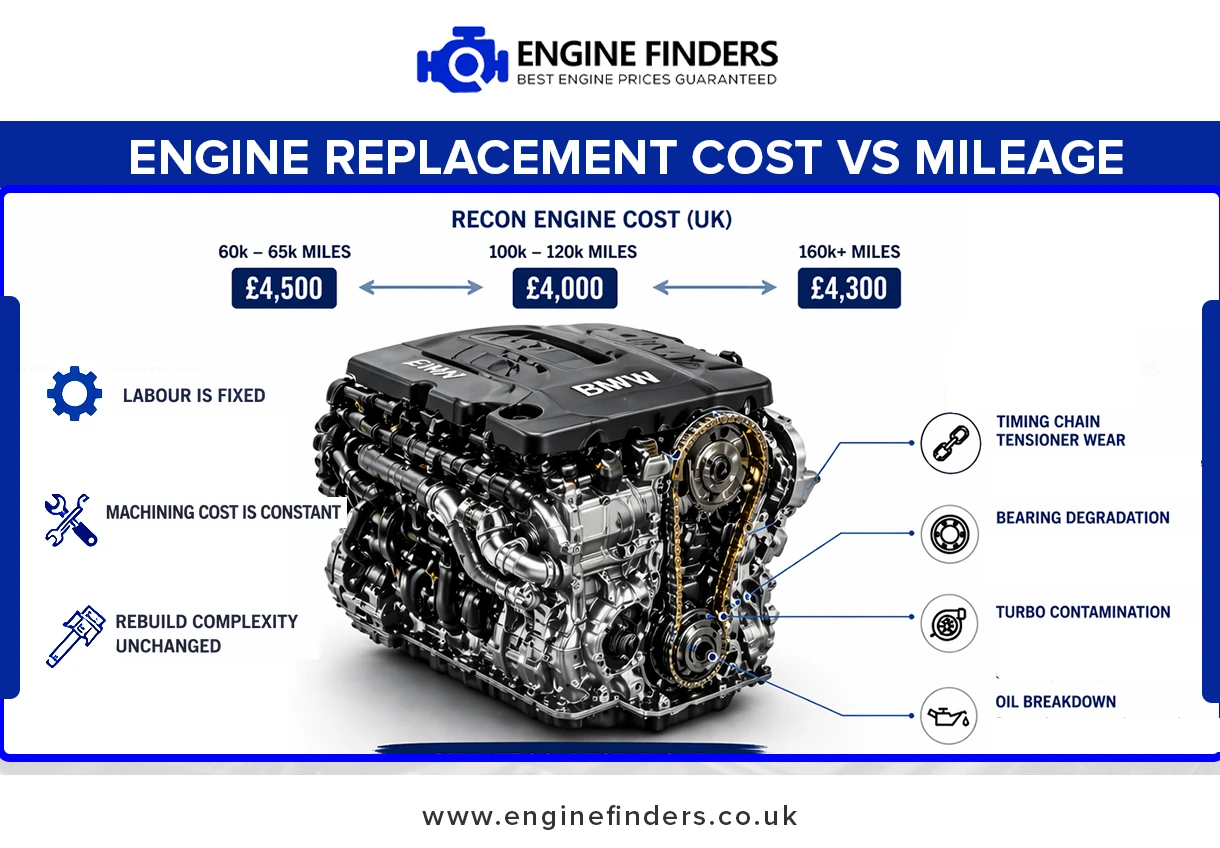
Engine failure is rarely sudden without warning. It is typically the culmination of gradual wear, poor maintenance, or design flaws.
The N57 engine is notorious for timing chain tensioner failure. If the chain jumps a tooth, pistons strike valves causing immediate severe damage. For similar issues in other BMW engines, see BMW N47 diesel engine common issues.
Oil degradation leads to metal-on-metal contact in main and big-end bearings. This causes knocking sounds and eventual seizure.
Overheating or warping allows coolant and oil to mix. Visible as white smoke or "mayonnaise" under the oil cap.
Failed turbos send metal shards into the intercooler and intake, contaminating the entire engine system.
Recognising the early signs of engine distress can save thousands of pounds. The following table outlines common UK driving scenarios.
| UK Driving Scenario | Likely Cause | Recommended Action |
|---|---|---|
| Rattling noise on cold start (first 2-3 seconds) | Timing chain tensioner bleed-down or worn guides. Common in N47/N57 engines. | High Urgency. Stop driving long distances. Inspect timing system immediately. |
| Loss of power on motorway overtaking | Turbo actuator failure, blocked DPF, or low compression in one or more cylinders. | Medium Urgency. Check fault codes. Perform boost leak and compression test. |
| White smoke from exhaust (sweet smell) | Head gasket failure allowing coolant into combustion chambers. | High Urgency. Do not drive. Tow to specialist. |
| Blue/Grey smoke under acceleration | Worn valve stem seals or piston rings. Oil burning in combustion chamber. | Medium Urgency. Monitor oil levels. Plan for overhaul or replacement soon. |
| Knocking sound from bottom end (increases with RPM) | Main or big-end bearing failure. Metal-on-metal contact. | Critical Urgency. Stop engine immediately. Replacement likely. |
| Intermittent Limp Mode in traffic | Sensor failure (MAP/MAF), EGR sticking, or turbo vane sticking. | Low/Medium Urgency. Diagnostic scan required. Often repairable without engine removal. |
For B47/N47 cold-start rattle specifics, see our BMW cold-start rattle repair guide for specialist diagnostic advice before committing to major work.
Engine replacement costs are high due to the complexity of modern powertrains. It is not just about swapping a block of metal.
Frequent stop-start traffic in cities like London, Manchester, and Birmingham places immense strain on engine components. For diesel engines, this prevents DPF regeneration, leading to excessive back-pressure. This pressure forces oil past piston rings and valve guides, accelerating wear. The damp UK climate also affects electrical sensors and connectors, causing erratic sensor readings.
The BMW N57 has a well-documented issue with its timing chain located at the rear of the engine. Accessing this chain requires removing the transmission and often the engine itself. This means a relatively inexpensive part becomes incredibly expensive due to labour costs. Similarly, some Ford EcoBoost engines have suffered from coolant pipe degradation.
A well-maintained engine with 160,000 miles can be in better condition than a neglected one with 60,000 miles. Regular oil changes using the correct specification oil are crucial. Modern engines require low-viscosity oils meeting specific manufacturer standards. Incorrect oil leads to sludge buildup and blocked oil galleries.
On the N57 engine, the timing chain is located at the rear, between the engine and gearbox. To replace the chain or tensioners, a technician must remove the gearbox and often separate the engine from the chassis. This labour-intensive process means even a "simple" chain rattle repair can cost £1,500-£2,000 in labour alone.
If the engine has other issues (slight oil consumption or minor turbo lag), it often makes financial sense to replace the entire unit rather than paying for extensive labour to fix just the chain. The accessibility issue skews the economics heavily towards replacement once major internal work is required.
Rising parts and labour costs have significantly impacted engine repair economics. Learn how inflation impacts engine repair costs to understand current market pressures on replacement decisions.
Deciding whether to repair or replace an engine is a financial and emotional calculation. There are clear guidelines to help.
💰 The 40-60% Trade Value Rule:
If repair costs approach 40–60% of the vehicle's current realistic trade value, replacement or reconditioned options are often worth comparing on purely financial grounds. For example, a £8,000 car with a £4,000 repair quote means spending half the car's value. A reconditioned engine with warranty might offer greater peace of mind.
⏱️ Unique Nuance: BMW N57 Rear Chain Complexity:
On the N57, replacing just the chain costs £1,500-£2,000 in labour. If the engine has other issues, replacing the entire unit is often more economical. For BMW 5 Series engine replacement guidance, this consideration is particularly relevant.
Engine replacement costs vary widely based on engine source, vehicle model, and garage location. Figures reflect 2026 market conditions.
Regional Variations:
Labour rates in London and the South East are typically 15-20% higher than in the North of England or Scotland. However, specialist garages in major cities may offer more competitive pricing on engine units due to higher volume.
VAT Note:
All prices quoted by VAT-registered garages will exclude 20% VAT unless stated otherwise. Always ask for the "out-the-door" price. Stay informed with current UK engine replacement cost trends to spot competitive pricing.
Preventing engine failure is far cheaper than fixing it. Here are practical steps UK owners can take to protect their investment.
"Will you perform a compression and leak-down test before quoting?" – Confirms internal health and avoids unnecessary stripping.
"What are the warranty terms on the engine and the labour?" – Look for at least 12 months on the engine and 3-6 months on labour.
"Are you replacing all ancillaries as part of the job?" – Reusing old mounts or seals leads to premature failure and additional labour.
A competent technician will answer these questions directly and provide clear documentation of the work planned.
Do not ignore oil pressure warnings. If the oil light comes on, stop immediately. Driving with low pressure can destroy an engine in minutes.
Do not clear fault codes and keep driving. Clearing codes masks the problem. The underlying issue remains and worsens.
Do not buy the cheapest used engine online without verifying engine code, mileage, and warranty terms. Always use a reputable supplier.
Do not attempt DIY unless experienced. Engine replacement requires specialised tools and knowledge. Incorrect installation leads to immediate failure.
Delaying action: Hoping the noise will go away is expensive. Early intervention is key.
Accepting vague advice: "It needs a new engine" is not enough. Ask for evidence: compression results, fault codes, video of the noise.
Choosing the cheapest supplier: The lowest quote often excludes essential items like fluids, seals, or VAT. Compare like-for-like.
Ignoring warranty terms: Read the fine print. Some warranties require specific servicing intervals to remain valid.
Ignoring compatibility: Ensure the replacement engine matches your vehicle's exact emissions standard (Euro 5 vs Euro 6).
Legal Note:
If your car fails its MOT due to engine issues, you cannot legally drive it on public roads except to a pre-booked repair appointment.
Typically 2-4 days. This includes removing the old engine, preparing the new unit, installation, and testing. Complex vehicles may take longer.
A professionally reconditioned engine replaces all worn parts with new or refurbished components. It is tested to meet original specifications. While not "brand new," it offers comparable reliability and comes with a warranty.
Yes. Inform your insurer of the engine replacement. Provide details of the work done and the warranty. This ensures your policy remains valid and may help maintain the vehicle's value.
A documented engine replacement with a warranty can maintain or even enhance value, especially if the previous engine had known issues. Keep all receipts and warranty documents.
Euro 6 engines have stricter emissions controls. Swapping a Euro 5 engine into a Euro 6 car (or vice versa) can lead to MOT failures and legal issues. Always match the emissions standard.
If your car is under manufacturer or extended warranty, check the terms. Most warranties cover engine failures unless caused by neglect or lack of maintenance.
It is difficult to verify exact mileage on a used engine. Rely on the supplier's reputation, warranty, and any available service history. Reconditioned engines are reset to zero miles for warranty purposes.
Getting a clear picture of the numbers early often makes the difference between a manageable repair and an avoidable write-off. Comparing specialist options can help make that decision clearer.
At EngineFinders.co.uk, we help you compare quotes from multiple vetted suppliers, ensuring you get a fair price and a reliable engine. Take the stress out of the process by exploring your options today.
No obligation. Just clear, comparable options to help you choose with confidence.