Fixed-price transparency • Verified UK fitters • Warranty clarity
FAULT
Uncertainty: salvage used vs professionally reconditioned engines
URGENCY
Medium to High (depends if engine runs & holds oil pressure)
LIKELY COST BAND (UK)
£800–£2,400 (used supply)
£1,600–£3,800 (reconditioned fitted)
BEST NEXT STEP
Record engine code, confirm car value, request itemised warranty terms
The difference between saving a few hundred pounds and facing a second catastrophic bill often comes down to one decision: how you replace a failed engine. Many UK owners delay this choice because the financial stakes feel disproportionate to the vehicle's remaining value. A failing engine rarely happens in isolation. It usually arrives alongside limp mode, persistent warning lights, and a garage estimate that seems to eclipse the cost of purchasing a different car entirely.
Waiting too long turns a straightforward swap into a compounding mechanical problem. Coolant contamination can thin engine oil, turbo debris can travel through intercooler piping, and a seized crankshaft can strip accessory drive pulleys or crack transmission mounts. This guide cuts through sales terminology and explains exactly how used and reconditioned engines differ under real-world UK conditions. You will understand what a warranty actually covers, why some cheap replacements fail within months, and how to match the right unit to your vehicle without overpaying or gambling on salvage yard inventory.
Terminology varies across suppliers — understanding the practical differences prevents costly mismatches.
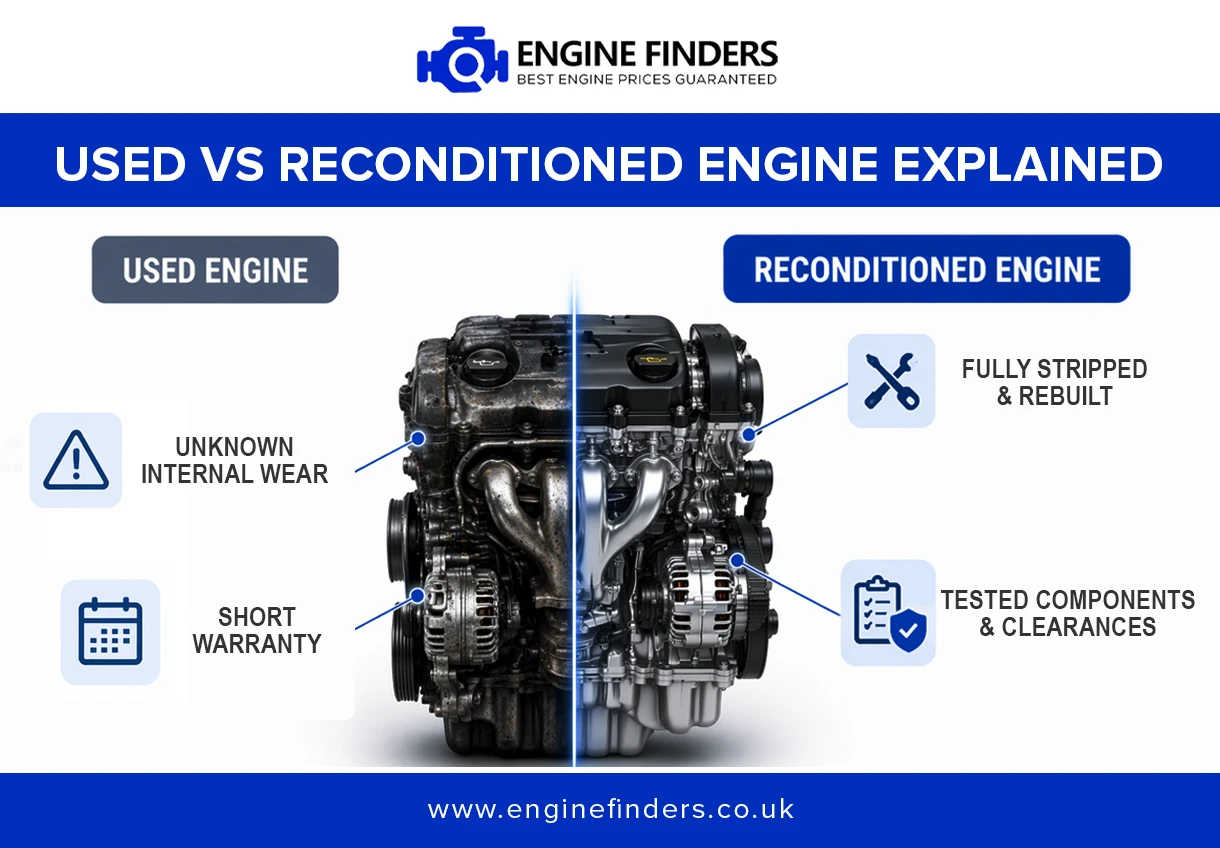
Pulled from donor vehicle, sold "as seen" with 30-90 day guarantee. Mileage claims rarely verified.
Systematically stripped, measured, rebuilt with new and re-certified components. Consult a reconditioned engine buyer's guide for restoration details.
Factory tolerances precisely followed. Every component replaced or machined to original spec. Delivers improved fuel economy.
| UK Driving Scenario | Likely Cause | Recommended Action |
|---|---|---|
| Cold start rattle lasting 2–5 seconds | Delayed oil pressure delivery or worn timing tensioner | Book oil pressure & leak-down test |
| Motorway power loss under light load | Turbo boost leak, carbon-restricted EGR, failing fuel pump | Inspect boost piping. Request live data scan of lambda values. |
| Sudden limp mode in heavy traffic/damp weather | Overheating sensor fault, wiring damp ingress | Allow thermal stabilisation. Check coolant concentration. |
| Blue-grey exhaust on initial acceleration | Worn valve stem seals or deteriorating piston rings | Monitor oil consumption. Conduct cylinder leakage test. |
| White, sweet-smelling exhaust at idle | Coolant migration via head gasket or cracked liner | Stop driving immediately — risk of hydrolock |
| Intermittent oil pressure warning after short trips | Oil dilution from fuel or gallery sludge | Change oil & filter. Verify DPF differential pressure. |
Premature failure is rarely a single catastrophic snap — it's a convergence of micro-wear patterns
Short, cold-start commutes, frequent stop-start urban traffic, and extended low-speed motoring prevent engine oil from reaching its optimal thermal operating window. This environment accelerates carbon accumulation on intake valves, EGR cooling jackets, and piston crowns while leaving moisture trapped in the crankcase.
A visually clean cylinder head does not guarantee clean oil passages. Sludge consolidates behind timing covers and inside cam followers — only becoming apparent after several hundred miles. The same maintenance neglect remains embedded in a randomly sourced replacement.
Reconditioned engines strip the core block and measure bore taper, crankshaft journal ovality, and connecting rod alignment. Clearances outside safety margins are machined to oversize specifications or replaced entirely. The assembly process resets internal tolerances to predictable running parameters. Fuel delivery components, turbocharger shafts, and oil pumps undergo pressure and rotational testing. This eliminates the statistical guesswork associated with second-hand inventory.
A reconditioned engine represents calculated risk reduction with documented components and known service lifespans. A used engine carries an undocumented history — the primary reason warranty depth differs so significantly.
Not every engine fault justifies a full replacement. Some issues are isolated and financially rational to repair. knowing if engine replacement is cost-effective is key to making the right decision.
Pricing varies by displacement, forced induction complexity, and regional labour rates
Engine longevity is dictated more by maintenance discipline than recorded mileage alone. UK environmental and driving conditions accelerate specific wear patterns, particularly with common DPF and EGR failure patterns.
“Will you perform a cylinder leak-down test and mechanical oil pressure verification on the replacement unit prior to installation, and can you provide the printed results for my records?”
“Which ancillary components are being replaced as part of the installation package, and are OEM or OE-equivalent components being specified for gaskets, tensioners, and water pumps?”
“Does the quoted labour include ECU adaptation reset, complete coolant system bleed, and a post-fit road test covering both urban stop-start and sustained motorway conditions?”
Do not ignore oil pressure warnings. Low pressure starves critical main and rod bearings within seconds.
Do not clear fault codes without diagnosing. Codes are symptoms, not root diagnoses.
Do not purchase the cheapest used engine online without verifying the exact engine casting code and securing written warranty covering parts & labour.
Do not assume low-mileage donor units are reliable. Vehicles stored for extended periods suffer from dried rubber seals and surface corrosion.
Do not allow installation without flushing the intercooler if the original engine exhibited blue smoke or excessive oil consumption.
Delaying action — A deteriorating power unit damages peripheral systems and reduces the vehicle's overall structural value.
Accepting vague mechanical advice — Statements like "it's just a tappet noise" rarely align with measurable diagnostics.
Choosing the lowest-priced supplier — Ignores warranty depth, return logistics, and technical support availability.
Ignoring used engine warranty terms — Basic budget warranties frequently exclude labour costs and ECU recoding.
Ignoring compatibility — Turbo piping routing, accessory bracket positioning, and sensor connector configurations vary between production years. Always check your exact engine code to ensure proper fitment.
Towing in these circumstances prevents hydrolock or complete crankshaft fracture.
Replacing a failing unit before a scheduled MOT prevents compounding administrative and mechanical failures.
It is not a production-line crate engine, but it is engineered to restore original clearances and operational parameters. In standard daily driving, a properly reconditioned engine performs indistinguishably from a dealer-supplied replacement, typically at a 30–50% cost reduction.
In most cases, no. The DVLA only requires formal notification if the engine capacity or primary fuel type changes. Swapping a 2.0 litre diesel for another 2.0 litre diesel does not trigger a mandatory update.
Standard policies rarely require immediate notification for a direct like-for-like replacement. However, if the replacement changes engine size, output rating, or emissions tier, you must update your policy.
Yes, provided it is installed correctly and paired with functional exhaust hardware. The unit is built to original emissions tolerances.
Supply chain logistics, regional stock availability, and verification standards create differences. Engines from low-mileage fleet vehicles command higher prices due to predictable internal wear profiles.
Technically possible, but practically limited. Most reputable suppliers require installation by a VAT-registered workshop to maintain parts warranty validity.
Established suppliers usually offer a core exchange discount, returning £150–£350. The failed unit is routed to a specialized reclamation facility for recycling or parts harvesting.
Comparing specialist options can help make that decision clearer. EngineFinders.co.uk allows you to request transparent quotes from vetted UK suppliers, verify warranty terms side-by-side, and match your exact engine code before committing to any workshop time.
A structured comparison removes guesswork and ensures you invest in a solution that aligns with long-term reliability.
No pressure. Just the information you need to decide with confidence.
-->