Signs Your Engine Needs Replacing
(Before It Fails)

Recognise terminal wear • Avoid sudden breakdown • Get transparent quotes
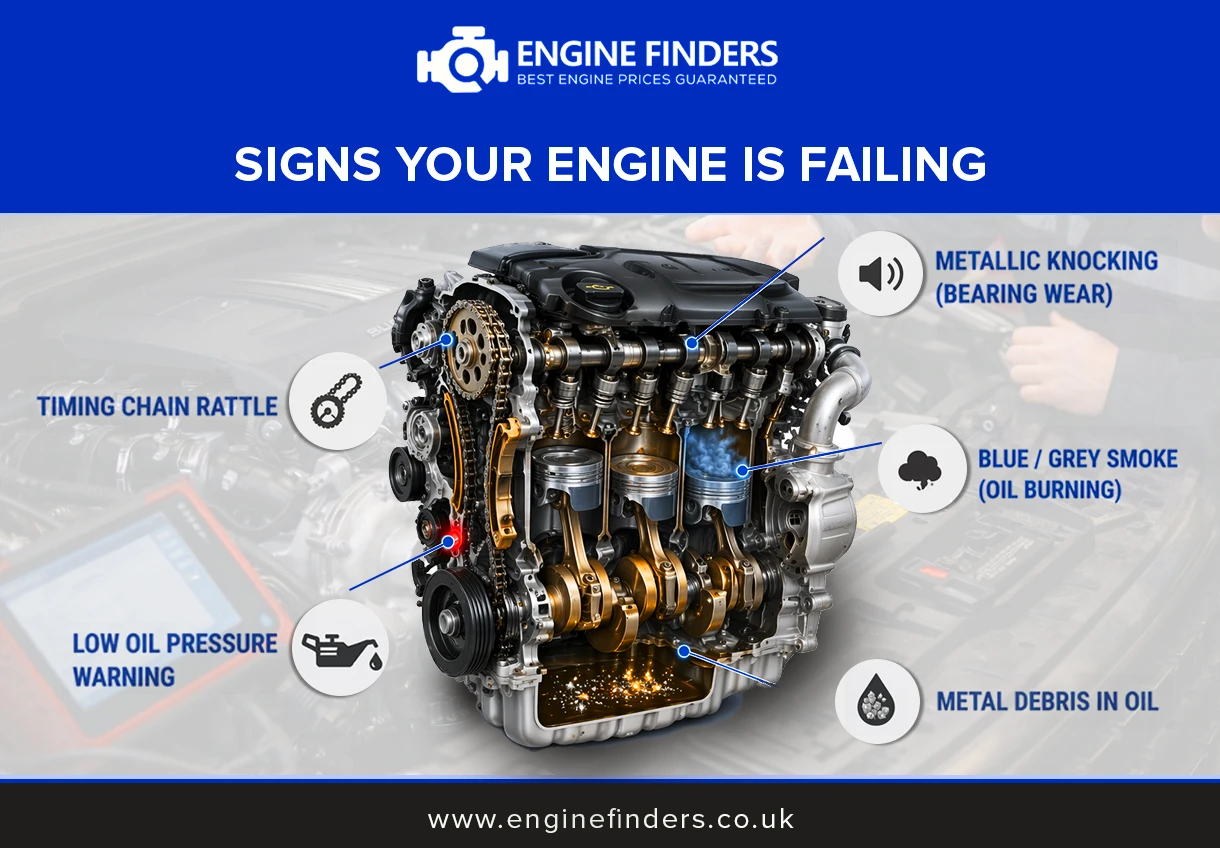
Engine warning signs

FAULT

Progressive internal mechanical wear reaching terminal failure (bearing clearance loss, chain stretch, or oil starvation)

URGENCY

High (metallic debris, consistent knocking, or confirmed low oil pressure)

LIKELY COST BAND (UK)

£850–£1,400 (diagnosis & teardown)

£2,800–£5,500+ (full fitted replacement)

BEST NEXT STEP

Park safely, verify oil for glitter, arrange independent diagnostic

Introduction

Engines Rarely Fail Without Warning

Engines rarely fail without warning. They announce their decline for months. The most costly outcome isn't the replacement itself - it's continuing to drive once internal damage has crossed into terminal territory. EngineFinders' own diagnostic data consistently reveals that roughly 78% of engines which required replacement exhibited abnormal acoustic or performance warnings for at least three months before complete failure.

Ignoring that window typically transforms a manageable component swap into a full engine exchange, pushing repair bills well beyond £3,000 and risking sudden roadside breakdown.

In the UK, driving a vehicle with a known dangerous mechanical defect carries immediate legal and financial exposure. A police or DVSA check can result in a PG9 prohibition notice, legally removing the car from the road until repaired and retested. Insurance may also refuse cover if a known fault contributed to an incident.

This guide exists to help you recognise the exact moment a repair no longer makes financial or mechanical sense. It translates workshop diagnostics into plain English risk assessments, outlines realistic UK replacement costs, and gives you a calm, structured path forward. You do not need to panic. You need accurate information and a clear decision threshold.

Problem Overview: What "Needs Replacing" Actually Means

Structural wear that exceeds safe manufacturing tolerances – not a software glitch or faulty sensor

Core component degradation

Crankshaft and connecting rod bearings, cylinder walls, timing drive components, or oil pump gallery network.

The oil wedge collapse

Modern engines rely on a microscopic hydrodynamic oil wedge. Once clearance widens beyond design limits, metal contacts metal – generating heat and shedding particles.

Common diagnostic codes

P0016 (crankshaft/camshaft correlation), P0300 (random misfire), P0524 (oil pressure too low), persistent knock sensor codes. Consult an engine fault code library to understand what each code truly means.

A technician will typically differentiate by: checking mechanical oil pressure, measuring cylinder compression, and inspecting the sump drain for particulate matter. Once those three metrics align negatively, the unit is classified as terminal.

Granular Warning Signs

Symptoms present differently depending on driving style, load, and ambient temperature. Map your experience to this table.

UK Driving ScenarioLikely CauseRecommended Action
Cold-start rattle lasting 3–8 secondsTiming chain tensioner drain-back, VVT phaser wear, or low oil viscosityCheck oil level/spec. Book diagnostic within 7–10 days.
Motorway power loss under sustained loadWorn rod bearings, low cylinder compression, or turbo lubrication failureReduce load immediately. Do not force throttle. Arrange urgent diagnostic.
Limp mode triggered in heavy stop-start trafficOverheating piston/valve recession, severe oil dilution, or sensor correlation driftStop vehicle. Verify coolant/oil cross-contamination. Arrange recovery.
Continuous blue/grey exhaust smokeOil burning past worn piston rings, cylinder scoring, or degraded valve stem sealsMonitor consumption. If exceeding 1 litre per 1,000 miles, prepare for major work or replacement.
Metallic glitter or sand-like debris on dipstick/drain plugTerminal bearing wear, cam lobe scuffing, or piston skirt failureImmediate replacement required. Further driving will guarantee catastrophic lock-up.

Any single item in the rightmost column warrants a definitive diagnostic step. Do not guess. Measure.

Why This Happens: The Mechanical Reality

Terminal wear follows a predictable mechanical pathway – cumulative stress interacting with compromised lubrication

Oil starvation or oil dilution

Modern direct-injection turbo engines run leaner combustion cycles and higher cylinder pressures. Frequent motorway runs spike oil temperatures. Short cold-start urban trips prevent optimal viscosity. Fuel wash from incomplete DPF/GPF regenerations thins the oil film over time – reducing bearing load capacity.

Timing chain system fatigue

Hydraulic tensioners rely on stable oil pressure. On cold mornings, thicker oil or clogged filter bypass valves delay pressurisation. The chain slaps against guides. Over thousands of cycles, the chain elongates. Cam timing drifts. Compression efficiency drops.

The abrasive loop

Metallic debris in the oil filter confirms bearing layer compromise. Tri-metal bearings embed contaminants in a soft overlay. Once that layer wears through, copper or aluminium contacts the crank journal – scoring the shaft. Scoring creates more debris. The lubrication circuit becomes an abrasive loop.

Transverse engine bottleneck

On modern transverse front-wheel-drive layouts, accessing the rear timing chain tensioner or rear main crank seal requires dropping the front subframe, disconnecting steering racks, and removing the clutch/flywheel. This labour complexity means partial repairs often exceed the viability of a complete unit swap.

The common finding:

Once the bearing overlay is breached and debris circulates, the engine enters a self-destructive cycle. At this point, targeted repair is no longer economical – full replacement or reconditioning becomes the only rational path.

decision guide

Repair vs Replace: Know the Threshold

Deciding between rebuild and replacement depends on mechanical extent, labour structure, and vehicle valuation. Replacement engine cost breakdown data shows that mileage plays a significant role in the decision.

Repair when: Top-end failures – cylinder head gaskets, valve train components, injector seals, cam phasers. Compression uniform across cylinders, no particulate contamination in sump.
Replace when: Bottom-end damage – spun rod bearings, scored crank journals, deep cylinder wall scoring. Requires machining, oversized components, and line-boring. Higher risk of premature recurrence.

💰 Common rule of thumb:

If repair costs approach 40–60% of the vehicle's current realistic trade value, compare reconditioned engine quotes and explore reconditioned options on purely financial grounds.

Hidden labour risks

Many owners focus solely on the engine unit price. They overlook ancillary time. Replacing an engine requires recovering refrigerant, draining coolant, disconnecting wiring harnesses, coding new control modules, and verifying emissions calibration. Hidden costs of engine replacement in the UK often catch buyers off guard.

If the transmission was accessed during subframe drop, replacing the clutch, flywheel, and rear seals at the same stage is standard practice.

UK Cost Guide

Pricing varies by region, garage type, and engine architecture. Figures reflect current market rates.

Service / Component
  • Diagnosis & Initial Teardown: £85–£180 (pressure/compression tests) + £350–£650 for sump/head lift
  • Minor Repair (gaskets/chain/sensors): £650–£1,800
  • Major Repair (Bottom End Rebuild): £1,800–£3,500+
  • Labour Rates: £60–£95/hr (Independents) vs £100+ (Main Dealers)
  • Reconditioned Engine (Unit Only): £1,200–£2,800 — many owners save 60 percent on replacement costs compared to new units.
  • Replacement Fitting: £850–£2,200
Hidden Costs to Budget For
  • Oil & genuine filters: £80–£140
  • Coolant, transmission fluid, AC regassing: £150–£300
  • VAT applies across all commercial labour and parts (20%)
  • London & South East rates sit at higher end of scales

Always request an itemised quote separating parts, labour, and consumables before authorising work.

Expert Ownership & Prevention Advice

Preventing terminal wear relies on consistent maintenance habits, correct fluid selection, and realistic driving expectations. For owners of Range Rover engines or MINI vehicles, following manufacturer-specific service schedules is particularly important.

Servicing priorities

Replace oil and filters at or below manufacturer intervals. Use genuine or OEM-equivalent filters with integrated anti-drain back valves.

Warm-up cycles

Allow oil pressure to stabilise before applying load. Thirty to sixty seconds of idle in cold weather permits circulation to upper galleries. Avoid high RPM until the temperature gauge reaches mid-range.

Warning signs owners often miss

  • Slow cranking after warm-up indicates thickened oil from contamination
  • Subtle exhaust ticking on overrun often signals early valve train clearance loss

What to ask a UK garage

“Can you confirm the exact mechanical oil pressure curve under both cold and warm conditions, and has a physical gauge been used to rule out sensor drift?”

“If we proceed with a rebuild, are you using OEM-clearance main and connecting rod bearings matched to the crankshaft's current journal measurements?”

“Does your quote include post-fit ECU adaptation, injector coding, and a verified cam-to-crank correlation check?”

What NOT To Do Next

Terminal engine faults escalate quickly. Avoid these actions to prevent compounding damage:

Do not ignore oil pressure or temperature warnings. Low pressure means metal-to-metal contact is occurring. Continued driving guarantees seizure.

Do not clear fault codes and assume the mechanical fault has resolved. Codes document symptoms, not structural condition.

Do not buy the cheapest used engine online without matching the exact engine code, emissions calibration, and mounting architecture. Use a used engine compatibility checker to verify fitment.

Do not continue driving once metallic debris appears on the dipstick or drain plug.

Do not skip clutch or flywheel replacement when the gearbox is separated for engine extraction.

Common Buyer Mistakes

The financial and mechanical consequences of engine failure are manageable if handled methodically.

Delaying action transforms a £1,500 chain replacement into a £3,800 full swap. Early intervention preserves the crankshaft.

Accepting vague garage advice leads to partial repairs. Demand measurement data rather than accepting statements like "it's just noisy."

Choosing the cheapest supplier without warranty and installation guide creates false economy. Warranties often require professional fitting proof and specific oil change records.

Ignoring compatibility causes installation failure. Engine codes, flywheel bolt patterns, and EGR/DPF hardware must align perfectly.

When to Seek Help / MOT Implications

Urgency thresholds:

  • Oil pressure drops
  • Consistent knocking persists under light throttle
  • Exhaust smoke increases visibly

Arrange recovery rather than attempting a final drive home.

MOT failure risks:

  • The test does not measure internal bearing wear, but checks for excessive emissions, dangerous fluid leaks, and unsafe mechanical defects.
  • Persistent blue smoke or heavy hydrocarbon readings will fail Section 6 (exhaust emissions).
  • Oil pooling on hot exhaust manifolds or dripping onto road surfaces can trigger a fail under safety criteria.

PG9 prohibition notice:

DVSA examiners can issue an immediate prohibition if a vehicle is deemed dangerous, legally removing it from the road.

FAQ Section

Will a knocking engine automatically fail its MOT?

Not automatically. The MOT does not test internal mechanical wear. However, visible smoke, unsafe oil leaks, or erratic idle can cause failure.

Do I need to notify the DVLA after replacing my engine?

Yes, if engine capacity changes. If capacity remains identical, notification is not legally required, though retaining fitting invoices is strongly advised for resale transparency.

Does an engine replacement affect my car insurance?

It should be reported. Reconditioned units of identical specification rarely impact premiums, but failure to disclose can invalidate claims.

Is a reconditioned engine better than a used one?

Typically, yes. Reconditioned options are fully disassembled and fitted with new bearings and seals. Used engines rely on salvage condition with unknown internal wear.

Make an Informed Decision Before It's Too Late

Getting a clear picture of the numbers early often makes the difference between a manageable repair and an avoidable write-off. Comparing specialist options can help make that decision clearer.

Reviewing vetted supplier quotes, understanding fitting requirements, and matching warranty terms to your driving pattern removes guesswork from a high-stakes decision.

Compare engine quotes Check your engine code

No pressure. Just the information you need to decide with confidence.