Ancillary expenses • ECU adaptation • VAT and labour variation • Budget realistically
FAULT
Unexpected ancillary and administrative costs during engine replacement. Consult our guide to hidden costs of engine replacement in the UK.
URGENCY
Medium (financial planning required before committing). See how much UK drivers save with Engine Finders.
LIKELY COST BAND (UK)
£200-£500 hidden ancillaries + potential £150-400 ECU adaptation. See how replacement costs vary across UK regions.
BEST NEXT STEP
Request itemised quote including VAT, ancillaries, and diagnostic pairing before authorising work. Compare transparent, no-obligation quotes now.
The real risk with engine replacement isn't usually the core price tag. It's the cascade of additional costs that appear once the work starts. Owners often delay action because quotes feel vague, or they fear committing to a bill that could spiral. See how much UK drivers save with Engine Finders to understand the value of comparing suppliers.
This guide cuts through that uncertainty. We focus on the costs that don't always make the initial estimate: fluids, seals, ancillary parts, VAT, regional labour differences, and the often-overlooked electronic adaptation required on modern vehicles. Start with our model-specific cost breakdowns to benchmark your expectations.
Ignoring these factors can turn a planned £3,000 repair into a £4,500 surprise. That difference can mean the gap between a sensible repair and an unexpected write-off. This guide helps you budget realistically, ask the right questions, and avoid costly pitfalls.
When a garage quotes for an engine replacement, they're typically pricing the core unit and labour. Hidden costs are everything else.
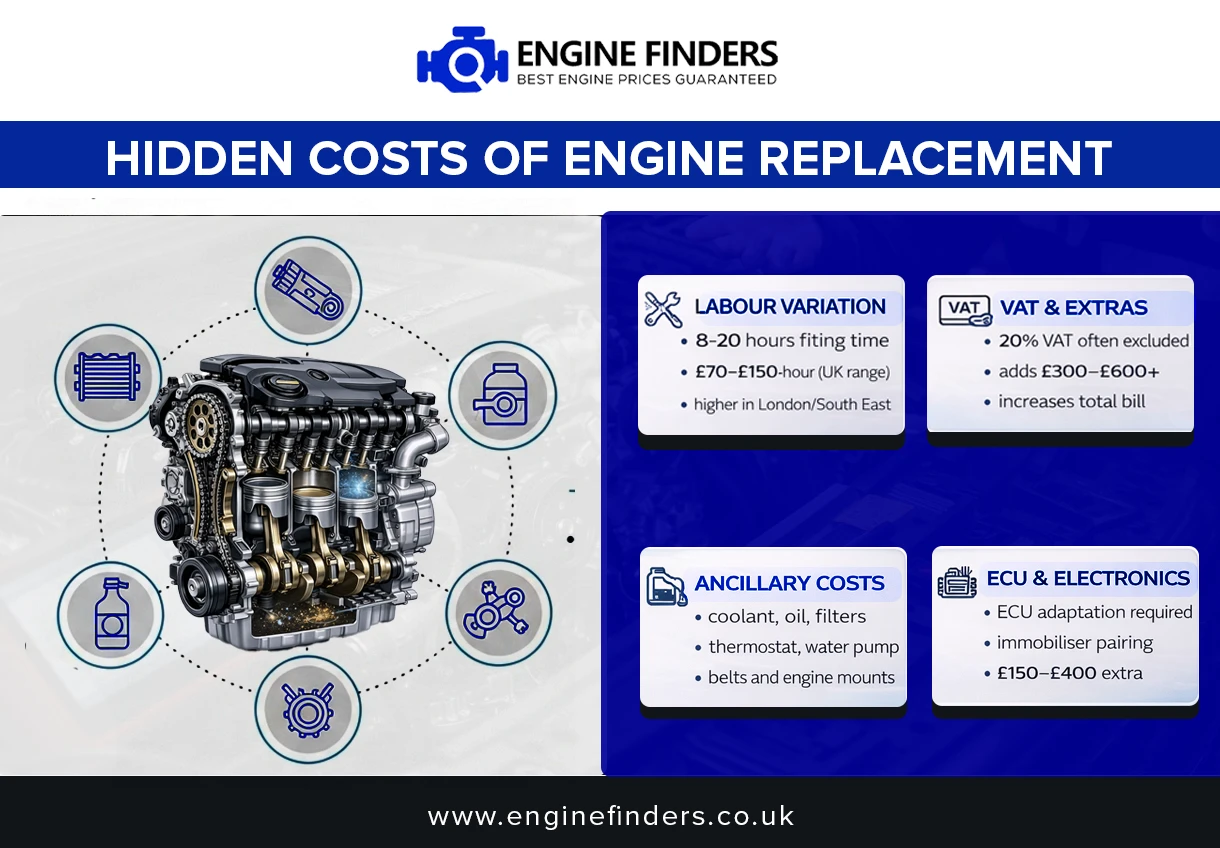
New coolant, hoses, thermostat, water pump – often required during engine-out work.
Oil, filter, sump seal – essential for break-in and proper operation of replacement unit.
Clutch, flywheel – if gearbox is removed, replacement is often sensible at high mileage.
ECU adaptation, immobiliser pairing – often overlooked and can add £150-400.
Use this table to identify scenarios where hidden costs are likely to emerge. It helps you gauge urgency and prepare questions before work begins.
| UK Driving Scenario | Likely Cause | Recommended Action |
|---|---|---|
| Post-replacement overheating on M25 commute | Ancillary cooling parts not renewed during engine swap | Insist on new thermostat/water pump if engine was out; minimal extra labour |
| Clutch slip after engine fit, especially on hilly routes | Clutch not replaced during gearbox removal; worn component now under new load | Ask about clutch/flywheel condition before reassembly; replace if over 80k miles |
| Immobiliser warning light after start, car won't proceed | ECU not adapted to replacement engine; security system not recognising new unit | Confirm garage has diagnostic capability for pairing before booking work |
| Oil pressure warning after first run, slight knock on cold start | Incorrect oil spec, filter fitment issue, or sump seal not properly renewed | Verify oil type and filter fitment before sign-off; request pressure test |
| Excessive downtime beyond quoted timeframe | Parts ordering delays for ancillaries or unexpected additional faults discovered | Get written timeline with contingency buffer; agree communication protocol for surprises |
Proactive questioning about ancillaries and ECU pairing before work starts prevents cost surprises and delays. See how replacement costs vary across UK regions to understand how labour rates affect your area.
Components wear in tandem. Replacing the core unit while retaining worn peripherals creates a weak link.
An engine failing at 120,000 miles likely has ancillaries with similar mileage. Replacing the core unit while retaining worn peripherals creates a weak link. Water pumps, thermostats, and belts often fail shortly after an engine replacement if not renewed.
Removing the gearbox to access the engine exposes the clutch and dual-mass flywheel. A technician will typically recommend replacement if mileage is high, as labour to access them again later duplicates the initial fitment cost.
A £3,000 engine becomes £3,600 with 20% VAT. Labour rates in London and the South East commonly run £100-£150/hr, compared to £70-£90/hr in the North and Scotland. A 15-hour job thus varies by £450-£900 purely on location. See how replacement costs vary across UK regions for detailed regional comparisons.
Many engines post-2005 require specialist diagnostic equipment to pair the replacement unit to the car's security system. This isn't always included in initial quotes and can add £150-400 in diagnostic time. Not all independent garages have the necessary software subscriptions. The BMW 5 Series: ECU pairing requirements & cost factors exemplify this challenge on premium vehicles.
Short cold-start school runs increase condensation in oil, accelerating internal corrosion. Damp conditions affect sensor connectors. Pothole damage can compromise sumps or mounts. These factors mean ancillaries often need attention during a major repair.
A BMW B47D20A-B has different ancillary requirements and ECU pairing protocols than a Jaguar Ingenium unit. Always match your V5C engine code to the right replacement to ensure accurate part matching and avoid compatibility issues. Velar engine replacement: what affects your quote shows how model-specific factors influence total cost.
A common rule of thumb is that if repair costs approach 40–60% of the vehicle's current realistic trade value, replacement or reconditioned options are often worth comparing on purely financial grounds.
💡 Hidden labour risks:
Ancillary replacement adds minimal labour when the engine is out, but significant cost if done later. Replacing a water pump during the swap might add £50 in parts and 30 minutes labour. Doing it separately later could cost £200+ in labour alone.
⏱️ Downtime consideration:
Sourcing a reconditioned engine with warranty from a vetted supplier often means 2-3 days downtime. Waiting for a specific warranty-backed used engine can stretch to 1-2 weeks. Factor in hire car costs or transport disruption. Consult our guide to hidden costs of engine replacement in the UK for complete budget planning.
Costs vary by vehicle, region, and supplier. Ranges reflect typical UK market conditions in 2026.
Model-specific considerations: Costs vary significantly by vehicle. Some require more complex access procedures, affecting labour time. Others have specific pairing requirements that influence total cost. Start with our model-specific cost breakdowns for accurate estimates. Consult our guide to hidden costs of engine replacement in the UK for a complete overview. Review our compliance checklist to avoid MOT surprises.
Prevention is always cheaper than cure. These habits, drawn from workshop experience, make a measurable difference to total cost of ownership.
"Does your quote include ECU adaptation and immobiliser pairing for the replacement engine, and do you have the diagnostic equipment in-house?"
"Which ancillary parts will be renewed as standard when the engine is out, and which are optional extras? Can I see an itemised list?"
"Can you provide a written breakdown showing labour hours, parts costs, and VAT separately, with a clear warranty statement for both parts and labour?"
These questions filter out generalists from specialists and ensure you're not caught off guard by hidden costs. Review our compliance checklist to ensure your replacement meets all legal requirements.
Do not accept a verbal quote without written itemisation including VAT. Verbal estimates leave room for misunderstanding. A written, itemised quote protects both parties.
Do not proceed without confirming warranty terms on a reconditioned engine. Understand what's covered (parts only? parts and labour?), duration, and the claims process. Spot red flags when choosing an engine supplier before committing.
Do not ignore the opportunity to replace wear items while labour is already booked. Replacing a clutch later costs significantly more in labour alone.
Do not choose a supplier on price alone without checking warranty coverage and return policy. The cheapest used engine may have no warranty or restrictive terms.
Do not skip compatibility checks. Always match your V5C engine code to the right replacement to ensure you're ordering the correct unit. BMW B47D20A-B: known issues & replacement options shows why code matching is critical.
Delaying action until complete failure: Running a failing engine can cause collateral damage (metal debris circulating, damaging turbo or bearings). Early intervention often reduces total cost. Find the most cost-effective replacement options for your vehicle to avoid unnecessary delays.
Accepting vague garage advice without written confirmation: "It'll be about £3k" isn't a quote. Insist on detail to avoid surprises.
Choosing the cheapest used engine without verifying compatibility: Engine codes matter. A visually similar engine may have different sensors, mounts, or ECU requirements. Start with our model-specific cost breakdowns to understand your vehicle's requirements.
Ignoring warranty exclusions: Some warranties cover the engine unit only, not the labour to refit it if it fails. Understand the terms. Warranty-backed used engine options provide better protection.
Not checking diagnostic capability: For modern vehicles, confirm the garage can perform necessary ECU adaptation. Otherwise, you risk a non-starting car after fitment. The BMW 5 Series: ECU pairing requirements & cost factors illustrate why this matters.
Stop driving to prevent further damage. Continuing to drive can turn a repairable issue into a write-off.
Emissions compliance:
For MOT purposes, the replacement engine must meet at least the original Euro standard. Keep documentation of the engine change, including the engine number and supplier details. If you suspect engine issues, get a professional diagnosis before committing to major spend. A £100 diagnostic can save £1,000 in unnecessary work. Review our compliance checklist for complete MOT guidance. Stay MOT-compliant: emissions rules for replacement engines are critical to understand.
As long as the replacement meets the original Euro emissions standard and is properly fitted, it shouldn't cause an MOT fail. Keep documentation of the engine change for your records. Review our compliance checklist for detailed MOT guidance.
Yes. While a like-for-like replacement usually doesn't affect your premium, failing to disclose modifications can invalidate your policy. A quick call to your insurer is essential.
Reconditioned units typically come with a 6-12 month warranty and known internal condition. Used engines are cheaper but carry higher risk. Understand the trade-offs between used, reconditioned, and rebuilt options. see how much UK drivers save with Engine Finders to see real-world cost differences.
Technically yes, but modern engines often require specialist diagnostics for ECU pairing and adaptation. Ask if they have the necessary equipment and software subscriptions before booking work. The BMW 5 Series: ECU pairing requirements & cost factors illustrate the complexity involved.
For a like-for-like replacement, no DVLA notification is typically needed. However, keep the invoice and note the new engine number for your records. If the engine capacity changes, you may need to update your V5C logbook. Review our compliance checklist for complete DVLA guidance.
Typically 2-5 days depending on parts availability and garage workload. Get a written timeline with a contingency buffer before authorising work, and agree on how delays will be communicated.
Reputable UK suppliers offer 6-12 months unlimited mileage warranties. Crucially, check if labour costs are covered if the engine fails under warranty, as this can be a significant additional expense. Consult our guide to hidden costs of engine replacement in the UK for warranty cost considerations.
Getting a clear picture of the numbers early often makes the difference between a manageable repair and an avoidable write-off. Comparing specialist options can help make that decision clearer.
The hidden costs of engine replacement aren't designed to catch you out; they're often just overlooked in initial planning. By budgeting for ancillaries, confirming VAT and labour rates, and asking about electronic adaptation, you take control of the process. See how much UK drivers save with Engine Finders to understand the value of comparing suppliers. Start with our model-specific cost breakdowns for accurate estimates. See how replacement costs vary across UK regions to understand regional differences. Consult our guide to hidden costs of engine replacement in the UK for complete planning. Review our compliance checklist to avoid MOT surprises.
A well-planned replacement, using a vetted supplier and a garage with the right diagnostics, can extend your vehicle's life reliably and cost-effectively. The key is informed preparation.
Ready to compare options? Compare transparent, no-obligation quotes now from vetted UK suppliers – all hidden costs disclosed upfront, so you choose with confidence.