Fixed-price transparency • Verified UK fitters • No hidden labour traps
FAULT
Major engine failure requiring full replacement
URGENCY
High - continued driving risks seizure
LIKELY COST BAND (UK)
£2,500 - £8,000
labour 40-60% of total
BEST NEXT STEP
Get fixed-price quote: engine + fitting labour
Ignoring an engine warning light rarely saves money. In 2026, the Motor Ombudsman reports an average engine failure bill of £5,400 — roughly nine times the cost of addressing early symptoms. Most owners delay because the numbers feel overwhelming. This guide breaks down realistic UK costs, repair vs replacement, and how to avoid hidden garage fees. The goal is simple: help you make a confident decision without panic buying or unnecessary write-offs.
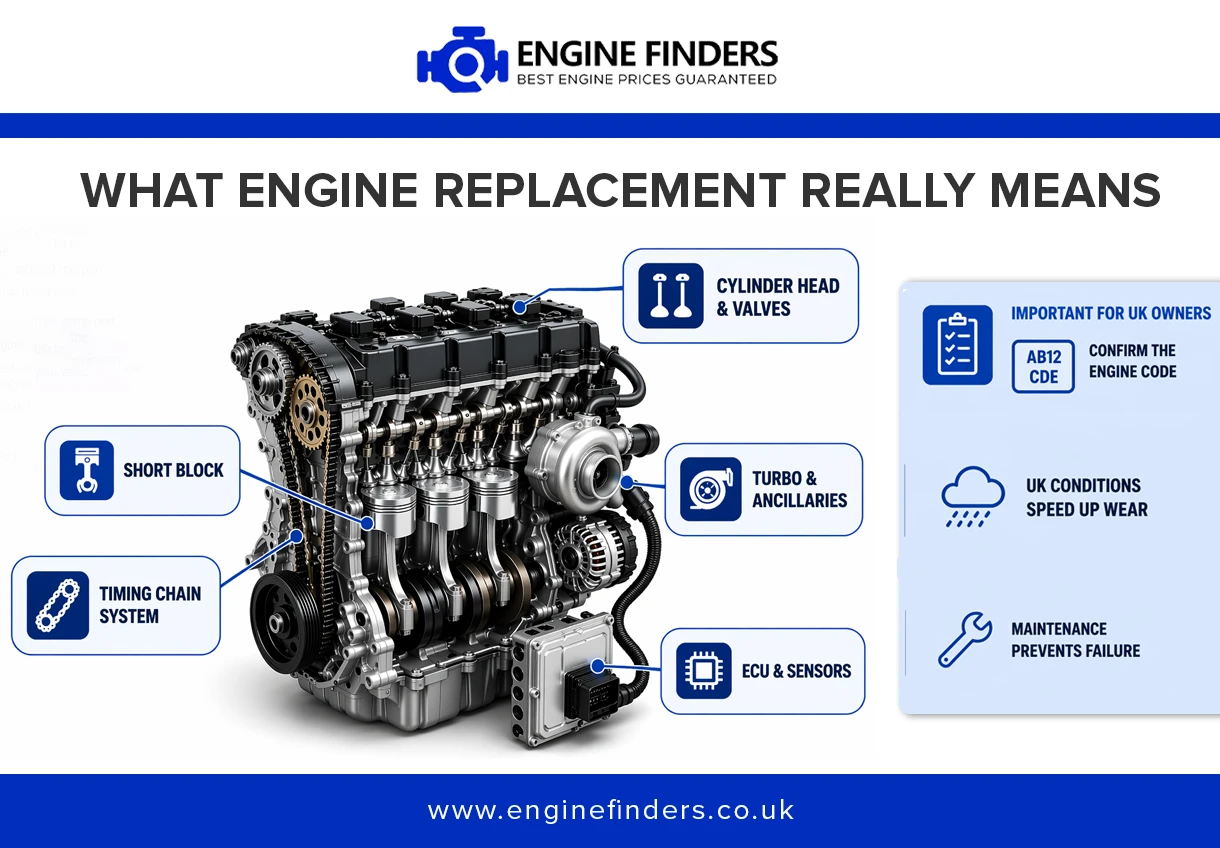
Short block, long block or complete swap — understand the scope before any garage touches your car.
Pistons, crankshaft, bearings — rotating assembly replacement.
Short block + cylinder head, valves, camshafts.
Full unit including alternator, starter, ECU ancillaries.
| UK Driving Scenario | Likely Cause | Recommended Action |
|---|---|---|
| Cold start rattle lasting 2-3 seconds | Timing chain tensioner wear or low oil pressure at startup | Check oil level/quality immediately |
| Power loss on motorway overtaking | Turbo failure, clogged DPF, or fuel delivery issue | Avoid hard acceleration. Get diagnostics within 7 days |
| Limp mode in stop-start traffic | Overheating, sensor fault, or ECU protection | Stop driving if temp gauge rises. Tow to specialist |
| Blue/grey smoke from exhaust | Oil burning via worn rings, valve seals, or turbo seal | Monitor oil consumption. If over 1L per 1,000 miles, plan for major work |
| Metallic knocking under load | Bearing wear, piston slap, or rod failure | DO NOT DRIVE — arrange recovery and inspection |
| Coolant mixing with oil (milky sludge) | Head gasket failure or cracked block/head | Stop driving. Pressure test required. Risk of hydro-lock |
A technician will typically find that early diagnosis can limit damage to a repairable component. Waiting until the engine stops altogether often multiplies the bill.
Most major failures stem from three root causes
Wrong oil spec, extended intervals, or ignoring low oil warnings creates accelerated wear. UK winters can emulsify oil if engine never reaches temp.
"Lifetime" chains stretch; tensioners wear. Interference engines suffer catastrophic damage if timing fails. Labour varies wildly.
Short UK journeys prevent DPF regen. Unburned fuel dilutes oil, killing turbo bearings. Debris can score cylinders.
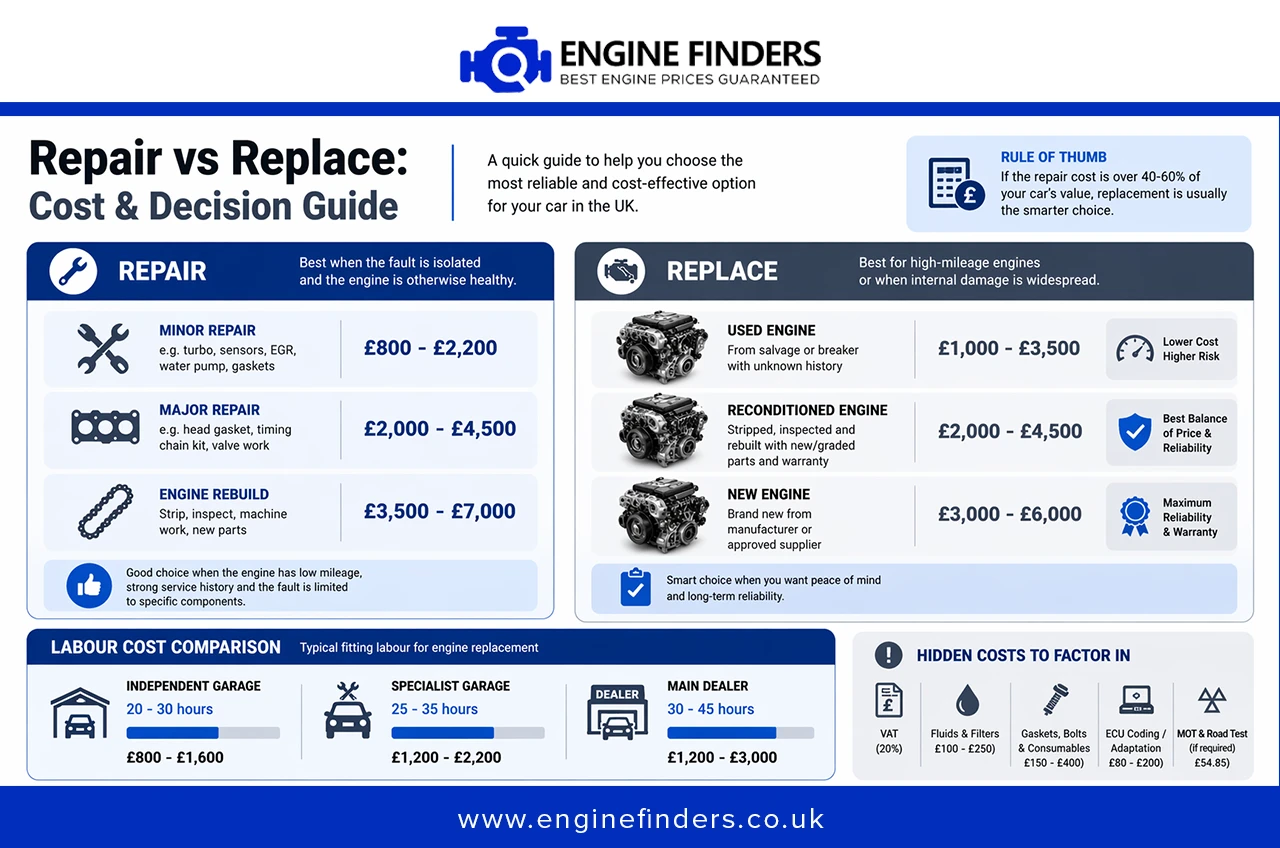
If repair costs approach 40-60% of vehicle value → reconditioned engine options are often the reliable move for long-term reliability.
All figures reflect UK market rates (VAT awareness)
Local independent garage: £260/hr → £3,100-£5,200
Franchised dealer: £361/hr → £4,300-£7,200
Specialist engine fitter: £290-£320/hr → £3,500-£6,400 (faster due to experience)
Prevention is always cheaper than replacement. These habits matter most for UK drivers:
1. "Can you confirm the exact engine code you are sourcing, and will you provide the donor vehicle details or rebuild certificate?" — Ensures compatibility and traceability.
2. "Does your quote include ECU adaptation and road test verification, or are those extra?" — Prevents post-fit running issues and hidden fees.
3. "If you find additional worn components once the engine is out (e.g., clutch, mounts), how will you communicate and price those before proceeding?" — Establishes transparency and avoids surprise upsells.
Do not ignore oil pressure warnings. Driving with the red oil light on for more than a few seconds can cause bearing seizure. Stop immediately and recover.
Do not clear fault codes and keep driving. Resetting a code without fixing the root cause often turns a repairable fault into a replacement-level failure.
Do not buy the cheapest used engine online without verification. Ensure you have a checklist of documents when buying a used engine to protect your investment. A £1,200 engine with no warranty that fails in 3 weeks costs more than a £2,200 unit with 12-month cover.
Do not assume all garages can code modern ECUs. Ask specifically about their diagnostic capability for your make before authorising work.
Do not delay once major symptoms appear. Continuing to drive a knocking or smoking engine can turn a £3k repair into a £7k replacement.
Delaying action after early warnings: Small rattle today can be seized engine tomorrow. Early diagnosis often limits damage to one component.
Accepting vague garage advice: "Your engine is knackered" is not a diagnosis. Request a written report with fault codes, compression figures, and photographic evidence.
Choosing the cheapest supplier without due diligence: The lowest quote often excludes delivery, core charge, ECU coding, or post-fit adjustments. Compare like-for-like scope.
Ignoring warranty terms: A 3-month warranty on a used engine may not cover labour if it fails. Understand what is covered and who pays for removal/refit. Review our checklist of documents when buying a used engine for full details.
Ignoring compatibility beyond engine code: Even with matching codes, wiring harness revisions, ECU software versions, or emissions equipment differences can cause fitment issues. A specialist supplier will check VIN-level compatibility.
Emissions and legal consequences: Removing or disabling emissions components to "fix" a problem is illegal under The Road Vehicles (Construction and Use) Regulations. It can invalidate insurance and result in fines. Always repair to original specification.
A professionally reconditioned engine with proper break-in can deliver 80k-120k+ miles. Used engines vary widely - request mileage evidence and service history. New OEM units carry the same expectancy as original.
A documented engine replacement with warranty can actually support value by proving the major fault is resolved. Keep all invoices and warranty paperwork for future buyers.
Yes. While a like-for-like replacement typically does not change your premium, failing to disclose modifications or major repairs can invalidate your policy. Provide the insurer with details of the work and warranty.
If you replace the engine with a different type or fuel (e.g., petrol to diesel), you must update the V5C. For like-for-like replacements, no DVLA notification is required, but keep documentation for resale.
Manufacturer warranty may cover engine defects if within term and mileage. Insurance rarely covers mechanical failure unless caused by a specific insured event (e.g., flood damage). Check your policy wording.
Request the donor vehicle's registration number and check its MOT history online. Look for consistent mileage progression and recent service records. Reputable suppliers provide this willingly.
Follow the supplier's guidance. Typically: avoid constant RPM for the first 500 miles, vary speed gently, check oil level frequently, and avoid heavy loads or towing. Change oil after the first 1,000 miles to remove initial wear particles.
Getting a clear picture of the numbers early often makes the difference between a manageable repair and an avoidable write-off. Comparing specialist options can help make that decision clearer.
If you are weighing quotes or need help verifying engine compatibility, our platform connects you with vetted UK suppliers who provide fixed-price, transparent quotes. No pressure. Just the information you need to decide with confidence.
No pressure. Just the information you need to decide with confidence.
For specialized needs, we offer dedicated solutions for Land Rover and Range Rover engines, ensuring compatibility with complex JLR systems.
To better understand market rates across different manufacturers, consult our average prices guide.
If your issue is isolated to forced induction, consider a turbocharger replacement instead of a full engine swap.
Learn why many owners prefer reconditioned engines for their balance of cost and reliability.
-->