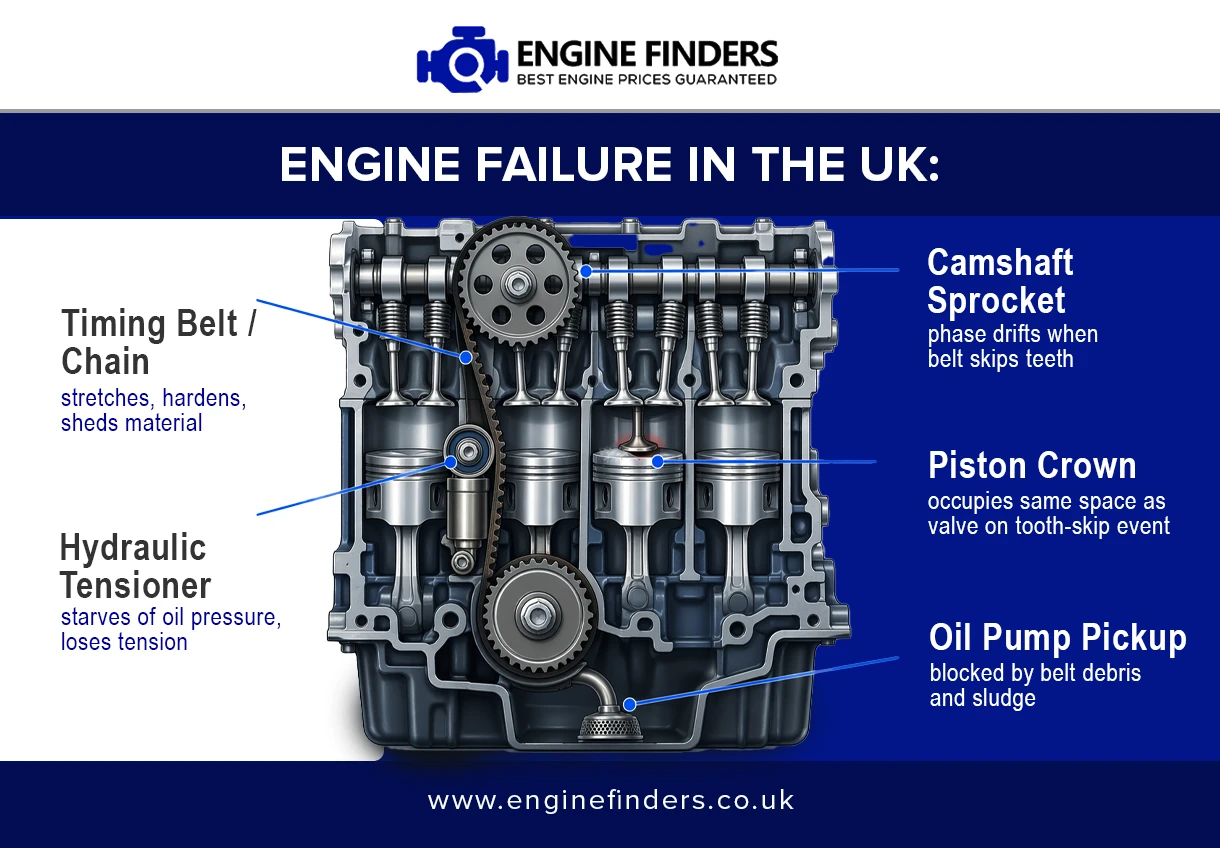
Timing drive degradation ⢠Interference engine damage ⢠Prevention costs vs repair bills
FAULT
Deferred timing drive maintenance leading to catastrophic interference engine damage. UK engine failure heatmap shows regional patterns.
URGENCY
High (if active warnings present) / Medium (preventative planning). Average car engine lifespan in the UK provides context.
LIKELY COST BAND (UK)
Ā£550āĀ£900 (scheduled belt service) | Ā£3,800āĀ£7,200 (post-failure). Warranty-backed reconditioned engine options offer savings.
BEST NEXT STEP
Stop driving if metallic knocking or oil pressure warnings appear. Verify your exact engine code and service history before approving work. Get verified quotes from certified suppliers.
Engine and powertrain failures consistently sit at the top of UK used car complaints. In 2025, they accounted for roughly 35% of all mechanical disputes. UK engine failure heatmap shows where these failures concentrate across the UK.
That figure does not represent a sudden drop in build quality. It highlights a predictable maintenance gap. The majority of these cases start as an overlooked service interval and finish as a seized crankshaft. Regional driving patterns and climate accelerate these issues, creating distinct failure heatmaps across the UK. Average car engine lifespan in the UK helps you understand where your vehicle sits on the reliability curve.
Most owners delay action because the car still starts. Dashboard warnings flicker intermittently. Strange noises disappear once the oil warms. The perceived cost of investigation feels too high for a problem that isn't immediately crippling. That delay compounds risk. Read our full case study on Discovery 4 TDV6 crankshaft failure illustrates how deferred maintenance leads to catastrophic outcomes.
What begins as a £600 scheduled belt change routinely escalates into a £5,000+ structural repair. Understanding Average engine lifespan expectations helps set realistic maintenance intervals. This guide cuts through workshop ambiguity, explaining exactly how these failures progress, why they cost what they do, and how to assess your options before financial pressure dictates the outcome.
The fault centres on timing drive degradation in interference engines
Unlike free-running designs, interference engines rely on precise camshaft-crankshaft synchronisation. When the belt stretches or loses tension, valve timing drifts and pistons contact valves. Understand how belt-in-oil designs differ from conventional timing systems.
Valvetrain, oil pump drive circuit, and VVT actuators all suffer. Debris migrates through galleries, blocking balance shafts and auxiliary pumps. JLR AJ300P petrol engine demonstrates how debris migration affects complex valvetrains.
P0016 ā Crankshaft/camshaft correlation bank 1 sensor A. P0335 ā Crankshaft position circuit malfunction. These appear early in the degradation cycle.
Waiting for complete failure guarantees maximum expense and minimum choice. The table below maps common UK driving scenarios to their mechanical triggers. Regional reliability heatmap shows where these patterns are most prevalent.
| UK Driving Scenario | Likely Cause | Recommended Action |
|---|---|---|
| Cold start rattle (lasting 2ā4 seconds). Common on belt-in-oil designs | Hydraulic tensioner drain-back, early belt wear, or oil pump pickup restriction | Book borescope and tensioner inspection. Monitor oil pressure. Do not delay beyond 2 services. |
| Motorway power loss above 60mph | Belt slip under sustained load, VVT limiter engagement, or turbo boost cut due to sync fault | Reduce load immediately. Scan for correlation codes. Avoid repeated high-RPM runs until timing integrity verified. |
| Intermittent limp mode in heavy traffic | ECU detects cam/crank phase drift and restricts revs to prevent valve strike. EGR cooler leaks on Mercedes W222 platforms can produce similar symptoms. | Stop driving if warning persists. Have compression and leak-down tests performed. Continuing risks bent valves. |
| Excessive blue/white smoke or coolant discolouration | Secondary damage from over-temperature stress, warped head, or failed cylinder sealing | Check oil for coolant emulsification. Verify head gasket integrity. Tow to inspection. |
| Persistent oil consumption without visible leaks. Discovery 4 TDV6 crankshaft failure shows how this progresses | Worn piston rings accelerated by belt debris migration or PCV contamination | Conduct cylinder compression baseline test. Inspect oil pan sump strainer for rubber particulate. |
Each scenario follows a predictable mechanical progression. Early intervention keeps the fault contained within the timing circuit. Ignored warnings allow metallic and rubber debris to migrate through the lubrication network. Verify engine code compatibility before any replacement to ensure the new unit matches your vehicle's exact specification.
Timing failures rarely occur without a contributing chain of events
Early service adherence interrupts this chain before point two. Workshop data consistently shows that maintaining fluid specifications and halving intervals on severe-cycle usage prevents roughly 90% of catastrophic timing failures. Average engine lifespan expectations confirm the value of proactive maintenance.
Choosing between strip-and-rebuild or full engine replacement depends entirely on damage containment.
š° Financial rule of thumb:
If repair costs approach 40ā60% of the vehicle's current realistic trade value, replacement or warranty-backed reconditioned engine options are often worth comparing on purely financial grounds. Read our full case study on Discovery 4 TDV6 crankshaft failure illustrates this calculation in practice.
ā±ļø Downtime reality:
Pricing varies significantly based on engine architecture, regional labour rates, and parts sourcing. Figures reflect 2025 independent and specialist workshop pricing. Get verified quotes from certified suppliers for accurate local pricing.
Belt-in-oil architecture nuance: A routine timing swap requires full disassembly, oil gallery pressure testing, and mandatory sump strainer replacement. Labour routinely doubles because the engine must be chemically cleaned and vacuum-flushed before any new components touch the circuit. Understand how belt-in-oil designs differ from conventional systems. Check exact labour and parts breakdowns for your vehicle before authorising work.
Prevention on modern interference engines hinges on fluid discipline and interval realism. Manufacturer schedules assume ideal driving conditions. Most UK ownership cycles do not meet that baseline. Average engine lifespan expectations provide realistic maintenance benchmarks.
"Will you pressure-flush the oil galleries before fitting the new timing kit, and what debris capture protocol do you follow during strip-down?" ā Confirms they understand wet-belt contamination risks. Verify engine code compatibility to ensure the garage has the correct procedures for your specific unit.
"Does your quote include a baseline compression and leak-down test, and will you provide the written results before any disassembly begins?" ā Ensures documented cylinder health metrics.
"Are you fitting OEM tensioner bearings with the latest manufacturer revision codes, and can I verify the part numbers before installation?" ā Prevents outdated or superseded pulley stock.
Clear technical questions filter out workshops that rely on pattern-matching rather than verified procedure. A competent technician will answer directly and provide reference numbers. Get verified quotes from certified suppliers who welcome these questions.
Do not ignore oil pressure warnings. Even intermittent illumination indicates restricted flow. Timing tensioners rely on stable pressure to maintain phase.
Do not clear fault codes and continue driving. The ECU stores correlation data for a reason. Resetting masks the drift without resolving the mechanical slack.
Do not buy the cheapest used engine online without verifying engine code match, warranty exclusions, and supplier testing documentation. Verify your exact engine code before any purchase. Explore warranty-backed reconditioned engine options offer documented quality assurance.
Do not assume a "low mileage" used engine is automatically reliable. Storage conditions, internal corrosion, and missing service history outweigh odometer readings. Read our full case study on Discovery 4 TDV6 crankshaft failure shows why mileage alone is not a reliable indicator.
Do not skip ancillary replacement when the oil pan is removed. Reinstalling worn components routinely triggers return visits and voided warranty claims.
Delaying action until failure occurs: Symptom management works for comfort issues. Timing degradation does not offer that luxury. The cost delta between scheduled service and post-impact rebuild typically exceeds 600%.
Accepting vague garage advice without documentation: Phrases like "it might be the sensor" introduce uncertainty. Request scan logs, live data prints, and compression figures.
Choosing the cheapest supplier based solely on headline pricing: A unit priced £800 below market typically reflects omitted machining steps, reused gaskets, or missing warranty validation. Check exact labour and parts breakdowns for your vehicle before comparing quotes.
Ignoring warranty transfer terms: Many engine warranties require installation by an accredited technician and specific torque sequences. Self-fit or unverified workshop installation routinely invalidates coverage. Explore warranty-backed reconditioned engine options provide clear installation requirements.
Overlooking compatibility beyond displacement: Turbo variants, DPF/EGR configurations, and ECU software versions differ. Match the full engine code, not just the model name. Learn how to verify your engine code for accurate matching. Jaguar F-Pace engines illustrate how variant differences affect compatibility.
Emissions compliance reality:
A compromised timing circuit disrupts exhaust gas routing, alters turbo spool timing, and may cause the ECU to derate power or block active regenerations. This triggers cascading emission faults long before visible smoke appears. Early mechanical verification prevents MOT surprises and protects downstream components. UK engine failure heatmap identifies high-risk areas. Get verified quotes from certified suppliers for pre-MOT diagnosis.
The Consumer Rights Act 2015 requires goods to be of satisfactory quality and fit for purpose at the time of sale. A catastrophic timing failure on a vehicle with incomplete service history often qualifies as a pre-existing fault. Retain all diagnostic reports, service records, and written correspondence. Average engine lifespan expectations provide context for what constitutes reasonable durability.
Yes. Engine replacement is a material change affecting vehicle valuation, performance categorisation, and risk assessment. Provide your insurer with the replacement invoice, engine code verification, and warranty documentation. Failure to update the policy may invalidate claims.
Not if the unit matches original specifications and is installed correctly. Ensure the workshop completes post-installation ECU adaptation, emissions system reset, and DPF regeneration cycles. A properly fitted warranty-backed reconditioned engine will pass emission checks identically to a factory-fresh block. EGR cooler leaks on Mercedes W222 platforms show the importance of addressing emissions systems during replacement.
Realistic timelines sit between 2 and 4 working days. Day 1: diagnostics, fluid drain, subframe removal, block extraction. Day 2: cleaning, mount inspection, sensor transfer, ECU pairing, fitment. Day 3: fluid fill, live testing, road calibration. Supply delays or unexpected ancillary damage can extend this window. Get verified quotes from certified suppliers to check current lead times.
Not inherently. Used engines have unknown storage history, potential internal corrosion, and unverified internal wear. Explore warranty-backed reconditioned engine options are pressure tested, bore honed, ring gap checked, and often dynamometer run-in. If the used engine comes from a documented crash vehicle with verifiable running hours and full service history, it can be viable. Regional reliability heatmap shows which areas have higher concentrations of quality used units.
You do not need to update the V5C for a like-for-like engine replacement. DVLA records track chassis number, not internal components. However, if the replacement changes the registered engine capacity or emissions class, you must inform the DVLA and update your tax class. Retain all workshop invoices to prove the change was a direct replacement. Verify your exact engine code to confirm it matches your V5C specification.
Engine failure diagnostics feel overwhelming because the numbers shift based on access complexity, parts grading, and hidden ancillary wear. Getting a clear picture of the baseline cost early often makes the difference between a manageable repair and an avoidable write-off. UK engine failure heatmap and average car engine lifespan in the UK provide the context you need.
A verified compression baseline, documented oil analysis, and transparent warranty terms are your foundation. Comparing specialist supply and installation quotes side-by-side removes guesswork, highlights where value actually sits, and gives you leverage to make a confident, financially sound decision. Explore warranty-backed reconditioned engine options. Get verified quotes from certified suppliers. Verify your exact engine code before committing. Explore Discovery 4 TDV6 crankshaft failure case study and EGR cooler leaks on Mercedes W222 platforms for real-world examples.
EngineFinders.co.uk helps you compare quotes from multiple vetted UK suppliers, source reconditioned or rebuilt engines, and understand your options before committing. No pressure. Just clarity.