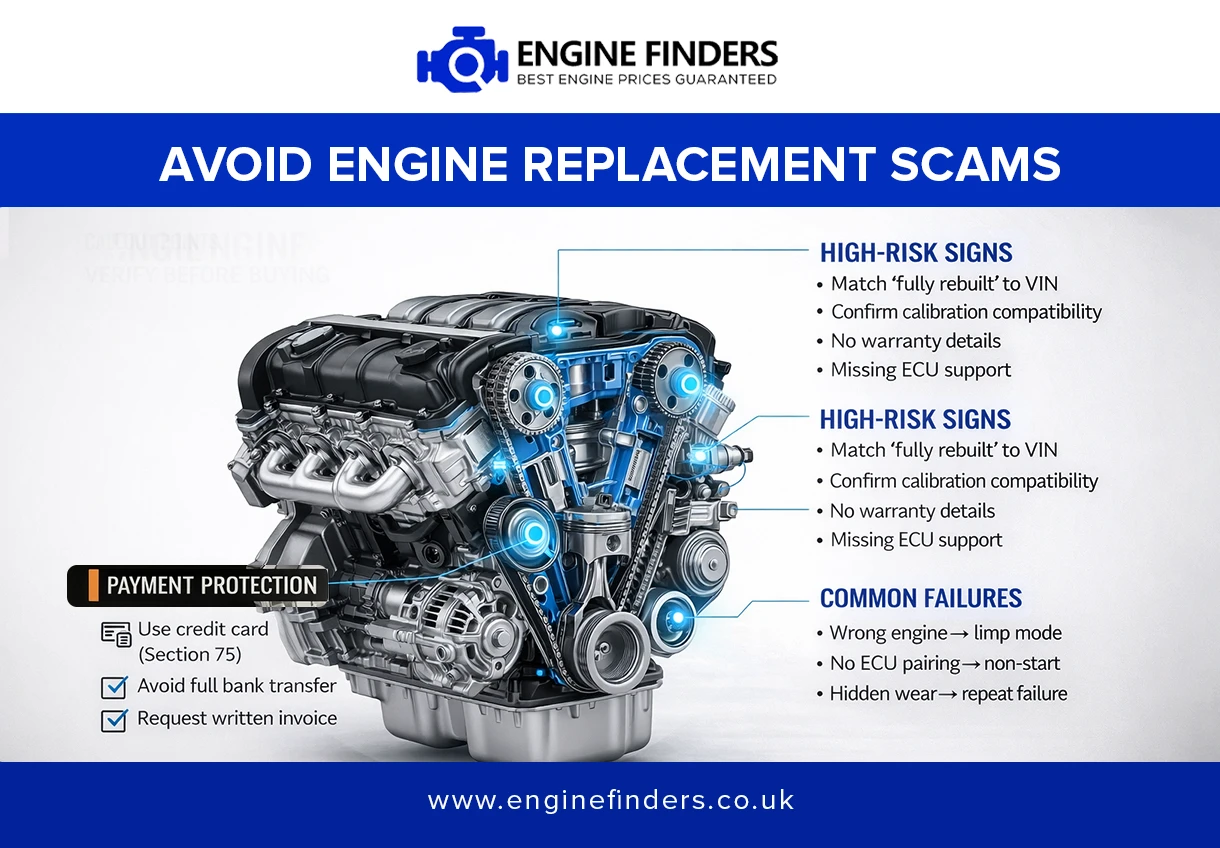
Verify compatibility • Demand documentation • Protect your warranty and your budget
FAULT
High risk of overpaying for misrepresented, incompatible, or poorly reconditioned replacement engines. Learn about compatible car engine types before sourcing.
URGENCY
High (verify documentation and compatibility before any financial commitment). Read our full cost breakdown by brand.
LIKELY COST BAND (UK)
£1,200–£4,500+
supply, fitting, calibration, and mandatory ancillaries. London engine replacement pricing details show regional variation.
BEST NEXT STEP
Cross-check engine calibration code against VIN, demand itemised written quote, confirm Section 75 protection. Request free quotes from verified suppliers.
Paying for an engine replacement without verifying compatibility, mileage history, or supplier accountability is one of the most financially damaging mistakes UK drivers make. A verbal estimate or a "collection only" listing strips away your legal protection the moment a forklift unloads a pallet. When a mis-matched or poorly reconditioned unit fails within weeks, the garage charges for a second diagnostic, a second teardown, and a second calibration session. You end up funding the exact same problem twice. Learn about compatible car engine types to verify compatibility before purchasing.
Many owners delay action because engine quotes feel opaque. Suppliers talk in broad terms like "fully rebuilt" or "plug-and-play", while garages give lump-sum figures that hide ancillary costs and software adaptation fees. Without clear paperwork, there is no baseline to challenge unexpected invoices. Read our full cost breakdown by brand to benchmark realistic pricing for your vehicle.
This guide cuts through the supply-chain noise. It helps you identify unreliable suppliers, avoid hidden labour traps, and secure a replacement that matches your vehicle's exact technical specification. Understanding compatible engine types is the first step—then follow the verification steps below to protect your investment. Ford engine specialists and Honda engine replacement UK resources provide brand-specific guidance.
An engine replacement fault isn't usually a sudden mechanical seizure. It's a mismatch between hardware and calibration.
Cylinder taper, bearing clearances, and oil pump pressure dictate longevity. Unverified units often hide internal wear. Common timing chain failure points show where unverified engines typically fail first.
DPF regeneration, EGR flow rates, and turbo boost targets are locked to ECU software versions. Mismatches cause limp mode.
ECU, injectors, and transponder must be paired. Swapping without re-adaptation leaves the vehicle in restricted mode.
The following scenarios often precede or follow an engine replacement decision. Recognising them helps you assess urgency and avoid compounding damage. Common timing chain failure points show where these symptoms typically originate.
| UK Driving Scenario | Likely Cause | Recommended Action |
|---|---|---|
| Cold-start metallic rattle lasting 2–4 seconds | Timing chain/tensioner wear exacerbated by cold, viscous oil or oil pressure delay | Check oil level and specification immediately. Book a timing inspection. Avoid high RPM until verified. |
| Intermittent power loss on A-roads with dashboard warning | Low compression, DPF soot saturation, or turbo actuator sticking | Record freeze-frame fault codes before clearing. Perform a leak-down and boost pressure test. |
| Persistent blue/grey smoke under steady acceleration | Worn valve stem seals, piston ring fatigue, or turbo centre seal failure | Avoid prolonged motorway speeds. Measure crankcase breather flow and oil consumption. Prepare for cylinder head or turbo assessment. |
| Loud rhythmic knocking at idle that worsens with heat | Spun main/rod bearings, degraded oil film, or oil pump starvation | Do not restart. Drain oil through a filter or magnetic trap to check for copper/steel debris. Arrange a low-mileage tow. |
A technician will typically find that buyers focus on displacement and physical bolt patterns, while ignoring calibration levels, injector coding, and ECU adaptation logs. This oversight is the primary driver of costly comebacks. Full fitting and calibration breakdown explains what should be included in a proper installation.
The root causes of engine replacement disputes rarely stem from a single catastrophic failure.
Certain engines rely on plastic timing guides, tensioners with limited fatigue life, or water pump housings prone to micro-cracking. When these components age, they shed particulates into the sump and oil galleries. A technician will typically find metal debris coating the oil pickup strainer. Common timing chain failure points identify the most vulnerable engine families.
Short, cold-start commutes and stop-start school runs prevent oil from reaching optimal operating temperature. Moisture and fuel vapour condense in the crankcase, emulsifying into the oil and accelerating additive breakdown. Engines that sit on breaker yards for months develop light bore corrosion.
Breakers grade engines by external cleanliness and mounting point condition. A "Grade A" unit says nothing about cylinder taper, camshaft lobe wear, or chain stretch percentage. Rebuilders who cut costs may reuse marginal oil pumps or omit pressure testing on cooling jackets. Reconditioned engine specifications with documented testing avoid these risks.
Modern engines are heavily integrated with chassis electronics, emission controls, and transmission management systems. A physically identical block can still cause limp mode, excessive smoke, or premature failure if it doesn't share the exact calibration level as the original. Learn about compatible car engine types to prevent calibration errors.
Many manufacturers pair the ECU to injectors, the crankshaft sensor, and the transponder. Swapping units without re-adaptation leaves the vehicle in restricted mode. Marrying a mismatched ECU typically adds £150–£400 in hidden diagnostic and software labour. Full fitting and calibration breakdown explains these essential post-installation steps.
Without a written, itemised breakdown of what was replaced during a rebuild, there is no technical baseline. This gap becomes critical when warranties are enforced, as suppliers point to missing documentation to deny labour or consequential damage claims. Warranty terms and claim guidance explain what documentation you need to protect your rights.
Knowing when to rebuild an existing block and when to fit a replacement unit depends on failure severity, component access, and financial logic.
💰 A common rule of thumb:
If repair costs approach 40–60% of the vehicle's current realistic trade value, reconditioned engine specifications are often worth comparing on purely financial grounds. Read our full cost breakdown by brand to apply this rule accurately.
⏱️ Unique UK market nuance:
On many modern turbo diesel and petrol variants sold in the UK, fitting an engine without matching the exact calibration level triggers DPF regeneration lockouts or boost control faults. UK suppliers sometimes list units by generic displacement alone, omitting the manufacturer's calibration code or injector compensation data. Full fitting and calibration breakdown covers what a proper installation should include.
Engine replacement pricing varies by source, garage type, and regional overheads. Figures reflect realistic ranges as of current market conditions. London engine replacement pricing details show how location affects your final bill.
Warranty comparison: Rebuilds from accredited specialists often come with 12-month/12,000-mile warranty covering parts and labour. Used engines from breakers might only offer 30–90 days, parts-only. Warranty terms and claim guidance explain what to look for. Explore the cheapest way to replace an engine in the UK without compromising quality. Request free quotes from verified suppliers to compare warranty coverage.
Extending the life of a replacement engine relies on disciplined maintenance and early intervention. These habits, drawn from workshop experience, make a measurable difference. Warranty terms and claim guidance explain how maintenance affects your coverage.
"Will you provide a written, itemised quote separating the engine supply cost from fitting labour, calibration fees, and mandatory ancillaries?"
"Does the reconditioned unit include a full technical breakdown of replaced internal components (bearings, piston rings, timing chains/tensioners, gaskets, and oil pump), with supplier references?" – Reconditioned engine specifications with full documentation should provide this.
"Will you perform baseline compression and leak-down testing before installation, plus ECU adaptation and immobiliser pairing afterwards, with printouts for the file?" – Full fitting and calibration breakdown covers what a proper installation should include.
A garage that answers these questions clearly demonstrates procedural discipline. Vague or defensive replies should be treated as a procurement warning. Request free quotes from verified suppliers who welcome these questions.
Do not accept verbal estimates. Verbal quotes shift all risk onto the vehicle owner. Demand a signed, itemised document.
Do not buy a "collection only" engine from an unverified source. Collection-only listings typically operate outside UK consumer protection frameworks. Reconditioned engine specifications from verified suppliers offer proper protection.
Do not clear fault codes before a technician records freeze-frame data. Erasing codes forces guesswork and increases diagnostic hours.
Do not assume any physically identical engine is plug-and-play. Calibration codes must align with your chassis number. Learn about compatible car engine types to verify.
Do not delay when oil pressure drops or metallic knocking appears. Tow the vehicle immediately. Common timing chain failure points show the consequences of delay.
Delaying until secondary damage occurs: Ignoring early symptoms allows failure to propagate to turbo, clutch, or transmission mounts.
Accepting vague garage advice: "It needs a new motor" without a diagnostic report leaves owners unable to verify necessity.
Choosing the absolute cheapest supplier: Lowest price typically means unknown mileage, missing ancillaries, and zero calibration documentation. Reconditioned engine specifications from verified suppliers prevent this.
Ignoring warranty terms: Many warranties cover the block only, excluding labour, fluids, and consequential damage. Warranty terms and claim guidance explain what to verify.
Overlooking compatibility beyond displacement: Calibration levels, ECU software versions, and emission equipment dictate functionality. Learn about compatible car engine types before purchasing.
Documentation matters:
Replacing an engine does not automatically reset MOT history. If the replacement changes the registered cubic capacity, the V5C must be updated with DVLA. Always retain invoices, calibration reports, and component breakdowns for future resale or technical disputes. Warranty terms and claim guidance explain the documentation you need. Request free quotes from verified suppliers who provide complete paperwork.
Physically, yes. However, mismatched calibration codes often trigger ECU communication faults, limp mode, or DPF regeneration failures. The unit must be adapted to your vehicle's software version, and emission equipment must match your original specification to remain road-legal. Learn about compatible car engine types to verify calibration compatibility.
DVLA notification is only required if the engine displacement changes from the registered figure. Insurers must be informed of major repairs or modifications. Standard like-for-like replacements typically do not affect premiums, but disclosure remains a policy requirement. Warranty terms and claim guidance cover insurance notification requirements.
Typically, yes. Reconditioned units undergo pressure testing, component replacement (bearings, rings, chains, gaskets), and dynamic balancing. Used salvage units carry unknown internal wear, and "low mileage" claims from breakers are rarely independently verified. Reconditioned engine specifications from verified suppliers provide documented quality assurance. Warranty terms and claim guidance explain the difference in coverage.
Direct swaps with matched calibration and healthy ancillaries usually take 1–2 working days. If ECU adaptation, software updates, or corroded fastener repair is required, allow 3–5 working days for completion and road testing. Full fitting and calibration breakdown explains the timeline.
Yes. Under UK Consumer Credit Act Section 75, paying any portion of the transaction (including a deposit) on a credit card for goods or services over £100 grants you joint liability protection. This applies even if the balance is paid by debit or bank transfer. Request free quotes from verified suppliers who accept protected payment methods.
It will, provided the unit matches your original emission standard, uses factory-spec DPF/EGR components, and the ECU is correctly adapted. Incorrect mapping or removed emission hardware will trigger an immediate failure. Warranty terms and claim guidance cover emissions compliance requirements.
A complete file should include an itemised invoice, warranty certificate, baseline compression and leak-down printouts, ECU adaptation logs, and oil/fluid specifications. Retain these records for warranty enforcement and future resale verification. Request free quotes from verified suppliers who provide complete documentation packages.
Getting a clear picture of the numbers early often makes the difference between a manageable repair and an avoidable write-off. Comparing specialist options can help make that decision clearer. Read our full cost breakdown by brand and London engine replacement pricing details for regional context.
Verify your engine code, request free quotes from verified suppliers with full ancillary breakdowns, and confirm supplier accountability before authorising work. A disciplined approach protects your vehicle, your warranty, and your budget. Learn about compatible car engine types to start. Browse reconditioned engine specifications with warranty. Read our full fitting and calibration breakdown. Review common timing chain failure points. Check warranty terms and claim guidance. Explore the cheapest way to replace an engine in the UK without compromising quality. Request free quotes from verified suppliers today.
No obligation. Just clear, comparable options to help you choose with confidence.