Knocking • Oil pressure • Smoke • Legal risks • £1,200 vs £4,500 decisions
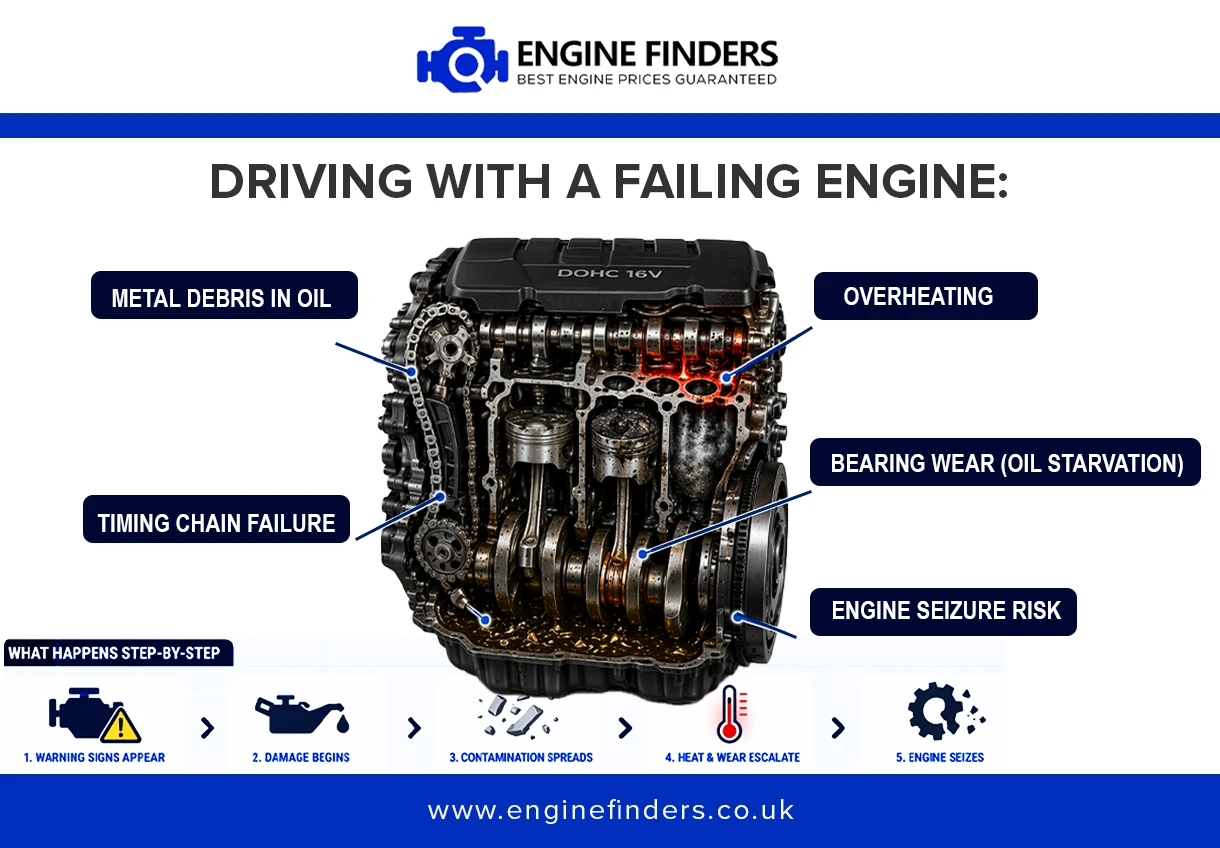
FAULT
Driving with confirmed or suspected internal engine failure (knocking, low oil pressure, severe overheating)
URGENCY
High/Critical. Immediate cessation of driving is recommended to prevent total loss
LIKELY COST BAND (UK)
£1,500 (minor repair) – £4,500+ (full replacement)
BEST NEXT STEP
Stop driving immediately. Arrange recovery to a specialist garage for a compression/leak-down test. Do not attempt to "drive it home"
When an engine begins to fail, it rarely does so silently. There are usually precursors: a change in sound, a drop in performance, or a warning light on the dashboard. The temptation to ignore these signs is understandable. A trip to the garage means inconvenience, diagnostic fees, and the potential for a large bill. Some drivers convince themselves that if the car is still moving, it must be safe.
This is a dangerous misconception. Internal combustion engines operate under extreme pressures and temperatures. Components are machined to tolerances measured in microns. When a critical component fails—such as a timing chain tensioner, an oil pump gear, or a piston ring—the resulting debris circulates through the lubrication system.
The difference between a £1,200 repair and a £4,500 engine replacement is often just a few miles of driving. Many owners delay action due to cost anxiety or the hope that the issue is a minor sensor glitch. This guide cuts through that uncertainty. It explains exactly what happens mechanically when you ignore these signs, the legal risks of driving a dangerous vehicle in the UK, and how to make a financially sound decision between repair and replacement.
"Failing engine" is a broad term—in a workshop context, it typically refers to a loss of mechanical integrity within the bottom end or the top end
Crankshaft, connecting rods, pistons. Failure here often means metal-on-metal contact and is usually terminal without full replacement.
Valves, camshafts, timing components. Failure often involves timing chain stretch, tensioner wear, or valve damage.
Alternator, starter, DPF—these leave you stranded but do not necessarily destroy the engine block itself.
Not all engine noises are created equal. A slight tick on a cold start might be normal; a deep knock under load is a death sentence. Use this table to assess severity.
| UK Driving Scenario | Likely Cause | Recommended Action |
|---|---|---|
| Rattling noise on cold start (lasts 2-3 seconds) | Timing chain tensioner bleed-down or VVT phaser wear. Common on higher mileage petrol engines. | Medium Urgency. Book diagnostic soon. Monitor oil levels weekly. Avoid hard acceleration until checked. |
| Deep knocking/tapping that increases with RPM | Big-end bearing failure or piston slap. Metal-on-metal contact inside the block. | CRITICAL. Stop driving immediately. Recovery required. Continued driving will seize the engine. |
| Blue/Grey smoke from exhaust on acceleration | Worn piston rings or valve stem seals. Oil entering combustion chamber. | High Urgency. Check oil level daily. Plan for engine overhaul or replacement. Risk of damaging catalytic converter. |
| White smoke (sweet smell) continuously | Blown head gasket. Coolant entering combustion chamber. See symptoms of a blown head gasket for more detail. | High Urgency. Do not drive. Overheating risk is extreme. Cylinder head warping is likely if driven. |
| Loss of power + "Limp Mode" on motorway | Turbocharger failure, severe boost leak, or timing issue. | High Urgency. Pull over safely. Do not attempt to reset by restarting. Recover to garage. |
| Oil pressure warning light flickers at idle | Low oil level, worn oil pump, or excessive bearing clearance. | CRITICAL. Stop engine immediately. Check oil level. If level is correct, do not restart. Recover. |
| Engine overheats in traffic/jams | Thermostat stuck closed, water pump failure, or blocked radiator. | High Urgency. Turn off engine. Allow to cool. Do not drive until cooling system is pressure tested. |
The "Italian Tune-Up" is a myth. If an engine is making noise due to mechanical wear, driving it harder increases load and heat, accelerating failure. For a failing timing chain or weak bearing, high-RPM driving is the fastest way to cause catastrophic destruction.
Most engine failures in the UK are not sudden acts of God—they are the result of cumulative stress and maintenance gaps
Oil is the lifeblood of the engine. In UK stop-start traffic, engines often run rich and at lower temperatures. If oil changes are extended or cheap oil is used, sludge forms, blocking oil galleries and starving critical components like camshaft VVT gears and turbocharger bearings. Modern multi-grade oils can break down under high heat—once viscosity drops, the protective film between moving parts thins, leading to metal-to-metal contact.
Timing chains are marketed as "lifetime" but they are not. Hydraulic tensioners rely on oil pressure—if pressure fluctuates or the seal fails, the chain becomes loose. Over time, the chain elongates, altering timing between crankshaft and camshafts. The engine management system tries to compensate, but eventually it throws codes or the chain skips a tooth, causing valves to hit pistons on interference engines. This is a known issue on BMW engines, Ford engines, and VAG TSI units.
For diesel owners, particularly those with DPF systems, short journeys are detrimental. The DPF requires high exhaust temperatures to regenerate. If this doesn't happen, soot accumulates. During failed regeneration attempts, extra fuel is injected—some washes past piston rings into the sump, diluting the oil. Thinned oil provides poor lubrication, accelerating wear on bearings and camshafts. This is a common, silent killer of modern diesel engines in urban environments.
The UK's damp, variable climate puts unique stress on cooling systems. Frequent short trips mean the engine never fully reaches optimal operating temperature, then cools down completely. This constant expansion and contraction weakens head gasket materials over time. Older vehicles may suffer from corrosion in the radiator or heater matrix, leading to coolant leaks and subsequent overheating. Symptoms of a blown head gasket include white smoke, coolant loss, and mayonnaise-like oil.
On many transverse-mounted V6 and complex 4-cylinder engines (Ford engines, VAG TSI units), accessing the rear timing chain or oil pump requires removing the engine or dropping the subframe. Labour for a "simple" timing chain job can skyrocket because the technician spends 8–10 hours just getting to the part. Even if the chain kit is only £300, the labour bill may exceed £1,500. A reconditioned engine swap might offer better value because you replace all worn internals for a similar labour investment.
The combination of short cold-start journeys, damp weather, and stop-start traffic accelerates wear on timing components and oil systems. A technician will typically find that engines used predominantly for short trips show earlier failure patterns than those used for sustained motorway runs, even with similar mileage.
When faced with a failing engine, the immediate question is: Can it be fixed, or does it need replacing?
💰 The 40–60% Trade Value Rule:
A common rule of thumb is that if repair costs approach 40–60% of the vehicle's current realistic trade value, compare engine replacement quotes and explore reconditioned engine or used vs reconditioned engines options on purely financial grounds.
⏱️ Unique Nuance: The Access Factor:
On many transverse-mounted engines, accessing the rear timing chain or oil pump requires removing the engine or dropping the subframe. Labour for a "simple" timing chain job can skyrocket because the technician spends 8–10 hours just getting to the part. A reconditioned engine swap might offer better value because you replace all worn internals for a similar labour investment.
Costs vary significantly by location (London/South East vs. North/Scotland), garage type, and engine complexity. All estimates include VAT where applicable.
Shipping a reconditioned engine nationwide is relatively affordable (£50–£100). Sourcing a supplier outside your immediate area can sometimes yield better overall value. Find a vetted engine supplier to ensure quality and warranty protection.
Preventing engine failure is far cheaper than curing it. These practical steps are essential for UK owners.
"Will you perform a compression test or leak-down test before quoting for major repairs?" – Confirms internal health. A garage that skips this is guessing.
"Does the reconditioned engine come with a new oil pump and timing components, or are these reused?" – Reusing old pumps/tensioners is false economy.
"What are the reconditioned engine warranty terms on parts AND labour?" – Ensure coverage for both in case of failure.
These questions separate thorough specialists from those relying on guesswork.
Do NOT ignore oil pressure warnings. If the red oil can light comes on, stop immediately. Driving for even 30 seconds can score bearings irreparably.
Do NOT clear fault codes and keep driving. Resetting the check engine light does not fix the mechanical issue. The underlying problem will worsen.
Do NOT buy the cheapest used engine online. A £300 engine from a breaker is a gamble—hidden damage, high mileage, or incompatible wiring looms. used vs reconditioned engines comparison shows the value of professional rebuilds.
Do NOT use stop-leak products for major leaks. These can clog oil galleries and heater matrices, causing more expensive damage downstream.
Delaying Action: Hoping the noise will go away—it won't. Early intervention saves money.
Accepting Vague Advice: "It needs a new engine" is not a diagnosis. Ask why—compression? Noise? Smoke? Get evidence.
Ignoring Compatibility: Engines look similar but have different sensor placements, flywheel patterns, or ECU requirements. Always provide VIN and engine code.
Overlooking reconditioned engine warranty terms: Some warranties are void if you don't change oil within first 1,000 miles or use wrong oil grade.
Legal note:
Driving a vehicle in a "dangerous condition" is a legal offence. If your engine seizes on a motorway, you risk endangering lives. If stopped by police, you could face a £2,500 fine, 3 penalty points, and a prohibition order. Recovery is the safer, legal choice.
Technically, you can drive to a pre-booked MOT or repair appointment if the vehicle is safe to operate. However, if the engine is knocking, it is considered a "dangerous condition." If stopped by police, you could face a £2,500 fine, 3 penalty points, and a prohibition order. Recovery is the safer, legal choice.
Generally, no. Breakdown cover (AA, RAC, etc.) covers recovery and roadside assistance, not mechanical repairs. Furthermore, if you ignored warning lights or maintenance schedules, your cover may be voided for negligence. Check your policy wording.
Yes, if the engine capacity (cc) or fuel type changes. If you replace like-for-like (same cc, same fuel), you do not need to inform the DVLA, but you should keep receipts for the engine change for future resale proof.
It is advisable. While a like-for-like replacement isn't always a "modification," some insurers require notification of major repairs. Failure to disclose could theoretically affect a claim if the engine failure leads to an accident.
Yes, for peace of mind. A reconditioned engine has been stripped, cleaned, inspected, and had worn parts replaced (pistons, rings, bearings, gaskets). A used vs reconditioned engines comparison shows reconditioned units typically come with longer warranties (12+ months vs. 30–90 days).
Typically 2–4 days for an independent specialist. This allows time for removal, cleaning, fitting ancillaries, installation, and testing. Main dealers may take longer due to scheduling.
Getting a clear picture of the numbers early often makes the difference between a manageable repair and an avoidable write-off. Comparing specialist options can help make that decision clearer.
At EngineFinders.co.uk, we help you compare engine replacement quotes from multiple vetted UK suppliers for reconditioned engines, rebuilt, and used units. We provide the transparency you need to choose the right path for your vehicle and your budget.
No obligation. Just clear, comparable options to help you choose with confidence.