Trade value vs repair cost • Transparent quotes • No write-off regret
FAULT
Major engine failure, catastrophic wear, or imminent replacement required
URGENCY
Medium to High (oil pressure warnings = stop immediately)
LIKELY COST BAND (UK)
£1,500–£6,000+ (engine replacement)
vs £15,000+ for equivalent used car
BEST NEXT STEP
Get car's trade value (Parkers/CAP) + 3 engine quotes before deciding
Facing a major engine fault is one of the most stressful moments for any UK car owner. The garage has delivered the news: the engine needs replacement, or repair costs are climbing into four figures. Immediately, two questions dominate: "Can I afford to fix this?" and "Should I just buy something else?"
The real risk isn't just the immediate bill. It's making a rushed decision based on emotion, incomplete information, or a single quote. Owners commonly delay action because they fear being overcharged, don't understand the technical options, or worry about buying a used car with hidden problems. This delay can turn a repairable issue into a write-off.
This guide cuts through the confusion. We'll translate workshop findings into clear cost and risk assessments, apply a defensible UK financial rule of thumb, and give you the practical steps to decide confidently. The goal is simple: help you avoid overpaying, prevent buying the wrong engine, and stop a good car from being scrapped unnecessarily.
For most UK owners, a brand-new factory engine is rarely the realistic option
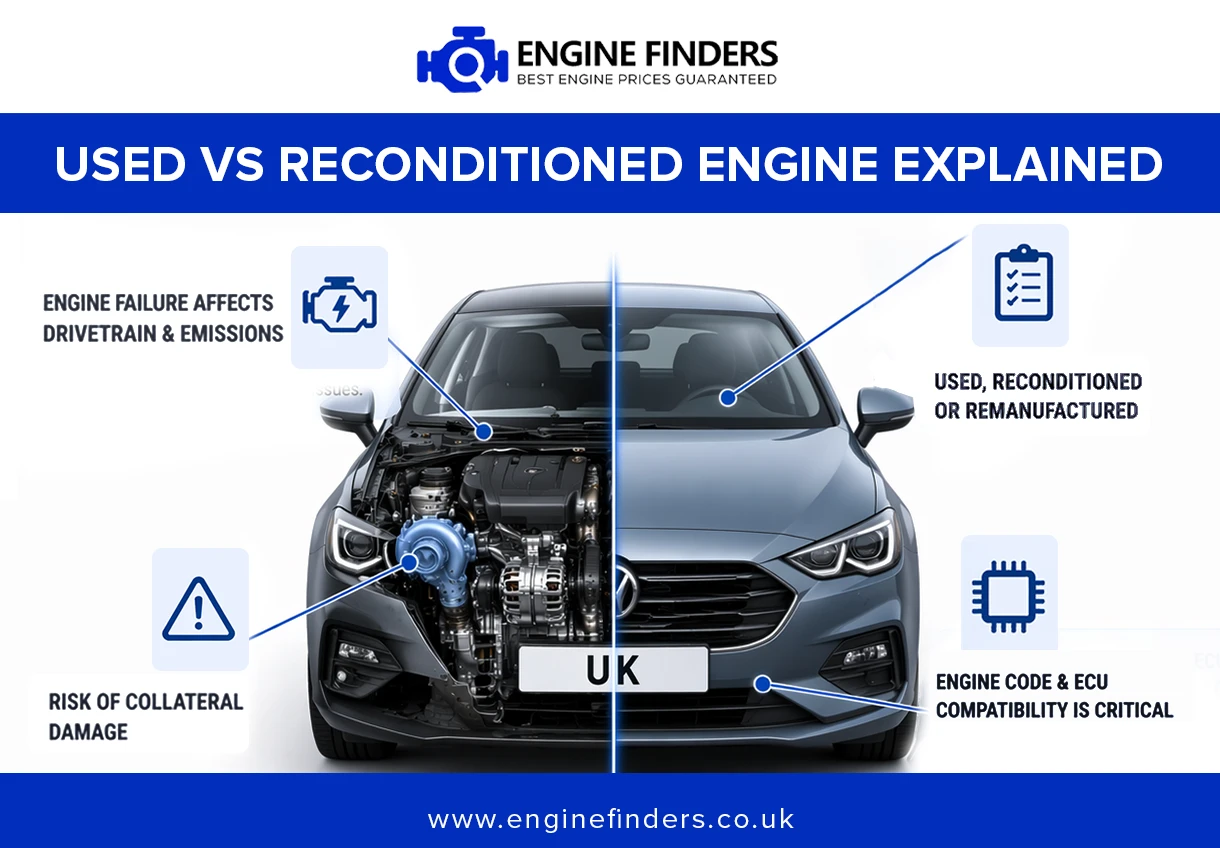
Sourced from a breaker, same mileage/age as your car. Lowest upfront cost, highest uncertainty.
Disassembled, worn parts replaced, tested. Balanced cost and reliability. Reconditioned engine options are often the smart middle ground.
New crankshaft, pistons, bearings fitted to your existing head or vice-versa.
Closest to new, often with warranty, but premium cost.
| UK Driving Scenario | Likely Cause | Recommended Action |
|---|---|---|
| Cold start rattle (first 2-3 seconds) | Timing chain tensioner bleed-down, common on some Ford engine replacement costs and BMW units. | Monitor. If rattle extends beyond 5 seconds or worsens, get a diagnostic scan. |
| Motorway power loss, turbo whistle | Turbocharger failure or intercooler pipe split. Common after hard UK A-road use. | Stop driving if smoke appears. Diagnostic needed to rule out ECU limp mode. |
| Limp mode in traffic, persistent DPF light | Soot-clogged DPF from short, cold-start school runs. May indicate underlying issues. | Attempt forced regeneration. If repeated, check engine compression. |
| Blue/grey smoke on overrun (decelerating) | Worn valve stem seals or piston rings. Typical on higher-mileage diesels (200k+ miles). | Compression test and leak-down test. If one cylinder is significantly low, replacement becomes more likely. |
| Knocking sound from bottom end, oil pressure warning | Bearing wear, crankshaft damage. Critical. | Stop driving immediately. Towing is cheaper than a seized engine. |
| Coolant mixing with oil (mayonnaise under cap) | Head gasket failure or cracked head/block. Common after overheating in traffic. | Pressure test cooling system. If combustion gases in coolant, engine removal usually required. |
Key insight: Emissions equipment failures (DPF, EGR, AdBlue) often occur before true mechanical engine failure on modern diesels. These can cost £1,000-£3,000 but don't necessarily mean the engine itself is finished.
Understanding root causes helps you assess whether a repair is a patch or a solution
On many modern petrol engines (Ford, BMW N47), chain tensioners can fail. Labour to access the chain (often at the rear) can exceed the cost of parts.
A stuck-open injector washes cylinder walls with diesel, diluting oil and causing rapid bearing wear. A "silent killer" – the engine may seem fine until it suddenly knocks.
UK short-trip, cold-start driving prevents DPFs from regenerating. Soot builds up, strains the turbo, and can contaminate oil.
Plastic thermostat housings and water pump impellers degrade. Overheating, even briefly, can warp cylinder heads.
Damp, salty conditions accelerate corrosion of electrical connectors. A faulty sensor can cause poor running misdiagnosed as mechanical failure.
On transverse-mounted UK models (Vauxhall 1.6 CDTI, Ford 1.5/1.6 Duratorq), labour to remove and refit the engine can be 30-50% higher. Always ask for a "remove-and-refit" estimate specific to your model.
This is where emotion meets arithmetic. The goal is a financially rational choice, not a perfect one.
💰 Common rule of thumb:
If repair costs approach 40–60% of the vehicle's current realistic trade value, compare engine quotes and explore reconditioned options on purely financial grounds.
All figures are estimates. VAT (20%) typically added. Regional variation significant.
Do not base the decision on retail value alone.
Check the car's actual trade value using Parkers or CAP HPI and compare it to the fitted engine quote. How to check your car's trade value guides help you get an accurate baseline.
Example: A car might retail for £6,000 but have a trade value of £3,500. If a fitted recon engine costs £3,000, you're investing nearly 85% of its trade value – a tough call.
London/South East labour rates can be 30-40% higher than the North or Wales. Average prices guide data shows significant regional variation.
If you proceed with a replacement, or want to maximise the life of your current engine, these habits matter. For 4x4 owners, Land Rover and Range Rover vehicles have specific maintenance requirements, especially the 200TDI diesel engine which benefits from regular timing checks.
“Can you provide a written breakdown of labour hours for the remove-and-refit, and which ancillary items you recommend replacing while the engine is out?” — This exposes vague quotes and upselling. UK engine replacement guide data shows labour estimates vary by as much as 40%.
“What diagnostic tests will you perform post-installation to verify the new engine is running correctly, and will you provide a printout?” — Ensures they check compression, fuel trims, and emissions readiness.
“What are the warranty terms for replacement engines, and does it require me to use you for future servicing?” — Some warranties are void if you don't use their garage for oil changes.
Do not ignore oil pressure warnings. The red oil can means stop immediately. Continuing for even a mile can turn a £2,000 bearing job into a £5,000 engine replacement.
Do not clear fault codes and keep driving. This masks symptoms. A P0300 (random misfire) could be a simple coil pack or low compression. Diagnosis is cheaper than guesswork.
Do not buy the cheapest used engine online without matching engine code and warranty. A £800 engine with no warranty is a £800 gamble.
Do not assume a "reconditioned" engine is the same everywhere. Ask what exactly was replaced: just bearings and gaskets, or also pistons, crankshaft grind, new oil pump?
Do not forget to update your V5C logbook with the DVLA if the engine number changes. It prevents future confusion on MOT or sale.
Delaying action: A small oil leak becomes a big one. A minor knock becomes a seized engine. Early diagnosis is almost always cheaper.
Accepting vague garage advice: "It needs a new engine" isn't a diagnosis. Ask for evidence: compression figures, leak-down percentages, borescope images.
Choosing the cheapest supplier: The lowest quote often excludes ancillaries, fluids, or ECU coding. Get itemised quotes.
Ignoring warranty terms for replacement engines: A 12-month warranty requiring specific oil is reasonable. A 3-month "parts only" warranty is not.
Ignoring compatibility: An engine from a similar model year might have different ECU, wiring loom, or emissions equipment. Always provide the supplier with your VIN.
Safety consequence: A seized engine at motorway speed means loss of power steering and brakes (engine-driven vacuum assist). This is a critical safety risk.
Yes. You must declare any modification, including an engine replacement. Most insurers won't increase premium for a like-for-like replacement, but failing to declare could invalidate your policy. Provide them with the invoice and engine details.
No. The mileage on the odometer reflects the chassis, not the engine. You should keep invoices for the engine replacement to show future buyers the work done.
If the engine number changes (it usually will), you should update the V5C. Section 7 allows you to report a new engine number. This prevents confusion during an MOT or sale.
Yes, if fitted correctly. A properly rebuilt engine should meet or exceed original emissions standards. Ensure the garage performs an emissions test post-installation.
With proper maintenance, a quality reconditioned engine should deliver 80,000-150,000 miles. Used engines are a gamble – warranty length is a good indicator of supplier confidence.
Typically no, unless the failure was caused by a specific insured event (e.g., flood damage, fire). Mechanical wear and tear is not covered by standard comprehensive policies.
A reputable garage will have public liability insurance. Get a written agreement that they are responsible for any damage caused during the work.
Getting a clear picture of the numbers early often makes the difference between a manageable repair and an avoidable write-off. The emotional weight of this decision is real, but the process doesn't have to be overwhelming.
Start with the arithmetic: find your car's realistic trade value using how to check your car's trade value guides, then obtain three detailed quotes for the work – one for repair, one for a used engine fit, one for a reconditioned diesel engines option. Compare them against the 40-60% rule of thumb.
Then, factor in the intangible: your attachment to the car, its history, your future plans. Sometimes, the financially rational choice aligns with peace of mind. Other times, it's a sign to move on.
Comparing specialist options through a platform that vets suppliers can help make that decision clearer, removing the guesswork from what to expect during an engine swap. The goal isn't just to fix a car, but to make a choice you won't regret in six months' time.
Whether you choose to repair, replace with a reconditioned unit, or move on to another car, getting transparent quotes is your first step toward a confident decision.
Our platform connects you with vetted UK suppliers who provide fixed-price, itemised quotes. No guesswork. No hidden fees.
No pressure. Just the information you need to decide with confidence.