What Happens When Your Engine Blows? (Step-by-Step)

Catastrophic failure • Repair vs replace • UK costs • Diagnostic clarity
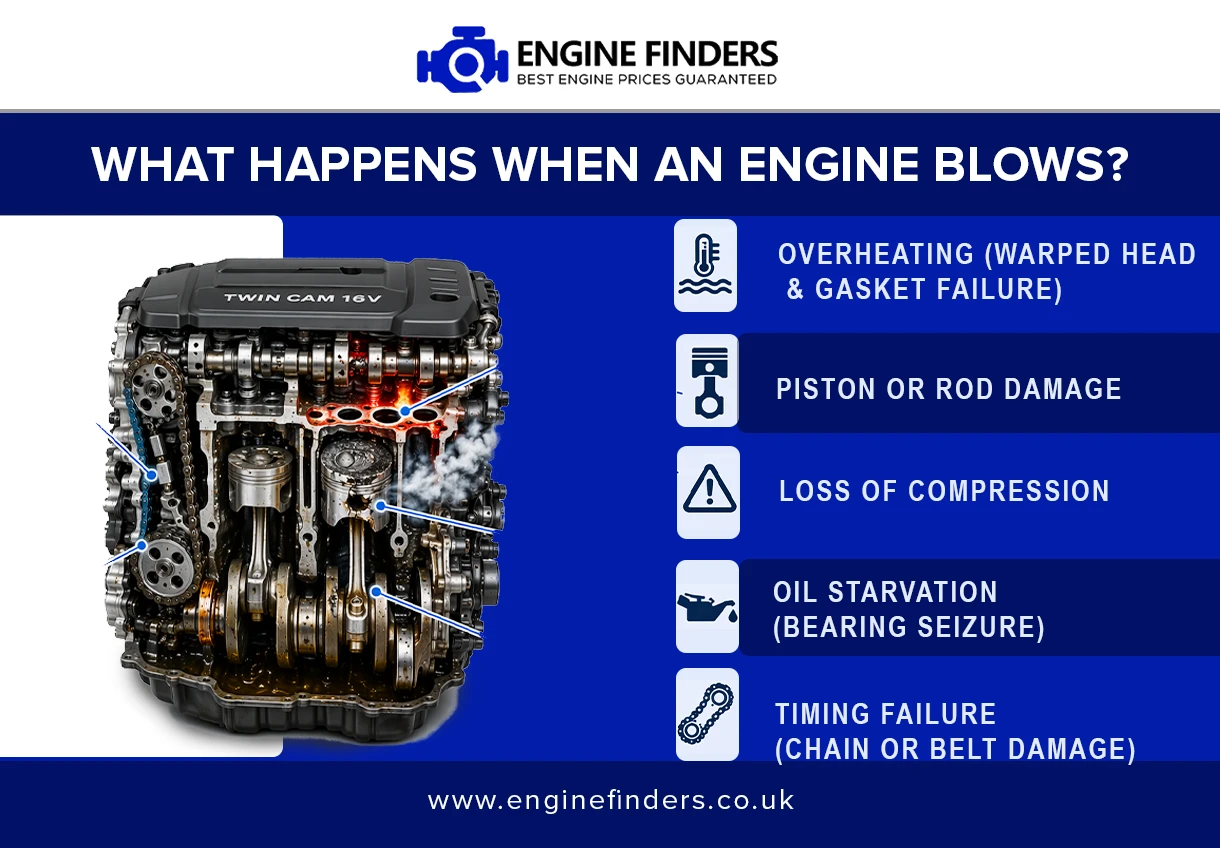
What happens when your engine blows UK guide

FAULT

Sudden loss of power, metallic knocking, excessive smoke, or critical warning lights indicating potential catastrophic engine failure

URGENCY

High – continuing to drive risks turning a repairable fault into a total write-off

LIKELY COST BAND (UK)

ÂŁ1,500 (targeted repair) to ÂŁ7,983+ (full replacement)

BEST NEXT STEP

If the oil pressure light is on, stop driving immediately. Get an independent diagnostic before accepting a "blown engine" quote

Introduction

The Loud Bang That Changes Everything

Hearing a loud bang from under the bonnet, seeing smoke pour from the exhaust, or watching the oil pressure warning glow red is every driver's nightmare. The immediate thought is often: "That's it, the car is dead."

Panic is understandable, but it is also expensive. A rushed decision based on fear often leads to accepting the first quote you receive, which can be thousands of pounds more than necessary.

This guide cuts through the workshop jargon. We explain what "blown engine" actually means in mechanical terms, what your immediate options are, and how to avoid turning a ÂŁ1,500 repair into a ÂŁ6,000 replacement.

The common finding in this scenario is that the term "blown engine" is often used as a catch-all diagnosis. A technician will typically find that while the damage is serious, it is rarely as absolute as the phrase suggests.

Problem Overview: What Does "Blown" Actually Mean?

Mechanically, there is no single definition of a "blown" engine—it is a colloquial term covering a spectrum of catastrophic failures where internal components have failed so severely that the engine cannot run safely or at all

Lubrication Failure

Loss of oil pressure leading to bearing seizure. Often caused by sludge, pump failure, or blocked pickup strainer—even with adequate oil level.

Thermal Failure

Overheating warping aluminium cylinder heads. Head gasket fails, allowing coolant into cylinders—hydro-lock bends rods or cracks pistons instantly.

Mechanical Integrity

Broken timing components, thrown connecting rods, or holed pistons. Structural failure of internal rotating or reciprocating parts.

For UK owners, urgency is defined by the specific symptom. A car that has seized completely requires a different approach to one that is still running but knocking loudly. Understanding the difference matters because it dictates your financial exposure—a seized engine often requires replacement; a knocking engine might only need a short block repair if caught early.

Granular Warning Signs: A UK Driver's Diagnostic Table

Use this table to assess urgency based on what you are experiencing on the road. These scenarios reflect common UK driving conditions.

UK Driving ScenarioLikely Mechanical CauseRecommended Action
Cold start rattle on a damp morning that clears after 30 secondsTiming chain tensioner wear or oil viscosity issue. Common on short-trip vehicles.Book a diagnostic. Not immediately critical, but monitor closely. Avoid hard acceleration.
Loud metallic knocking that increases with revs, especially under loadConnecting rod bearing failure or piston slap. Often oil-pressure related.Stop driving immediately. Towing is cheaper than a new engine.
White/blue smoke from exhaust with loss of power and coolant dropBlown head gasket or cracked cylinder head. Coolant entering combustion chamber. See head gasket failure symptoms and costs for more detail.Stop driving. Continuing risks hydro-lock, which can bend rods and destroy the block.
Sudden loss of power steering and brake assist while drivingEngine has stalled or seized. Serpentine belt no longer driving auxiliary pumps.Pull over safely using remaining momentum. Do not attempt to restart. Call recovery.
Oil pressure warning light illuminates (red can symbol)Critical loss of oil pressure. Bearings are running dry.Stop the engine instantly. Every second of running increases damage exponentially.
Misfuelling (petrol in diesel) followed by rough running or stallingFuel system contamination. High-pressure pump sending metal debris through injectors.Do not start the engine. If already driven, stop immediately. Requires full fuel system flush.

A technician will typically find that the term "blown engine" is often used as a catch-all diagnosis—while the damage is serious, it is rarely as absolute as the phrase suggests.

Why This Happens: The Mechanical Reality

When an engine suffers catastrophic failure, it is rarely a random event—it is usually the endpoint of a chain of mechanical stresses

The Lubrication Failure Pathway

The most common route to a seized engine is oil starvation. This does not always mean the sump is empty. Sludge buildup from extended service intervals, a failing oil pump, or a blocked pickup strainer can starve bearings of pressure even with adequate oil level. How to check your oil level correctly is a crucial skill that can prevent this scenario. Once the oil film breaks down, metal-to-metal contact generates extreme heat. Bearings weld themselves to the crankshaft. The engine seizes. This is the scenario behind the "never drive with the oil light on" rule.

The Thermal Failure Pathway

Overheating warps aluminium cylinder heads. The head gasket fails, allowing combustion gases into the cooling system or coolant into the cylinders. If coolant enters a cylinder in sufficient quantity, it cannot be compressed. This "hydro-lock" can bend connecting rods or crack pistons instantly.

The UK-Specific Factor: Short-Trip Wear & Emissions Complexity

A genuinely unique risk for UK owners involves the combination of typical driving patterns and modern engine design. Many vehicles are used for short, cold-start journeys: school runs, local shopping, stop-start commuting. This pattern prevents the engine from reaching optimal operating temperature consistently, leading to fuel dilution of the oil—thinning the lubricant and accelerating wear on timing chains and bearings. Compounding this is the UK supply chain complexity: a 2014 diesel may be Euro 5, while a 2016 model is Euro 6, and these engines are not always interchangeable due to ECU, DPF, and AdBlue system differences. Understanding engine codes and compatibility is essential when sourcing a replacement.

The Mechanical Failure Pathway

Broken timing components cause valves to collide with pistons—catastrophic internal damage. Thrown connecting rods can punch holes through the block, releasing oil and coolant instantly. Holed pistons result from severe pre-ignition or detonation, often caused by incorrect fuel or extreme overheating.

The Labour Access Multiplier

On many common UK family cars (Ford Focus, Vauxhall Astra, Volkswagen Golf), the engine is mounted transversely. For certain failures, like rear main seal leaks or timing chain issues on 1.0-1.2L EcoBoost or 1.4 TSI units, the labour time to access the fault can be disproportionate. The engine may need to be partially dropped or the subframe lowered, tipping the financial balance towards a replacement engine where the unit is swapped as a whole.

The Cost Escalation Reality

A ÂŁ1,500 repair on a car worth ÂŁ3,500 may still be worthwhile if the rest of the vehicle is solid. A ÂŁ4,000 repair on a car worth ÂŁ5,000 is rarely prudent. A technician will typically find that the most costly outcome is not the failure itself, but the delay in addressing early warning signs that could have prevented catastrophic damage.

decision framework

Repair vs Replace: The Decision Framework

This is the critical financial decision. The goal is to avoid spending good money after bad.

Repair when: Fault is isolated (blown head gasket on otherwise healthy, low-mileage engine). Vehicle has high sentimental or specialist value. A reputable specialist confirms the block and crank are undamaged after strip-down.
Replace when: Engine has seized or thrown a rod. Vehicle is high-mileage with other pending wear items. The cost of labour for a complex repair approaches the value of a fitted replacement unit.

💰 The 40–60% Trade Value Rule:

A common rule of thumb is that if repair costs approach 40–60% of the vehicle's current realistic trade value, compare quotes from vetted engine suppliers and explore reconditioned engines or used engines on purely financial grounds.

⏱️ Unique Nuance: Access Complexity on Transverse Engines:

On many common UK family cars (Ford Focus, Vauxhall Astra, Volkswagen Golf), the engine is mounted transversely. For certain failures, like rear main seal leaks or timing chain issues on 1.0-1.2L EcoBoost or 1.4 TSI units, the labour time to access the fault can be disproportionate. The engine may need to be partially dropped or the subframe lowered. This labour cost can tip the financial balance towards a replacement engine, where the unit is swapped as a whole, often in less time.

Decision Factor Table
FactorFavour RepairFavour Replacement
Fault TypeIsolated externalSeized or thrown rod
MileageLow with service historyHigh with pending wear
Vehicle ValueHigh relative to repairLow relative to replacement
Labour AccessComponents accessibleEngine-out/subframe required
Block ConditionSound, undamagedCracked or scored

UK Cost Guide: Realistic Ranges & Hidden Variables

Costs vary significantly by region, garage type, and engine complexity. All figures are estimates excluding VAT unless stated.

Service / Repair
  • Independent Diagnostic: ÂŁ80–£150
  • Head Gasket Replacement: ÂŁ1,200–£2,500
  • Short Block Repair (pistons, rods, bearings): ÂŁ2,500–£4,500
  • Used Engine Supply Only: ÂŁ800–£3,000
  • Reconditioned Engine Supply: ÂŁ2,000–£5,000+
  • Labour for Engine Replacement: ÂŁ1,200–£2,500
  • Ancillaries & Fluids: ÂŁ300–£800
Explaining the Variables
  • VAT Impact: Always confirm if quotes are inclusive or exclusive of VAT. A ÂŁ4,000 quote + VAT is ÂŁ4,800.
  • Regional Labour: Labour rates in London/South East can be 20-30% higher than other regions.
  • Hidden Costs: The "engine price" is rarely the final bill. Fluids, seals, gaskets, and ancillary components add up.
  • ECU/Emissions Compatibility: A cheap replacement engine may be physically compatible but electronically incompatible—leading to costly retrofitting or MOT emissions failures. Understanding engine codes and compatibility helps avoid this pitfall.

A reputable supplier will itemise all components. Always confirm whether the quote includes VAT, ancillaries, and a warranty that covers both parts and labour. Compare reconditioned vs used engine warranties before making your decision.

Expert Ownership & Prevention Advice

Catastrophic failure is often preventable. Maintenance habits matter more than mileage.

Prevention Priorities

  • Oil is Life: Use the exact specification recommended by the manufacturer. How to check your oil level correctly is one of the most important skills any driver can learn. Check the level every two weeks, especially on older vehicles. Top up immediately if low.
  • Respect the Warm-Up: Avoid hard acceleration until the oil temperature gauge (if fitted) is in the normal range. On short trips, this is especially critical.
  • Address Warning Lights Immediately: The oil pressure and coolant temperature warnings are not suggestions—they are emergency alerts.
  • Service History is Evidence: A full service history with receipts helps a technician diagnose whether a failure is due to wear or a component defect.

Warning Signs Owners Often Miss

  • Slight increase in oil consumption between services
  • Subtle change in exhaust note or idle quality
  • Minor coolant top-ups becoming more frequent

What to Ask a UK Garage (3 Technical Questions)

"Can you provide a written diagnostic report with fault codes and live data readings before authorising any major work?" – Ensures they've diagnosed properly, not just guessed.

"If you are recommending a replacement engine, can you confirm the engine code, mileage, and warranty terms in writing, and check compatibility with my vehicle's ECU and emissions system?" – Prevents compatibility issues and MOT failures. Understanding engine codes and compatibility is essential here.

"What ancillary components (clutch, flywheel, water pump, belts) do you recommend replacing while the engine is out, and what is the cost difference if I do them now versus later?" – Saves future labour costs.

These questions separate thorough specialists from those relying on guesswork.

What NOT To Do Next: Critical Mistakes

Do not ignore the oil pressure warning light. Driving for even a few hundred yards can turn a bearing noise into a seized block.

Do not clear fault codes and keep driving. This masks the problem and allows damage to escalate.

Do not accept a "blown engine" diagnosis without a second opinion. Get an independent inspection, especially if the quote is near the vehicle's value.

Do not buy the cheapest used engine online without verification. Match the engine code exactly. Confirm the reconditioned vs used engine warranties cover parts and labour.

Do not attempt a complex repair without the proper tools and knowledge. A mistake during reassembly can cause immediate failure.

Common Buyer Mistakes When Sourcing a Replacement

Delaying Action: Continuing to drive a faulty engine increases damage and cost.

Choosing Price Over Provenance: The cheapest engine may have unknown history, high mileage, or incompatible electronics.

Ignoring Warranty Fine Print: A "3-month warranty" may exclude labour costs, which are the majority of the expense. Always compare reconditioned vs used engine warranties carefully.

Overlooking Compatibility: Euro 5 vs Euro 6, manual vs auto, and trim level affect engine electronics and mounting points. Understanding engine codes and compatibility prevents costly mistakes.

Forgetting the Ancillaries: Fitting a replacement engine with a worn clutch or failing turbocharger is false economy.

When to Seek Help / MOT Implications

Seek immediate professional help if:

  • Oil pressure warning light illuminates
  • Loud, persistent knocking or banging from the engine
  • Significant smoke from the exhaust or engine bay
  • Engine has stalled and will not restart, especially after a warning

MOT & Legal Implications:

  • Excessive Smoke: Blue (oil) or black (fuel) smoke can be an MOT failure under emissions rules
  • Engine Noise: Excessive mechanical noise may lead to further inspection and potential failure
  • Fluid Leaks: Significant oil leaks that risk environmental contamination or fire hazard can result in failure
  • DVLA Notification: If you replace with different capacity or type, update V5C. For like-for-like, keep invoices as proof

The workshop diagnosis is just the starting point. Comparing specialist options—whether a targeted repair, a reconditioned engine, or a vetted used engine—can help make that decision clearer.

FAQ: Real Questions from UK Owners

Can a blown engine be fixed, or does it always need replacing?â–Ľ

It depends on the damage. A blown head gasket or failed turbocharger on a healthy block can often be repaired. If the block is cracked, the crank is damaged, or bearings have welded, replacement is usually the only viable option.

How much does it cost to diagnose a blown engine in the UK?â–Ľ

An independent diagnostic typically costs ÂŁ80-ÂŁ150. This is a wise investment to avoid unnecessary major work. Some garages may deduct this from the repair bill if you proceed with them.

Is a reconditioned engine better than a used one?â–Ľ

A properly reconditioned engine from a reputable specialist includes new bearings, seals, and gaskets, and is often tested. It typically comes with a longer warranty (12 months+) than a used engine (30-90 days). The upfront cost is higher, but the risk and long-term value can be better. Compare reconditioned vs used engine warranties to see the difference.

What questions should I ask before buying a used engine?â–Ľ

Ask for: the exact engine code and mileage; the warranty terms (parts AND labour?); the supplier's return policy if it's incompatible; and whether it includes ancillaries like the sump or injectors. Understanding engine codes and compatibility is essential.

Do I need to inform my insurance if I replace my engine?â–Ľ

Yes, you should notify your insurer of any major modification, including an engine replacement. While a like-for-like swap may not affect your premium, failing to disclose it could invalidate your policy in the event of a claim.

Will a replacement engine affect my car's MOT or emissions compliance?â–Ľ

If the replacement engine is the same specification and emissions standard (e.g., Euro 6 for Euro 6), it should not cause an MOT issue. However, if the engine is from a different standard, it may fail the emissions test. Always confirm compatibility with your garage.

How long should a replacement engine last?â–Ľ

A quality used engine with verifiable history can last tens of thousands of miles. A professionally reconditioned engine with new components should offer longevity comparable to a new unit, provided maintenance is upheld.

Final Thought: Clarity Before Commitment

Getting a clear picture of the numbers early often makes the difference between a manageable repair and an avoidable write-off. The workshop diagnosis is just the starting point.

Comparing specialist options—whether a targeted repair, a reconditioned engine, or a vetted used engine—can help make that decision clearer. The goal is to restore your mobility with confidence, not just to fix the immediate fault.

UK Flag

No obligation. Just clear, comparable options to help you choose with confidence.