Land Rover Engine Failure –
What Owners Must Know

3.0 TDV6 injector seal failure • Oil starvation • Knock diagnosis • Replacement costs
Land Rover engine failure

FAULT

3.0 TDV6 oil starvation from injector seal failure + carbon build-up

URGENCY

High – rhythmic knocking = immediate shutdown

LIKELY COST BAND (UK)

£4,500 – £8,500

replacement depending on source & fitment

BEST NEXT STEP

Stop driving; get compression test + oil pressure reading from LR specialist

Introduction

Don't Let a £1,500 Repair Become a £6,000 Replacement

If your Land Rover's 3.0 TDV6 is showing rhythmic knocking or the oil pressure warning has flickered on, continuing to drive risks turning a £1,500 repair into a £6,000 replacement.

This guide breaks down what's actually happening inside the engine, what the realistic UK costs look like, and how to decide whether repair, replacement, or walking away makes the most financial sense.

Owners often delay action hoping the noise "goes away" or fearing an open-ended repair bill. The common finding in this scenario is that early intervention on the 3.0 TDV6 can preserve the engine, but ignoring the warning signs almost always leads to catastrophic failure.

This guide helps you avoid unnecessary write-offs, poor repair decisions, and the costly mistake of buying another problematic replacement engine without proper checks.

Problem Overview: What's Actually Failing?

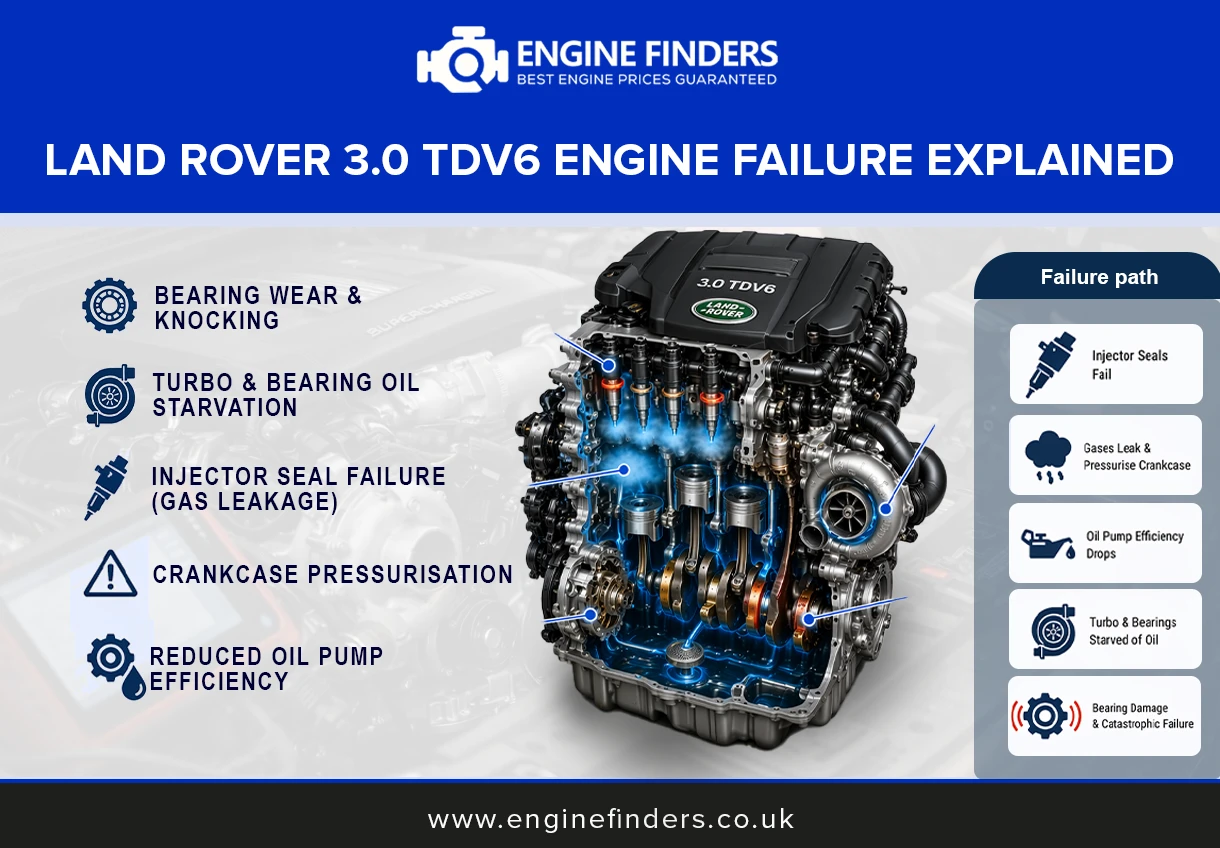
The core fault affecting the Land Rover 3.0 TDV6 (AJD-V6 engine family) is oil starvation triggered by failing injector copper washer seals.

The Failure Sequence

  • Injector copper washer seals harden and fail (60k-90k miles)
  • Combustion gases leak into rocker cover
  • Crankcase pressurised, oil pump efficiency drops
  • Oil flow to turbocharger and bearings restricted
  • Bearings wear → knocking begins → seizure

UK Relevance & Engine Codes

The 3.0 TDV6 (AJD-V6 family) was used across Range Rover Sport engine options, Range Rover (L405), Discovery 4, and Jaguar XF diesel models.

UK driving conditions exacerbate the issue: damp weather accelerates sensor corrosion, while short cold-start runs prevent full DPF regeneration and increase carbon deposits in oil galleries.

Why this matters to you: once bearings spin or the turbo seizes from oil starvation, the engine is often beyond economical repair. Understanding the early signs is the difference between a manageable repair and a write-off.

Granular Warning Signs: Know What to Watch For

Match what you're experiencing with likely causes and the right next action. This helps you identify urgency before calling a garage.

UK Driving ScenarioLikely CauseRecommended Action
Cold start rattle lasting 2-3 secondsWorn timing chain tensioners or low oil pressure at startupBook oil pressure test; avoid cold revving
Sudden loss of power on motorway with limp modeTurbo actuator fault or oil starvation to turboStop driving; check oil level and for metallic debris
Rhythmic knocking from lower block that increases with revsSpun main or big-end bearing due to oil starvationStop immediately – engine likely needs replacement
Oil pressure warning flickers at idle then clearsFailing oil pump pickup strainer clogged with carbon/debrisUrgent inspection; do not ignore even if it clears
Excessive blue/grey smoke on overrunTurbo seal failure from oil starvation or worn valve guidesCompression test and turbo inspection before further use
Metallic flakes in oil filter on serviceBearing material breaking downDo not restart – engine has internal damage

If you recognise any "High Urgency" signs – particularly rhythmic knocking or persistent oil pressure warnings – stop driving and arrange recovery to a specialist.

Why This Happens: The Mechanical Reality

Understanding the root cause helps you assess garage advice and avoid repeat failures

Primary failure sequence

Injector copper washer seals harden and fail (60k-90k miles) → combustion gases leak into rocker cover → crankcase pressurised, reducing oil pump efficiency → oil flow to turbo and bearings restricted → bearings wear, knocking begins → seizure.

Contributing factors in UK use

Short-trip driving prevents oil from reaching full operating temperature, allowing carbon deposits to accumulate in narrow oil galleries. Coolant temperature sensor faults cause prolonged "warm-up" mode, increasing carbon formation.

Rear timing chain complexity

The 3.0 TDV6's timing chain is mounted at the rear of the engine, against the bulkhead. Access requires significant labour – often engine removal or front subframe drop. This complexity leads some owners to defer chain maintenance until failure.

Critical oil pressure threshold

Once oil pressure drops below 1 bar at hot idle, bearing damage accelerates rapidly. This is why the oil pressure warning must never be ignored, even if it clears after revving.

decision guide

Repair vs Replace: Making the Financial Decision

Deciding whether to repair or replace requires balancing the vehicle's value, the extent of damage, and realistic cost expectations.

Repair when: early detection of injector seal leak before bearing damage, oil pressure stable under load, no metallic debris, strong service history.
Replace when: rhythmic knocking present, oil pressure warning persistent, metallic debris confirmed, turbo already failed.

💰 The 40–60% rule:

If repair costs approach 40–60% of the vehicle's current realistic trade value, get a quote and explore reconditioned options. Check Parkers or WeBuyAnyCar for current values before authorising major work.

Unique nuance for the 3.0 TDV6

The injector seal repair requires removal of the rocker cover and precise torque sequencing using Land Rover-specific procedures. If done incorrectly, the leak returns within weeks. Many generalist garages lack the specific torque specs.

Choosing a Land Rover-specialist garage is critical even for "minor" repairs – choosing based on price alone often leads to repeat failures.

Decision aid table

SymptomDamage LevelRecommendation
Early seal leak, no knockingLowRepair with LR specialist
Oil pressure warning, no noiseMediumCompare repair vs recon quote
Rhythmic knocking + warningHighReplacement more cost-effective
Post-failure seizureCatastrophicEvaluate vehicle value vs total cost

UK Cost Guide: Realistic Ranges for 2026

Costs vary significantly by region, garage type, and vehicle model. Ranges reflect typical UK quotes for Land Rover 3.0 TDV6 work. See our 3.0 TDV6 replacement engine costs guide for more detail.

Diagnostic & Minor Work
  • Specialist diagnosis (oil pressure test, compression, codes): £120–£250
  • Injector copper washer replacement + rocker cover gasket set: £800–£1,800
  • Oil system flush and filter replacement: £150–£300
Major Repair Work
  • Turbocharger replacement: £1,800–£3,200
  • Combined turbo + injector seal repair: £2,500–£4,200
  • Timing chain service (rear access): £2,200–£4,500
Replacement Engine Options
  • Reconditioned options 3.0 TDV6 (supply only): £2,800–£4,500 — Reconditioned Land Rover engines come with comprehensive testing.
  • Used engine (supply only, 3-month warranty): £1,800–£3,200
  • Replacement fitting labour: £1,200–£2,800
  • Total replacement cost: £4,500–£8,500 typical

Important cost variables:

VAT – confirm inclusive/exclusive. Regional labour: £65-85/hr North, £95-120/hr London. Hidden costs: seals, gaskets, oil, filters, coolant add £300-£600. Core charge: £300-£800 if old unit not returned.

Expert Ownership & Prevention Advice

Prevention is significantly cheaper than repair on the 3.0 TDV6. These habits extend engine life and reduce failure risk. When sourcing a replacement, always check engine compatibility carefully.

Prevention habits that work

  • Use fully synthetic 5W-30 oil meeting Land Rover STJLR.03.5004 specification. Cheaper oils accelerate carbon build-up.
  • Change oil every 10,000 miles or 12 months maximum. UK short-trip driving degrades oil faster.
  • Allow 30-second idle after cold start before gentle driving – circulates oil to turbo bearings.
  • Check oil level monthly. Low level accelerates starvation risk.
  • Every 30,000 miles, consider walnut blasting of intake valves to reduce carbon ingress.

Servicing priorities

  • Replace injector copper washers preventatively around 80,000 miles
  • Use genuine or OEM coolant temperature sensors – cheap replacements fail quickly in UK damp conditions
  • Flush cooling system every 5 years to prevent overheating from sensor failure

Warning signs owners commonly miss

  • Slight increase in oil consumption dismissed as "normal for a diesel"
  • Intermittent oil pressure flicker at hot idle ignored because warning clears after revving
  • Minor cold-start rattle accepted as "just diesel clatter" rather than early chain tensioner wear

What to ask a UK garage

“Can you perform an oil pressure test at operating temperature and show me the live reading?” — A Land Rover specialist will have the correct adapter for the TDV6 pressure sender port.

“If you're replacing injector seals, will you use the updated Land Rover torque sequence and replace the rocker cover gasket as a complete set?” — Prevents repeat leaks; torque sequence is critical.

“What are the Land Rover warranty considerations for the replacement unit?” — Avoids compatibility issues and ensures clear warranty scope.

What NOT To Do Next (Critical)

These actions commonly turn manageable issues into catastrophic failures on the 3.0 TDV6.

Do not ignore an oil pressure warning. Even if it clears after revving, bearing damage may have occurred.

Do not clear fault codes and keep driving. Resetting masks the problem while internal damage progresses.

Do not buy the cheapest used engine online without verification. Match engine code, confirm mileage, ensure 6-month warranty.

Do not allow a non-specialist to attempt injector seal replacement. Incorrect torque causes repeat leaks within weeks.

Do not delay if rhythmic knocking appears. Every mile increases likelihood of seized engine. Arrange recovery, not a test drive.

Common Buyer Mistakes to Avoid

Delaying action hoping the noise "goes away" – mechanical faults in the TDV6 do not self-resolve.

Accepting vague garage advice like "it might be the turbo" – insist on diagnostic data.

Choosing the cheapest supplier – a £2,200 used engine with no warranty costs more than a £3,800 reconditioned engines unit.

Ignoring warranty considerations – some exclude "consequential damage." Get terms in writing.

Ignoring compatibility – the 3.0 TDV6 has multiple variants. How to check engine compatibility ensures you get the right unit.

When to Seek Help / MOT Implications

When to seek immediate help:

  • Oil pressure warning illuminated – stop driving immediately
  • Rhythmic knocking from lower engine – tow to specialist
  • Excessive blue smoke with power loss – likely turbo failure

MOT fail risks to be aware of:

  • Excessive smoke from exhaust – visible blue/grey smoke is a direct MOT fail
  • Significant oil leaks – can be recorded as advisory or fail
  • Engine management light with emissions-related codes – indicates underlying issues

Emissions and safety consequences:

A failing turbo or injector seals can increase particulate emissions, affecting DPF function. Sudden engine seizure at motorway speeds creates a significant safety hazard. Addressing warning signs proactively is not just about cost – it's about road safety.

Clear next step: If you're seeing any warning signs, the most cost-effective action is a specialist diagnostic (£120–£250) to establish actual condition before authorising major work.

FAQ: Real Questions Land Rover Owners Ask

Can the 3.0 TDV6 injector seal issue be prevented?▼

Preventative replacement of copper injector washers around 80,000 miles, using correct Land Rover torque procedure, significantly reduces risk. Combined with regular oil changes using STJLR.03.5004 spec oil, this extends engine life considerably.

How long does a reconditioned 3.0 TDV6 typically last?▼

A properly reconditioned unit from a reputable supplier, installed with new ancillaries and maintained correctly, commonly achieves 80,000–120,000 miles depending on driving style and maintenance adherence.

Will a replacement engine affect my insurance?▼

You should notify your insurer. Most won't increase premiums for like-for-like replacement, but failing to disclose could invalidate your policy.

Do I need to update the V5C if I change the engine?▼

DVLA requires notification if engine number changes or fuel type/output changes. For like-for-like replacement, keep invoices and record new engine number for resale transparency.

Is it worth repairing a 3.0 TDV6 with 120,000 miles?▼

Apply the 40–60% rule. If repair quote is £3,000 and vehicle trade value is £6,000, replacement or part-exchange may be more sensible. Consider overall condition and service history.

Can I drive if oil pressure warning flickers then goes out?▼

No. Even intermittent warnings indicate a serious lubrication issue. Have the vehicle towed to a Land Rover specialist for proper diagnosis.

What's the difference between reconditioned, rebuilt, and used engines?▼

Used: sold as-is, limited warranty. Rebuilt: major worn components replaced. Reconditioned: fully stripped, machined to spec, dyno-tested. Price and warranty terms reflect this hierarchy.

Final Thought: Clarity Before Commitment

Getting a clear picture of the numbers early often makes the difference between a manageable repair and an avoidable write-off. Comparing specialist options can help make that decision clearer.

If you're weighing repair versus replacement quotes, EngineFinders.co.uk lets you get a quote from vetted suppliers for reconditioned options and replacement 3.0 TDV6 units, with transparent warranty terms and UK-fitment guidance. No pressure, just the information to decide confidently.

UK Flag

No pressure. Just the information you need to decide with confidence.