Cheapest Way to Replace an Engine in the UK – A Practical Cost & Risk Guide

Complete failure • Seized or broken internals • Three replacement routes compared
Cheapest engine replacement UK guide

FAULT

Complete or impending engine failure requiring replacement. Read our 2026 reconditioned engine buyer's guide.

URGENCY

High. Driving with a failing engine risks total immobilisation. Read our full labour cost analysis.

LIKELY COST BAND (UK)

£1,000 – £4,500+

depending on method (DIY source vs. specialist supply & fit). Browse vetted used engine suppliers or View certified reconditioned engines with warranty.

BEST NEXT STEP

Confirm the exact engine code from your V5C or under-bonnet sticker, then compare specialist quotes.

Introduction

Why the "Cheapest" Option Often Costs More

Replacing an engine is one of the most stressful financial decisions a UK car owner can face. It sits in that uncomfortable grey area between a manageable repair bill and the cost of buying a new vehicle. When the quote lands on your desk, the immediate reaction is often shock. The instinct is to find the absolute lowest number possible. Read our 2026 reconditioned engine buyer's guide for a comprehensive overview of your options.

However, in the UK automotive market, the "cheapest" price tag rarely reflects the final cost of ownership. A bargain engine sourced without due diligence can lead to double labour charges, extended downtime, and a vehicle that remains unreliable. Read our full labour cost analysis to understand where your money actually goes.

This guide breaks down the three primary routes for engine replacement in the UK. It translates workshop realities into plain English, helping you understand where costs come from, where corners are cut, and how to make a decision that protects both your wallet and your safety. We are not here to sell you a specific part. We are here to help you compare options like a knowledgeable mechanic would advise a friend.

The temptation to minimise cost is understandable. With the cost of living rising and used car prices remaining elevated, many owners look for shortcuts. The most common shortcut is sourcing a used engine privately or choosing the lowest bidder for installation. The risk here is asymmetry. If you save £300 on the engine but it fails in three months, you do not just lose the £300. You lose the labour cost to remove it again (often £600–£1,000), the cost of new fluids and seals, and the inconvenience of being without a vehicle.

Problem Overview: When Replacement Becomes the Only Option

Not every engine noise requires a full replacement. Certain failures render repair economically or mechanically unviable.

Catastrophic Failure

Seized bearings, snapped timing chains destroying valves, or cracked engine blocks. Internal integrity is compromised beyond economical repair. The N47D20C diesel engine specifications illustrate a unit where timing chain failure can cause catastrophic damage.

Chronic Oil Consumption

Worn piston rings or valve stem seals. Labour intensity of stripping the head and pistons often exceeds the cost of a replacement unit. The Jaguar AJ30 petrol engine details provide context on how bore wear affects replacement decisions.

Hybrid & Complex Engines

Integrated electronics and cooling systems make a swap the preferred route for most independent garages when mechanical failure occurs.

The Role of Engine Codes. Every engine has a specific code (e.g., N47D20C, EA888, K20Z3). This code dictates compatibility. Using the wrong variant, even if it fits physically, can cause ECU mismatches, sensor errors, and poor performance. Identifying this code is non-negotiable before seeking quotes. Understanding N47 common failure patterns helps you assess whether a used unit is likely to repeat the same issues.
Misdiagnosis is a leading cause of unnecessary spending. Confirming the severity of the fault is the first step in budgeting for a replacement. Verify used engine history before committing to any purchase.

Granular Warning Signs: Is Your Engine Beyond Repair?

Before committing to a replacement, confirm the diagnosis. Misdiagnosis is a leading cause of unnecessary spending. Use the table below to assess urgency.

UK Driving ScenarioLikely CauseRecommended Action
Loud knocking from bottom end on cold start. Common on engines with known N47 timing chain issuesWorn main bearings or big-end bearings. Oil pressure is insufficient to cushion metal-on-metal contact.High Urgency. Stop driving. Check oil level/pressure. Continued use will seize the engine.
White smoke from exhaust (sweet smell)Blown head gasket allowing coolant into combustion chambers. Common after overheating events.Medium/High Urgency. Check coolant levels. Do not ignore. Overheating can warp the head.
Blue smoke from exhaust (burning oil smell)Worn valve stem seals or piston rings. Oil is entering the combustion chamber.Medium Urgency. Monitor oil levels closely. If consumption is >1 litre per 1,000 miles, replacement is often more economical than repair.
Metallic rattling from timing cover area. N47 common failure patterns often start with this symptomStretched timing chain or failed tensioner. Common in high-mileage diesel and some petrol engines.High Urgency. If the chain skips a tooth, valves hit pistons. Immediate inspection required.
Loss of power + Check Engine Light + Limp ModeCould be turbo, sensors, or mechanical compression loss.Diagnostic First. Do not assume engine failure. Get a compression test and leak-down test to rule out simpler fixes.
Oil mixing with coolant (mayonnaise substance)Head gasket failure or cracked block/head.High Urgency. Stop driving. This contaminates the entire cooling system and lubrication path.

A technician will typically confirm internal damage through compression testing, leak-down testing, and bore scope inspection before recommending a full replacement. Verify used engine history before committing to any replacement unit.

Why This Happens: The Mechanical Reality

Engines do not fail at random. There are predictable patterns driven by design, maintenance, and driving conditions.

The UK Driving Cycle Effect

Short trips, frequent stop-start traffic, and damp weather prevent engines from reaching optimal operating temperature consistently. Diesel Particulate Filters (DPF) clog, oil dilution occurs in direct-injection petrol engines, and moisture accumulation accelerates corrosion.

Design Flaws and Weak Points

Certain engines have known vulnerabilities. Some timing chain tensioners rely on oil pressure that diminishes as the engine warms up. Others have water pump impellers made of plastic that degrade over time. A cheap used engine will likely retain the original flawed components. The N47D20C diesel engine is a well-known example where timing chain design creates a predictable failure point.

Maintenance Gaps

The most common cause of premature engine failure is delayed maintenance. Extended service intervals (e.g., 20,000 miles) recommended by some manufacturers are often too long for real-world conditions. Oil degrades, losing its ability to protect bearings. Read our 2026 reconditioned engine buyer's guide for maintenance recommendations specific to replacement units.

Oil Dilution in Direct Injection

In direct-injection petrol engines, unburnt fuel can wash into the sump, thinning the oil and accelerating bearing wear. This is exacerbated by short journeys where the engine never reaches full operating temperature.

Turbocharger Oil Coking

Modern turbos spin at extreme RPMs with lean tolerances. Cutting the engine immediately after high-load running traps heat in the bearing housing. Oil coking occurs, leading to turbo failure that can send debris through the engine.

Corrosion from Damp Conditions

UK winters can lead to moisture accumulation in the oil if the car is not driven long enough to evaporate it. This moisture combines with combustion byproducts to form acids that attack bearings and cylinder liners. Read our full labour cost analysis to understand the financial impact of these progressive failures.

decision framework

Repair vs Replace Decision Guide

Deciding whether to repair your current engine or replace it entirely depends on three factors: the extent of the damage, the value of the vehicle, and the availability of parts.

Repair when: External leaks, single component failure (water pump, alternator), or head gasket only if block and head are undamaged. Verified by pressure testing.
Replace when: Internal damage to bearings, pistons, or crankshaft. Cracked block. High mileage (over 120,000 miles) with other components nearing end-of-life. Browse vetted used engine suppliers or View certified reconditioned engines with warranty.

💰 The 40–60% rule of thumb:

If repair costs approach 40–60% of the vehicle's current realistic trade value, replacement or reconditioned options are often worth comparing on purely financial grounds. Example: If your car is worth £3,000 and a repair costs £1,800, a reconditioned engine with warranty might be the smarter long-term investment. Read our 2026 reconditioned engine buyer's guide for detailed cost comparisons.

⏱️ Unique nuance: Access complexity and labour multipliers:

On many modern transverse-mounted V6 and compact diesel engines, access is severely restricted. A replacement engine is often swapped as a complete unit, making replacement cheaper in labour terms than a complex top-end rebuild. Read our full labour cost analysis for examples of how access complexity affects pricing.

Repair vs Replacement Decision Table
FactorFavour RepairFavour Replacement
Damage TypeExternal leaks, single componentInternal bearings, cracked block
MileageUnder 80,000 milesOver 120,000 miles
Vehicle ValueHigh relative to repairLow relative to replacement
Labour AccessEngine accessible without major disassemblyEngine-out required; labour exceeds 12-14 hours
WarrantyParts-only repair with short turnaroundFull unit with bench test and long warranty

UK Cost Guide: Breaking Down the Options

Costs vary by region, garage type, and vehicle model. Ranges reflect typical UK market data for family cars. Compare specialist quotes for accurate local pricing.

Replacement Options
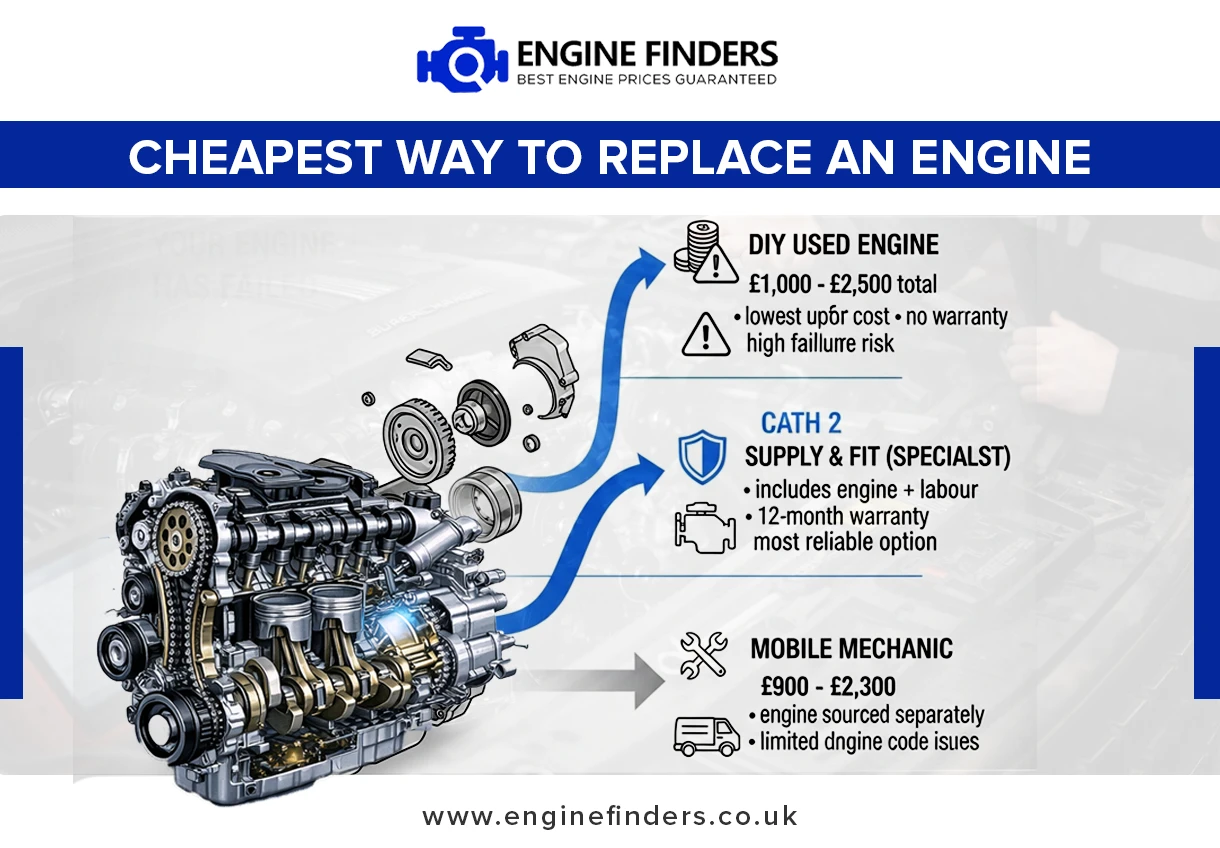
  • Option 1: Source Your Own Used Engine
    Engine Cost: £500 – £1,500
    Fitment Cost: £500 – £1,000
    Total: £1,000 – £2,500. Browse vetted used engine suppliers.
  • Option 2: Specialist Supplier (Supply & Fit)
    Package Cost: £2,000 – £4,000
    Includes warranty, delivery, fitment, fluids. View certified reconditioned engines with warranty.
  • Option 3: Mobile Mechanic Fitting
    Fitment Cost: £400 – £800 (labour only)
    Engine Cost: Separate (you source it)
    Total: £900 – £2,300
Hidden Costs to Anticipate
  • VAT: Ensure quotes specify if VAT is included. Specialists usually charge VAT.
  • Ancillaries: Belts, pulleys, and mounts should be replaced during the swap. Budget £100–£300.
  • Fluids: Oil, coolant, and gearbox fluid. Budget £100–£200.
  • ECU Coding/Adaptation: Modern engines may require software adaptation. Some garages charge extra (£50–£150).

Labour Deep Dive: Average fitment costs vary by region. Independent garages typically charge £70-£120/hr, with London and South East at the higher end. Read our full labour cost analysis for regional breakdowns. Read our 2026 reconditioned engine buyer's guide for warranty comparisons. Verify used engine history before committing to any purchase. Compare specialist quotes for transparent pricing.

Expert Ownership & Prevention Advice: Protecting Your Investment

Once you have installed a replacement engine, protecting your investment is crucial. These habits, drawn from workshop experience, make a measurable difference. Read our 2026 reconditioned engine buyer's guide for complete post-installation care recommendations.

Prevention Habits That Work

  • Warm-Up Routine: Avoid high RPMs until the oil temperature is up. Cold oil is thick and does not lubricate effectively.
  • Cool-Down: For turbocharged engines, allow a minute of idle before switching off after hard driving. Prevents oil coking in turbo bearings.
  • Oil Quality: Use the exact specification recommended by the manufacturer. Do not substitute with generic oils.

Servicing Priorities

  • Shorten Intervals: If the manufacturer recommends 20,000 miles, consider servicing every 10,000–12,000 miles.
  • Filter Quality: Use OEM or high-quality aftermarket filters. Cheap filters can bypass filtration when cold.

What to Ask a UK Garage (3 Technical Questions)

"Do you perform a compression and leak-down test on the replacement engine before installation?" – This verifies the health of the unit before it goes in. Verify used engine history before committing.

"What is your policy if the replacement engine fails within the warranty period? Does it cover labour and diagnostics?" – Many warranties only cover the part, leaving you with a huge labour bill. Understand warranty cover before making a decision.

"Will you update the ECU adaptations and reset service intervals after installation?" – Ensures the car runs optimally and maintains service history integrity.

These questions filter out generalists from specialists and ensure you're not caught off guard by hidden costs. Compare specialist quotes from vetted specialists who welcome these questions.

What NOT To Do Next: Critical Mistakes

Do not ignore oil pressure warnings. If the oil light flickers or stays on, stop immediately. Driving for even a few seconds can score bearings.

Do not clear fault codes and keep driving. Clearing a code masks the symptom while the underlying damage worsens.

Do not buy the cheapest used engine online without verification. Always ask for compression test results and proof of mileage. Verify used engine history before committing. Compare reconditioned engine options for quality assurance.

Do not skip the ancillaries. Reusing old belts, hoses, and mounts on a new engine is false economy.

Do not ignore compatibility. Ensure the replacement engine matches your VIN-specific requirements. N47D20C diesel engine specifications illustrate why precise code matching matters.

Common Buyer Mistakes: Lessons Learned

Delaying action: Ignoring early signs like minor knocks or smoke allows damage to spread. Early intervention is always cheaper.

Accepting vague garage advice: "If it sounds bad, it needs a new engine" is not a diagnosis. Insist on evidence: compression figures, leak-down percentages.

Choosing the cheapest supplier: The cheapest quote often excludes vital steps like ECU coding, fluid top-ups, or proper disposal of the old engine. Compare specialist quotes for transparent, all-inclusive pricing.

Ignoring warranty terms: Read the fine print. Some warranties exclude "consequential damage" or require specific servicing intervals. View certified reconditioned engines with warranty to compare coverage terms. Understand warranty cover before purchasing.

Ignoring compatibility: Differences in sensor placements, flywheel types, or ECU software can cause major headaches. The Jaguar AJ30 petrol engine details show how variant differences affect compatibility.

When to Seek Help / MOT Implications

Seek immediate help if:

  • Loud knocking or grinding noises
  • Significant loss of power
  • Heavy smoke (blue, white, or black)
  • Oil or coolant warnings

MOT risks & safety consequences:

  • Excessive smoke will fail the MOT emissions test
  • A leaking engine that drips oil onto the ground is an MOT failure
  • A seized engine can lock the drive wheels, causing loss of control
  • Oil leaks onto hot exhaust components pose a fire risk

Safety first:

These are not just financial issues; they are safety hazards. A vehicle that stalls unpredictably due to engine issues may be deemed dangerous and refused for MOT testing. Read our 2026 reconditioned engine buyer's guide for MOT compliance advice on replacement engines.

FAQ Section: Real Questions, Practical Answers

Can I replace the engine myself?▼

Technically yes, but it requires significant mechanical skill, specialised tools (engine crane, torque wrenches), and space. For most UK owners, the risk of error and lack of warranty makes professional installation the safer choice. Read our full labour cost analysis to understand what professional fitting includes.

Do I need to notify the DVLA after an engine change?▼

Generally, no. As long as the engine is of the same type and fuel category, you do not need to update the V5C. However, if the engine capacity changes significantly, you should inform the DVLA. Always check with your insurer.

Will my insurance premium increase?▼

You must inform your insurer of any major modifications or repairs. A like-for-like replacement usually does not affect premiums, but failure to disclose it could invalidate your policy in the event of a claim.

What is the difference between reconditioned and rebuilt?▼

"Reconditioned" typically means the engine has been disassembled, cleaned, and worn parts replaced to meet OEM standards. "Rebuilt" can vary in quality, sometimes meaning only the faulty parts were fixed. Compare reconditioned engine options from vetted suppliers with full documentation. Read our 2026 reconditioned engine buyer's guide for detailed explanations.

How long does a replacement take?▼

Typically 1–3 days. Sourcing the engine can add time. Complex vehicles may take longer due to electronic integration. Read our full labour cost analysis for typical timeframes by vehicle type.

Is a used engine better than a reconditioned one?▼

A reconditioned engine is generally safer because worn parts are replaced. A Browse vetted used engine suppliers is a gamble on its previous life. For long-term ownership, reconditioned is preferred. Read our 2026 reconditioned engine buyer's guide for a complete comparison. Verify used engine history to assess risk.

Can I claim on insurance for engine failure?▼

Standard comprehensive insurance does not cover mechanical breakdown. You would need specific breakdown cover or mechanical breakdown insurance. If the failure was caused by an accident, it may be covered.

Final Thought: Compare Before You Commit

Getting a clear picture of the numbers early often makes the difference between a manageable repair and an avoidable write-off. Comparing specialist options can help make that decision clearer. Read our 2026 reconditioned engine buyer's guide for comprehensive guidance. Read our full labour cost analysis for detailed budget planning. Understand the labour vs parts cost breakdown to see exactly where your money goes.

At EngineFinders.co.uk, we help you compare specialist quotes from multiple vetted suppliers across the UK. Whether you are looking for a reconditioned unit with a warranty or a low-mileage used engine, we provide the transparency you need to make a confident choice. Mini engine replacement options are just one example of the model-specific guidance available.

Take the stress out of the process by starting your comparison today. Compare specialist quotes for transparent, no-obligation pricing from vetted UK suppliers.

UK Flag

No obligation. Just clear, comparable options to help you choose with confidence.