Most Common Engine Failures by Brand: A 2025 UK Analysis

Timing chain wear • EGR/DPF blockage • Oil-system failures across mainstream and premium UK brands
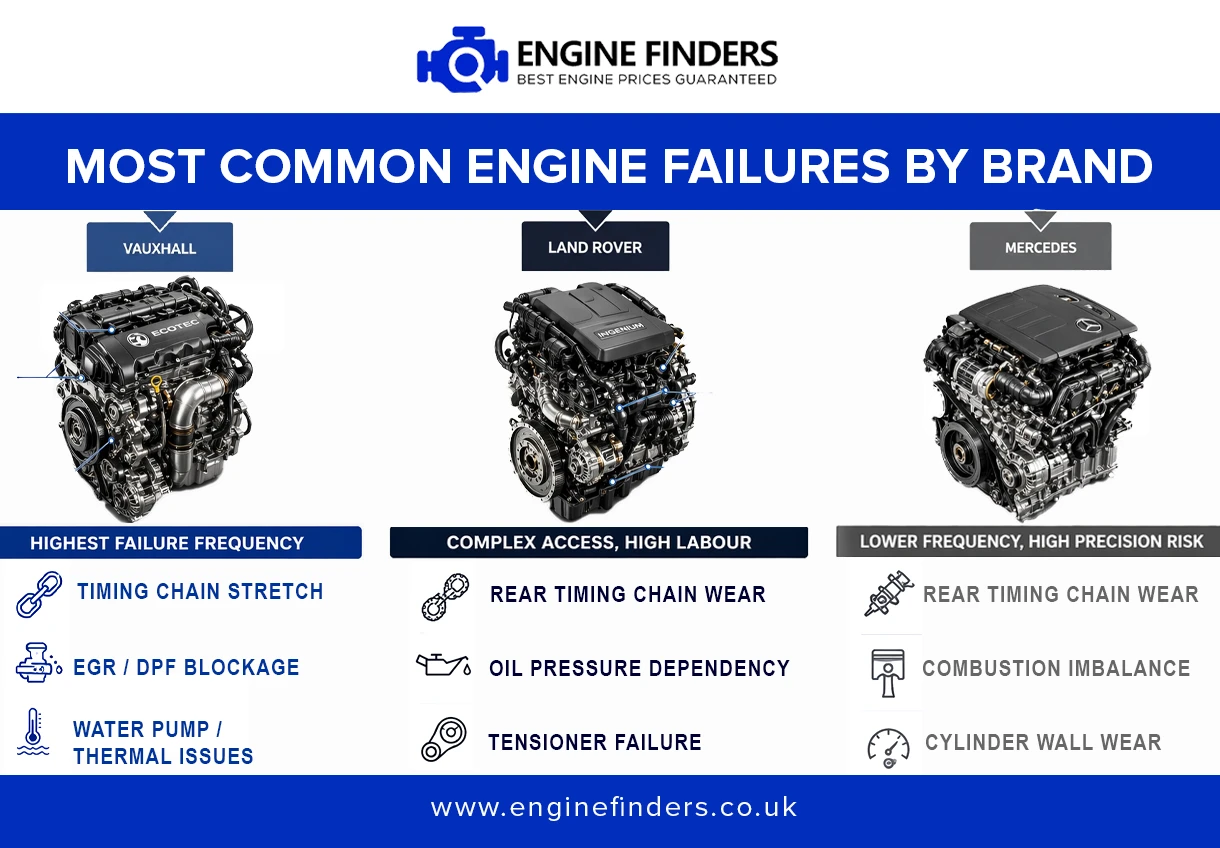
Common engine failures by brand UK 2025

FAULT

Premature timing chain wear, EGR/DPF blockage, and complex oil-system failures

URGENCY

Medium to High (escalates with oil pressure fluctuation or flashing MIL)

LIKELY COST BAND (UK)

£850 – £4,200

diagnosis to major repair | £4,500 – £15,000+ full replacement fitted

BEST NEXT STEP

Run a full vehicle history check and secure an independent diagnostic scan before booking workshop time

Introduction

What 2025 Data Reveals About Brand-Specific Engine Failures

Engine failure rarely announces itself with a sudden bang. More often, it's a slow drain on oil, a persistent rattle on cold starts, or a creeping fuel bill that owners write off as normal wear. Ignoring these early signals typically turns a straightforward gasket or sensor swap into a multi-thousand-pound rebuild.

In the current UK market, models from Vauxhall rank highest for documented engine damage, with roughly one in four inspected examples showing a recorded fault during history checks. Premium marques like Land Rover and Mercedes face a different reality: lower failure frequency, but significantly higher complexity and fitting costs. A Land Rover 2.0L Ingenium replacement can routinely exceed £15,000 once installed. For expert guidance, Land Rover engine replacement UK specialists can provide detailed cost breakdowns and advice.

This guide translates workshop findings into plain English cost and risk assessments. You will leave with clear pricing bands, a practical decision framework, and exact questions to ask before signing an invoice.

Problem Overview: What the Fault Actually Is

The core issue across these brands is not a single broken part. It is a combination of thermal management stress, emissions system complexity, and timing drive wear.

Vauxhall

1.4L, 1.6L, and 2.0L families commonly develop timing chain stretch, integrated water pump degradation, and EGR valve clogging. Codes A14NET, B16XER frequently trigger P0008 or P2002 between 70k–110k miles. For a deeper dive, Vauxhall engine codes explained can help you identify which specific engine variant you have and its known issues. Vauxhall engine specialists can provide targeted advice for these common failures.

Land Rover

2.0L Ingenium (In4P/In4T) presents tighter packaging challenges. The aluminium block relies on high oil pressure for the rear timing chain tensioner. Missed oil specifications or urban cycling accelerates tensioner wear. Read our full Land Rover engine failure guide for a comprehensive analysis of common failures and prevention strategies. Technical specifications for the 204DTD diesel engine highlight these design constraints.

Mercedes

OM654 diesel and M274 petrol engines follow a premium trajectory. High-pressure fuel systems and precision tolerances leave minimal margin for delayed servicing or incorrect fluid grades. For detailed technical data, check the OM654.920 diesel engine specifications to understand its unique requirements.

Why it matters: A technician will typically find that these faults compound quickly. A leaking thermostat housing alters coolant flow, raising combustion temperatures. Carbon migrates through the EGR, then into the turbocharger. Oil thins out from incomplete DPF regenerations, starving the top end of proper lubrication. Understanding the pattern matters more than reacting to a single dashboard light.
To understand understand why UK engines fail early, mechanic insights point to these compounding factors across all three brands.

Granular Warning Signs: Recognising the Red Flags

The following scenarios map to specific brand vulnerabilities. Recognising them helps you assess urgency and avoid costly delays.

UK Driving ScenarioLikely CauseRecommended Action
Cold start rattle lasting over 5 secondsTiming chain tensioner slow to pressurise or stretched chain linksBook independent inspection for timing cover and borescope cylinder check. Avoid high RPM until resolved.
Limp mode during overtaking or hill climbingTurbo actuator binding, intercooler hose split, or DPF restrictionRecord fault codes before clearing. Check boost pipe integrity and MAP sensor readings.
Blue smoke after short school runs or damp morningsPCV blockage, turbo seal wear, or piston ring glazing from low-load drivingMonitor oil consumption weekly. If exceeding 1L/1,000 miles, request compression and leak-down test.
Rough idle and hesitation in cold, wet conditionsMAF sensor moisture, coil pack degradation, or EGR stuck openInspect electrical seals. Replace coils as a matched set. Clean EGR passages rather than deleting them.
Oil pressure warning during normal cruisingOil pump drive wear, degraded fluid spec, or main bearing clearance lossStop driving immediately. Topping up is temporary. Tow to a specialist for pressure testing.

A technician will typically verify clearances with dial indicators and confirm oil pump output before committing to bottom-end work.

Why This Happens: The Mechanical Reality

Workshop analysis points to three overlapping factors: design compromises, maintenance drift, and the UK driving environment.

Land Rover 2.0 Ingenium Specific Issue

The timing chain assembly sits at the rear of the block, positioned between the engine casing and the transmission bellhousing. The tensioner requires consistent, high-flow oil pressure. UK driving cycles dominated by cold starts and short commutes prevent oil from reaching optimal temperature. The tensioner hesitates, chain slack increases, and plastic guide wear accelerates.

Oil Specification Mismatch

A common compounding factor is oil specification mismatch. Land Rover mandates STJLR.03.5005 for modern Ingenium units. Switching to cheaper, generic 5W-30 reduces anti-wear additive concentration and alters viscosity shear stability under turbo load. This directly shortens tensioner lifespan and increases crankshaft bearing wear.

Vauxhall Thermal Management Vulnerability

Vauxhall's smaller turbocharged engines share a thermal management vulnerability. The water pump and thermostat share a single housing. Impeller corrosion or thermostat sticking disrupts coolant circulation. The engine runs hotter, accelerating carbon formation in the exhaust recirculation system.

Mercedes Precision Tolerance Sensitivity

Mercedes units face high-pressure fuel rail precision and AdBlue dosing complexity. Minor sensor drift or injector deposits alter combustion timing. The management system compensates, placing asymmetric thermal load on pistons. Microscopic scoring develops on cylinder walls, leading to gradual oil consumption that owners mistake for normal top-up needs.

DPF Regeneration Strain

Repeated DPF regeneration cycles under low-speed urban driving introduce unburnt fuel into the sump, diluting engine oil and compromising hydraulic lifter operation. This accelerates wear across all three brands but appears most prominently in high-mileage Vauxhall diesels.

The Accumulation Pattern

These failures are rarely sudden. They accumulate across thousands of miles of low-temperature operation, delayed oil changes, and software maps that delay warning lights until physical wear exceeds safe tolerances.

decision framework

Repair vs Replace Decision Guide

The decision hinges on structural damage extent and labour accessibility. External faults like faulty actuators, isolated gasket leaks, or sensor failures respond well to targeted repair. Internal wear changes the equation.

Repair when: Faults remain external. Compression stays within 10% across cylinders. Oil analysis shows standard wear metals.
Replace when: Timing components require full removal. Bearing clearances demand machining. Turbo failure has introduced debris into the intake tract.

💰 Financial rule of thumb:

If repair costs approach 40–60% of the vehicle's current realistic trade value, replacement or reconditioned engine options are often worth comparing on purely financial grounds. You can compare specialist quotes for your vehicle to get a clearer picture of the available options.

⏱️ Downtime expectation:

Major repairs typically require 5–10 working days. Straight recon swaps usually take 3–5 days, assuming ancillary components transfer without complication. On Ingenium units, rear timing access extends labour significantly.

Repair vs Replacement Decision Table
FactorFavour RepairFavour Replacement
Damage TypeExternal, isolated faultsInternal, timing or bottom-end
CompressionWithin 10% varianceSignificant loss across cylinders
Oil AnalysisStandard wear metalsElevated metals or debris
Labour AccessEngine accessibleEngine-out required
Vehicle ValueHigh relative to repairLow relative to replacement

UK Cost Guide: Realistic Ranges and Variables

Prices reflect 2025 UK independent specialist and main dealer averages. Labour rates vary regionally, with London/Southeast £90–£135/hr and Midlands/North £65–£95/hr.

Service Level
  • Diagnostic Scan + Road Test: £60 – £120
  • Minor Repair (Sensor/Actuator/EGR Clean): £250 – £750
  • Major Repair (Turbo/Chain/Gasket Set): £1,800 – £3,800
  • Full Labour (Engine Drop to Reinstall): £1,200 – £2,400
  • Reconditioned Engine (Unit Only): £2,200 – £4,500
  • Fitted Price (Land Rover 2.0 Ingenium typical): £8,500 – £15,000+
Hidden Costs That Frequently Appear
  • VAT impact: Always confirm whether quotes include 20% VAT. Dealers always include it; independents may not.
  • Engine mounts: £80–£220
  • Full coolant system flush: £45–£90
  • Manufacturer-spec oil and filters: £60–£110
  • AdBlue dosing recalibration: £40–£150
  • Brittle clips/brackets that fracture during removal: £20–£75 each

A transparent quote will itemise these rather than bundling them under vague "consumables." A premium marque job at a main dealer typically carries a 25–40% premium over a specialist independent. Independent specialists often provide equivalent quality with clearer communication and faster parts turnaround.

Expert Ownership & Prevention Advice

Engine longevity depends on consistency in thermal cycles and fluid quality. UK owners frequently underestimate the impact of repeated short journeys. The engine and exhaust never fully dry out, promoting corrosion in the EGR cooler and moisture retention in turbo feed lines.

Prevention Habits That Deliver Results

  • Complete one 20–30 minute steady motorway run every 7–10 days. This brings oil to operating temperature, burns off fuel dilution, and completes pending DPF regenerations cleanly.
  • Stick strictly to manufacturer oil specifications. The approval code matters more than viscosity alone. Deviating from STJLR.03.5005, MB-Approval, or ACEA C3 standards accelerates internal wear.
  • Replace air filters annually. Restricted airflow forces the turbo to work harder, raising exhaust gas temperatures and breaking down oil faster.
  • Monitor oil pressure trends. Normal operating pressure should remain steady above 2.0 bar at idle and scale with engine speed. A declining baseline under warm conditions indicates pump or bearing wear.

Warning Signs Owners Routinely Miss

  • Subtle oil pressure fluctuation at hot idle
  • Faint sweet smell in the cabin after motorway runs
  • Gradual increase in crank time on first start of the day
  • Rapidly increasing soot deposits on exhaust tips

What to Ask a UK Garage (3 Critical Questions)

"Can you provide timing chain tension measurements or borescope cylinder photos before stripping the engine?"

"Does the replacement part include the manufacturer's revised tensioner and guide design, or is it the superseded original?"

"Are software adaptations, idle learn procedures, and DPF regeneration cycles included in the final test, or billed separately?"

A technician will typically verify clearances with dial indicators and confirm oil pump output before committing to bottom-end work. Requesting documentation ensures transparency and prevents surprise costs later.

What NOT To Do Next: Critical Mistakes

Do not ignore intermittent oil pressure warnings. These indicate pump wear or internal leakage, not random sensor errors.

Do not clear fault codes and continue driving. Removing codes strips the management system's protective strategies.

Do not purchase the cheapest used engine online without verifying exact engine code, suffix letters, and ECU compatibility. Vauxhall engine code compatibility ensures you're getting the right unit for your vehicle.

Do not assume a "running and tested" unit covers labour under warranty. Budget sellers typically guarantee only the engine itself. Always view verified reconditioned units and check warranty terms carefully.

Do not delay DPF or EGR maintenance to cut short-term expenses. Exhaust backpressure starves the turbo of cooling, warping housings.

Common Buyer Mistakes: Lessons Learned

Delaying action until complete power loss occurs: Transforms a repairable fault into a seized crankshaft or bent con-rod.

Accepting vague workshop advice: "The chain needs attention" without access understanding inflates final invoices.

Choosing the lowest-priced supplier: Discount cores frequently skip crankshaft balancing or use reconditioned oil pumps with relaxed clearances. It's always better to compare specialist quotes for your vehicle and evaluate all options.

Misreading warranty terms: A 12-month parts-only guarantee means little if fitting labour is excluded.

Ignoring compatibility factors: AdBlue dosing strategy or dual-mass flywheel pairing causes immediate post-installation failure. Learn how to verify your engine code to avoid compatibility issues.

When to Seek Help / MOT Implications

Urgency shifts to mandatory when:

  • Oil consumption exceeds manufacturer limits
  • Coolant mixes with oil
  • Engine management light flashes rather than holding steady
  • Metallic knocking under load or oil pressure drops below idle specification

A flashing MIL indicates active misfire, which dumps raw fuel into the exhaust and destroys catalytic converters within hours.

MOT implications:

  • Excessive smoke during diesel opacity test triggers automatic fail
  • Persistent MIL illumination fails immediately under emissions regulations
  • Severe oil leaks dripping onto subframe or exhaust create fire hazard flagged during safety check

Safety consequences are measurable:

Sudden power loss on dual carriageways due to turbo failure or limp mode places the vehicle in traffic at unpredictable speeds. Loss of drive can trigger collisions if brake lights fail to illuminate during coasting. Steering and braking remain functional, but predictability drops. These symptoms do not resolve with driving.

FAQ Section: Real Questions, Practical Answers

How do I verify a replacement engine matches my UK model year?

Locate the engine plate or VIN sticker. The code appears as a 4–8 character alphanumeric string (e.g., 204DTD, B201FT, A16LET). Cross-reference with your V5C logbook and confirm emission standard compliance (Euro 5 vs Euro 6). Suppliers should match the exact code, not just displacement. For Mercedes models, checking the Mercedes GLE 350d OM651 failure guide can provide additional insights into specific engine variants and common issues.

Do I need to notify the DVLA when swapping a used or reconditioned engine?

Yes, but only if the replacement alters engine capacity, fuel type, or CO2 output enough to change your tax class. Like-for-like replacements matching original specifications do not require DVLA notification. Retain all invoices and fitting records for future sales.

Will a reconditioned engine affect my car insurance?

Standard policies typically cover like-for-like replacements without penalty. Performance changes or significant modifications require insurer notification. Failing to declare major mechanical alterations can void claims under undisclosed modification clauses.

Can I drive with a rattling timing chain?

Short distances at low RPM to reach a specialist are acceptable. Extended driving or high throttle input accelerates guide failure. If chain stretch pulls timing beyond 3 degrees, valve-to-piston contact becomes possible on interference designs like the Ingenium and Vauxhall 1.4/2.0 units.

How do UK garages handle AdBlue compliance after engine swap?

Professional fitting includes dosing valve calibration, tank level reset, and software adaptation. Original AdBlue components must be tested before reuse. A competent workshop provides an emissions readiness report confirming DPF regeneration cycles and urea dosing parameters are stable.

Is a full engine replacement viable on a 6–8 year old vehicle?

Market value dictates viability. A common rule of thumb is that if repair costs approach 40–60% of the vehicle's current realistic trade value, replacement or reconditioned engine options are often worth comparing on purely financial grounds. Premium SUVs often justify a £6,000–£9,000 recon swap due to resale retention. Mainstream hatchbacks nearing £3,000–£4,000 trade value rarely justify full replacement without specific attachment or modification reasons. For Land Rover owners, the Discovery 4 TDV6 crankshaft failure and engine replacement guide provides a real-world example of this decision process.

Final Thought: Compare Before You Commit

Getting a clear picture of the numbers early often makes the difference between a manageable repair and an avoidable write-off. Comparing specialist options can help make that decision clearer.

Review your vehicle's history, gather two or three independent diagnostics, and weigh those figures against reconditioned engine options. Clarity removes the guesswork and puts you back in control of the process.

UK Flag

Get a personalised quote to start your comparison with confidence. No obligation. Just clarity.