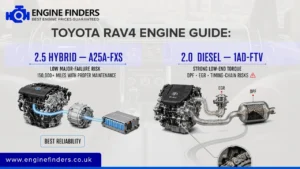
The Toyota RAV4 2.5-litre hybrid (A25A-FXS) is widely regarded as the most reliable engine option for UK buyers, routinely surpassing 150,000 miles with minimal major issues when properly maintained. In contrast, the older 2.0-litre diesel (1AD-FTV) offers strong low-end torque but carries a higher risk of costly failures related to the Diesel Particulate Filter (DPF), Exhaust Gas Recirculation (EGR) system, and timing chain wear.
If you are deciding between keeping, buying, or replacing a RAV4 engine, understanding these distinct failure profiles is critical to avoiding unexpected repair bills.
Quick Summary: 2.5 Hybrid vs 2.0 Diesel
- Most Reliable Option: 2.5L Hybrid (A25A-FXS / 2AR-FXE). Fewer moving parts in the combustion cycle and regenerative braking reduce wear on traditional friction components.
- Most Common Hybrid Fault: Auxiliary radiator fan failure and inverter coolant pump issues, which are relatively inexpensive to resolve compared to major mechanical failures.
- Most Common Diesel Faults: DPF clogging (especially on short UK journeys), EGR valve carbon buildup, and premature timing chain stretch on higher-mileage examples.
- Indicative UK Replacement Cost (2026): £1,500–£2,500 for a used 2.5L hybrid unit; £1,800–£3,200 for a reconditioned 2.0L diesel. Fully fitted costs will be higher.
- ULEZ Compliance: Post-2019 2.5L hybrids are Euro 6 and fully ULEZ compliant. Most pre-2015 2.0L diesels are Euro 5 and will incur daily charges in Clean Air Zones.
For a deeper dive into model-specific quirks, you can explore our dedicated Toyota RAV4 engine page.
The Toyota RAV4 2.5L Hybrid: Reliability and Common Issues
The 2.5-litre hybrid powertrain, primarily the A25A-FXS (found in the 2019–present XA50 generation) and the earlier 2AR-FXE (2013–2018), is the cornerstone of the RAV4’s reputation for durability. Toyota’s Hybrid Synergy Drive system is designed to reduce strain on the internal combustion engine by relying on the electric motor for low-speed manoeuvring and initial acceleration.
Because the petrol engine frequently shuts off during idle and low-speed driving, components like the starter motor are replaced by a high-voltage generator, and traditional wear items like brake pads last significantly longer due to regenerative braking.
However, no powertrain is entirely fault-free. UK owners should be aware of a few specific weak points.
Known Weak Points in the 2.5L Hybrid System
- Auxiliary Radiator Fan Failure: The hybrid system has a dedicated cooling fan for the inverter. This fan is prone to bearing wear or electrical failure, which can trigger warning lights and force the vehicle into a reduced-power “limp” mode.
- Inverter Coolant Pump: Similar to the fan, the electric water pump circulating coolant through the inverter can fail, leading to overheating warnings.
- 12V Battery Drain: The auxiliary 12V battery, which powers the vehicle’s computers and wakes up the high-voltage system, can degrade faster than expected, especially if the vehicle is left stationary for extended periods.
For a detailed breakdown of cooling-related issues, our guide on Toyota RAV4 hybrid 2.5L overheating and auxiliary fan upgrades provides actionable diagnostic steps.
Official technical details on how these systems interact can be verified through Toyota UK’s hybrid technology resources.
The Toyota RAV4 2.0L Diesel: Reliability and Common Issues

The 2.0-litre diesel engine, coded as the 1AD-FTV (producing around 124 bhp), was a staple in the RAV4 lineup from 2006 to 2012. While it shares its fundamental architecture with the larger 2.2-litre 2AD-FTV, the 2.0L variant was generally slightly less stressed.
When comparing diesel vs petrol longevity, modern diesels in compact SUVs often face a harsher reality in the UK. The RAV4’s diesel engine was engineered for long, steady motorway runs, not the stop-start nature of British urban commuting.
DPF, EGR, and Timing Chain Concerns
- DPF Clogging: The Diesel Particulate Filter traps soot and requires high exhaust temperatures to regenerate (burn off the soot). Short, low-speed journeys prevent this, leading to blocked filters, restricted airflow, and eventual engine limp mode.
- EGR Valve Carbon Buildup: The Exhaust Gas Recirculation (EGR) system redirects exhaust gases to lower combustion temperatures. Over time, this mixes with oil vapour to create thick carbon sludge, restricting airflow and causing rough idling or poor fuel economy.
- Timing Chain Stretch: While more prevalent in the 2.2L variant, the 1AD-FTV can also suffer from timing chain tensioner wear or chain stretch beyond 100,000 miles, resulting in a distinct rattling noise on cold starts.
If you are exploring broader options across the brand, our Toyota engines overview highlights which powertrains offer the best long-term value.
Head-to-Head Comparison: 2.5 Hybrid vs 2.0 Diesel

The table below summarises the key differences between these two popular RAV4 powertrains to help you make an informed decision.
| Feature | 2.5L Hybrid (A25A-FXS / 2AR-FXE) | 2.0L Diesel (1AD-FTV) |
| Typical Model Years | 2013–Present | 2006–2012 |
| Power Output | 176–218 bhp (combined system) | 124 bhp |
| Torque | 163 lb-ft (engine only) | 229 lb-ft |
| Primary Reliability Risk | Auxiliary fan, inverter pump, 12V battery | DPF blockage, EGR clogging, timing chain |
| Maintenance Cost | Low to Moderate | Moderate to High (if DPF/EGR fails) |
| ULEZ / CAZ Compliance | Fully compliant (Euro 6) | Mostly non-compliant (Euro 5) |
| Indicative Used Engine Cost | £1,500 – £2,500 | £1,200 – £2,000 |
| Best Use Case | Mixed urban/motorway, family commuting | High-mileage motorway cruising, towing |
Note: Pricing is indicative based on UK market observations in 2026 and excludes VAT, delivery, and fitting labour.
UK Engine Replacement Costs: What to Expect in 2026
When an engine fails, understanding the true cost of replacement is vital. A common mistake is comparing an engine-only price with a fully fitted quote.
Based on current UK market data, here is a realistic breakdown of what you might expect to pay:
- Used 2.5L Hybrid Engine: £1,500 – £2,500. Hybrids hold their value well, and complete, low-mileage donor units are in high demand.
- Reconditioned 2.0L Diesel Engine: £1,800 – £3,200. A professionally rebuilt unit with a new DPF, EGR, and timing chain will sit at the higher end of this spectrum.
- Labour and Ancillaries: Expect to add £800 – £1,500 for professional fitting. This covers engine removal, installation, new fluids, seals, and diagnostic ECU coding.
For a comprehensive breakdown of what influences these figures, refer to our engine replacement cost UK guide.
Need a precise figure for your vehicle?
Don’t rely on guesswork. Get a free, no-obligation quote from our vetted UK supplier network. We match your exact registration to verified used and reconditioned engine stock, complete with warranty options.
Which Toyota RAV4 Engine Should You Buy or Keep?
The “best” engine depends entirely on your driving profile and financial priorities.
Choose the 2.5L Hybrid if:
- You do a mix of urban and motorway driving.
- You live in or frequently travel to a ULEZ or Clean Air Zone.
- You prioritise low running costs, smooth refinement, and long-term reliability over outright towing capacity.
Choose the 2.0L Diesel if:
- You regularly cover high annual mileage (15,000+ miles) predominantly on A-roads or motorways.
- You need consistent low-end torque for towing a caravan or trailer.
- You are purchasing an older model on a strict budget and are prepared to maintain the DPF/EGR systems proactively.
If you are considering a replacement, always verify the history of the unit. Learning how to check if a car has its original engine can protect you from purchasing a vehicle with a poorly documented past. Furthermore, reviewing what to check before buying a reconditioned engine online ensures you do not fall victim to substandard rebuilds.
When evaluating whether to repair or replace, a useful rule of thumb is to compare the total replacement cost against the vehicle’s current private-sale value. If the repair exceeds 50–60% of the car’s value, it may be more economical to explore the cheapest ways to replace a car engine in the UK or consider a vehicle upgrade.
Enter Your REG to Get a Free Engine Quote

Frequently Asked Questions
Is the Toyota RAV4 2.5 hybrid engine reliable?
Yes, the 2.5L hybrid (A25A-FXS and 2AR-FXE) is highly reliable. Its design reduces wear on traditional combustion components. The most common issues are minor, such as auxiliary fan or 12V battery failures, rather than catastrophic mechanical damage.
What are the most common problems with the RAV4 2.0 diesel?
The 1AD-FTV 2.0L diesel is prone to DPF (Diesel Particulate Filter) clogging, EGR (Exhaust Gas Recirculation) valve carbon buildup, and, at higher mileages, timing chain stretch. These are exacerbated by frequent short, urban journeys.
How much does it cost to replace a Toyota RAV4 engine in the UK?
Indicative costs for a used 2.5L hybrid engine range from £1,500 to £2,500, while a reconditioned 2.0L diesel costs between £1,800 and £3,200. Professional fitting labour and ancillaries typically add £800 to £1,500 to the final bill.
Is a diesel Toyota RAV4 ULEZ compliant?
Most 2.0L diesel RAV4 models registered before September 2015 are Euro 5 and are not ULEZ compliant, meaning they incur a daily charge in London and other Clean Air Zones. Post-2019 2.5L hybrids are Euro 6 and fully compliant. You can verify your specific vehicle at the TfL ULEZ Checker.
Can I replace a diesel RAV4 engine with a hybrid one?
While technically possible, swapping a diesel for a hybrid powertrain is highly complex, expensive, and requires extensive ECU reprogramming and wiring modifications. In the UK, significant engine changes may also require a DVLA Vehicle Identity Check (VIC) to ensure the vehicle’s registration documents are updated correctly.
How long does a Toyota RAV4 hybrid engine last?
With proper maintenance, including regular oil changes and hybrid system inspections, a RAV4 2.5L hybrid engine can comfortably exceed 150,000 to 200,000 miles. However, lifespan is heavily dependent on service history, driving conditions, and the health of the high-voltage battery.