Executive Summary
The K9K engine, commonly known as the Renault 1.5 dCi, is a 1,461 cc turbo-diesel engine produced since 2001 by the Renault-Nissan alliance. It has been fitted to millions of vehicles across Renault, Nissan, Dacia, Mercedes-Benz, and even some Peugeot and Citroën models. While celebrated for its fuel efficiency and tractable low-end torque, the K9K has developed a reputation for several well-documented reliability issues that UK owners should understand before buying or maintaining one.
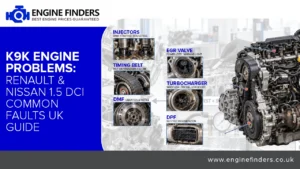
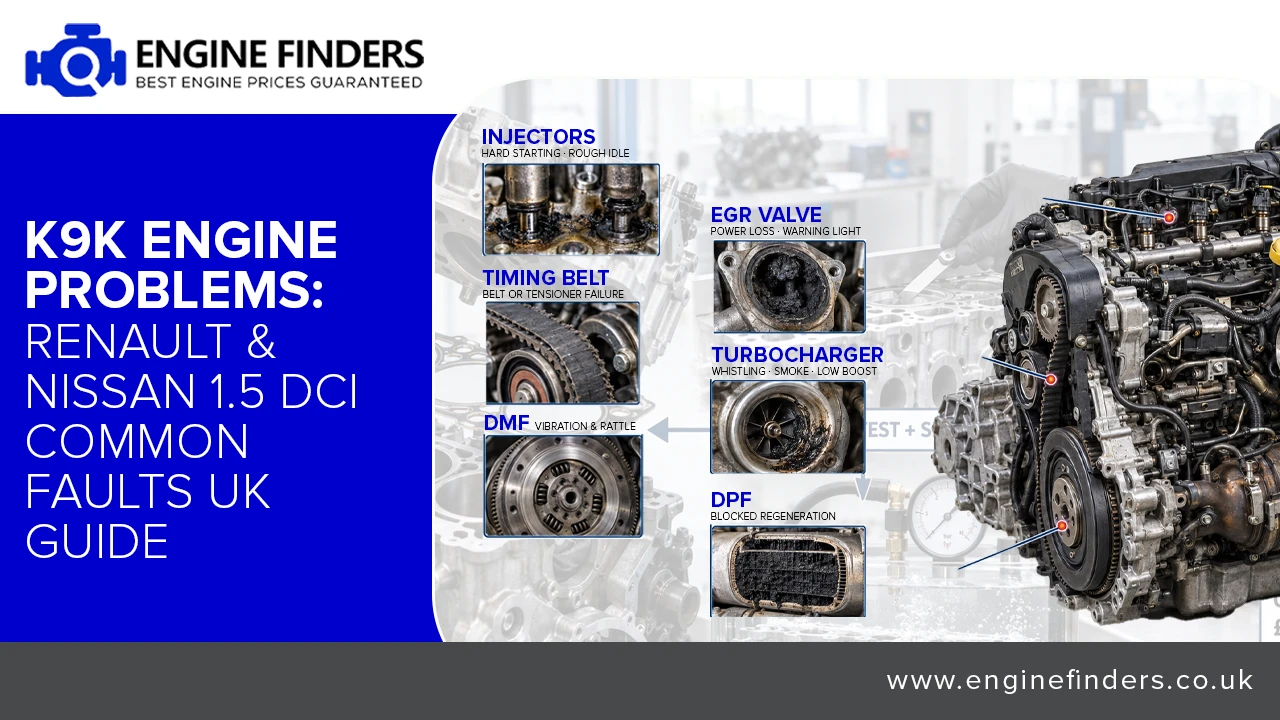
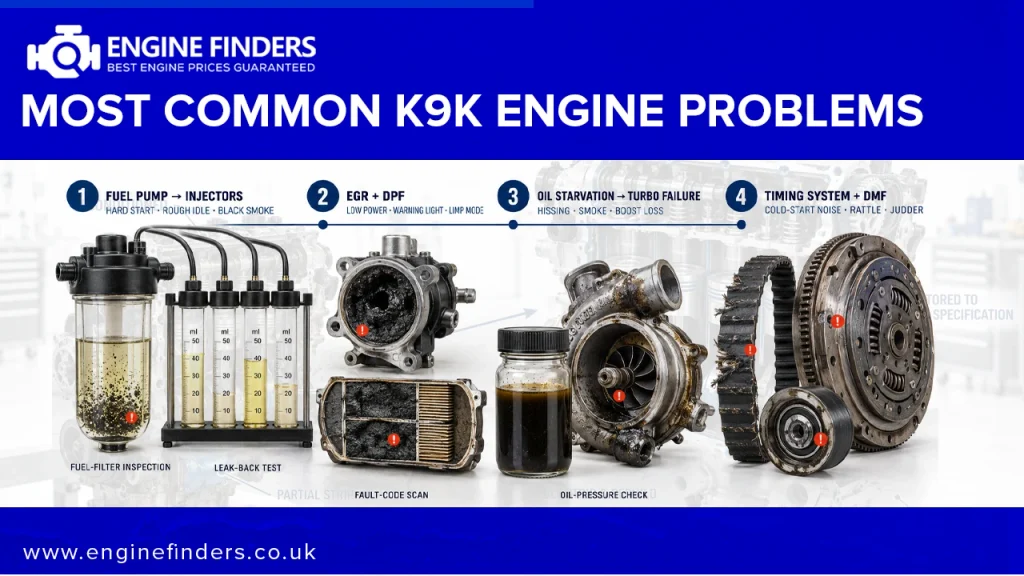
The most common K9K engine problems include injector failure (particularly with Delphi systems), EGR valve clogging, timing belt or chain failures, turbocharger issues, dual-mass flywheel (DMF) wear, and high-pressure fuel pump failure. These faults vary by specific K9K variant, as there are over 30 different codes (e.g., K9K 608, K9K 657, K9K 704, K9K 826), each with its own characteristics and weak points.
For UK buyers, emissions compliance is a key consideration: early K9K engines (pre-2005) are typically Euro 3 and not ULEZ-compliant, while later variants (Euro 4, Euro 5, and Euro 6) may be compliant depending on the specific model year and vehicle. Replacement engine costs range from £450 for a used unit to £2,500+ for a reconditioned engine with warranty.
Engine Finders is a price comparison platform, not a direct engine seller. Final pricing, warranty terms, and availability vary by vetted UK supplier. Professional diagnosis is recommended before purchasing any replacement engine.
What Is the K9K Engine?
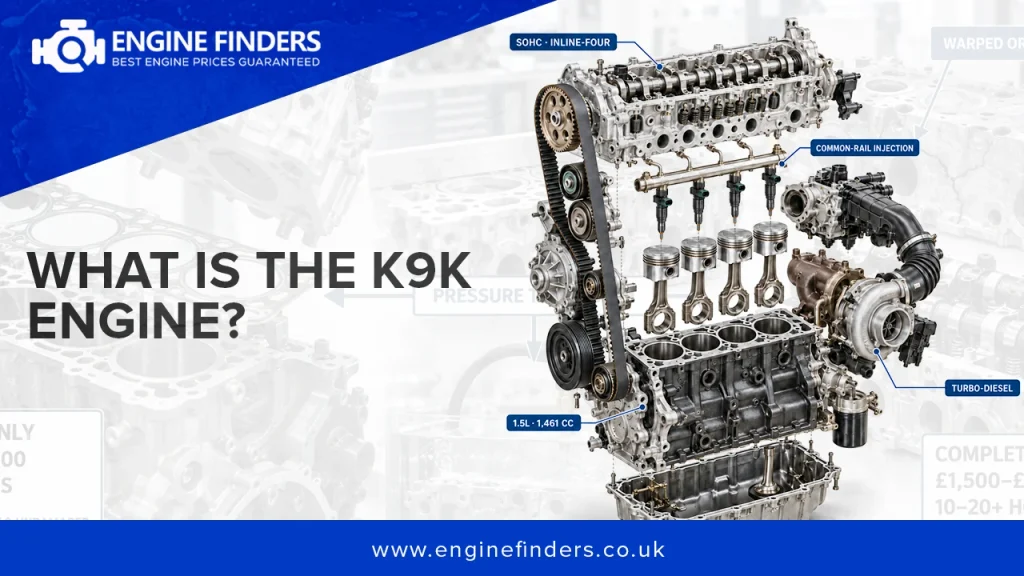
The K9K is a 1.5-litre (1,461 cc) inline-four turbo-diesel engine developed by Renault and used extensively across the Renault-Nissan-Mitsubishi alliance. It features:
- Common rail direct injection (varying suppliers including Delphi, Siemens VDO, and Denso)
- Single overhead camshaft (SOHC) design
- Turbocharged induction with fixed-geometry turbochargers (Garrett)
- Cast iron block with aluminium cylinder head
Key Applications in the UK Market
| Brand | Models |
|---|---|
| Renault | Clio, Megane, Scenic, Modus, Kangoo, Captur, Kadjar |
| Nissan | Qashqai, Juke, Pulsar, Micra, Note |
| Dacia | Sandero, Logan, Duster |
| Mercedes-Benz | A-Class (W176), B-Class (W246), as OM607 |
| Other | Certain Peugeot, Citroën, and Suzuki models |
The K9K is the same unit fitted to the Nissan Qashqai as the 1.5 dCi, so many of the faults below apply directly to Qashqai, Juke, and Micra owners.
K9K Variant Overview
There are over 30 K9K variants, each with different power outputs, emissions standards, and specific components. Key UK-relevant variants include:
| Variant | Years | Power | Timing | Key Issues |
|---|---|---|---|---|
| K9K 657 | 2001–2008 | 68 PS | Chain | High-pressure fuel pump failure |
| K9K 608 | 2005–2010 | 86 PS | Belt | DMF failure, EGR clogging |
| K9K 704 | 2007–2018 | 90 PS | Belt | EGR clogging, DPF issues (post-2011) |
| K9K 826 | 2012–2018 | 68 PS | Chain | High-pressure fuel pump failure |
Most Common K9K Engine Problems
1. Injector Failure
Injector failure is one of the most frequently reported issues on K9K engines, particularly those fitted with Delphi injectors.
Causes:
- Poor-quality fuel causing injector nozzle clogging
- Metallic fragments from a failing high-pressure fuel pump contaminating the injectors
- General wear and tear, particularly on higher-mileage examples
Symptoms:
- Difficulty starting (hot or cold)
- Rough idle or stalling at idle
- Black smoke from the exhaust
- “Check Injection” warning light on the dashboard
- Tapping or knocking noise from the engine bay
- Smell of fuel in the cabin
Repair considerations:
- Injectors cost approximately £100 each and are best replaced as a full set
- New injectors must be coded to the ECU using specialist diagnostic software
- A leak-back test is the first diagnostic step
Critical warning: If an injector fails badly, it can cause a piston to melt or burn through. Injector and glow plug failures have been known to cause pistons to fail catastrophically.
2. EGR Valve Clogging
The Exhaust Gas Recirculation (EGR) valve is a very common failure point on K9K engines, particularly on vehicles used predominantly for short-trip urban driving.
Causes:
- Carbon and soot buildup from exhaust gases
- Short-trip driving cycles prevent the EGR system from clearing deposits
- Urban use is the primary risk factor
Symptoms:
- Rough idle or stalling at idle
- Sluggish acceleration
- Increased fuel consumption
- Engine management light (common fault codes: P0401, P0402, P0403)
- Difficulty starting
Repair considerations:
- EGR valve cleaning is a common maintenance item
- Replacement may be required if cleaning is ineffective
- Regular longer, faster journeys help reduce EGR clogging
3. Timing System Failures
The K9K engine uses either a timing chain or a timing belt depending on the variant. Both can fail, with catastrophic consequences.
Timing Belt (K9K 608, K9K 704):
- Replacement interval: Every 5 years or 75,000 to 90,000 miles, whichever comes first
- The timing belt must be replaced at the specified interval and not exceeded
- A snapped timing belt will cause catastrophic engine damage (bent valves, damaged pistons)
- Many owners report that the 5-year time interval is the most critical
Timing Chain (K9K 657, K9K 826):
- Timing chain tensioners are prone to wear
- If the tensioner fails, the chain can jump or snap
- Tensioner rattle should be inspected around 150,000 km (93,000 miles)
Warning signs:
- Rattle or noise from the timing cover on cold start
- Engine management light
- Loss of power or rough running
4. Turbocharger Failure
Turbocharger issues are reported on K9K engines, particularly from around 60,000 miles.
Causes:
- Oil starvation (often due to extended service intervals or using incorrect oil)
- Carbon buildup affecting the variable geometry (where fitted)
- Contaminated oil from injector failure
Symptoms:
- Loss of power or hesitation under acceleration
- Hissing noise from the engine bay (boost leak)
- Black smoke from exhaust
- “Check Injection” warning light
- Fault codes relating to boost pressure or turbo actuator
Prevention:
- Strict adherence to oil change intervals
- Using the correct Renault RN0700 specification oil (5W-40 or 5W-30)
5. Dual-Mass Flywheel (DMF) Failure
The dual-mass flywheel is a known weak point on K9K engines, particularly the K9K 608.
Causes:
- Wear and tear from frequent stop-start driving or towing
- Internal damper failure
Symptoms:
- Drivetrain shudder under load
- Rattle or noise from the gearbox area, particularly on idle
- Clutch judder
Repair considerations:
- DMF replacement is expensive, typically £600 to £1,000 including labour
- Later K9K variants featured a revised flywheel design for improved durability
6. High-Pressure Fuel Pump Failure
High-pressure fuel pump failure is documented across multiple K9K variants.
Affected variants:
- K9K 657 (pre-2005 models most susceptible)
- K9K 826 (pre-mid-2015 models)
Causes:
- Fuel contamination (poor-quality diesel)
- Extended service intervals
- Lack of regular fuel filter changes
Symptoms:
- No-start condition
- Engine warning light (P0002, P0087)
- Poor idle or rough running
- Metallic fragments in the fuel filter, a critical warning sign
Repair considerations:
- High-pressure fuel pump replacement is expensive
- If the pump fails, it can send metallic fragments through the fuel system, damaging injectors
- Regular fuel filter changes are essential for prevention
7. Diesel Particulate Filter (DPF) Issues
On Euro 5 K9K variants (post-2011), the DPF can cause problems, particularly for urban drivers.
Causes:
- Short-trip driving prevents passive DPF regeneration
- Ignoring DPF warning lights
Symptoms:
- DPF warning light on dashboard
- Reduced performance or limp mode
- Increased fuel consumption
- Regeneration errors
Prevention:
- Regular motorway driving (at least 20 to 30 minutes) to allow passive regeneration
- Using ultra-low sulfur diesel (EN 590)
- Do not ignore DPF warning lights. A blocked filter may eventually need DPF replacement
UK-Specific Considerations
ULEZ and Emissions Compliance
Emissions compliance is a critical consideration for UK K9K owners:
| Euro Standard | Typical Model Years | ULEZ Compliant? |
|---|---|---|
| Euro 3 | Pre-2005 (K9K 657) | Not compliant |
| Euro 4 | 2005–2010 (K9K 608, early K9K 704) | Petrol equivalent standard |
| Euro 5 | 2011–2018 (K9K 704, K9K 826) | Diesel non-compliant (Euro 6 required) |
| Euro 6 | 2018+ (later K9K variants) | Compliant |
Key points:
- Diesel cars must meet Euro 6 standards to be ULEZ-compliant
- Early K9K engines (pre-2005, Euro 3) are not ULEZ-compliant and will incur the £12.50 daily charge
- Always check your specific vehicle’s Euro standard using the GOV.UK clean air zones service before purchasing
MOT Emissions Testing
K9K engines generally pass MOT emissions tests when properly maintained. However:
- A clogged EGR valve or failing injector can cause test failure
- DPF removal is illegal and will cause MOT failure
- Regular maintenance is essential for emissions compliance
You can review any vehicle’s test record using the GOV.UK MOT history service before buying.
Road Tax (VED)
Vehicle Excise Duty is based on CO₂ emissions. K9K engines are generally in lower tax bands due to their efficiency, but:
- Early K9K engines may have higher CO₂ emissions
- Check the specific vehicle’s CO₂ rating before purchase
K9K Engine Replacement Costs UK
If your K9K engine has suffered catastrophic failure, replacement costs vary significantly:
| Engine Condition | Price Range | Example |
|---|---|---|
| Used engine (unknown condition) | £450–£1,100 | K9K 732: ~£763 |
| Used engine (tested, with warranty) | £1,000–£1,900 | Nissan Pulsar K9K: ~£1,264 |
| Reconditioned engine | £1,500–£2,500+ | Supplied and fitted: from ~£1,495 |
| New engine | £2,500–£3,000+ | Varies by supplier |
Labour costs:
- Engine replacement typically adds £600 to £1,200 depending on the workshop and vehicle
- Some suppliers offer “supplied and fitted” packages
Always verify:
- The exact K9K variant (e.g., K9K 608, K9K 704), as compatibility is not universal. Our engine compatibility guide explains how to confirm your engine code
- Warranty terms and conditions
- Whether ancillaries (turbo, injectors, fuel pump) are included
Browse used engines and reconditioned engines from vetted UK suppliers, or compare quotes for accurate, no-obligation pricing.
Practical Takeaways for K9K Owners and Buyers
Do
- Change the oil regularly, using Renault RN0700 specification oil (5W-40 or 5W-30) and not exceeding the recommended interval
- Replace the fuel filter regularly and inspect for metallic fragments (a sign of fuel pump failure)
- Use high-quality fuel, specifically EN 590 ultra-low sulfur diesel
- Replace the timing belt at the specified interval, every 5 years or 75,000 to 90,000 miles
- Take the car on longer journeys to allow DPF regeneration and reduce EGR clogging
- Have the engine diagnosed professionally if warning lights appear
- Verify the K9K variant before buying a replacement engine, following our used engine buying checklist
Don’t
- Ignore the “Check Injection” warning light, as it often indicates a serious issue
- Use poor-quality fuel, as it can destroy injectors and the fuel pump
- Ignore oil pressure or timing chain rattle, as catastrophic failure may be imminent
- Assume all K9K engines are the same, as compatibility varies by variant
- Buy a used engine without verifying the engine code and condition
Engines to Avoid
- Engines with no service history, where unknown maintenance is a gamble
- Engines with known injector or fuel pump issues, which can be expensive to repair
- Engines showing metallic fragments in the fuel filter, indicating fuel pump failure
- Engines with timing chain rattle, indicating potential catastrophic failure
Before committing, our guide on how to buy a used engine safely covers every check to make.
Enter Your REG to Get a Free Engine Quote

Frequently Asked Questions
What are the most common K9K engine problems?
The most common K9K engine problems are injector failure (particularly with Delphi systems), EGR valve clogging, timing belt or chain failure, turbocharger issues, dual-mass flywheel wear, and high-pressure fuel pump failure. Symptoms include rough idle, black smoke, difficulty starting, and “Check Injection” warning lights.
How reliable is the Renault 1.5 dCi engine?
The K9K 1.5 dCi is generally reliable when properly maintained, with many examples exceeding 150,000 miles. However, it has well-documented weak points that require attention: regular oil changes (Renault RN0700), timely timing belt replacement (5 years/75,000 miles), and using high-quality fuel are essential for longevity.
How much does a K9K engine replacement cost in the UK?
A used K9K engine typically costs £450 to £1,900 depending on variant and condition. Reconditioned units range from £1,500 to £2,500+. Labour adds £600 to £1,200. Compare quotes from vetted UK suppliers for accurate, no-obligation pricing.
When should the K9K timing belt be replaced?
The K9K timing belt must be replaced every 5 years or 75,000 to 90,000 miles, whichever comes first. The 5-year time interval is particularly critical. A snapped timing belt will cause catastrophic engine damage.
Is the K9K engine ULEZ compliant?
It depends on the Euro standard, not the engine itself. Early K9K engines (pre-2005, Euro 3) and Euro 5 diesels are not ULEZ-compliant, as ULEZ requires Euro 6 for diesel vehicles. Euro 6 variants (2018+) are compliant. Always check your specific vehicle’s emissions standard.
What oil should I use in a K9K engine?
Use Renault RN0700 specification oil, typically SAE 5W-40 for older variants (K9K 657, K9K 608, K9K 704) and SAE 5W-30 for newer variants (K9K 826). Never exceed the recommended service interval.