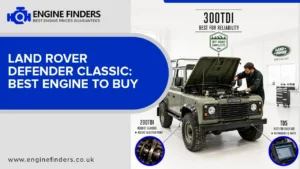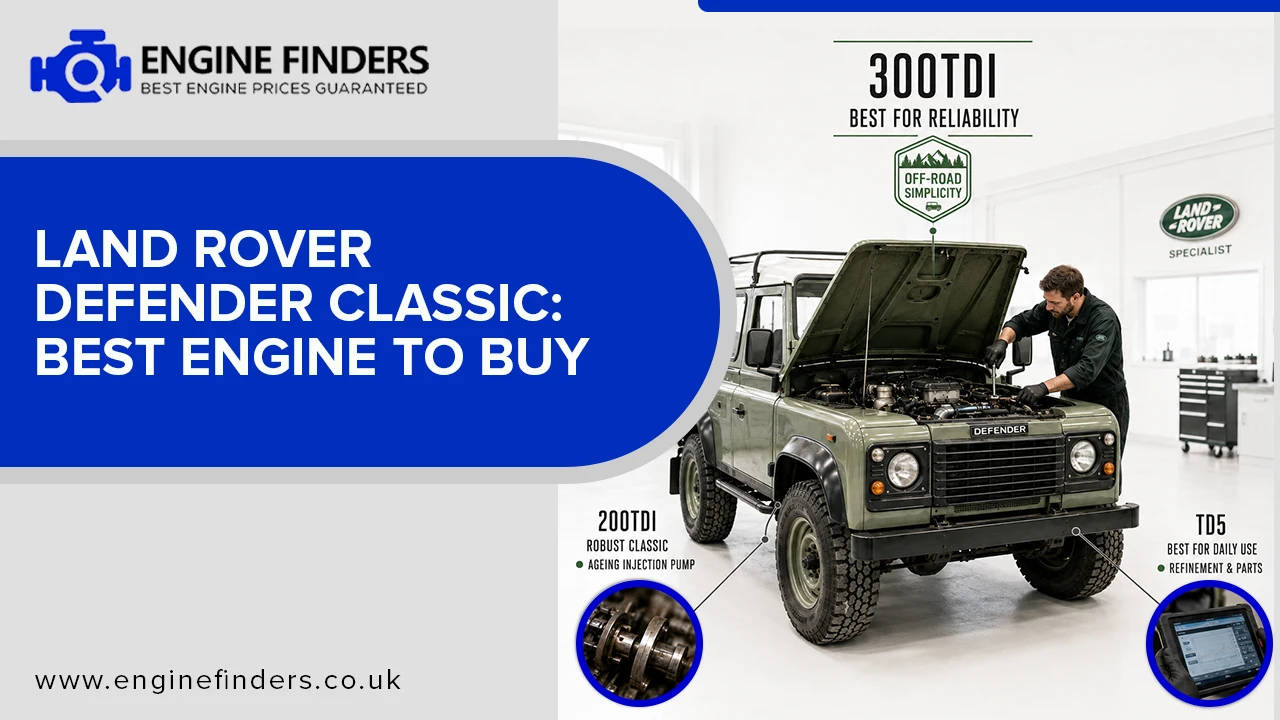
For classic Land Rover Defender owners, the 300Tdi is widely regarded as the best engine to buy for pure mechanical reliability, while the Td5 offers the best balance of everyday refinement and parts availability. The earlier 200Tdi is a robust classic but increasingly suffers from age-related injector pump wear. Your ideal choice depends entirely on whether you prioritise off-road simplicity or on-road drivability.
If you are researching a replacement or upgrade, understanding the distinct failure points, maintenance demands, and current UK market costs of these three iconic diesel engines is essential before making a purchase.
Quick Summary
- Most Reliable: 300Tdi (mechanically simple, robust block, easily repaired).
- Best for Daily Driving: Td5 (quieter, more torque, better fuel economy, but requires electrical vigilance).
- Best for Collectors: 200Tdi (original classic feel, though parts are becoming scarcer).
- Common 300Tdi Fault: Cylinder head gasket failure if overheated.
- Common Td5 Fault: Water ingress damaging the ECU and injector wiring loom.
- Indicative UK Replacement Cost (Engine Only): £1,500 – £3,800 depending on condition and specification.
- What to Avoid: Buying a Td5 without verifying the ECU part number and checking for water in the footwells.
Understanding the Classic Defender Engine Lineup
The classic Land Rover Defender (produced until 2016, though the “classic” era generally refers to pre-2007 models) was powered by three main iterations of Land Rover’s inline-four diesel engine. Each represents a different era of automotive engineering.
The 200Tdi (1989–1994) introduced direct injection to the Defender, replacing the older indirect-injection diesels. The 300Tdi (1994–2006) refined this design with a quieter, more efficient cylinder head and improved lubrication. Finally, the Td5 (1998–2007) brought electronic engine management, delivering significantly more power, better emissions, and a smoother driving experience, albeit with added electrical complexity.
When exploring reconditioned Land Rover Defender engines, it is vital to match the engine code not just to the model year, but to the specific chassis and transmission setup.
Land Rover 200Tdi: The Original Workhorse
Introduced in 1989, the 200Tdi was a revelation for the Defender, offering a substantial power increase over its predecessors. It features a mechanically controlled Lucas/CAV DPC rotary injection pump and a simple, robust design.
Reliability and Common Faults
Mechanically, the 200Tdi block is exceptionally strong. However, age is its primary enemy. The most common failure point is the rotary injection pump, which can suffer from internal wear, leading to hard starting, excessive smoke, or a complete loss of fuel pressure. Rebuilding these pumps requires specialist equipment. Additionally, the vacuum pump (driven off the camshaft) is known to fail, which can cause brake servo issues.
Because of its age, finding a low-mileage, original-specification 200Tdi is increasingly difficult. For detailed specifications and compatibility, refer to our dedicated Land Rover 200Tdi diesel engine page.
Land Rover 300Tdi: The Peak of Mechanical Simplicity
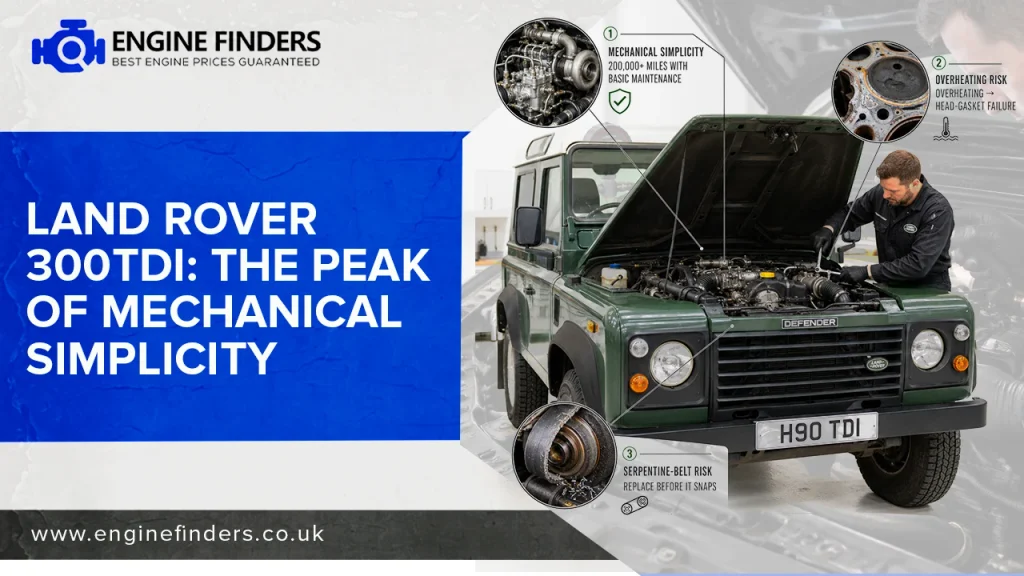
Launched in 1994, the 300Tdi is frequently cited by enthusiasts and mechanics as the sweet spot in classic Defender ownership. It retains the mechanical injection pump of the 200Tdi but features a redesigned, quieter cylinder head with swirl chambers, a more efficient turbocharger, and an improved oiling system.
Reliability and Common Faults
The 300Tdi is renowned for its durability. It can easily surpass 200,000 miles with basic maintenance. The most well-documented weakness is the cylinder head gasket. If the engine is allowed to overheat, the head gasket can fail, sometimes leading to cracked cylinder heads if not addressed immediately.
Another minor but notable issue is the serpentine belt. If it snaps, it can be drawn into the front crankshaft oil seal, causing significant oil leaks. Preventative replacement of this belt is a standard part of any essential Land Rover Defender engine maintenance routine.
For those seeking a dependable workhorse, sourcing a reconditioned 300Tdi engine is often the most cost-effective long-term strategy.
Land Rover Td5: The Modern Classic Compromise
Introduced in 1998, the Td5 (engine codes 10P and 15P) marked a major technological leap. It utilised an Electronic Control Unit (ECU) to manage fuel injection, resulting in a quieter cabin, increased torque (up to 300 Nm), and better fuel economy.
Reliability and Common Faults
While the mechanical internals of the Td5 are robust, its Achilles’ heel is electrical. The engine wiring loom, which runs along the cylinder head, is prone to oil wicking. Oil travels up the injector harness and into the ECU connector, causing corrosion, misfires, and the infamous “limp home” mode.
Water ingress is another critical issue. The Td5 ECU is mounted in the passenger footwell. If the bulkhead seals fail, water pools in the footwell, submerging and destroying the ECU.
Despite these electrical gremlins, the Td5 is highly desirable for its drivability. If you are considering a swap or replacement, reviewing a comprehensive Land Rover Td5 diesel engine guide is highly recommended to ensure you understand the ECU coding requirements.
Comparison Table: 200Tdi vs 300Tdi vs Td5
| Feature | 200Tdi | 300Tdi | Td5 (10P/15P) |
| Production Years | 1989 – 1994 | 1994 – 2006 | 1998 – 2007 |
| Power Output | ~107 bhp | ~111 bhp | ~122 bhp (10P) / 130 bhp (15P) |
| Torque | 265 Nm | 280 Nm | 300 Nm – 330 Nm |
| Fuel System | Mechanical Rotary Pump | Mechanical Rotary Pump | Electronic Unit Injectors (ECU controlled) |
| Primary Weakness | Injector pump wear, age | Head gasket (if overheated) | Wiring loom oil wicking, ECU water damage |
| Maintenance Cost | Moderate (specialist pump work) | Low (highly DIY-friendly) | Moderate (requires diagnostic tools) |
| Best Use Case | Historical preservation, light use | Serious off-roading, remote travel | Daily driving, towing, on-road comfort |
Replacement Costs and Buying Advice (UK 2026)
When budgeting for an engine replacement, it is crucial to separate the cost of the engine unit from the total installed cost. Based on current UK market data, here is an indicative breakdown:
- Used 300Tdi / Td5: £1,200 – £2,200. (Risk: Unknown service history, potential hidden faults).
- Reconditioned 300Tdi / Td5: £2,500 – £3,800. (Includes new head gasket, seals, and often a rebuilt injection pump or new loom).
- Labour and Fitting: £800 – £1,500. (Varies significantly based on chassis condition, rusted bolts, and regional specialist rates).
- Ancillaries: £200 – £400 (New fluids, filters, belts, and engine mounts).
Total Indicative Installed Cost: £3,500 – £5,700.
Note: These figures are indicative averages for 2026 and exclude VAT unless explicitly stated by the supplier. Always confirm what is included in a reconditioned engine price, such as the injection pump, turbocharger, and ECU.
If your current engine has suffered catastrophic failure, consulting a Land Rover engine failure guide can help you determine whether a repair or a full replacement is more financially viable. You can also explore used Land Rover engines or reconditioned options to compare supplier offerings.
Need a Replacement Engine?
Don’t gamble with unknown mileage or hidden faults. Get a competitive, no-obligation quote for a verified used or reconditioned Land Rover Defender engine from our network of trusted UK specialists. All suppliers are vetted for quality and warranty compliance.
Legal and Practical Considerations for Engine Swaps
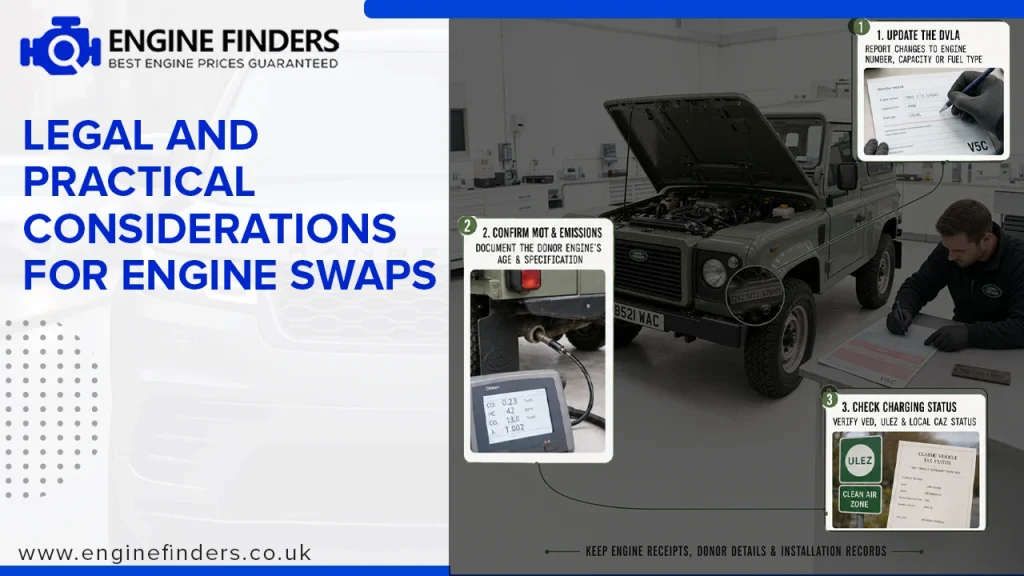
If you are swapping a 200Tdi for a Td5, or replacing a like-for-like engine, there are legal and regulatory steps to follow in the UK.
- DVLA Notification: If you change the engine to one with a different capacity or fuel type, you must notify the DVLA. Even for a like-for-like replacement, it is best practice to update your V5C logbook with the new engine number. You can find the official process on the GOV.UK vehicle change notification page.
- MOT and Emissions: A Td5 swap into an older chassis must meet the emissions standards applicable to the donor engine’s year of manufacture, not necessarily the chassis year. Ensure the swap is documented correctly to avoid MOT failure.
- ULEZ and Classic Vehicle Tax: Vehicles over 40 years old are generally exempt from Vehicle Excise Duty (VED) and ULEZ charges. You can verify your vehicle’s specific status using the official GOV.UK classic vehicle tax checker. However, be aware that local Clean Air Zones may have specific rules, which can be checked via the national Clean Air Zone framework.
Which Engine Should You Choose?
The “best” engine is entirely subjective and depends on your intended use:
- Choose the 300Tdi if: You want the most reliable, mechanically simple engine. It is the preferred choice for overlanders, farmers, and those who repair their own vehicles in remote locations. Our analysis of the most reliable Land Rover engines consistently highlights the 300Tdi’s durability.
- Choose the Td5 if: You use your Defender for daily commuting, towing, or motorway driving. The refinement, power, and fuel economy are vastly superior, provided you proactively manage the wiring loom and ECU water risks. For a broader perspective on Defender ownership, read our guide on buying a Land Rover Defender engine in the UK.
- Choose the 200Tdi if: You are restoring a vehicle to original factory specification and value historical authenticity over modern convenience.
(Note: For those looking beyond the classic era, understanding the transition to modern powertrains is also valuable. See our guide on the Defender Puma 2.2 engine survival kit for context on later models).
Enter Your REG to Get a Free Engine Quote

Frequently Asked Questions
Is the Land Rover 300Tdi engine reliable?
Yes, the 300Tdi is widely considered one of Land Rover’s most reliable diesel engines. Its mechanical injection system and robust cast-iron block make it highly durable, provided it is not allowed to overheat, which can cause head gasket failure.
What is the most common Td5 engine problem?
The most common Td5 issue is oil wicking through the injector wiring loom into the ECU connector, causing electrical faults and “limp mode.” Water ingress into the passenger footwell can also destroy the ECU.
How much does a Land Rover Defender engine replacement cost in the UK?
Indicative UK pricing for a reconditioned 300Tdi or Td5 engine ranges from £2,500 to £3,800 for the unit alone. Total installed costs, including labour, fluids, and ancillaries, typically range from £3,500 to £5,700.
Can I swap a Td5 engine into an older 300Tdi Defender?
Yes, a Td5 swap is a popular upgrade. However, it requires swapping the ECU, wiring loom, pedals, and instrument cluster. You must also notify the DVLA of the engine change and ensure the vehicle meets relevant MOT emissions standards.
Are 200Tdi engines still worth buying in 2026?
They are worth buying primarily for historical restoration projects. For daily use or heavy work, the 200Tdi’s age makes finding reliable, unworn injector pumps difficult, making the 300Tdi a more practical choice for most owners.