Executive Summary
The Volkswagen Golf R’s EA888 Gen 3 engine is one of the most capable four-cylinder turbocharged petrol engines ever produced. Fitted to the Mk7 and Mk7.5 Golf R (2013 to 2020), this 2.0-litre TSI unit delivers 300 PS (296 bhp) and 400 Nm of torque in standard form, propelling the Golf R from 0 to 62 mph in just 4.7 seconds with the DSG gearbox. The engine is renowned for its tuning potential, with Stage 1 remaps pushing power beyond 360 bhp and hybrid turbo builds exceeding 500 bhp.
Key verdict: The EA888 Gen 3 is a fundamentally robust and tuneable engine, but it has specific weak points including water pump/thermostat housing failures, timing chain stretch, and early piston ring land issues on 2015 to 2017 examples. Used engines range from £1,500 to £3,500, while professionally reconditioned units with warranty command £4,000 to £7,000+. The CJXC/CJXB engine codes are the most common Golf R variants, with later CYFB and DNUE codes featuring incremental improvements.
Engine Finders is a price comparison platform, not a direct engine seller. Final pricing, warranty terms, and availability vary by vetted UK supplier. Professional diagnosis is recommended before purchasing any replacement engine.
What is the EA888 Gen 3 Engine?
The EA888 is Volkswagen Group’s third-generation 2.0-litre turbocharged four-cylinder petrol engine, introduced in 2012. It features an aluminium cylinder block, DOHC valvetrain with four valves per cylinder, and a combination of direct and port fuel injection (dual injection) on most high-output variants.
EA888 Gen 3 Specifications (Golf R)
| Specification | Detail |
|---|---|
| Engine code | CJXC, CJXB (Mk7), CYFB (Mk7.5), DNUE (later) |
| Production years | 2013–2020 (Mk7/Mk7.5 Golf R) |
| Displacement | 1,984 cc |
| Cylinder configuration | Inline-4, aluminium block |
| Fuel system | Direct injection + port injection (dual) |
| Power | 300 PS (296 bhp) @ 5,500-6,200 rpm |
| Torque | 400 Nm (295 lb-ft) @ 1,800-5,500 rpm |
| Turbocharger | BorgWarner IS38 |
| Compression ratio | 9.3:1 |
| Applications | VW Golf R Mk7/7.5, Audi S3 8V, Seat Leon Cupra, Audi TTS |
EA888 Gen 3 Variants in the Golf R
| Generation | Engine Code | Power | Torque | Years |
|---|---|---|---|---|
| Mk7 Golf R | CJXC / CJXB | 300 PS | 400 Nm | 2013-2016 |
| Mk7.5 Golf R | CYFB / DNUE | 300 PS | 400 Nm | 2017-2020 |
| Mk8 Golf R | EA888 Evo4 | 320 PS | 420 Nm | 2020+ |
The Mk7 and Mk7.5 Golf R engines are mechanically very similar, with the CJXC/CJXB codes used in earlier cars and CYFB/DNUE in later facelift models. All use the BorgWarner IS38 turbocharger, which is larger than the IS20 found in the Golf GTI. The same EA888 family also powers the Audi S3 and Seat Leon Cupra, so the faults below apply across all three.
Golf R Engine Prices UK (2026)
Price Ranges by Engine Type
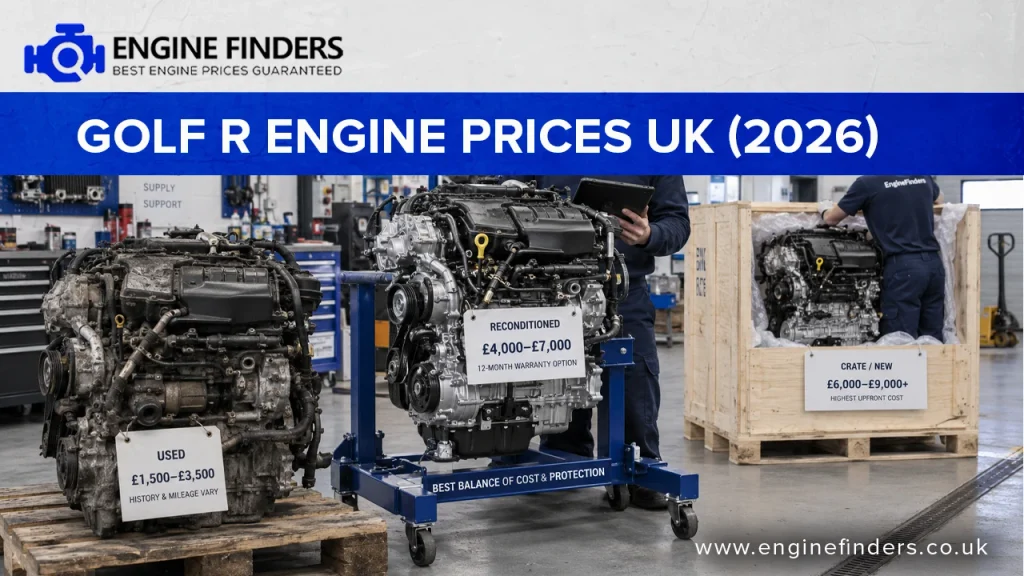
| Engine Type | Price Range (inc. VAT) | Warranty | Typical Mileage / Condition |
|---|---|---|---|
| Used (private/breaker) | £1,500 – £2,500 | None / limited | 40,000-100,000+ miles; condition varies |
| Used (trade supplier) | £2,000 – £3,500 | 3-6 months | Inspected, compression tested |
| Reconditioned (supply only) | £4,000 – £7,000 | 12 months | Professionally rebuilt to OEM+ spec |
| New crate engine (OEM) | £6,000 – £9,000+ | Manufacturer | Genuine VW supply |
| Exchange rebuild (bottom end) | £2,495 – £2,995 | Varies | Rebuilt bottom end only |
Cost Breakdown: What’s Included?
Used Engine (£1,500 to £3,500):
- Complete long engine (block, head, internals)
- May include ancillaries (turbo, injectors, alternator, starter)
- Limited or no warranty from trade suppliers
- Private sales are typically “sold as seen”
Browse used VW engines from vetted UK suppliers with verified condition.
Reconditioned Engine (£4,000 to £7,000):
- Fully stripped and rebuilt to OEM or better specifications
- New piston rings, bearings, timing chain kit, and gaskets
- Cylinder head reconditioned with new valve seals
- Water pump and thermostat housing replaced
- 12-month warranty typically included
- May include upgraded components (e.g., forged pistons)
Reconditioned VW engines from specialist rebuilders address the EA888’s known weak points. Our reconditioned engines buyers guide explains what a proper rebuild should include.
Crate/New Engine (£6,000 to £9,000+):
- Genuine VW or Audi supply
- Full OEM specification
- Comprehensive manufacturer warranty
- Highest cost option
What Affects the Price?
- Engine code, as CJXC/CJXB vs CYFB/DNUE differ and later codes may command a premium
- Mileage, as lower mileage engines fetch higher prices
- Service history, as documented maintenance adds value
- Ancillaries included, as turbo, injectors, ECU, and wiring loom add significant value
- Warranty, as a trade supplier with a 6-month warranty costs more than a private sale
- Location, as prices vary across the UK with London/South East typically higher
Known EA888 Gen 3 Problems in the Golf R
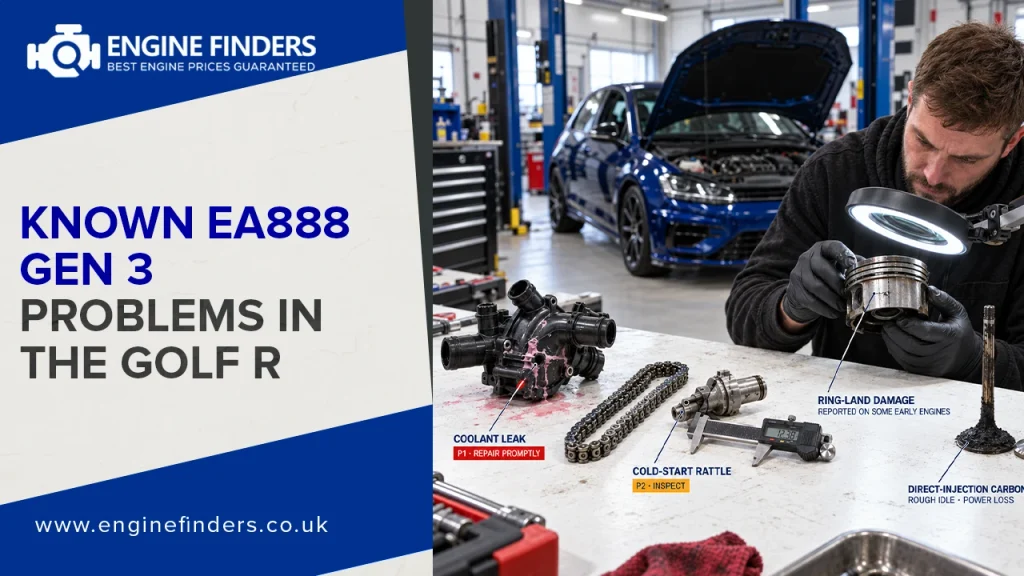
The EA888 Gen 3 is fundamentally a tough, tuneable engine, but like any high-performance turbocharged unit, it has specific vulnerabilities that UK owners should understand.
1. Water Pump and Thermostat Housing Failure (Urgent)
This is the most common issue affecting the EA888 Gen 3. The factory plastic thermostat housing degrades over time due to heat cycling, leading to coolant leaks. The electronic water pump can also fail, with the plastic impeller coming loose from the shaft.
Symptoms:
- Coolant loss without visible external leak
- Low coolant warning light
- Overheating under load
- Coolant smell from engine bay
- Error codes related to cooling system
Fix: Replace the water pump and thermostat housing as a complete unit. Many aftermarket suppliers offer upgraded aluminium housings that are more durable than the factory plastic units.
Cost: Water pump replacement typically costs £400 to £800 at an independent specialist. The job requires timing cover removal, with book time of 3.5 to 4.5 hours.
Prevention: Check coolant levels regularly and inspect for leaks. Replace the water pump proactively if you are having other engine work done.
2. Timing Chain Stretch (Urgent)
The EA888 Gen 3 uses a timing chain system that can stretch over time, particularly on higher-mileage or tuned examples. If the chain tensioner fails or the chain stretches excessively, catastrophic engine damage can occur. VW issued a recall on some EA888 timing chains, and our guide to the VW Tiguan EA888 timing chain recall explains how to check your VIN.
Symptoms:
- Rattling noise on cold start (especially after sitting overnight)
- Rough idle
- Timing-related fault codes
- Engine management light
Fix: Timing chain and tensioner replacement requires specialist tools and careful work. The timing cover must be removed, and the chain, guides, and tensioner replaced.
Cost: Timing chain replacement typically costs £800 to £1,500 at an independent specialist.
Prevention: Regular oil changes using the correct VW 504/507 specification oil are critical. Many UK specialists recommend 8,000 to 10,000-mile intervals rather than VW’s 18,000-mile LongLife schedule.
3. Piston Ring Land Failure (Early 2015-2017 Models)
Early EA888 Gen 3 engines (particularly 2015 to 2017 models) can suffer from piston ring land failure, typically affecting cylinders 3 or 4. This leads to excessive oil consumption and, in severe cases, catastrophic engine failure.
Symptoms:
- Excessive oil consumption (1 litre per 1,000 miles or more)
- Blue smoke from exhaust
- Loss of power
- Misfire codes
Fix: Complete engine rebuild with new pistons and rings, or engine replacement. Many specialist rebuilders use upgraded aftermarket pistons with improved ring land design.
Prevention: Regular oil changes and avoiding sustained high-load operation when the engine is cold. If buying a used Golf R from this era, have a compression test and leak-down test performed.
4. Carbon Build-Up on Intake Valves (Inspect)
As a direct-injection engine, the EA888 Gen 3 is susceptible to carbon deposits on the intake valves. This is exacerbated by short-trip driving where the engine does not reach optimal operating temperature. Our guide to Audi 1.4 TFSI carbon buildup and walnut blasting covers the same process, which applies to the EA888.
Symptoms:
- Reduced throttle response
- Poorer fuel economy
- Hesitation on acceleration
- Rough idle
Fix: Walnut blasting or chemical intake cleaning. This involves removing the intake manifold and blasting the valves with crushed walnut shells to remove carbon deposits.
Cost: Intake cleaning typically costs £300 to £600 at a specialist.
Prevention: Regular longer journeys and using quality fuel. Some owners fit catch cans to reduce oil vapour entering the intake system.
5. Oil Leaks from Timing Chain Cover (Inspect)
Oil leakage from the timing chain cover is a common issue on higher-mileage EA888 Gen 3 engines.
Symptoms:
- Oil staining on the front of the engine
- Oil drips on the driveway
- Burning oil smell
Fix: Timing chain cover reseal. This is labour-intensive as the cover must be removed and re-sealed with the correct sealant.
Cost: Typically £400 to £800 at an independent specialist.
6. High-Pressure Fuel Pump (HPFP) Seal Failure
The HPFP seals can degrade over time, leading to fuel leaks and potential fire risk.
Symptoms:
- Fuel smell from engine bay
- Fuel leaks visible around the pump
- Hard starting
- Fuel pressure fault codes
Fix: High-pressure fuel pump seal replacement or complete pump replacement.
Golf R Engine Buying Guide: Where and How to Buy
Best Sources for EA888 Gen 3 Engines in the UK
| Source | Pros | Cons | Best For |
|---|---|---|---|
| Specialist reconditioners | Professional rebuild, warranty, tested | Highest cost | Long-term reliability |
| Engine breakers / suppliers | Inspected, some warranty | Limited history | Budget with some peace of mind |
| Private sale (eBay, Gumtree) | Cheapest | Unknown history, no warranty | DIY rebuilders / project cars |
| VW specialist breakers | Known source, often with history | Can be expensive | Quality used engines |
What to Look For in a Used EA888 Gen 3
- Engine code, verifying the correct code for your vehicle (CJXC/CJXB for Mk7, CYFB/DNUE for Mk7.5). Our engine compatibility guide explains how
- Service history, as regular oil changes with correct VW 504/507 spec oil are non-negotiable
- Timing chain condition, listening for rattle on cold start
- Water pump condition, checking for coolant leaks and cooling system integrity
- Compression test, having a compression and leak-down test performed on any used engine
- Mileage, where lower mileage is generally better, but service history matters more
- Ancillaries, ensuring the engine comes with the correct turbo, injectors, and ECU if needed
Which Engine Code to Buy?
CJXC / CJXB (Mk7 Golf R, 2013-2016):
- Most common and widely available
- Well-understood tuning potential
- Early piston ring land issues on some examples
CYFB / DNUE (Mk7.5 Golf R, 2017-2020):
- Incremental improvements
- Generally more reliable
- Often command a premium
Recommendation: If buying used, prioritise a CYFB or DNUE engine from a 2017 to 2020 Mk7.5 Golf R. These have the benefit of later production improvements and are less prone to early piston ring land issues.
Models/Engines to Avoid
- High-mileage (over 80,000 miles) examples without documented timing chain replacement
- Engines with evidence of coolant leaks, as water pump/thermostat housing failure is common
- Engines with excessive oil consumption, which indicates potential piston ring issues
- Private sales with no service history, where unknown maintenance means unknown risk
- Engines from heavily modified cars, which may have been subjected to extreme stress
Our guide on how to buy a used engine safely covers every check to make before committing.
Golf R Engine Replacement Cost Breakdown

Full Replacement Costs
| Cost Component | Estimated Range | Notes |
|---|---|---|
| Engine supply | £1,500 – £7,000 | Used to reconditioned |
| Labour | £800 – £2,000 | 15-25 hours at £50-£100/hour |
| Parts & consumables | £500 – £1,000 | Oil, coolant, gaskets, mounts |
| Total | £3,500 – £9,500+ | Complete replacement |
Additional Costs to Consider
Labour: Golf R engine replacement typically requires 15 to 25 hours of labour. At UK independent specialist rates of £60 to £100 per hour, expect £900 to £2,500 for fitment. Main dealer rates are significantly higher (£150 to £200 per hour). Our engine replacement labour cost guide breaks down rates in detail.
Additional Parts: Replacement often requires new:
- Engine mounts (£200 to £400)
- Coolant and oil (£150 to £200)
- Timing chain kit (if not included) (£300 to £600)
- Gaskets and seals (£100 to £300)
- Water pump and thermostat (if not included) (£200 to £400)
Total Estimated Cost: A full EA888 Gen 3 replacement with labour and parts typically ranges from £3,500 to £9,500, depending on engine condition, supplier, and workshop rates.
Used vs Reconditioned vs New: Which is Best Value?
| Option | Pros | Cons | Best For |
|---|---|---|---|
| Used | Lower upfront cost | Unknown history; limited warranty | Budget-conscious; low-mileage donor |
| Reconditioned | Professionally rebuilt; 12-month warranty | Higher cost than used | Most UK owners seeking reliability |
| New | Full OEM specification; comprehensive warranty | Highest cost | Insurance claims; high-value vehicles |
Recommendation: For most UK Golf R owners, a reconditioned EA888 Gen 3 with a 12-month warranty offers the best balance of cost and peace of mind. Before buying, read our guide on what to check before buying a reconditioned engine online.
Practical Takeaways for UK Golf R Owners
For Current Golf R Owners
- Check coolant levels regularly, as the water pump/thermostat housing is the most common failure point
- Reduce oil change intervals from VW’s 18,000-mile recommendation to 8,000 to 10,000 miles
- Listen for timing chain rattle on cold starts and have it inspected immediately if present
- Monitor oil consumption, as excessive consumption may indicate piston ring issues
- Use quality fuel, as supermarket fuel is fine but premium fuel can help reduce carbon build-up
For Prospective Buyers
- Prioritise 2017 to 2020 Mk7.5 models with CYFB/DNUE engines, which have the best reliability record
- Verify service history, as regular oil changes with VW 504/507 spec oil are non-negotiable
- Check for coolant leaks, as water pump/thermostat housing failure is common
- Listen for timing chain rattle on cold starts
- Budget for maintenance, as high-performance engines require attentive servicing. Factor in £500 to £1,000 annually. Our guide to reliable Volkswagen engines puts the EA888 in context
When to Compare Quotes for Replacement
If your EA888 Gen 3 exhibits any of the following, professional diagnosis is essential:
- Metallic rattling from the timing chain area
- Persistent coolant loss or overheating
- Excessive oil consumption (1 litre per 1,000 miles or more)
- Loss of power or engine management lights
- Catastrophic failure (piston ring land collapse, timing chain failure)
Compare quotes from vetted UK suppliers for no-obligation pricing on used and reconditioned EA888 Gen 3 engines. Always obtain a professional diagnosis before committing to replacement, and our engine repair versus replacement guide helps you decide.
Enter Your REG to Get a Free Engine Quote

Frequently Asked Questions
What is the most reliable Golf R engine?
The EA888 Gen 3 in 2017 to 2020 Mk7.5 Golf R (engine codes CYFB/DNUE) is the most reliable Golf R engine. These later units benefit from production improvements over early 2013 to 2016 examples. Regular oil changes at 8,000 to 10,000 miles and proactive water pump replacement are key to longevity.
How much does a Golf R engine replacement cost?
A used Golf R EA888 Gen 3 engine typically costs £1,500 to £3,500, while a reconditioned unit with 12-month warranty ranges from £4,000 to £7,000. Labour adds £800 to £2,500. Total replacement costs range from £3,500 to £9,500+ depending on engine type and workshop. Compare quotes from vetted UK suppliers for accurate pricing.
Does the Golf R EA888 have timing chain issues?
Yes, the EA888 Gen 3 can suffer from timing chain stretch, particularly on higher-mileage or poorly serviced engines. Symptoms include rattling on cold start and timing-related fault codes. Replacement costs £800 to £1,500 at independent specialists. Prevention requires regular oil changes with correct VW 504/507 spec oil.
What are the common problems with the Golf R engine?
The most common EA888 Gen 3 issues are water pump/thermostat housing failure (coolant leaks), timing chain stretch, piston ring land failure on early 2015 to 2017 models, carbon build-up on intake valves, and oil leaks from the timing chain cover. Regular maintenance prevents most issues.
Which Golf R engine code should I buy?
For Mk7 Golf R (2013 to 2016), the engine codes are CJXC/CJXB. For Mk7.5 (2017 to 2020), codes are CYFB/DNUE. The later CYFB/DNUE engines are generally preferred for their incremental improvements and reduced risk of early piston ring issues. Always verify the correct code for your specific vehicle.
How can I get a no-obligation quote for a Golf R engine?
Use the Engine Finders comparison tool to compare quotes from vetted UK suppliers for used, reconditioned and new EA888 Gen 3 engines. All quotes are no-obligation, and suppliers are vetted for quality and warranty terms. Compare quotes now. Professional diagnosis is recommended before purchasing any replacement engine.