Executive Summary
When searching for the best Volkswagen engines, the 1.9 TDI and latest-generation 2.0 TDI (EA288) diesel units consistently rank among the most reliable choices for UK drivers, with many examples exceeding 200,000 miles with proper maintenance. For petrol enthusiasts, the EA888 Gen 3 (2.0 TSI) represents VW’s most dependable modern petrol engine, addressing earlier timing chain and oil consumption issues.
However, engine selection depends heavily on your usage patterns: diesel engines remain cost-effective for high-mileage drivers but face increasing ULEZ and clean air zone restrictions, while modern petrol units suit urban driving but command higher fuel costs on motorways.
Engine Finders is a price comparison platform, not a direct engine seller. Final pricing, warranty terms, and availability vary by vetted UK supplier. Professional diagnosis is recommended before purchasing any replacement engine.
Understanding VW Engine Reliability (2015-2025)
Volkswagen’s engine lineup between 2015 and 2025 spans diesel, petrol, and increasingly, hybrid powertrains. The most reliable VW engines UK buyers can source share common characteristics: robust internal components, proven design evolution, and extensive real-world mileage data from UK roads.
The Diesel Legacy: TDI Engines
1.9 TDI (PD and Common Rail Variants)
Although production tapered after 2015, the legendary 1.9 TDI remains the benchmark for VW TDI engine reliability. This four-cylinder diesel, producing between 90-150 bhp depending on tuning, features a cast-iron block and simple mechanical design that enables 250,000+ mile lifespans with regular servicing.
Key specifications:
- Engine code: BXE, BLS, BKC (common rail post-2006)
- Displacement: 1,896cc
- Power output: 90-150 bhp
- Common applications: Golf Mk5/Mk6, Passat B6, Polo, Caddy
Known failure points:
- Dual-mass flywheel wear (symptom: rattling noise at idle, gear selection difficulty)
- EGR valve carbon buildup (symptom: reduced power, rough idle)
- Injector seal degradation causing fuel dilution
For high-mileage drivers seeking a VW engine buying guide UK recommendation, the 1.9 TDI remains exceptional value, though most examples now exceed Euro 4 emissions standards and face restrictions in London’s ULEZ and other clean air zones. For more information about ULEZ compliance, check our Volkswagen engines MOT and ULEZ compliance guide.
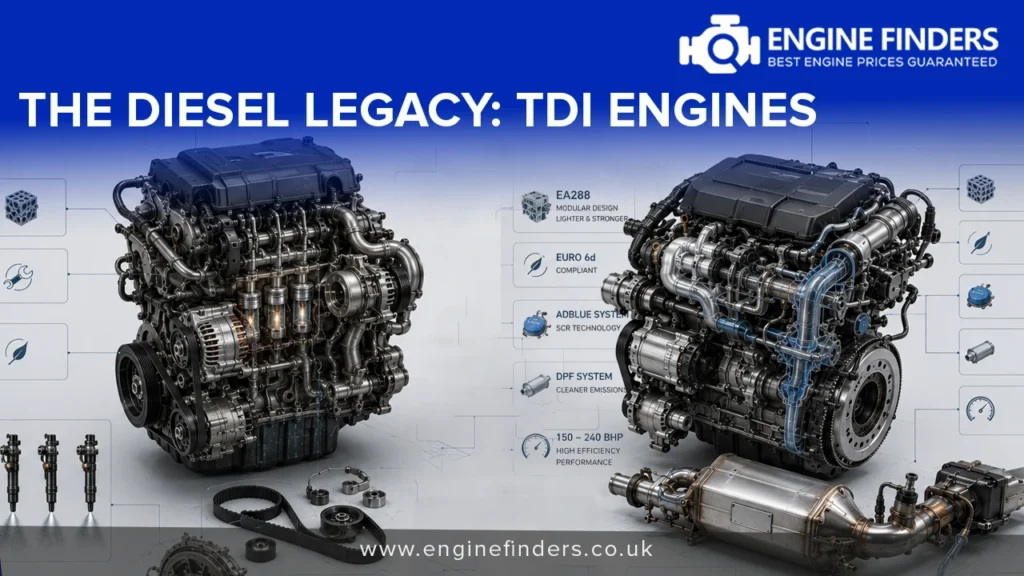
2.0 TDI (EA288 Engine Family, 2015-Present)
The EA288 replaced earlier 2.0 TDI units (EA189) affected by the 2015 emissions scandal. This modular diesel engine family represents VW’s most refined diesel engine reliability achievement, featuring improved emissions systems and enhanced durability.
Key specifications:
- Engine codes: CUAA, CUNA, DFHA (varies by power output)
- Displacement: 1,968cc
- Power output: 115-240 bhp (multiple tunings)
- Common applications: Golf Mk7/Mk8, Passat B8, Tiguan, Arteon
Advantages over predecessors:
- Revised cylinder head with improved coolant flow
- Enhanced timing chain tensioner design
- More robust turbocharger bearings
- Better emissions compliance (Euro 6d-TEMP and Euro 6d)
Common issues to monitor:
- AdBlue system faults (symptom: warning message, reduced power mode)
- DPF clogging on short-journey vehicles (symptom: warning light, regeneration attempts)
- EGR cooler leaks on early EA288 units (BMW experienced similar issues; VW issued technical service bulletins)
The 2.0 TDI EA288 typically achieves 150,000-200,000 miles with proper maintenance, making it one of the most durable VW engines for drivers covering 15,000+ miles annually.
Best VW Petrol Engines
EA888 Gen 3 (2.0 TSI, 2012-Present)
The third-generation EA888 addressed critical weaknesses in earlier versions, establishing itself as the best VW petrol engines choice for performance and reliability balance. This 2.0-litre turbocharged unit powers everything from the Golf GTI to the Tiguan.
Key specifications:
- Engine codes: CHHB, CHHA, CJXB, DKZA (varies by application)
- Displacement: 1,984cc
- Power output: 180-310 bhp
- Common applications: Golf GTI/Golf R, Passat, Tiguan, Arteon, Skoda Octavia vRS
Improvements over Gen 2:
- Redesigned timing chain tensioner (eliminated catastrophic failure risk)
- Revised piston design reducing oil consumption
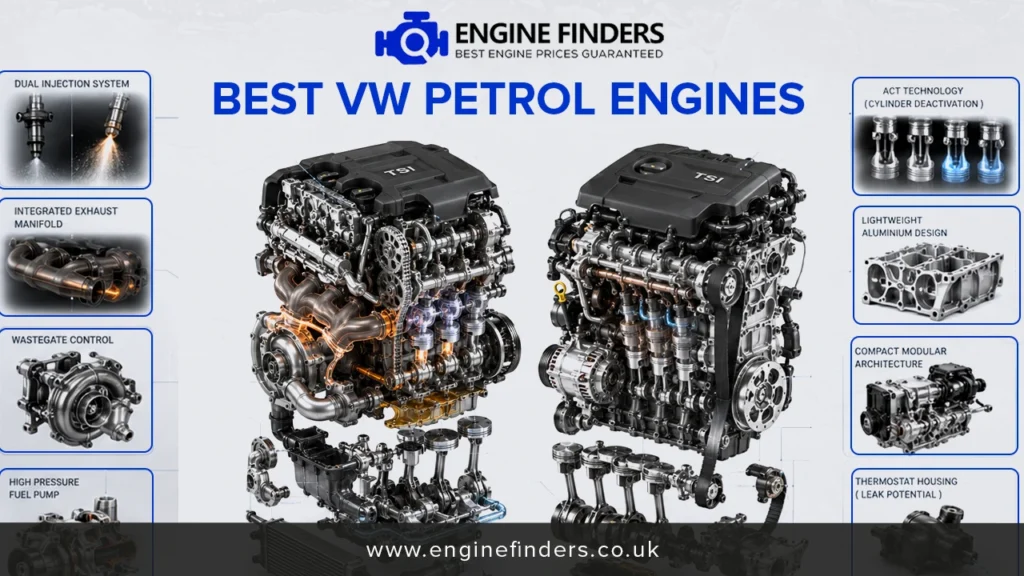
- Integrated exhaust manifold for faster warm-up
- Dual injection (direct + port) on later variants reducing carbon buildup
Maintenance requirements:
- Oil changes every 8,000-10,000 miles (not VW’s 18,000-mile LongLife interval)
- Spark plugs every 40,000 miles
- Carbon cleaning on intake valves every 60,000-80,000 miles (direct injection variants)
With proper servicing, the EA888 Gen 3 regularly achieves 150,000+ miles, though VW EA888 engine problems related to carbon buildup and high-pressure fuel pump wear can emerge after 100,000 miles. For detailed information about carbon buildup issues, see our guide on turbocharged vs naturally aspirated engines.
1.4 TSI (EA211 Engine Family, 2012-Present)
The EA211 1.4 TSI replaced the problematic EA111 chain-driven units, introducing a belt-driven design with improved reliability. This engine suits urban drivers seeking which VW engine is best for efficiency without sacrificing refinement.
Key specifications:
- Engine codes: CZCA, CZDA, CHPA (varies by power output)
- Displacement: 1,395cc
- Power output: 125-150 bhp
- Common applications: Golf Mk7, Passat B8, Tiguan, Touran
Strengths:
- Timing belt (not chain) eliminates tensioner failure risk
- Cylinder deactivation (ACT) improves fuel economy
- Lightweight aluminium construction
- Generally reliable to 120,000+ miles
Potential concerns:
- Water pump/thermostat housing leaks (plastic components degrade)
- Carbon buildup on intake valves (direct injection)
- Turbocharger wastegate rattle on high-mileage examples
For VW 2.0 TDI problems alternatives, the 1.4 TSI offers lower running costs for drivers covering under 12,000 miles annually, though diesel remains more economical for motorway-heavy usage.
Engines to Approach with Caution
EA111 1.4 TSI (Pre-2012, Twincharger) While not within the 2015-2025 scope, many used vehicles still feature the problematic twincharged (supercharger + turbocharger) 1.4 TSI. These units suffered from:
- Timing chain tensioner failure (catastrophic engine damage)
- Excessive oil consumption
- Piston ring land failure
Avoid unless comprehensive timing chain replacement documentation exists.
Early EA888 Gen 2 (2008-2012) Similar to Gen 1, these engines experienced timing chain failures and severe oil consumption. While some 2012-2013 transitional models received updated components, verification of timing chain replacement is essential before purchase.
Replacement Cost Considerations (UK Market)
When VW engine buying guide UK research indicates replacement necessity, costs vary significantly by engine type and source:
Used engines:
- 1.9 TDI: £400-£800
- 2.0 TDI EA288: £800-£1,500
- 1.4 TSI EA211: £500-£900
- 2.0 TSI EA888 Gen 3: £1,000-£1,800
Reconditioned engines:
- 1.9 TDI: £900-£1,400
- 2.0 TDI EA288: £1,500-£2,500
- 1.4 TSI EA211: £1,100-£1,600
- 2.0 TSI EA888 Gen 3: £1,800-£3,000
Labour typically adds £600-£1,200 depending on garage rates and engine accessibility. Compare quotes from vetted UK suppliers for no-obligation pricing across multiple suppliers. For detailed cost information, see our engine replacement cost guide.
Hidden costs to consider:
- Clutch replacement (recommended during engine R&R): £400-£800
- Flywheel renewal (if dual-mass): £300-£600
- Ancillary components (hoses, mounts, belts): £200-£400
- ECU coding/adaptation: £100-£250
Practical Takeaways
Best Engines by Use Case
High-mileage motorway drivers (15,000+ miles/year):
- Choose: 2.0 TDI EA288 (150 or 190 bhp variants)
- Avoid: Petrol engines (higher fuel costs)
- Consider: ULEZ compliance (Euro 6 diesel required)
Urban/suburban drivers (under 12,000 miles/year):
- Choose: 1.4 TSI EA211 or 2.0 TSI EA888 Gen 3
- Avoid: Diesel (DPF issues from short journeys)
- Benefit: Lower purchase price, no ULEZ charges
Performance enthusiasts:
- Choose: EA888 Gen 3 (Golf GTI/R variants)
- Budget: £2,500-£4,000 for reconditioned unit plus labour
- Maintain: Strict oil change intervals (maximum 10,000 miles)
When to Use EngineFinders
If your VW has suffered catastrophic engine failure, timing chain damage, or requires replacement due to wear, comparing quotes through EngineFinders connects you with vetted UK suppliers offering competitive pricing on used, reconditioned, and new engines. Professional diagnosis before purchase ensures you’re addressing the correct issue. For guidance on engine compatibility, use our engine compatibility guide.
Professional Verification Requirements
Before purchasing any replacement engine:
- Verify engine code matches your vehicle’s specification
- Confirm emissions standard (Euro 5/6) for ULEZ compliance
- Request compression test results (petrol) or leak-down test (diesel)
- Check warranty terms (minimum 3-6 months recommended)
- Ensure supplier provides VAT invoice for warranty validity
Enter Your REG to Get a Free Engine Quote

Frequently Asked Questions
Which Volkswagen engine is the most reliable overall?
The 1.9 TDI is VW’s most reliable engine, often exceeding 250,000 miles. Modern 2.0 TDI EA288 and EA888 Gen 3 petrol units typically achieve 150,000-200,000 miles with proper maintenance.
How much does a VW 2.0 TDI engine replacement cost?
A reconditioned VW 2.0 TDI EA288 costs £1,500-£2,500 including VAT. Labour adds £600-£1,200. Compare quotes from vetted UK suppliers via EngineFinders for competitive pricing.
Are VW petrol engines reliable?
Modern VW petrol engines like the EA888 Gen 3 and EA211 are generally reliable with proper maintenance. Key requirements include oil changes every 8,000-10,000 miles and carbon cleaning on direct injection variants.
What are the common problems with VW TDI engines?
Common issues include dual-mass flywheel wear, EGR valve carbon buildup, DPF clogging on short journeys, and AdBlue system faults on EA288 engines. Regular motorway runs help prevent DPF issues.
Is it worth replacing a VW engine or buying a new car?
Engine replacement costs £1,500-£3,500. If your vehicle is otherwise in good condition with service history, replacement typically offers better value than purchasing a new car.
Can VW engines last 200,000 miles?
Yes, particularly diesel engines. The 1.9 TDI regularly achieves 250,000+ miles, while 2.0 TDI EA288 units can reach 200,000 miles with proper maintenance and regular oil changes.
For additional information about engine replacement and reconditioned engines, check our comprehensive reconditioned engines buyer’s guide. For community discussions and owner experiences, visit the PistonHeads Volkswagen forum