Executive Summary
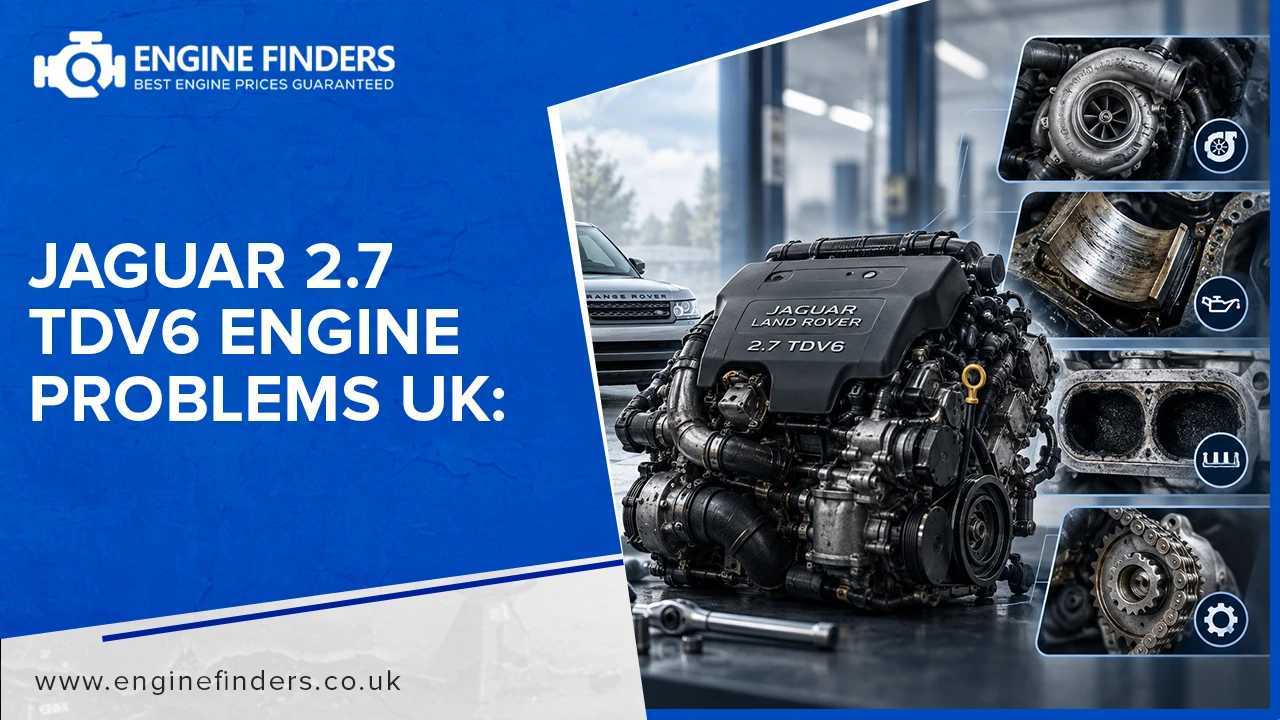
The 2.7-litre TDV6, known as the AJD-V6, was Jaguar Land Rover’s compact twin-turbo V6 diesel, fitted to the Jaguar XF and XJ, the Land Rover Discovery 3, and the Range Rover Sport during the mid to late 2000s. It was a smooth, torquey engine for its era, but time and mileage have exposed several recurring faults that UK owners should understand before buying, keeping or replacing one.
The most talked-about problems are crankshaft and bottom-end failure (the forerunner of the issue later seen on the 3.0 litre), turbocharger failure, oil pump and oil supply issues, and inlet manifold and swirl flap problems. Because the 2.7 TDV6 sits in older, higher-mileage vehicles, many failures now stem from a lifetime of deferred maintenance rather than an inherent design flaw alone.
For UK owners, a good used 2.7 TDV6 engine supplied and fitted typically costs between £2,500 and £4,500, while a reconditioned unit sits at the higher end of that range. Given the age of these vehicles, the economics of repair versus replacement, and versus moving the car on, deserve careful thought.
Engine Finders is a price comparison platform, not a direct engine seller. Final pricing, warranty terms, and availability vary by vetted UK supplier. Professional diagnosis is recommended before purchasing any replacement engine.
Detailed Content
What Is the 2.7 TDV6 (AJD-V6)?
The 2.7 TDV6 was co-developed by Ford and PSA and adopted by Jaguar Land Rover as the AJD-V6. It is a 2.7-litre twin-turbo diesel producing around 190 PS, notable in its day for compact packaging, good refinement and strong low-end torque. It later grew into the 3.0-litre 306DT, which shares much of its architecture and, unfortunately, some of its weaknesses.
2.7 TDV6 Applications at a Glance
| Model | Years | Power |
|---|---|---|
| Jaguar XF / XJ | 2007–2011 | 190–207 PS |
| Land Rover Discovery 3 | 2004–2009 | 190 PS |
| Range Rover Sport | 2005–2009 | 190 PS |
Note: Applications and outputs vary by model year and market. Confirm your exact engine code from the VIN before sourcing any replacement.
Common 2.7 TDV6 Problems
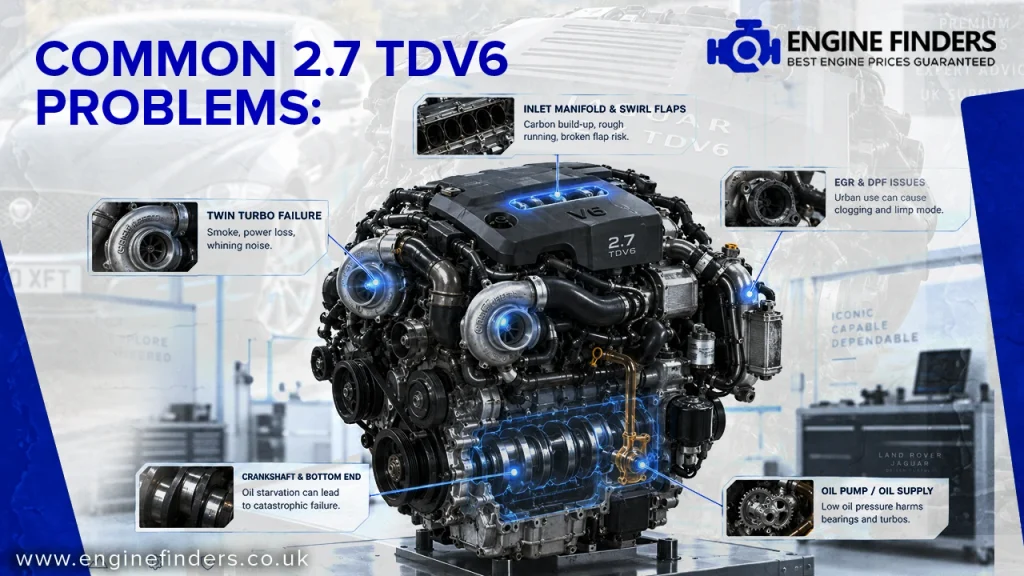
Crankshaft and bottom-end failure: Like its larger 3.0-litre successor, the 2.7 TDV6 can suffer crankshaft failure, usually linked to oil starvation, extended oil change intervals or a failing oil pump. When the bottom end goes, the damage is typically catastrophic and requires a replacement engine.
Turbocharger failure: The engine uses twin turbochargers, and these can fail with age and mileage, particularly where oil quality and oil feed pipes have been neglected. A blocked or restricted turbo oil feed is a common contributor. Symptoms include loss of power, excessive smoke and whistling or whining noises.
Oil pump and oil supply: The oil pump is central to the engine’s health. A weak or failing pump reduces oil pressure to the crank bearings and turbos, and is strongly implicated in the more serious bottom-end failures.
Inlet manifold and swirl flaps: Carbon build-up and swirl flap issues in the inlet manifolds can cause rough running, reduced performance and, in some cases, debris entering the engine if a flap breaks up.
EGR and DPF issues: As with most diesels of this era, the EGR valve can clog with carbon, and the DPF can block up on cars used mainly for short urban journeys, causing limp mode and warning lights.
Symptoms to Watch For
Knocking or rumbling from the bottom of the engine (a serious warning sign) Low oil pressure warnings on the dashboard Excessive exhaust smoke, especially blue (oil) or black (fuelling) Turbo whistle, whine or loss of boost Rough running, misfires or hesitation Warning lights for EGR, DPF or the engine management system
Any low oil pressure warning or bottom-end knock should be treated as urgent, as continued driving risks turning a repairable fault into a destroyed engine.
Repair vs Replace: Weighing It Up
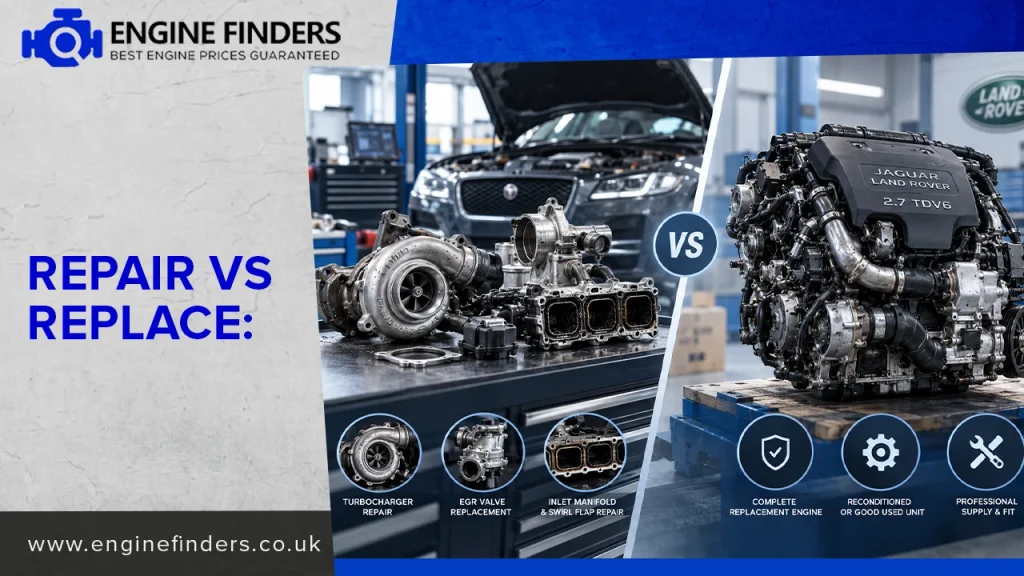
Because the 2.7 TDV6 lives in vehicles that are now well over a decade old, the repair-versus-replace decision is heavily influenced by the overall condition and value of the car. A turbo, EGR valve or swirl flap repair can be worthwhile on an otherwise sound vehicle. A crankshaft or bottom-end failure, by contrast, usually means a replacement engine, and owners must decide whether the car justifies that outlay.
2.7 TDV6 Cost Breakdown (Indicative UK Ranges)
| Job | Typical Cost |
|---|---|
| Good used engine (supply & fit) | £2,500–£4,000 |
| Reconditioned engine (supply & fit) | £3,500–£4,500 |
| Single turbocharger replacement | £800–£1,500 |
| EGR valve replacement | £300–£700 |
| Diagnostic inspection | £60–£150 |
Note: These are indicative UK market ranges. Exact quotes vary by supplier, location, and vehicle. Always confirm whether prices include VAT.
For a detailed look at the same engine family and an owner’s escape plan on the XF, our AJD-V6 XF diesel guide is directly relevant, and the AJ300D diesel engine page covers the related unit. For wider pricing context, see the general engine replacement cost UK guide.
UK-Specific Considerations
MOT and emissions: The 2.7 TDV6’s diesel emissions must meet the DVSA’s MOT standards. A car that smokes heavily, has a blocked or removed DPF, or a faulty EGR will fail. Removing the DPF is illegal for road use.
ULEZ and Clean Air Zones: These are older Euro 4 and Euro 5 diesels, which are not compliant with London’s ULEZ or most Clean Air Zone diesel standards (only Euro 6 diesels meet the ULEZ diesel requirement). Owners in affected areas should factor in daily charges. Check your vehicle and the current rules using the GOV.UK guidance on driving in a Clean Air Zone.
Notifying the DVLA: If you replace the engine, you must inform the DVLA and update your V5C.
Consumer rights: Any replacement engine and fitting work is covered by the Consumer Rights Act 2015.
Practical Takeaways
Recommendations for 2.7 TDV6 Owners
Prioritise oil health: Frequent oil changes with the correct grade protect the crank bearings, turbos and oil pump. Do not stretch intervals on an ageing engine Watch the oil pressure: Treat any low oil pressure warning as an emergency Keep the turbos fed: Ensure turbo oil feed pipes are clean and unrestricted, and address any turbo noise early Drive it properly: Give the engine occasional longer runs to help the DPF regenerate and reduce carbon build-up Investigate noises promptly: A bottom-end knock is a red flag that should never be ignored
Buying a Used 2.7 TDV6 Vehicle
If you are buying an older XF, XJ, Discovery 3 or Range Rover Sport with this engine, insist on a full service history with frequent oil changes, listen for bottom-end noise and turbo whine, and check for smoke on start-up and under load. Our Jaguar engines overview and the Range Rover Sport engines page give useful background on the wider ranges, and the Discovery 3 engine page covers that application.
When to Use Engine Finders
If your 2.7 TDV6 has suffered turbo or engine failure and you need a replacement, compare quotes from vetted UK suppliers. Confirm your engine code from the VIN, request written warranty terms, and have the vehicle professionally diagnosed to identify the true cause before committing, so that a replacement engine is not put at risk by an unresolved underlying fault.
Enter Your REG to Get a Free Engine Quote

Frequently Asked Questions
What are the common problems with the Jaguar 2.7 TDV6 engine?
The most significant problems are crankshaft and bottom-end failure, turbocharger failure, oil pump and oil supply issues, and inlet manifold or swirl flap faults. EGR and DPF clogging are also common on cars used for short journeys. Many failures are linked to oil starvation and deferred maintenance on these now-ageing vehicles.
How much does a 2.7 TDV6 engine replacement cost in the UK?
A good used 2.7 TDV6 engine supplied and fitted typically costs £2,500–£4,000, with reconditioned units at the higher end. Turbo replacement runs around £800–£1,500 per turbo, and EGR work £300–£700. Prices vary by supplier and vehicle, so comparing quotes is worthwhile, especially given the age of these cars.
Is the 2.7 TDV6 a reliable engine?
The 2.7 TDV6 was refined and capable for its time, but it shares the crankshaft vulnerability later seen on the 3.0-litre engine and is now found only in older, high-mileage vehicles. With diligent oil changes and prompt attention to warning signs it can be reliable, but neglected examples are prone to serious bottom-end failure.
Is the Jaguar 2.7 TDV6 ULEZ compliant?
No. The 2.7 TDV6 is a Euro 4 or Euro 5 diesel, and only Euro 6 diesels meet London’s ULEZ diesel standard. Owners driving in the ULEZ or most Clean Air Zones will face daily charges. Always check your specific vehicle’s emissions status and the current rules on GOV.UK before relying on it in a charging zone.
Can a 2.7 TDV6 engine be repaired after crankshaft failure?
After crankshaft or bottom-end failure, metal debris usually contaminates the oil system and the damage is extensive, making repair uneconomical. A replacement engine, either a verified used unit or a reconditioned one, is the normal solution. Owners should weigh the cost against the overall value and condition of the vehicle.
Which vehicles have the 2.7 TDV6 (AJD-V6) engine?
The 2.7 TDV6 was fitted to the Jaguar XF and XJ, the Land Rover Discovery 3, and the Range Rover Sport, broadly between 2004 and 2011 depending on the model. Confirm your exact engine code from the VIN, as the engine later evolved into the 3.0-litre 306DT with a different specification.