The Jaguar X-Type, launched in 2001, marked a new direction for the brand. Aimed at luxury sedan buyers seeking compact size and accessible pricing, it competed with the BMW 3 Series and Audi A4. Initially promising, the model suffered from early reliability issues and criticism over its Ford-based platform.
But by 2004, Jaguar had made substantial improvements that turned the X-Type into a more refined and reliable vehicle. If you’re considering a used car engine purchase or a luxury car on a budget, later model Jaguar X-Type engines are the smarter choice.
In this post, we’ll explore why 2004–2009 models are vastly superior, and how platforms like Engine Finders make sourcing a reconditioned engine or used engine easier than ever.
1. Background of the Jaguar X-Type

As Jaguar’s first compact executive sedan in decades, the X-Type sought to attract younger buyers. While based on the Ford Mondeo’s platform, Jaguar added its own suspension, engines, and signature styling.
Although some car enthusiasts criticized its shared architecture, the X-Type filled a crucial gap in Jaguar’s lineup—bridging the space between the classic Jaguar XJ Engines and the larger Jaguar S-Type Engines. Today, it’s often compared to modern compact models like the Jaguar XE Engines and the versatile Jaguar E-Pace Engines.
2. Early Model Weaknesses

The 2001–2003 Jaguar X-Type models had several issues that hurt their long-term reputation:
- Transmission problems, particularly with early automatics.
- Electrical glitches, such as malfunctioning central locking and dashboard clusters.
- Rust issues on door sills, wheel arches, and underbody.
- Interior materials that lacked the premium touch associated with the Jaguar brand.
These problems were more than just minor annoyances—they affected resale value and overall reliability. As a result, many early adopters were disappointed, and the model earned a reputation that only later versions would redeem.
3. Key Improvements in Later Models (2004–2009)
Jaguar took customer feedback seriously and implemented crucial improvements to the X-Type lineup starting in 2004.
Mechanical Refinements
- Upgraded gearboxes for smoother shifts and longer life.
- Enhanced suspension tuning for a more balanced ride.
- New and improved engine options, especially efficient diesel models (in Europe).
These mechanical updates were inspired by lessons learned not only from the X-Type but also from engineering developments in models like the Jaguar F-Pace Engines and Jaguar I-Pace Engines, where performance and refinement go hand-in-hand.
Interior & Technology Enhancements
- Better cabin insulation and reduced road noise.
- Higher-quality materials on the dash, doors, and console.
- Updated infotainment systems and more intuitive controls.
4. Styling and Design Enhancements

To help the X-Type stand out, Jaguar refreshed its appearance:
- Facelifted bumpers and grille gave it a sleeker, more modern look.
- New wheel options and subtle chrome accents offered a more upscale feel.
- Later trims like Sovereign and Sport came with attractive customization packages.
These design cues aligned more closely with the elegance of models like the Jaguar XF Engines, the coupe styling of the Jaguar F-Type Engines, and even the bold aggression of the Jaguar XK Engines.
5. Better Value in the Used Market

Today, the 2004–2009 Jaguar X-Type represents one of the best value buys in the used luxury car market.
Higher Reliability and Longevity
Many of the mechanical and electrical problems in early models were resolved, giving later models better long-term performance. For example, later X-Type engines perform comparably to the more recent Jaguar F-Pace Engines when it comes to daily driving reliability.
Lower Mileage and Better Condition
Because of Jaguar’s waning production numbers toward the end of the X-Type’s lifecycle, many remaining units are:
- Low mileage
- Well maintained
- Owned by enthusiasts
These cars often come with service histories and fewer mechanical issues—perfect if you’re looking to install a reconditioned engine or refresh a classic build.
6. Ideal for Enthusiasts and Budget Buyers
Later model X-Types offer the traditional Jaguar experience—leather, wood trim, and a whisper-quiet ride—without the cost or complexity of newer models like the Jaguar XF or Jaguar XE.
Great Engine Options
- The 2.5L and 3.0L V6 petrol engines are proven, smooth, and reliable.
- Diesel variants, especially the 2.2L TDCi, provide fuel efficiency and low-end torque.
Sourcing parts is easier than ever. If you’re restoring one or replacing your car engine, platforms like Engine Finders allow you to get a quote for a rebuilt Jaguar X-Type engine, or even compare prices with rebuilt Jaguar S-Type engines and other models.
7. Comparing Early vs. Late X-Type Models
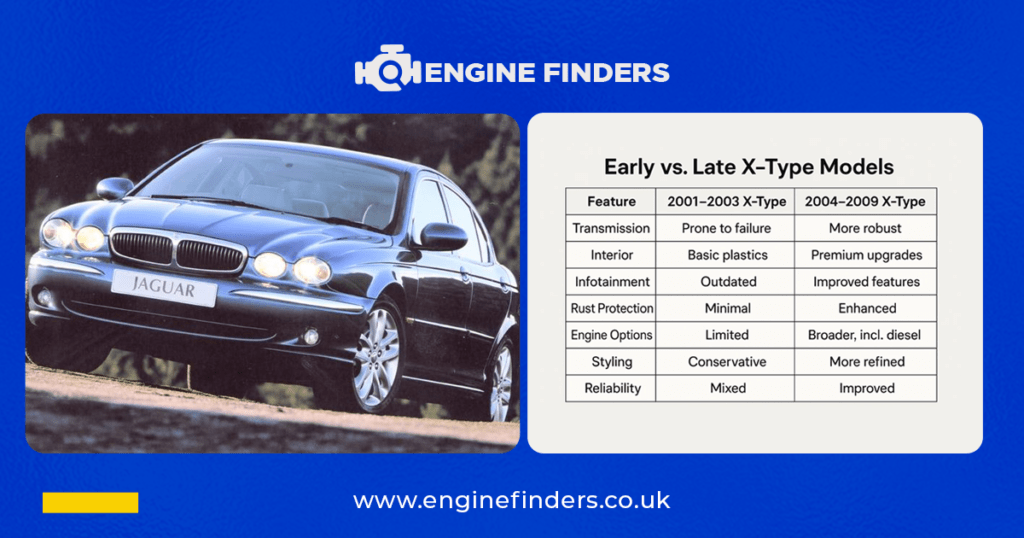
Here’s a simple side-by-side breakdown:
| Feature | 2001–2003 X-Type | 2004–2009 X-Type |
| Transmission | Prone to failure | More robust |
| Interior | Basic plastics | Premium upgrades |
| Infotainment | Outdated | Improved features |
| Rust Protection | Minimal | Enhanced |
| Engine Options | Limited | Broader, incl. diesel |
| Styling | Conservative | More refined |
| Reliability | Mixed | Improved |
It’s clear: later models are more dependable, better-looking, and packed with thoughtful improvements.
8. Final Verdict
While the Jaguar X-Type may not have started strong, later models tell a different story. The 2004–2009 versions offer a smooth ride, luxury touches, and decent reliability—all at a fraction of the cost of newer Jaguar sedans or SUVs.
Here’s why later X-Type models are a smart buy:
- Upgraded components across the board
- More refined interior and exterior styling
- Greater reliability and owner satisfaction
- Easy access to parts, including reconditioned engines and used engines
Whether you’re buying your first Jaguar or adding to your collection, a late-model X-Type offers classic British luxury without the premium price tag. Plus, with access to rebuild parts, swap options, and engine sourcing tools like Engine Finders, maintenance is more affordable than ever.
Looking for even more powerful or luxurious options? Compare your needs to:
- Which Jaguar XF Engine Is Best
- Jaguar & Land Rover Engines History
- Range Rover engine rebuild cost
And don’t forget—before committing, always get a quote for parts, engines, or labor to ensure you’re getting the best value.