Executive Summary
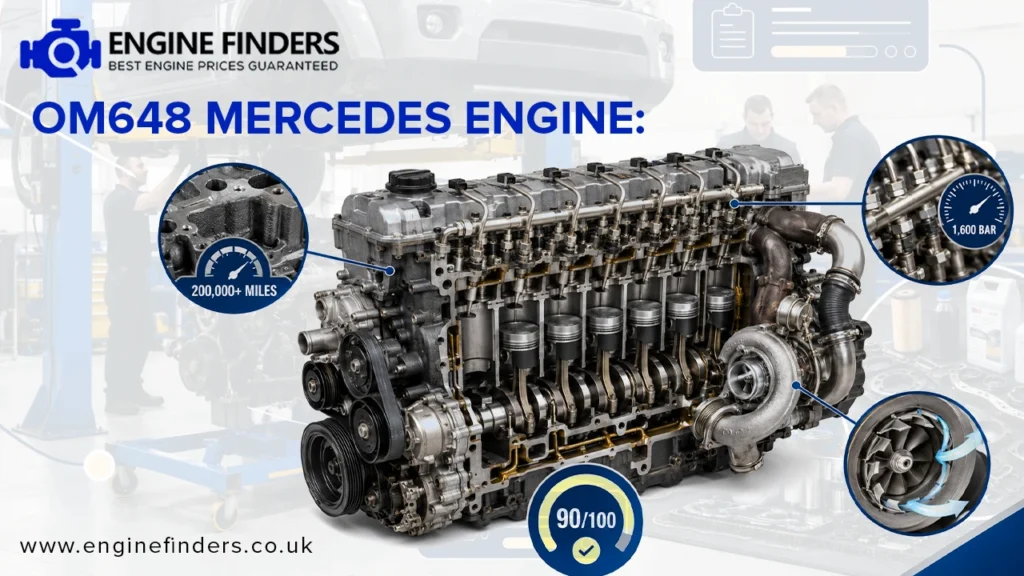
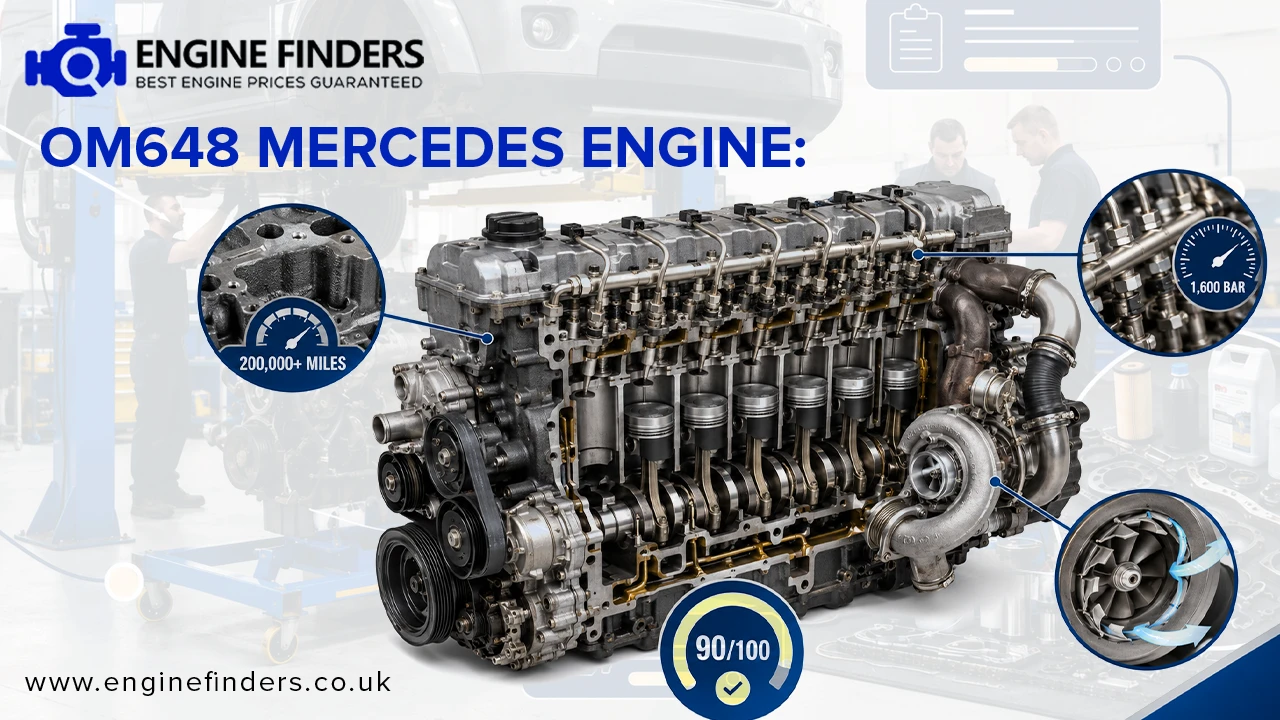
The Mercedes-Benz OM648 is a 3.2-litre straight-six diesel engine produced from 2002 to 2006, fitted exclusively to the W211 E-Class (E320 CDI) and facelift W220 S-Class (S320 CDI). With 204 PS (150 kW) and 500 Nm of torque from just 1,800 rpm, it delivers exceptional refinement and pulling power. The OM648 is widely regarded as one of Mercedes’ most reliable diesel engines, thanks to its robust cast-iron block, duplex timing chain, and proven common-rail fuel system.
However, age and mileage bring predictable issues: injector seal leaks (“black death”), EGR and swirl flap fouling, timing chain stretch on higher-mileage examples, and turbocharger oil feed line failures. For UK owners, Euro 4 emissions classification means ULEZ compliance remains a consideration in London and other clean air zones.
Engine Finders is a price comparison platform, not a direct engine seller. Final pricing, warranty terms, and availability vary by vetted UK supplier. Professional diagnosis is recommended before purchasing any replacement engine.
Detailed Content
OM648 Engine Specifications
| Specification | Detail |
|---|---|
| Engine code | OM648 (variants: OM648.960, OM648.961) |
| Production years | 2002–2006 |
| Configuration | Inline-6, 24-valve DOHC |
| Displacement | 3,222 cc (3.2 litres) |
| Bore × Stroke | 88 mm × 88.3 mm |
| Block material | Cast iron |
| Head material | Aluminium |
| Fuel system | Common rail direct injection |
| Injection pressure | 1,600 bar (23,000 psi) |
| Turbocharger | Single VGT (variable geometry turbo) |
| Valvetrain | Duplex timing chain |
| Power output | 204 PS (150 kW; 201 hp) @ 4,200 rpm |
| Torque output | 500 Nm (369 lb-ft) @ 1,800–2,600 rpm |
| Compression ratio | 18:1 |
| Oil capacity | 7.5 litres |
| Oil specification | MB 229.51 or MB 228.31 (5W-30) |
| Euro standard | Euro 4 |
| Predecessor | OM613 |
| Successor | OM642 (V6) |
Vehicles Fitted with the OM648
| Model | Chassis | Years |
|---|---|---|
| Mercedes E-Class E320 CDI | W211 | 2002–2006 |
| Mercedes S-Class S320 CDI | W220 (facelift) | 2002–2006 |
A lower-output 177 PS version (425 Nm) was also offered in some markets.
Common Faults & Known Issues
The OM648 is considered highly reliable, but with engines now 19 to 24 years old, several age-related issues are well documented. Based on owner-reported data and workshop consensus, the following are the most common failure points.
1. Injector Seal Leaks (“Black Death”)
Symptoms: Loss of power, decreased fuel economy, black crusty deposits around injectors, burning smell from the engine bay, melted wiring insulation on injector connectors.
Cause: The injector seals on the OM648 are prone to leaking with age, allowing combustion gases to escape past the injector and create carbon buildup on top of the cylinder head. This is commonly referred to as “black death”.
UK-specific note: A severe case of black death can damage the engine wiring harness, leading to expensive electrical repairs.
Repair: Injector seal replacement typically requires specialist tools. A full injector overhaul or replacement may be necessary if injectors are damaged. Refurbished injectors are available from UK diesel specialists from approximately £90 to £150 each.
2. Timing Chain Stretch
Symptoms: Rattling noise on cold start, metallic noise from the front of the engine, rough running, and in severe cases, engine management warnings or complete failure.
Cause: The duplex timing chain can stretch over time, particularly on higher-mileage engines (150,000+ miles). Pre-2014 OM648 engines are noted as having timing chain stretch as a critical concern. Failed tensioners can also contribute.
Inspection: There is an inspection plate at the front of the engine that can reveal timing chain problems.
Repair cost: Timing chain replacement typically costs £800 to £1,400 for most vehicles, with premium marques at the upper end. Parts (chain kit) are available from approximately £150, but labour is substantial due to the chain’s location deep within the engine.
3. EGR Valve & Swirl Flap Fouling
Symptoms: Rough idle, surging at part throttle, loss of power under acceleration, poor fuel economy, and engine management lights (P2015, P0234 codes).
Cause: The EGR valve becomes heavily clogged with carbon deposits over time. Swirl flap actuators and linkage arms can wear or break, causing the flaps to stick.
Repair: EGR valve cleaning or replacement. Swirl flap deletion is a common modification, though this requires appropriate ECU remapping to avoid fault codes. Some owners fit resistors to bypass faulty swirl flap motors.
UK MOT note: EGR and swirl flap modifications may affect emissions testing and can result in an MOT failure. Consult your MOT tester before carrying out deletions.
4. Turbocharger Oil Feed Line Leaks
Symptoms: Oil smell, visible oil leaks on the passenger side of the engine, oil puddles under the vehicle, and in severe cases, alternator contamination from oil spray.
Cause: The turbo oil feed line o-rings and lines can fail with age and heat cycling.
Repair: Replacement of the oil feed line and o-rings. A reconditioned turbocharger unit costs approximately £300, with labour around £500 for access.
5. Crankshaft Harmonic Balancer Pulley Failure
Symptoms: Loud low-pitch booming or droning noise from the engine area, vibration felt through the steering wheel and centre armrest, and engine shudder on shutdown.
Cause: The rubber damping element in the harmonic balancer pulley loses elasticity with age (typically 150,000+ miles), reducing its NVH deadening properties.
Repair: Harmonic balancer pulley replacement.
6. Thermostat Failure
Symptoms: Engine temperature gauge rarely rises above 60°C, even on long journeys; fuel consumption 10 to 15% worse than normal.
Cause: Faulty thermostat stuck open.
Repair: Thermostat replacement, a relatively straightforward and inexpensive job.
Reliability Verdict
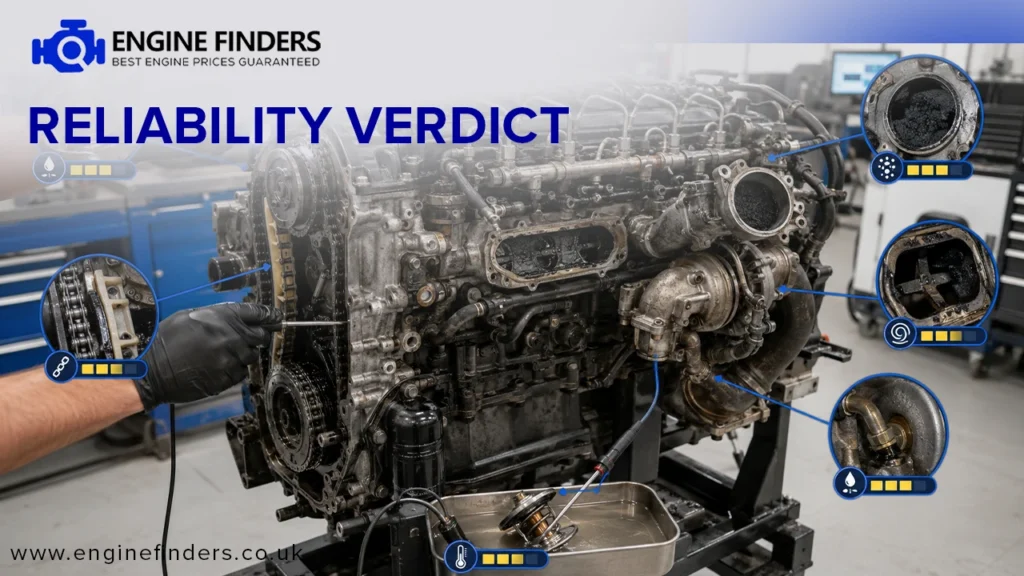
Based on the available data, the OM648 scores highly for reliability, with independent reviewers rating it around 90/100 with only two commonly documented issues and total potential repair costs between roughly £450 and £1,100. The robust cast-iron block and duplex timing chain design contribute to exceptional longevity, with many examples exceeding 200,000 miles. For a wider comparison, our guide to the most reliable Mercedes-Benz engines ranks the OM648 against every major petrol and diesel unit.
Owner-reported lifespan examples include 400,000 to 450,000 km (approximately 250,000 to 280,000 miles) with proper maintenance.
UK workshop consensus: The OM648 is one of the most durable diesel engines Mercedes ever produced. The key to longevity is preventative maintenance, including regular oil changes (not Mercedes’ extended 13,000-mile interval), timely injector seal replacement, and early attention to timing chain noise.
Replacement & Cost Considerations
Engine Replacement Costs (UK Market)
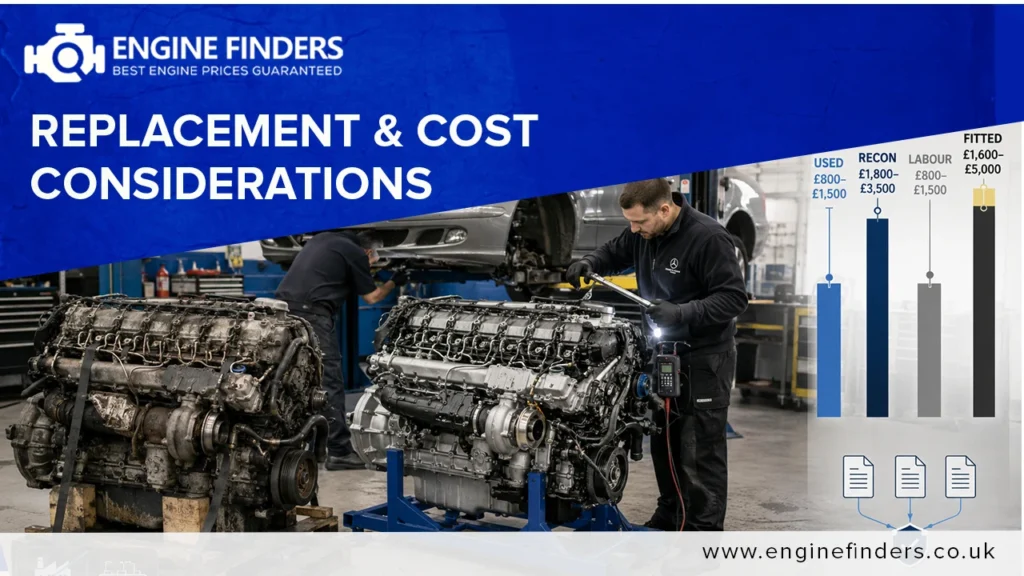
| Option | Estimated Cost Range | Notes |
|---|---|---|
| Used OM648 engine | £800–£1,500 | Mileage and condition vary significantly; no warranty typically included |
| Reconditioned OM648 engine | £1,800–£3,500 | Includes new seals, gaskets, timing chain, and often a warranty |
| New OM648 engine | Not available | No longer manufactured; NOS (new old stock) extremely rare |
| Labour for replacement | £800–£1,500 | 15–20 hours at specialist rates (£50–£80/hour) |
| Total replacement cost | £1,600–£5,000 | Dependent on engine source and workshop |
Note: Costs are estimates based on typical UK market patterns. Manual verification required for current pricing. Browse used Mercedes engines and reconditioned Mercedes engines from vetted UK suppliers, or see our full Mercedes engine replacement cost guide for a model-by-model breakdown.
When to Replace vs. Repair
Consider replacement if:
- Timing chain has failed catastrophically (bent valves, damaged pistons)
- Cylinder head is cracked (rare but documented between injector and glow plug holes)
- Engine has suffered a major bottom-end failure
- Repair costs exceed 60 to 70% of a replacement engine cost
Consider repair if:
- Issue is isolated to injector seals, EGR, or swirl flaps
- Timing chain stretch is caught early (before failure)
- Turbocharger or oil feed line issues are identified promptly
Our engine repair versus replacement guide walks through the full financial decision in detail.
UK-Specific Considerations
ULEZ & Clean Air Zones
The OM648 is Euro 4 compliant. In London’s Ultra Low Emission Zone (ULEZ), Euro 4 diesel vehicles are not compliant and are subject to the daily charge. This affects all OM648-equipped vehicles (2002 to 2006) in the ULEZ.
Key points:
- ULEZ standards: Euro 6 for diesel (NOx ≤ 0.08 g/km)
- OM648 (Euro 4): does not meet ULEZ requirements
- Daily charge applies for non-compliant vehicles
- Check the official GOV.UK clean air zones service for current ULEZ boundaries and charges
MOT Emissions Testing
The OM648’s Euro 4 classification means it must pass the relevant diesel emissions test at MOT. Key areas:
- Smoke test: Must not exceed the limits for the vehicle’s age
- EGR function: Must be operational (or mapped out with appropriate documentation)
- DPF: UK-market OM648s were not fitted with diesel particulate filters (DPFs) as standard (US-market 2005 to 2006 CDIs also lacked DPFs), so DPF-related MOT failures are not applicable
You can review the full test record for any example using the GOV.UK MOT history service before purchase.
Fuel Economy
Owner-reported fuel economy figures:
- Urban: 31 to 33 mpg (UK Imperial)
- Motorway: 46 to 47 mpg (UK Imperial)
- Combined: Approximately 38 to 40 mpg
These figures are remarkable for a 2-tonne luxury saloon with 500 Nm of torque.
Maintenance Recommendations
For maximum OM648 longevity, UK owners and specialists recommend the following. Always use the correct Mercedes-Benz engine oil, as oil quality directly affects timing chain and injector longevity on this engine.
| Interval | Action |
|---|---|
| Every 8,000–10,000 miles | Oil change with MB 229.51 or 228.31 spec 5W-30 (not Mercedes’ 13,000-mile LongLife interval) |
| Every 40,000 miles | Fuel filter replacement |
| Every 60,000 miles | Air filter replacement; EGR valve inspection and cleaning |
| Every 80,000–100,000 miles | Timing chain inspection (via front inspection plate); injector seal inspection |
| Every 100,000 miles | Coolant system check; thermostat inspection |
| As needed | Harmonic balancer pulley inspection (age-related degradation) |
Practical Takeaways
Who Should Buy an OM648-Equipped Vehicle?
Recommended for:
- Buyers prioritising reliability and low running costs
- High-mileage motorway users (excellent fuel economy and comfort)
- Enthusiasts who appreciate the smoothness of a straight-six diesel
- Owners willing to perform preventative maintenance
Not recommended for:
- ULEZ-zone daily drivers (Euro 4 non-compliant)
- Buyers unwilling to invest in maintenance (these engines reward care)
- Those seeking modern infotainment or safety features
Engines to Avoid
The OM648 itself is not an engine to avoid. However, be cautious of:
- Poorly maintained examples: No service history equals high risk
- Engines with active “black death”: Inspect the top of the engine for carbon deposits before purchase
- High-mileage engines with timing chain noise: Rattling on cold start is a red flag
- Engines with EGR/swirl flap faults: These are repairable but indicate neglect
If you are still deciding which Mercedes diesel to buy, our guide to the best Mercedes-Benz engine to buy used compares the OM648 against later units.
When to Use EngineFinders
If you are facing a major OM648 repair or replacement, Engine Finders connects you with vetted UK suppliers for no-obligation quotes. Compare prices on used and reconditioned OM648 engines from trusted suppliers across the UK.
For those needing specific advice on engine sourcing, our guide on what to check before buying a reconditioned engine online provides detailed guidance on warranty terms and supplier selection.
Frequently Asked Questions
Is the Mercedes OM648 a reliable engine?
Yes, the OM648 is widely regarded as one of Mercedes’ most reliable diesel engines. Its cast-iron block, duplex timing chain, and common-rail fuel system enable 200,000+ mile lifespans with proper maintenance. Owner-reported examples exceed 250,000 miles. Regular oil changes every 8,000 to 10,000 miles are key to longevity.
How much does an OM648 engine replacement cost in the UK?
A used OM648 engine typically costs £800 to £1,500, while a reconditioned unit ranges from £1,800 to £3,500. Labour adds £800 to £1,500 for professional fitment. Total replacement costs typically range from £1,600 to £5,000 depending on engine source and workshop rates. Compare quotes from vetted UK suppliers for no-obligation pricing.
What is “black death” on the OM648 engine?
“Black death” refers to injector seal leaks that allow combustion gases to escape, creating hard black carbon deposits around injectors on top of the cylinder head. Symptoms include loss of power, poor fuel economy, and a burning smell. Prompt injector seal replacement prevents damage to the wiring harness.
Is the OM648 ULEZ compliant?
No, the OM648 is Euro 4 compliant and does not meet London ULEZ standards (Euro 6 for diesel). Vehicles fitted with this engine (2002 to 2006 E320 CDI and S320 CDI) are subject to the daily ULEZ charge. Check the GOV.UK clean air zones service for current charges and boundary maps.
What oil should I use in an OM648 engine?
Mercedes recommends MB 229.51 or MB 228.31 specification oil, typically 5W-30. Capacity is 7.5 litres. Many specialists recommend changing oil every 8,000 to 10,000 miles rather than Mercedes’ 13,000-mile LongLife interval for optimal engine protection.
How long does an OM648 engine last?
With proper maintenance, the OM648 can exceed 250,000 to 280,000 miles. The robust cast-iron block and duplex timing chain design contribute to exceptional durability. Regular oil changes, timely injector seal replacement, and early attention to timing chain noise are essential for maximum lifespan.