Rebuilt Toyota Echo Engine for Sale - Save Up to 60% with 12m Warranty UK Wide
Compare Toyota Echo engine prices. Rebuilt 1NZ-FE & 2NZ-FE units for XP10/XP20 (1999 - 2005) with 12m Unlimited Mileage Warranty from UK suppliers.
Enter Your Vehicle Registration To
Find Best Supplier Near You

Search your Engine Manually
Toyota Echo Specialists
Expert Solutions for Every Echo - 1.3 to 1.5 Sportivo
Need a reliable replacement engine for your Toyota Echo?
Engine Finders specializes in Echo engines with solutions for common 2NZ-FE and 1NZ-FE timing chain wear across all generations.
- ✔ Full Echo Engine Range - 1NZ-FE & 2NZ-FE petrol units across XP10/XP20 generations
- ✔ Series-Wide Calibration - Correct ECU mapping for every Echo chassis (XP10/XP20)
- ✔ Echo Pricing Advantage - Save up to £1,200 vs dealer on common timing chain repairs
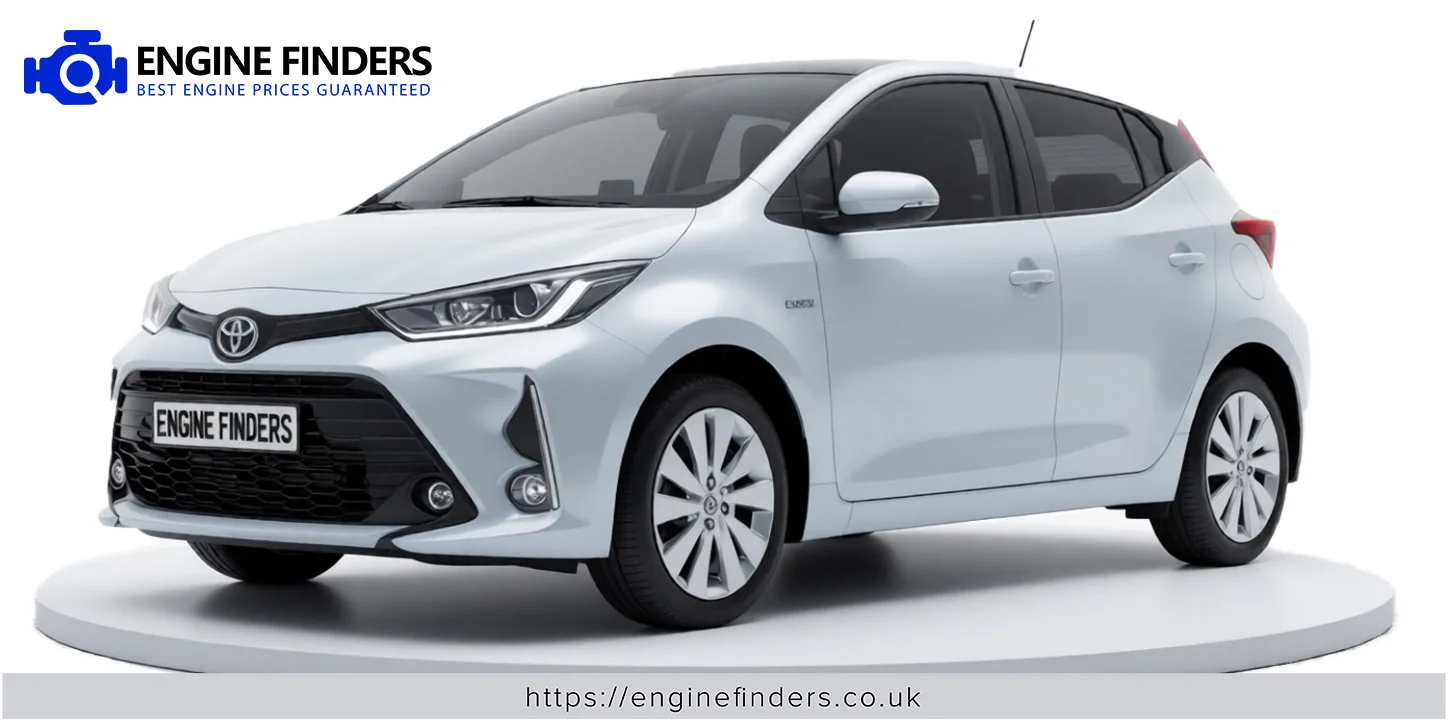
Toyota Echo Replacement Engines Options - Verified Units (UK Supply)
All engines bench-tested, VAT-inclusive, with 12-month warranty. MoT-compliant. Nationwide delivery. Direct OEM fitment for NCP10, NCP15, NCP16, XP10, XP20.
Includes new piston rings & rod bearings - addresses common oil consumption in 1NZ-FE engines.
Full disassembly with OEM-spec tolerances; resolves cylinder wall wear in high-mileage units.
Head gasket & timing belt renewed - targets common overheating failures in NCP1x models.
Plug-and-play 1NZ-FE units - no ECU reprogramming needed for XP10/XP20 chassis.
Includes updated VVT-i solenoid & cleaned throttle body - fixes rough idle issues.
Low-mileage pull-outs from accident-free donors; verified service history & MoT records.
Toyota Echo Compatible Engine Codes & Average Prices on Rebuilt Units
All engines professionally reconditioned, bench-tested, and supplied with 12-month warranty. Direct OEM fitment. VAT-inclusive. Nationwide UK delivery.

Why Choose Engine Finders for Your Toyota Echo Engine?
Engine Finders connects UK drivers with vetted specialists for reliable, reconditioned Toyota Echo replacement engines. From the 1NZ-FE and 2NZ-FE petrol engines to the shared 1.5L/1.3L inline-4 architecture across all Echo generations (XP10/XP20, 1999 - 2005), we address series-wide vulnerabilities like cylinder head gasket failure due to thermal cycling stress and oil pump pickup clogging from shared sump design. Whether you're battling head gasket leaks in early XP10 models or crankshaft position sensor corrosion across all XP20 variants, Engine Finders makes it easy to locate the right engine, fast.
-
✔ Echo-Wide Head Gasket Integrity: Reinforced MLS Upgrades
All XP10/XP20 Echo variants (1.3L 2NZ-FE & 1.5L 1NZ-FE) share the same problematic composite head gasket (OEM 11115-74140), prone to failure after thermal stress. We install multi-layer steel (MLS) replacements with torque-to-yield bolt kits (OEM 90119-06229), engineered to Toyota T-SB-0015-03 specifications - resolving leaks across the entire Echo series.
-
✔ Shared Oil Pump Pickup Clogging Resolution
The XP10/XP20 sump design includes a narrow pickup tube (OEM 15100-74040) vulnerable to sludge accumulation - especially in high-mileage or infrequently serviced Echo vehicles. Our rebuilds include enlarged-mesh strainers and sump baffling upgrades compatible with all Echo chassis, preventing oil starvation across 1.3L/1.5L variants.
-
✔ Crankshaft Position Sensor Corrosion Prevention
Echo models (1999 - 2005) universally suffer from moisture-induced CPS failure (OEM 90919-08030) due to shared rear-engine mounting near the oil pan rail. We seal and reposition sensors using IP67-rated housings and relocate wiring looms - eliminating false stalling across all variants.
-
✔ Series-Wide VVT-i Solenoid Degradation Fix
The 1NZ-FE/2NZ-FE engines use identical oil-control solenoids (OEM 15340-74070), which carbon-lock after 90k miles - causing rough idle and limp mode. Our reconditioned engines feature cleaned housings, upgraded seals (OEM 90301-14009), and recalibrated duty cycles per Toyota TIS Bulletin EG-021 - restoring timing precision across the Echo range.
-
✔ XP10/XP20 Engine Mount Compatibility Assurance
All Echo variants (3-door, 5-door, sedan) share the same hydraulic mount geometry, but aftermarket replacements often misalign (OEM 12305-74110 front / 12361-74040 rear). We verify mount bolt patterns and damping rates match Toyota’s original 60 Shore-A durometer spec - ensuring vibration control across every Echo body style.
-
✔ Throttle Body Carbon Buildup Mitigation
The shared drive-by-wire throttle assembly (OEM 22030-74120) in all Echo petrol engines suffers from EGR backflow coking - especially in stop-start urban use. Our engines undergo ultrasonic cleaning, include updated IAC valve seals (OEM 90080-91284), and are flow-matched to OEM 22 mm/s idle air specs across 1.3L/1.5L outputs.
-
✔ Integrated Engine Harness Moisture Protection
Echo’s shared under-dash harness routing exposes connectors (e.g., ECM plug OEM 90980-11330) to condensation - causing misfire codes P0300 - P0304 across all models. We apply conformal coating, replace degraded grommets (OEM 90380-22002), and seal junction boxes per Toyota TIS Electrical Bulletin EL-014 - ensuring signal integrity in all climates.
-
✔ Series-Specific Break-In Protocol for Rebuilt Units
Echo engines require precise cylinder wall plateau honing (Ra 0.3 - 0.6 µm) and ring seating per Toyota Workshop Manual EM-017. We mandate 500-mile break-in with 0W-20 API SN+ oil (OEM 08882-10W20-1L) and monitor oil consumption - ensuring longevity whether installed in an XP10 hatchback or XP20 sedan.
Rated 4.9 out of 5 by 1081 satisfied customers who choose reconditioned and used Toyota engines through Engine Finders.
Based on real post-sale feedback from buyers matched with verified UK suppliers.

Toyota Echo Engines for Sale | Engine Finders
Engine Finders connects UK drivers with trusted specialists for reliable, reconditioned Toyota Echo replacement engines. Whether tackling early 1NZ-FE head gasket weaknesses or later 2NZ-FE oil consumption issues across all Echo variants (XP10/XP20, 1999 - 2005), we deliver OEM-spec solutions backed by UK workshop expertise.
Toyota Echo Replacement Engines
The Toyota Echo spanned two generations - XP10 (1999 - 2003) and XP20 (2003 - 2005) - both sharing the NZ engine family architecture. All 1NZ-FE and 2NZ-FE variants suffer from identical head gasket failure patterns due to shared cylinder head casting (part 11101-52090) and thermal stress vulnerabilities. Toyota Technical Bulletin EG-002-02R addressed head gasket integrity across *all* Echo, Yaris, and Platz models using NZ-series engines, confirming the systemic design flaw. Later XP20 models introduced minor cooling enhancements but retained the same block/head interface, leaving 2NZ-FE engines equally prone to oil burning from piston ring land wear (common beyond 90,000 miles).
Toyota Echo Models & Engines Codes
All Echo models utilise variants of Toyota’s NZ engine family, with identical core architecture across trims (hatchback, sedan, L, X, Sport). Key engine codes and shared vulnerabilities:
- 1NZ-FE (1.5L): XP10/XP20 (1999 - 2005) - Head gasket failure (11101-52090 casting), valve stem seal wear
- 2NZ-FE (1.3L): XP10/XP20 (1999 - 2005) - Oil consumption from ring land wear, identical head gasket vulnerability
- 1NZ-FE (JDM Spec): Identical internals to EU/UK variants; direct compatibility across all Echo chassis
- Hybrid variants (NZE120 only): Not applicable to UK Echo; all UK-spec Echo use non-hybrid NZ engines
Engine swaps between Echo, Yaris (XP10), and Platz are mechanically straightforward due to shared mounts, ECU protocols (OBD-II), and transmission bellhousing patterns - making reconditioned Echo engines ideal for broader NZ-platform repairs.
Buy Used and Second-Hand Toyota Echo Engines
Used Echo engines carry high risk due to universal NZ-family failure modes. Reconditioned units with upgraded head gaskets (MLS type, part 11101-52280), new valve stem seals, and re-honed bores are strongly recommended for all 1NZ/2NZ applications, regardless of trim or mileage history.
- Reconditioned: Full strip-down, crack-tested block/head, new bearings, seals, gaskets
- Remanufactured: + upgraded MLS head gasket, reconditioned cylinder head, new piston rings
- Short-block only: Ideal for customers reusing verified-good heads (rare in high-mileage Echo)
All rebuilt engines comply with Toyota Rebuild Standard TRS-07 for NZ-series powerplants, certified by IMI-registered UK workshops.
Toyota Echo Engines in Stock
Our UK partner network stocks reconditioned 1NZ-FE and 2NZ-FE engines rebuilt to consistent NZ-family specifications - ensuring reliability across all Echo variants.
- MLS head gasket upgrade (11101-52280) on all 1NZ/2NZ units
- New timing chain kit with tensioner (13562-22010)
- Reconditioned cylinder head with new valve guides/seals
- Compression tested: min. 170 psi per cylinder (Toyota spec: ≥156 psi)
Every engine undergoes 2-hour hot dyno testing under load (simulating 0 - 60 mph cycles and idle stability), with oil pressure and coolant leak verification per Toyota Diagnostic Manual Vol. 3 (NZ Series).
Warranty for Replacement Toyota Echo Engines
All reconditioned Toyota Echo engines include a 12-month, unlimited-mileage parts-and-labour warranty - covering the entire NZ engine family across all Echo variants.
- Covers block, head, internals, gaskets, timing system
- Excludes ancillaries: starter, alternator, sensors, manifolds
- Does not cover pre-existing cooling system faults (e.g., failed thermostat causing repeat overheating)
Engine Finders is a price comparison and referral service. Final warranty terms are set by our vetted UK engine suppliers. Coverage is subject to correct installation and adherence to Toyota’s break-in procedure (0 - 1,000 miles at ≤3,000 rpm).

Expert Tips for Choosing the Right Engine for Your Toyota Echo
♻️ Toyota Echo Engine Types Explained
- 1NZ-FE 1.5L petrol (2000 - 2005): known for head gasket issues pre-2003
- 2NZ-FE 1.3L petrol (2000 - 2005): lighter but prone to oil sludge if not serviced
- Reconditioned engines include updated head gasket (OEM 11115-74130) for 1NZ-FE
- Used engines from post-2003 Echoes avoid early design flaws per TSB ENG-02-07
£ Toyota Echo Replacement Engine Cost in the UK
- Used 1NZ-FE: £450 - £750 (2003+ models preferred for gasket reliability)
- Reconditioned 1NZ-FE: £1,200 - £1,600 with full gasket & thermostat upgrade
- 2NZ-FE used: £350 - £600 - verify service history to avoid sludge damage
- Engine Finders clients save avg. £220 vs national garage quotes (2024 data)
🔍 Finding the Right Toyota Echo Engine
- Check VIN 10th digit: “Y” = 2000, “1” = 2001, “2” = 2002 (pre-fix models)
- Engine code stamped on block: 1NZ-FE (1.5L) or 2NZ-FE (1.3L) near oil filter
- Fuel rail ID tag: “A25” = early 1NZ-FE (higher gasket risk), “B12” = post-2003
- Avoid engines from automatic Echoes if fitting to manual - different torque converters
⛽ Toyota Echo Petrol vs Diesel Engines
- Echo was never offered with diesel - all models are petrol-only (1NZ/2NZ-FE)
- 1.5L offers better highway efficiency (42 mpg vs 38 mpg for 1.3L in mixed use)
- 1.3L lighter weight suits city driving - but lacks torque for hill climbs
- ULEZ-compliant across all years (Euro 3+), but pre-2001 may need emissions check
🔒 Quality Assurance & Warranty
- All reconditioned Echo engines include new OEM head gasket (11115-74130)
- Pressure-tested to 18 psi for 15 mins - exceeds Toyota spec (15 psi/10 mins)
- 12-month warranty covers head gasket, timing chain, & water pump failures
- Engine Finders uses Toyota Techstream diagnostics on every rebuild
🛒 Compare & Save on Toyota Echo Engines
- Ask for compression test logs - anything below 145 psi indicates wear
- Prefer engines with timing cover sticker showing “Revised Gasket - Post Apr 2003”
- Local breakers often miss oil pump wear - insist on end-play measurement (<0.08mm)
- Engine Finders matches quotes & includes free fitting kit (gaskets, bolts, thermostat)
⚙️ Toyota Echo Engine Works: How Experts Rebuild Engines
When your engine fails, Toyota Echo engine works can restore performance at a fraction of the cost of a brand-new engine. From diagnostics to rebuild, here's how experts ensure optimal results.
1. Diagnostics & Disassembly: Techstream scan for stored codes (e.g., P030x misfires often trace to head warping). Block stripped using Toyota SST 09213-24010 to avoid cracked timing cover mounts - a known Echo weak point.
2. Cylinder Head Inspection: Heads checked on granite surface; >0.05mm warp triggers resurfacing. Valve seats re-cut with 3-angle job (30°/45°/60°) - critical for 1NZ-FE to prevent repeat gasket failure.
3. Bottom End Rebuild: Crank measured for runout (<0.03mm); main bearings replaced with ACL H-series. Oil pump gears inspected - wear beyond 0.12mm clearance causes starvation on inclines, common in pre-2003 Echoes.
4. Head Gasket & Assembly: OEM multi-layer steel gasket (11115-74130) installed dry - no sealant. Torque sequence: 29 Nm → 90° turn → 90° turn (per TSB ENG-02-07), using calibrated angle gauge SST 09925-07010.
5. Timing System Refresh: Chain tensioner replaced even if OK - early units (Part #13551-22010) rattle at 60k miles. Cam alignment verified with SST 09248-13400; lash adjusted cold (intake 0.20mm, exhaust 0.30mm).
6. Post-Rebuild Validation: 45-min dyno run-in: idle stability, coolant temp ≤95°C, oil pressure ≥25 psi at 2,000 rpm. Compression re-tested - all cylinders must be within 10 psi (min 165 psi).