Executive Summary
Choosing the right BMW engine can mean the difference between years of reliable motoring and costly repairs. For most UK drivers, the B58 petrol engine (2015-present) and B57 diesel (2015-present) represent the best balance of reliability, performance, and running costs. The legendary M57 diesel (1998-2013) remains the top choice for high-mileage drivers seeking proven durability, while the B48 petrol offers excellent efficiency for daily use.
Critical considerations: Engine choice depends heavily on your model year, intended use, and emissions zone requirements. Post-2015 engines generally offer better reliability but may carry premium pricing. Always verify engine code compatibility with your chassis before purchasing.
Engine Finders is a price comparison platform, not a direct engine seller. Final pricing, warranty terms, and availability vary by vetted UK supplier. Professional diagnosis is recommended before purchasing any replacement engine.
How We Rank BMW Engines: Our Criteria

We’ve evaluated BMW engines based on five critical factors that matter to UK owners:
Reliability & Longevity: Based on verified failure data, workshop consensus, and owner community reports spanning 20+ years of BMW production.
Running Costs: Fuel economy, typical maintenance intervals, and common repair expenses in the UK market.
Performance: Power delivery, torque characteristics, and suitability for different driving styles.
Emissions Compliance: Euro standard classification and compatibility with UK Clean Air Zones (CAZ) and ULEZ restrictions.
Replacement Availability: Parts availability and cost of reconditioned or used engines through UK suppliers.
Best BMW Engines by Category
Overall Best BMW Engine: B58 (2015-Present)
Engine Code: B58B30M0/B58B30O0
Production: 2015-present
Chassis Applications: F30 340i, G20 340i/M340i, G30 540i, G05 X5 xDrive40i, G29 Z4 M40i, Toyota Supra (shared development)
The B58 3.0-litre turbocharged straight-six has earned its reputation as BMW’s most reliable modern petrol engine. Featuring a closed-deck block design, integrated exhaust manifold, and improved cooling system, the B58 addresses nearly all weaknesses of its predecessor, the N55.
Known Strengths:
- Closed-deck block provides superior cylinder wall strength
- Timing chain located at front of engine (accessible for inspection)
- Robust cooling system with electric water pump
- Typical lifespan: 150,000-200,000 miles with proper maintenance
- Oil change interval: Every 8,000-10,000 miles (ignore BMW’s 18,000-mile LongLife recommendation)
Common Issues:
- Coolant loss from expansion tank or thermostat housing (symptom: low coolant warning, visible leaks)
- VANOS solenoid wear after 100,000 miles (symptom: rough idle, reduced power)
- Carbon buildup on intake valves (direct injection characteristic)
Replacement Cost (UK Market):
- Used B58: £1,500-£2,500
- Reconditioned B58: £2,500-£4,000
- Labour: £800-£1,500
Verdict: The B58 is the best all-round BMW engine for UK buyers seeking modern performance without reliability compromises. Compare quotes from vetted UK suppliers for competitive pricing.
Best BMW Diesel Engine: M57 (1998-2013)
Engine Code: M57D25/M57D30 Production: 1998-2013 Chassis Applications: E39 530d, E46 330d, E60 530d/535d, E70 X5 3.0d, E90 330d
The M57 3.0-litre diesel is widely regarded as BMW’s most reliable diesel engine ever produced. Its cast-iron block, robust timing chain design, and conservative tuning enable exceptional longevity when properly maintained.
Known Strengths:
- Cast-iron block construction (later engines use aluminium with iron liners)
- Timing chain designed for engine life (though inspection recommended at 100,000 miles)
- Typical lifespan: 200,000-300,000 miles achievable
- Excellent fuel economy: 40-50 mpg combined
- Strong torque delivery ideal for motorway cruising
Common Issues:
- Swirl flap failure in intake manifold (pre-2004 models; symptom: rattling noise, potential engine damage)
- EGR cooler leaks (symptom: coolant loss, white smoke)
- Turbocharger wear after 150,000 miles (symptom: reduced boost, blue smoke)
- Injector failure (symptom: rough running, difficult cold starts)
Maintenance Requirements:
- Oil changes every 10,000 miles (use BMW Longlife-04 5W-30)
- Timing chain inspection at 100,000 miles
- EGR system cleaning every 60,000 miles
Replacement Cost (UK Market):
- Used M57: £600-£1,200
- Reconditioned M57: £1,500-£2,500
- Labour: £800-£1,200
Emissions Consideration: Most M57 engines are Euro 3 or Euro 4, making them non-compliant with London ULEZ and other Clean Air Zones without exemptions.
Verdict: The M57 remains the diesel benchmark for reliability, but emissions restrictions limit its viability in urban areas. Ideal for rural or motorway-focused drivers outside CAZ zones.
Best Modern Diesel: B57 (2015-Present)
Engine Code: B57D30A/B57D30B Production: 2015-present Chassis Applications: G20 320d/330d, G30 520d/530d, G05 X5 xDrive30d, G01 X3 xDrive20d
The B57 3.0-litre diesel replaced the N57 and addresses many of its predecessor’s reliability issues while meeting stricter Euro 6 emissions standards.
Known Strengths:
- Modular design with improved cooling system
- Timing chain at front of engine (accessible)
- Better fuel economy than M57: 45-55 mpg
- Euro 6 compliance
- Reduced EGR-related problems
Common Issues:
- AdBlue system faults (symptom: warning messages, reduced power mode)
- EGR cooler leaks (less frequent than N57)
- Turbocharger actuator wear after 100,000 miles
- DPF regeneration issues on short-journey vehicles
Maintenance Requirements:
- Oil changes every 10,000-12,000 miles
- AdBlue top-up every 10,000 miles
- DPF inspection if primarily used for short journeys
Replacement Cost (UK Market):
- Used B57: £1,200-£2,000
- Reconditioned B57: £2,500-£3,500
- Labour: £1,000-£1,500
Verdict: The B57 is the best choice for modern diesel buyers requiring ULEZ compliance and lower emissions, though complexity means higher repair costs than the M57.
Best BMW Petrol Engine for Daily Use: B48 (2014-Present)
Engine Code: B48B20 Production: 2014-present Chassis Applications: F30 320i/330i, G20 320i/330i, G30 520i, F45 2 Series Active Tourer, G01 X3 xDrive20i
The B48 2.0-litre turbocharged four-cylinder offers the best balance of efficiency, reliability, and running costs for daily driving.
Known Strengths:
- Improved reliability over N20 predecessor
- Timing chain at front of engine
- Good fuel economy: 35-45 mpg
- Adequate performance for most drivers
- Lower insurance groups than six-cylinder engines
Common Issues:
- Coolant leaks from thermostat housing (symptom: low coolant warning)
- High-pressure fuel pump wear (symptom: rough running, reduced power)
- Carbon buildup on intake valves
- Oil filter housing gasket leaks
Maintenance Requirements:
- Oil changes every 8,000-10,000 miles
- Spark plugs every 40,000 miles
- Coolant system inspection at 60,000 miles
Replacement Cost (UK Market):
- Used B48: £1,000-£1,800
- Reconditioned B48: £1,800-£2,800
- Labour: £800-£1,200
Verdict: The B48 is ideal for budget-conscious buyers prioritising running costs and reliability over outright performance.
Best Performance BMW Engine: S55 (2014-2020)
Engine Code: S55B30T0 Production: 2014-2020 Chassis Applications: F80 M3, F82/F83 M4
The S55 3.0-litre twin-turbo straight-six powers the F80 M3 and F82/F83 M4, offering exceptional performance with reasonable reliability for a high-performance engine.
Known Strengths:
- 425-444 bhp depending on variant
- Closed-deck block design
- Forged rotating components
- Excellent tuning potential
- Distinctive exhaust note
Common Issues:
- Crankshaft hub failure (symptom: rattling noise, potential catastrophic failure) – BMW extended warranty coverage for some vehicles
- Rod bearing wear (controversial; some owners preemptively replace at 60,000-80,000 miles)
- Throttle body actuator wear
- Carbon buildup on intake valves
Maintenance Requirements:
- Oil changes every 5,000-7,000 miles (use BMW M-approved 10W-60)
- Coolant system inspection every 40,000 miles
- Spark plugs every 30,000 miles
- Regular oil analysis recommended for track use
Replacement Cost (UK Market):
- Used S55: £4,000-£7,000
- Reconditioned S55: £6,000-£10,000
- Labour: £1,500-£2,500
Verdict: The S55 offers M-car performance with acceptable reliability, but maintenance costs and potential repairs are significant. Best for enthusiasts prepared for higher running costs.

BMW Engines to Approach with Caution
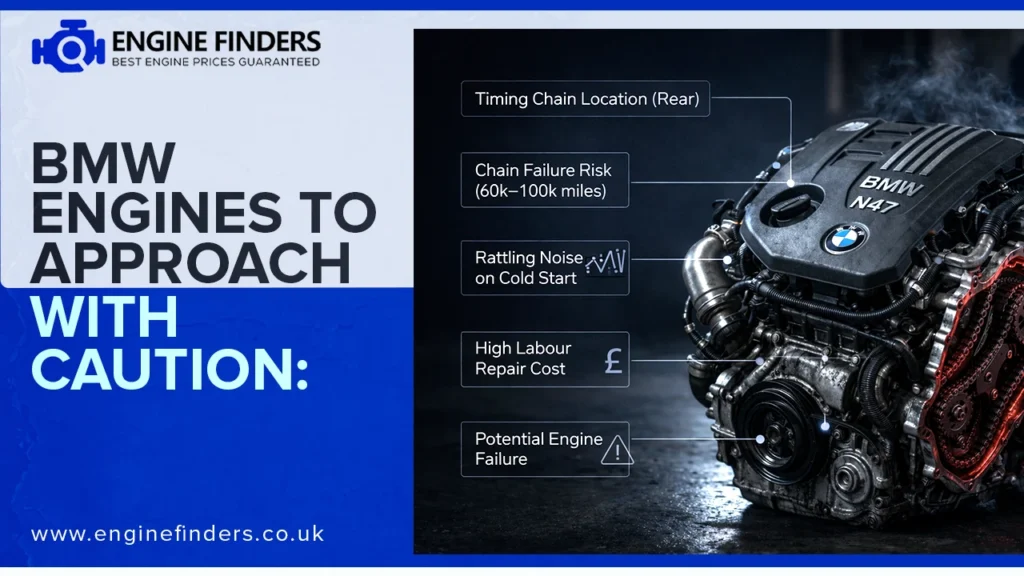
N47 (2007-2014) – Timing Chain Issues
Engine Code: N47D20 Production: 2007-2014 Chassis Applications: E90 318d/320d, E60 520d, E70 X5 xDrive20d
The N47 2.0-litre diesel is notorious for timing chain failure, with the chain located at the rear of the engine (flywheel end), making replacement extremely labour-intensive.
Critical Failure Mode:
- Timing chain tensioner failure (symptom: rattling noise from rear of engine, especially on cold starts)
- Chain stretch and guide failure typically occurs between 60,000-100,000 miles
- Complete engine failure possible if chain skips teeth
Replacement Cost:
- Timing chain replacement: £1,200-£1,800 (labour-intensive due to rear location)
- Used N47: £500-£1,000
- Reconditioned N47 with upgraded chain: £1,500-£2,200
Verdict: Avoid unless timing chain has been replaced with upgraded components and full documentation is available.
N54 (2006-2013) – High Maintenance Requirements
Engine Code: N54B30 Production: 2006-2013 Chassis Applications: E90 335i, E60 535i, E82 135i, E70 X5 xDrive35i
The N54 3.0-litre twin-turbo petrol offers excellent performance but requires significant maintenance investment.
Common Issues:
- High-pressure fuel pump (HPFP) failure (BMW extended warranty to 10 years/120,000 miles for some vehicles)
- Turbocharger wastegate rattle (symptom: metallic rattling on deceleration)
- Injector failure (symptom: rough running, misfires)
- Carbon buildup on intake valves
- Oil leaks from valve cover gasket and oil filter housing
Maintenance Requirements:
- Oil changes every 5,000-7,000 miles
- Spark plugs every 30,000 miles
- HPFP monitoring and potential replacement
- Injector indexing and potential replacement
Replacement Cost:
- Used N54: £800-£1,500
- Reconditioned N54: £2,000-£3,500
- Labour: £1,000-£1,500
Verdict: Only consider if you’re prepared for ongoing maintenance costs and have a specialist BMW mechanic available.
N57 (2008-2016) – Timing Chain Concerns
Engine Code: N57D30 Production: 2008-2016 Chassis Applications: E70 X5 xDrive30d, F10 530d, F30 330d, F15 X5 xDrive30d
The N57 3.0-litre diesel replaced the M57 but introduced timing chain reliability concerns.
Critical Failure Mode:
- Timing chain tensioner failure (symptom: rattling noise on cold starts)
- Chain guide failure typically occurs between 80,000-120,000 miles
- Chain located at rear of engine (difficult access)
- Complete engine failure possible
Replacement Cost:
- Timing chain replacement: £1,500-£2,500
- Used N57: £800-£1,500
- Reconditioned N57: £2,000-£3,500
Verdict: Approach with caution. Only consider if timing chain has been replaced or you’re prepared for potential £2,000+ repair bill.
Engine Compatibility by BMW Model
BMW 3 Series Engine Recommendations
E46 (1998-2006):
- Best petrol: M54B30
- Best diesel: M47D20 or M57D30 (early examples)
- Avoid: M43 (underpowered), early M47 (timing chain issues)
E90/E91/E92/E93 (2005-2013):
- Best petrol: N52B30 (naturally aspirated), N54B30 (performance, high maintenance)
- Best diesel: M47D20 (pre-2007), N47D20 (post-2007, check timing chain)
- Avoid: N43 (direct injection issues), N47 without timing chain replacement
F30/F31/F34/F35 (2012-2019):
- Best petrol: B48B20 (efficiency), B58B30 (performance and reliability)
- Best diesel: B47D20 (post-2015), N47D20 (pre-2015, timing chain caution)
- Avoid: N20 (timing chain concerns), N47 without service history
G20/G21 (2019-present):
- Best petrol: B48B20 (320i), B58B30 (330i/M340i)
- Best diesel: B47D20 (320d), B57D30 (330d)
- All modern engines generally reliable with proper maintenance
BMW 5 Series Engine Recommendations
E39 (1995-2003):
- Best petrol: M54B30
- Best diesel: M57D30
- Avoid: M62 (cooling system issues), early M57 (swirl flaps)
E60/E61 (2003-2010):
- Best petrol: N52B30
- Best diesel: M57D30 (pre-2007), N57D30 (post-2007, timing chain caution)
- Avoid: N62 (oil consumption, cooling issues), N47 without timing chain replacement
F10/F11 (2010-2017):
- Best petrol: N55B30, B58B30 (LCI models)
- Best diesel: N57D30 (timing chain caution), B57D30 (post-2015)
- Avoid: N20 (timing chain), N47 without service history
G30/G31 (2017-present):
- Best petrol: B48B20 (520i), B58B30 (540i)
- Best diesel: B47D20 (520d), B57D30 (530d)
- All modern engines reliable with proper servicing
Cost Considerations: Used vs Reconditioned vs New
When replacing your BMW engine, you have three main options:
Used Engines:
- Cost: £500-£2,500 depending on engine code
- Pros: Lowest upfront cost, immediate availability
- Cons: Unknown history, limited warranty (typically 30-90 days), potential hidden issues
- Best for: Budget-conscious buyers, older vehicles, short-term ownership
Reconditioned Engines:
- Cost: £1,500-£4,000 depending on engine code (compare quotes using EngineFinders comparison tool)
- Pros: Rebuilt to specification, warranty coverage (typically 6-12 months), known quality
- Cons: Higher cost than used, longer lead time
- Best for: Long-term ownership, peace of mind, warranty protection
New/Crate Engines:
- Cost: £4,000-£10,000+ depending on engine code
- Pros: Brand new, full warranty, zero mileage
- Cons: Very expensive, often not cost-effective vs vehicle value
- Best for: Classic BMW restoration, rare engines, unlimited budgets
Practical Takeaways: Which BMW Engine Should You Choose?
For Daily Commuting (Under 10,000 Miles/Year)
Best choice: B48 petrol (2.0-litre turbo)
- Good fuel economy, low emissions, reliable
- Avoid diesels if primarily short journeys (DPF issues)
For High Mileage Motorway Driving (15,000+ Miles/Year)
Best choice: M57 diesel (if outside CAZ) or B57 diesel (if ULEZ compliance needed)
- Excellent fuel economy, proven durability
- M57 offers lower running costs but emissions restrictions apply
For Performance Enthusiasts
Best choice: B58 petrol (modern) or S55 (M-car performance)
- B58 offers reliability with strong performance
- S55 delivers M-car thrills with higher maintenance costs
For Budget-Conscious Buyers
Best choice: N52 petrol (naturally aspirated) or M57 diesel
- Lower purchase price, proven reliability
- Accept higher emissions for older engines
For ULEZ/CAZ Compliance
Best choice: B48, B58 petrol or B47, B57 diesel (Euro 6)
- Post-2015 engines generally compliant
- Verify specific vehicle emissions rating before purchase
When to Use EngineFinders
If your BMW has suffered engine failure or you’re planning a preventative replacement, Engine Finders connects you with vetted UK suppliers for no-obligation quotes. Compare pricing, warranty terms, and availability across multiple suppliers in minutes.
Professional Verification Requirements
Before purchasing any replacement engine:
- Verify engine code matches your chassis requirements
- Check emissions compliance for your area
- Confirm warranty terms and supplier credentials
- Obtain professional diagnosis to confirm engine replacement is necessary
- Consider compression test and leak-down test for used engines
Enter Your REG to Get a Free Engine Quote

Frequently Asked Questions
What is the best BMW engine ever made?
The M57 3.0-litre diesel (1998-2013) is widely considered BMW’s most reliable engine, with many examples exceeding 300,000 miles. For petrol engines, the B58 (2015-present) represents BMW’s most reliable modern design, addressing weaknesses of earlier turbocharged units.
How much does a BMW engine replacement cost in the UK?
Used BMW engines typically cost £500-£2,500, while reconditioned units range from £1,500-£4,000 depending on the engine code. Labour adds £800-£1,500. Compare quotes from vetted UK suppliers for competitive pricing.
Which BMW engines have timing chain problems?
The N47 diesel (2007-2014) and N57 diesel (2008-2016) have well-documented timing chain failures. The N20 petrol (2011-2015) also suffers from chain guide failure. These engines have rear-mounted chains, making replacement extremely labour-intensive and costly.
What is the most reliable BMW 3 Series engine?
For E90 generation (2005-2013), the N52 3.0-litre naturally aspirated petrol is most reliable. For F30 (2012-2019), the B58 3.0-litre turbo petrol offers the best reliability. Diesel buyers should choose B47 (post-2015) over N47 due to timing chain concerns.
Are BMW diesel engines reliable?
BMW’s M57 diesel (1998-2013) is exceptionally reliable with proper maintenance. Modern B47 and B57 diesels (2015-present) are also dependable but more complex. Avoid N47 and N57 diesels due to timing chain failure risks. All diesels require regular long journeys to prevent DPF issues.
Can I swap a newer BMW engine into an older model?
Engine swaps are possible but complex, requiring ECU reprogramming, wiring modifications, and potential emissions compliance issues. BMW 3 Series Engine Replacement specialists can advise on compatibility. Always verify MOT and insurance implications before proceeding with engine swaps.