Executive Summary
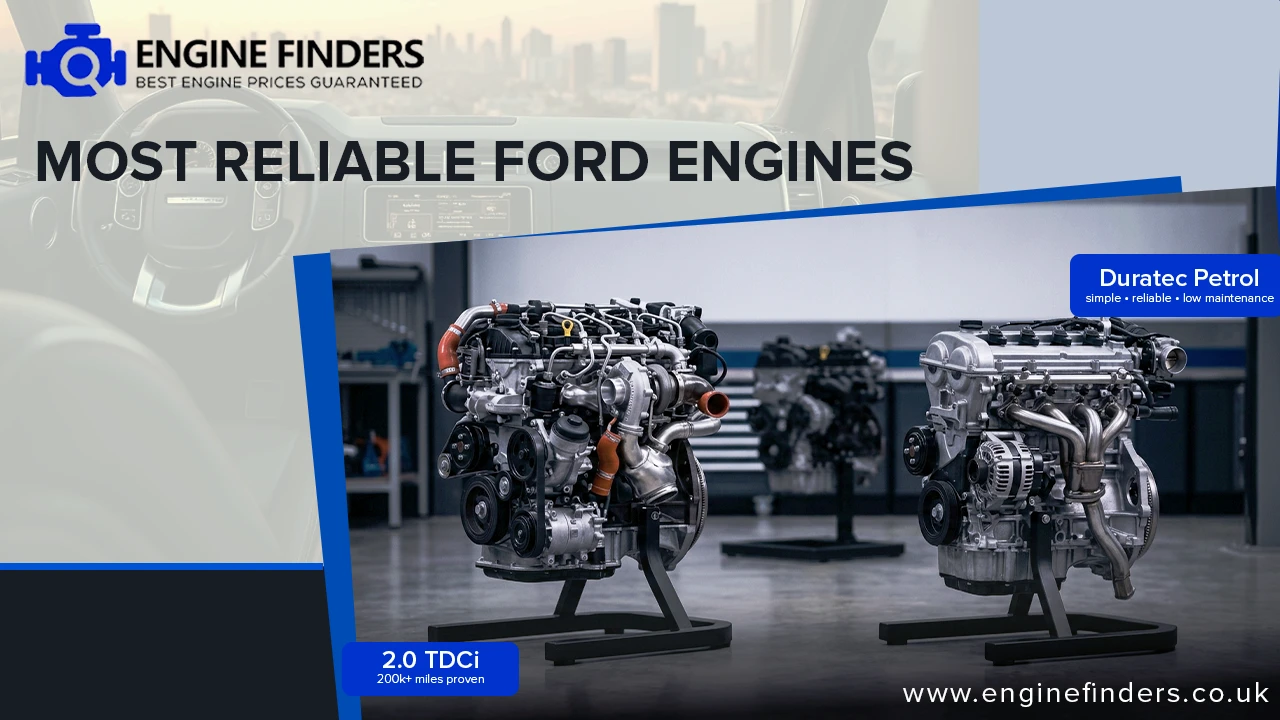
When it comes to Ford engine reliability in the UK, the 2.0-litre Duratorq TDCi diesel and Duratec petrol engines consistently prove themselves as the most dependable options, with many examples surpassing 200,000 miles with proper maintenance. The 2.0 TDCi (particularly the 2006-2014 variants) has earned legendary status among UK van and car owners for its robust construction and relatively simple design, while the naturally-aspirated Duratec 1.6 and 2.0 petrol units offer proven longevity without turbocharger complications.
However, not all Ford engines are created equal. The 1.0-litre EcoBoost, despite winning numerous awards, has documented issues with timing belt degradation and coolant leaks that can lead to catastrophic failure if not addressed. Similarly, early 1.6 TDCi units require strict adherence to timing belt replacement intervals to avoid expensive damage.
For UK drivers seeking a replacement engine, the 2.0 TDCi remains the safest bet for high-mileage reliability, while Duratec petrol engines offer straightforward, cost-effective ownership. Always verify engine codes and service history before purchasing.
Engine Finders is a price comparison platform, not a direct engine seller. Final pricing, warranty terms, and availability vary by vetted UK supplier. Professional diagnosis is recommended before purchasing any replacement engine.
Ford Engine Reliability: Detailed Analysis by Engine Family
The Duratorq TDCi Diesel Range: Workhorse Champions
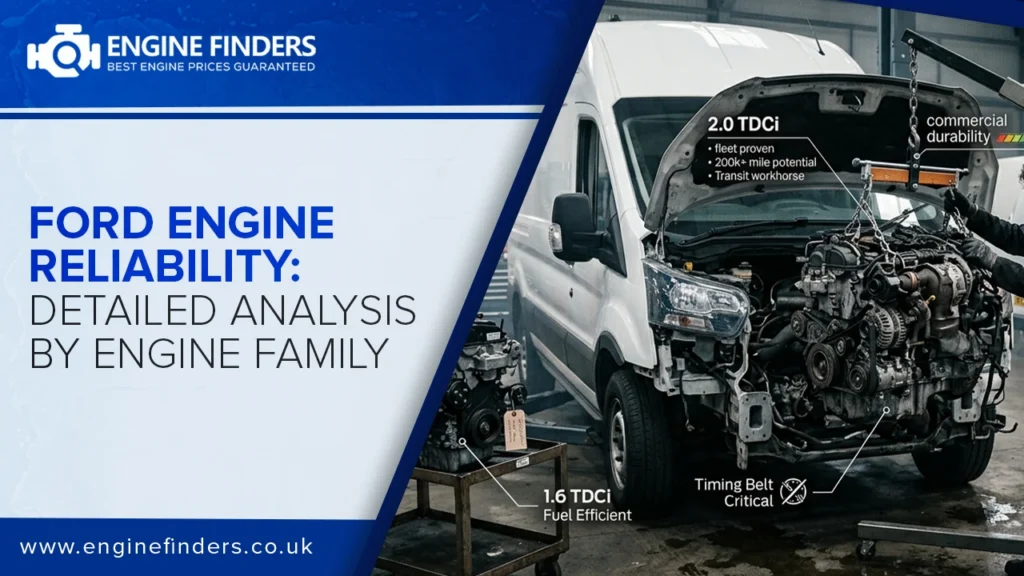
Ford’s Duratorq TDCi diesel engines have powered millions of UK vehicles since 2000, from Focus and Mondeo models to Transit vans and Ranger pickups. These engines dominate the UK commercial vehicle market for good reason.
2.0-litre TDCi (DW10/DLD-420): The Gold Standard
The 2.0 TDCi, particularly the 8-valve variants produced between 2006-2014, represents Ford’s most reliable diesel offering. Found in Ford Transit engines, Mondeo models, and Focus vehicles, this engine features:
- Production years: 2000-present (multiple iterations)
- Common applications: Transit MK6/MK7, Mondeo MK4, Focus MK2/MK3
- Known strengths: Robust bottom end, simple 8-valve design (early versions), widely available parts
- Common failure points: Dual-mass flywheel wear (symptom: rattling at idle), EGR valve carbon buildup (symptom: reduced power, rough idle), injector seal failure (symptom: diesel smell, hard starting)
The 2.0 TDCi typically achieves 150,000-250,000 miles with regular servicing. Oil changes every 10,000 miles (not Ford’s 18,000-mile interval) and timely cambelt replacement at 125,000 miles or 10 years are critical.
1.6-litre TDCi (DLD-416): Compact but Capable
The 1.6 TDCi powers the Fiesta, Focus, and smaller Transit Custom models. While generally reliable, it demands stricter maintenance:
- Production years: 2004-2020
- Common applications: Fiesta MK6/MK7, Focus MK2/MK3, Transit Custom
- Critical maintenance: Timing belt replacement every 125,000 miles or 10 years (non-negotiable)
- Known issues: Turbocharger actuator sticking (symptom: limp mode), DPF clogging on short-journey vehicles, swirl flap mechanism wear
The 1.6 TDCi can reach 150,000+ miles but is less tolerant of neglect than its 2.0-litre sibling.
2.2/2.4-litre TDCi: Transit Specialists
These larger-displacement engines power heavy-duty Transit vans and Ranger pickups:
- 2.2 TDCi: 2006-present, Transit MK7/MK8, Ranger
- 2.4 TDCi: 2000-2013, Transit MK6/MK7
- Strengths: Torque-rich performance, proven in commercial use
- Weaknesses: Higher fuel consumption, turbocharger failures on poorly-maintained examples
For those needing a replacement 2.2 TDCi engine, check our Ford Ranger engines options.
Duratec Petrol Engines: Simple and Dependable
Ford’s Duratec family represents naturally-aspirated petrol engineering at its most straightforward.
Duratec 1.6 and 2.0: The Reliable Choice
- Production years: 1993-2014 (various iterations)
- Applications: Focus MK1/MK2, Fiesta, Mondeo, C-Max
- Reliability rating: Excellent
- Common issues: Minor oil leaks from rocker cover gasket, coil pack failures (symptom: misfire codes), thermostat housing cracks on older units
These engines regularly exceed 200,000 miles with basic maintenance. The lack of turbochargers and direct injection complexity means fewer failure points. For used engine buyers, the Duratec 2.0 offers exceptional value and availability.
For those interested in Duratec engine options, see our Ford engines page.
Duratec HE (Hybrid Edition): Found in Mondeo and Escape hybrids, these units share the base Duratec architecture with proven reliability.
EcoBoost Engines: Award-Winning but Complex
Ford’s EcoBoost range won International Engine of the Year awards repeatedly, but real-world reliability varies significantly.
1.0-litre EcoBoost: Controversial Champion
- Production years: 2012-present
- Applications: Fiesta, Focus, EcoSport, B-Max
- Awards: Multiple International Engine of the Year titles
- Serious concerns:
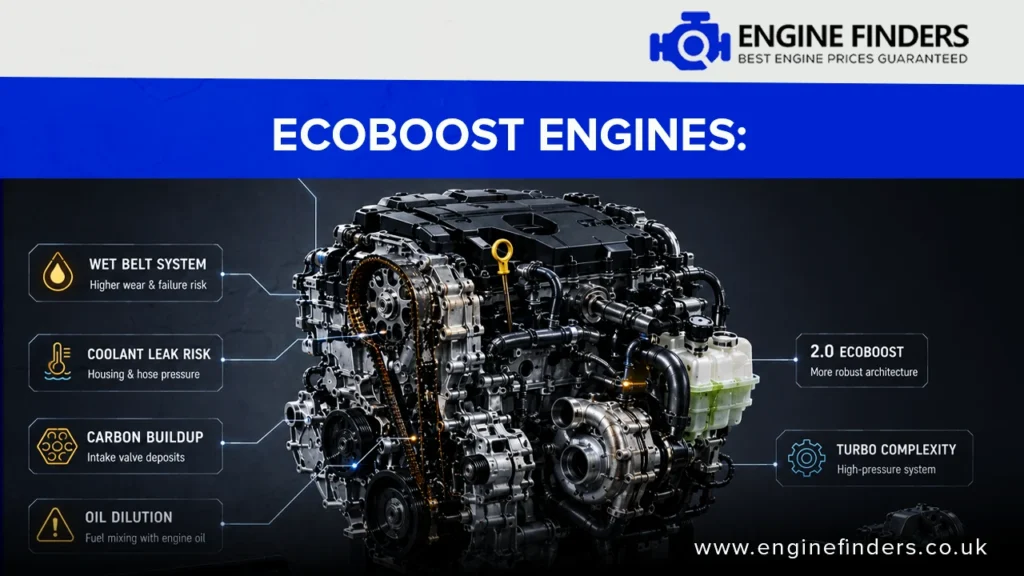
- Timing belt degradation (Ford recommends inspection at 10 years/150,000 miles, but failures reported earlier)
- Coolant leaks from degas bottle and hose connections
- Carbon buildup on intake valves (direct injection)
- Oil dilution from fuel (symptom: rising oil level)
The 1.0 EcoBoost can be reliable with meticulous maintenance, but repair costs often exceed engine value. Many UK owners opt for replacement when issues arise. For detailed information about 1.0 EcoBoost problems, see our Ford 1.0 EcoBoost engine problems guide.
1.5/1.6-litre EcoBoost: Generally more robust than the 1.0, but watch for:
- Carbon buildup (direct injection)
- Turbocharger wastegate rattle
- Coolant intrusion issues (certain 2011-2019 models – check DVSA recall database)
2.0/2.3-litre EcoBoost: Found in Mondeo, Ranger, and performance models. More reliable than smaller EcoBoosts but still complex.
Engines to Approach with Caution
1.6-litre Ti-VCT Petrol (Sigma Engine)
- Production years: 2004-2020
- Applications: Fiesta, Focus, C-Max
- Issues: Variable timing system failures (symptom: rattling on startup, loss of power), oil consumption on high-mileage examples
- Verdict: Acceptable but not exceptional; timing system repairs cost £800-£1,200
Early 2.0-litre EcoBlue (2016-2018)
- Issues: AdBlue system faults, turbocharger reliability concerns
- Note: Later iterations (2019+) show improvement
Cost Considerations for Ford Engine Replacement
UK pricing for Ford engine replacements varies significantly by type and source:
Used Ford Engines:
- 1.6 TDCi: £400-£800
- 2.0 TDCi: £600-£1,200
- Duratec 1.6/2.0: £350-£700
- 1.0 EcoBoost: £500-£900
Reconditioned Ford Engines:
- 2.0 TDCi: £1,200-£2,000
- Duratec 2.0: £1,000-£1,600
- 1.6 TDCi: £1,100-£1,800
- 1.0 EcoBoost: £1,300-£2,200
Labour costs typically add £600-£1,200 depending on vehicle model and garage rates. Compare quotes from vetted UK suppliers to find competitive pricing with warranty protection. For detailed cost information, see our engine replacement cost guide.

Practical Takeaways: Which Ford Engine Should You Choose?
For Maximum Reliability:
- Best diesel: 2.0-litre TDCi (2006-2014, 8-valve variant)
- Best petrol: Duratec 2.0 or 1.6 (naturally aspirated)
- Avoid if possible: 1.0 EcoBoost without comprehensive service history
For Commercial Use:
- Transit owners should prioritise 2.0 or 2.2 TDCi engines with full service records
- Expect 200,000+ miles from well-maintained examples
- Budget £1,500-£2,500 for reconditioned replacement
For Daily Driving:
- Duratec petrol engines offer lowest running costs and simplest repairs
- 1.6 TDCi acceptable for mixed driving but avoid if primarily short journeys (DPF issues)
- EcoBoost engines require premium fuel and strict maintenance
When to Use EngineFinders: If your Ford has suffered catastrophic engine failure, comparing quotes from multiple vetted suppliers ensures you get competitive pricing and warranty terms. Reconditioned engines from reputable suppliers often include 6-12 month warranties, providing peace of mind that used engines cannot match.
Always verify engine codes match your vehicle’s specifications, and request compression test results or borescope images when purchasing used engines. Professional diagnosis before purchase prevents costly compatibility errors. For guidance on engine compatibility, use our engine compatibility guide.
Enter Your REG to Get a Free Engine Quote

Frequently Asked Questions
What is the most reliable Ford engine ever made?
The 2.0-litre Duratorq TDCi diesel (2006-2014) and Duratec 2.0 petrol are Ford’s most reliable, regularly achieving 200,000+ miles with proper maintenance. The 2.0 TDCi’s robust design makes it ideal for high-mileage UK drivers.
How much does a Ford 2.0 TDCi engine replacement cost?
A reconditioned Ford 2.0 TDCi typically costs £1,200-£2,000 including VAT. Labour adds £600-£1,200. Compare quotes from vetted UK suppliers for competitive pricing.
Which Ford engines should I avoid?
Avoid the 1.0-litre EcoBoost (timing belt/coolant issues) and early 1.6 Ti-VCT (timing system failures). The 2016-2018 2.0 EcoBlue had AdBlue/turbo problems. Always verify service history and check recalls first.
How long do Ford EcoBoost engines last?
With meticulous maintenance, EcoBoost engines can reach 100,000-150,000 miles. However, the 1.0-litre variant has premature failure risks from timing belt degradation. Many UK owners report issues before 80,000 miles on poorly-maintained units.
Is it worth replacing a Ford engine or buying a new car?
For vehicles under 10 years old, engine replacement costs £1,500-£3,000 versus £15,000+ for new. A reconditioned engine with warranty offers 12-24 months protection. Get professional assessment before deciding.