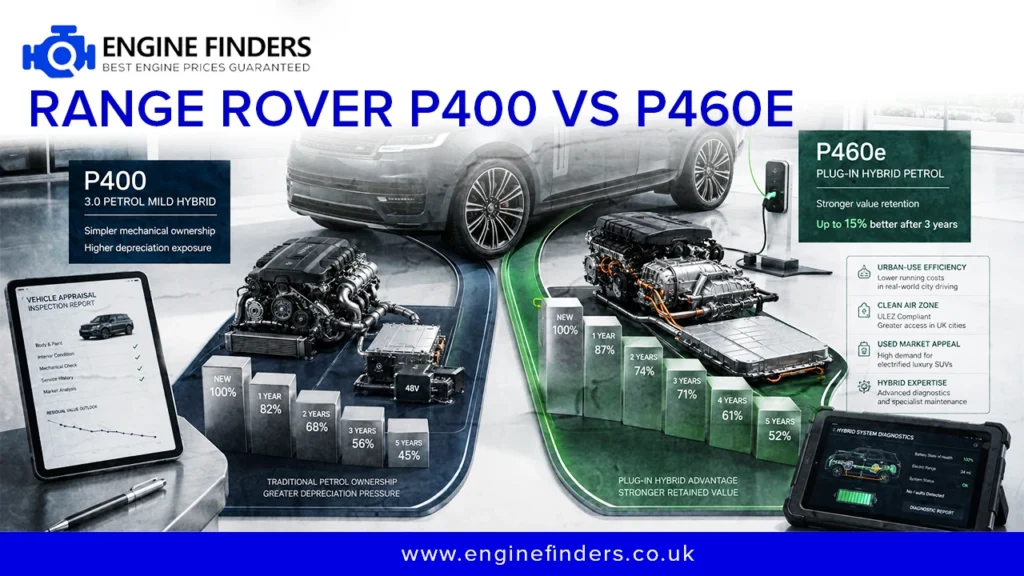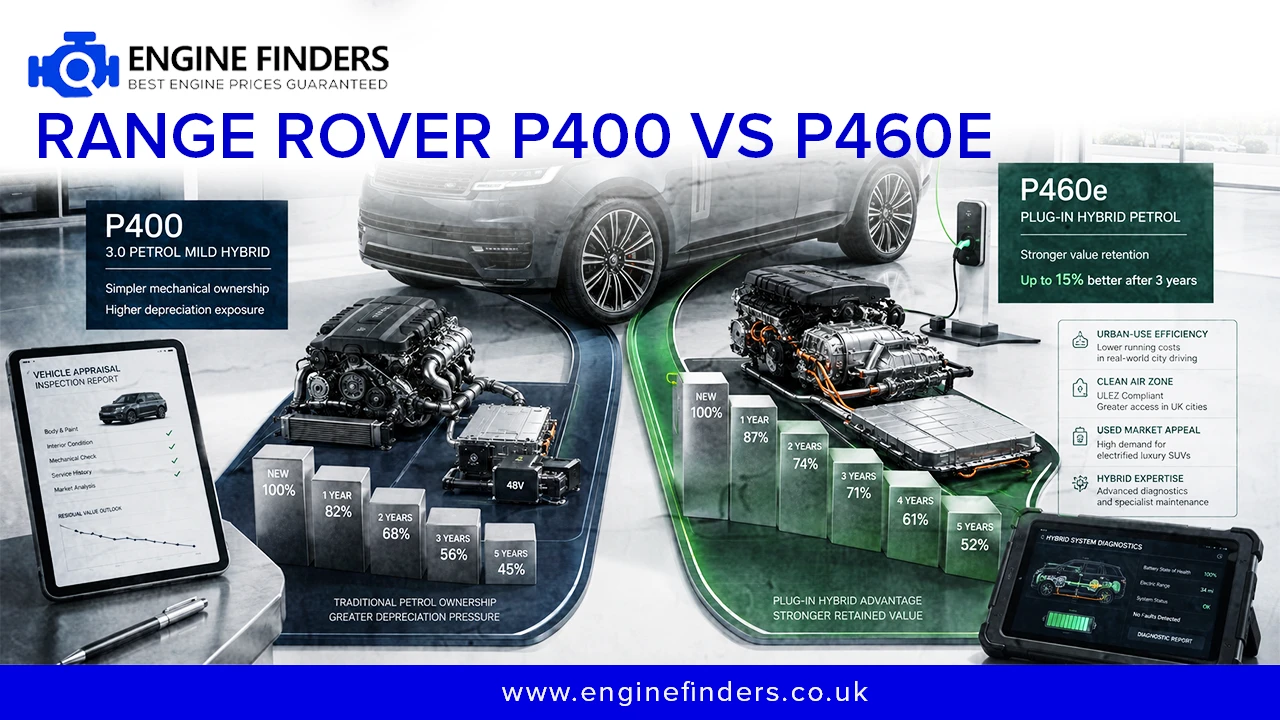
In the UK luxury SUV market, the Range Rover P460e plug-in hybrid currently retains up to 15% more of its original value after three years compared to the mild-hybrid P400, based on 2026 UK automotive valuation data.
For buyers weighing the Range Rover P400 vs P460e, the decision extends beyond initial purchase price. It involves navigating Clean Air Zone charges, complex hybrid maintenance, and long-term depreciation. Understanding the mechanical realities of both powertrains is essential before committing to a six-figure investment.
Quick Summary: P400 vs P460e at a Glance
- Resale Value: The P460e holds value better due to lower Benefit-in-Kind (BiK) tax rates and ULEZ compliance.
- Reliability: The P400’s mild-hybrid system is mechanically simpler, presenting fewer electronic failure points than the P460e’s high-voltage architecture.
- Running Costs: P460e offers near-zero emission urban driving, but out-of-warranty battery degradation can incur steep replacement costs.
- What to Avoid: Do not ignore software update histories on P460e models, as unresolved ECU glitches frequently mimic hardware failures.
Range Rover P400 vs P460e Engine Specifications Compared
To make an informed decision, buyers must understand the fundamental engineering differences between these two 3.0-litre inline-six configurations. Both utilise JLR’s award-winning Ingenium architecture, but their electrification strategies diverge significantly.
Ingenium 3.0L Inline-6 MHEV (P400) Technical Data
The P400 engine produces 400 PS (395 bhp) and 550 Nm of torque. It pairs a turbocharged and supercharged 3.0-litre petrol engine with a 48-volt mild-hybrid electric vehicle (MHEV) system.
According to official JLR technical specifications, the 48V system primarily assists the starter-generator, enabling smoother stop-start functionality and minor torque fill during acceleration. It cannot propel the vehicle on electric power alone. This mechanical simplicity makes the P400 a robust choice for high-mileage motorway driving.
3.0L Inline-6 Plug-In Hybrid (P460e) Technical Data
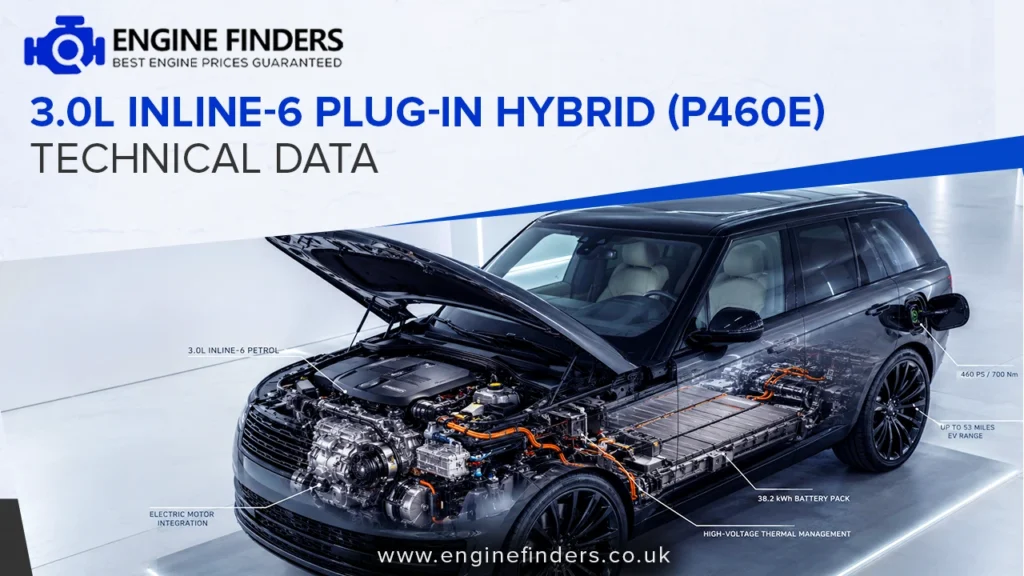
The P460e combines the same 3.0-litre Ingenium petrol engine with a significantly larger electric motor and a 38.2 kWh battery pack. This setup delivers a combined 460 PS (454 bhp) and 700 Nm of torque.
Crucially, the P460e can travel up to 53 miles on electric power alone under WLTP conditions. However, this performance relies on a complex integration of high-voltage cabling, thermal management systems, and dual power control units. For those exploring alternatives, the Range Rover Sport PHEV engine shares similar architecture and componentry.
Depreciation and Resale Value: P400 vs P460e in the UK
When evaluating the Range Rover P400 vs P460e, depreciation is the most significant financial variable. UK market trends heavily favour electrified vehicles, but not without caveats.
Impact of ULEZ and Clean Air Zones on Petrol SUV Values
London’s Ultra Low Emission Zone (ULEZ) and expanding Clean Air Zones (CAZ) in cities like Birmingham and Bristol directly impact residual values. The P460e is fully exempt from these daily charges, making it highly desirable for urban professionals.
Conversely, while the P400 meets Euro 6d emissions standards, it does not offer the zero-emission buffer that future-proofs a vehicle against tightening municipal regulations. Buyers seeking mainline Range Rover models must factor in these daily operational costs when calculating total cost of ownership.
Company Car Tax (BiK) Advantages for the P460e
The P460e’s CO2 emissions fall below 50g/km, placing it in a highly favourable Benefit-in-Kind (BiK) tax bracket. According to current UK vehicle tax bands, this results in substantial annual savings for company car drivers compared to the P400. This corporate demand artificially inflates the used market value of the P460e, slowing its depreciation curve.
Long-Term Reliability and Maintenance Costs
A vehicle’s value retention is inextricably linked to its reliability profile. While both engines share the same base block, their ancillary systems fail at different rates.
Common P400 Engine Issues and Repair Costs
The P400 is generally regarded as one of JLR’s more reliable modern powertrains. However, it is not immune to issues. Owners occasionally report P400 petrol engine misfires, often traced to carbon buildup on the intake valves or failing ignition coils.
The 48V mild-hybrid belt-driven starter generator (BSG) is another known wear item. If the BSG fails, the vehicle may experience a complete loss of electrical power, requiring a costly replacement. Regular oil changes using OEM-approved low-SAPS lubricants are critical to mitigating these risks.
P460e Hybrid System Complexity and Battery Degradation
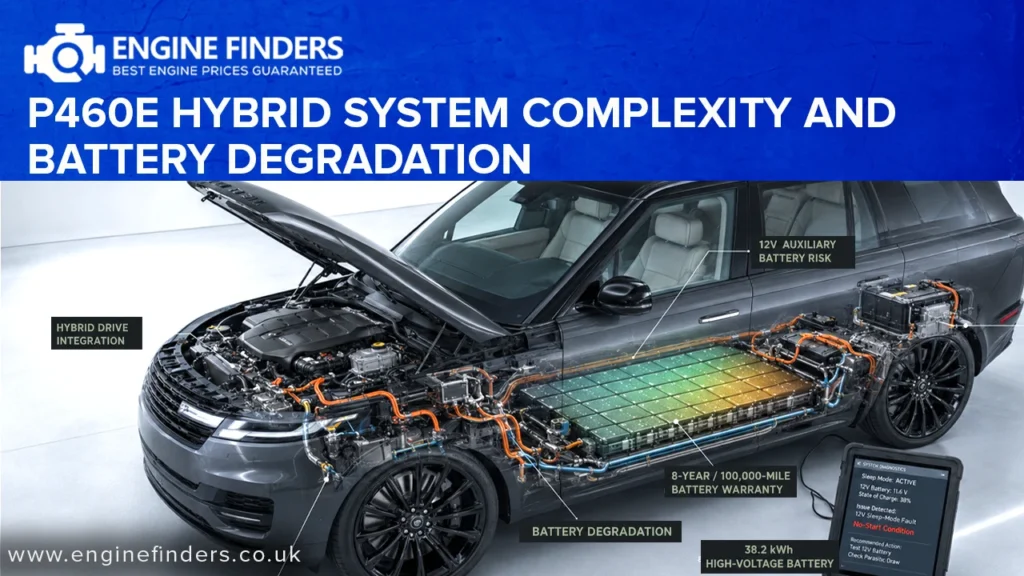
The P460e introduces high-voltage components that carry inherent long-term risks. While the battery is warranted for 8 years or 100,000 miles, capacity degradation is a chemical certainty.
Furthermore, the integration of software and hardware creates unique failure modes. For instance, owners of similar JLR hybrids frequently report 12V battery drain and hybrid system quirks, where the auxiliary battery fails to manage the high-voltage system’s sleep mode, leading to a vehicle that refuses to start.
Engine Replacement Costs and Warranty Considerations
When an engine fails, the financial implications dictate the true cost of ownership. Understanding the replacement landscape is vital for buyers purchasing out-of-warranty models.
What Happens When the P400 or P460e Engine Fails?
Catastrophic failure in the 3.0L Ingenium engine is rare but expensive. Issues such as timing chain stretch or turbocharger bearing failure can necessitate a full engine swap.
If you are facing this scenario, understanding the Range Rover engine replacement cost is the first step. A brand-new OEM engine from a main dealer can exceed £15,000, excluding labour.
For cost-conscious owners, sourcing quality used engines from verified breakers or investing in reconditioned engines with independent warranties offers a viable, financially sound alternative. A professional engine rebuild process in the UK can restore OEM specifications at a fraction of the dealer cost.
Need clarity on your specific situation? Our team can help you navigate the complexities of engine sourcing. Get a free, no-obligation quote today, and we will match you with vetted, DVLA-compliant suppliers across the UK.
Which Range Rover Engine Should You Buy?
The choice between the Range Rover P400 vs P460e ultimately depends on your driving profile and risk tolerance.
Choose the P460e if you have access to home charging, regularly drive in urban environments, and want to maximise resale value through tax efficiencies and ULEZ compliance. Be prepared for higher out-of-warranty electrical repair costs.
Choose the P400 if you predominantly drive long distances on motorways, prefer mechanical simplicity, and want to avoid the complexities of high-voltage battery management. While it depreciates slightly faster, its lower maintenance complexity can offset the initial value loss over a five-year ownership period. For those specifically looking at the latest generation, reviewing the current L460 generation specifications will confirm that these powertrain dynamics remain consistent across the lineup.
Frequently Asked Questions (FAQ)
Does the Range Rover P460e hold its value better than the P400?
Yes. 2026 UK market data indicates the P460e retains approximately 10-15% more value after three years. This is driven by strong corporate demand, lower BiK tax rates, and exemption from Clean Air Zone charges, which the P400 does not fully offer.
Can the Range Rover P400 drive on electric power alone?
No. The P400 utilises a 48-volt mild-hybrid (MHEV) system. This system only assists the combustion engine during acceleration and enables smoother stop-start functionality. It cannot propel the vehicle independently without the petrol engine running.
What is the real-world electric range of the P460e?
While JLR claims up to 53 miles under WLTP testing, real-world UK driving typically yields 35 to 45 miles. Cold weather, motorway speeds, and battery age will reduce this figure. Regular charging is required to maintain the stated efficiency benefits.
Are P460e batteries covered under warranty in the UK?
Yes. Jaguar Land Rover provides an 8-year or 100,000-mile warranty on the high-voltage battery, guaranteeing it will retain at least 70% of its original capacity. However, damage from neglect or non-OEM software modifications may void this coverage.
How does MOT testing differ for the P460e compared to the P400?
Both must pass standard emissions tests. However, under strict MOT emissions testing standards, the P460e’s hybrid system is checked for warning lights and safe high-voltage isolation. A malfunctioning hybrid ECU will result in an immediate MOT failure.
Is it cheaper to replace a P400 or P460e engine?
The base mechanical replacement cost is similar, as both share the same 3.0L Ingenium block. However, the P460e requires additional labour for high-voltage system isolation and recalibration of hybrid control modules, typically adding £500 to £1,000 to the final labour bill.
Does replacing the engine affect my Range Rover’s DVLA tax band?
No. Like-for-like engine replacements maintain your original vehicle registration details and tax band. You must ensure the replacement engine matches the original displacement and fuel type to remain compliant with DVLA regulations.