Executive Summary
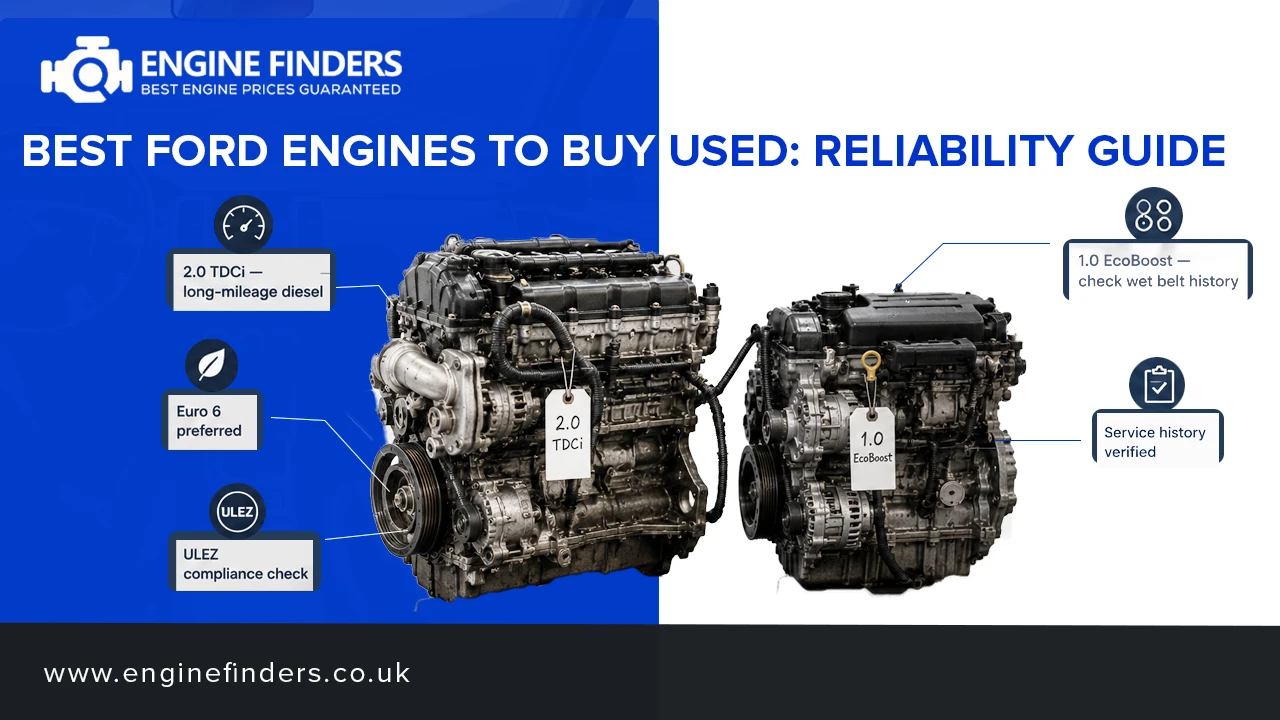
When searching for the best Ford engines to buy used in the UK, the 2.0-litre TDCi diesel and 1.0-litre EcoBoost petrol engines stand out as the most reliable options from 2015-2025. The 2.0 TDCi (particularly post-2018 Euro 6 versions) consistently achieves 150,000+ miles with proper maintenance, while the 1.0 EcoBoost offers solid reliability when the timing belt is replaced every 10 years or 150,000 miles. However, early 1.0 EcoBoost engines (2012-2015) had wet belt degradation issues that require careful inspection.
For diesel buyers, the 2.0 TDCi remains the benchmark for longevity, though ULEZ restrictions affect older Euro 5 models. Petrol buyers should prioritise post-2018 EcoBoost units with updated belt systems. Always verify service history and consider a pre-purchase inspection before committing.
Engine Finders is a price comparison platform, not a direct engine seller. Final pricing, warranty terms, and availability vary by vetted UK supplier. Professional diagnosis is recommended before purchasing any replacement engine.
Ford Engine Reliability: What UK Buyers Need to Know
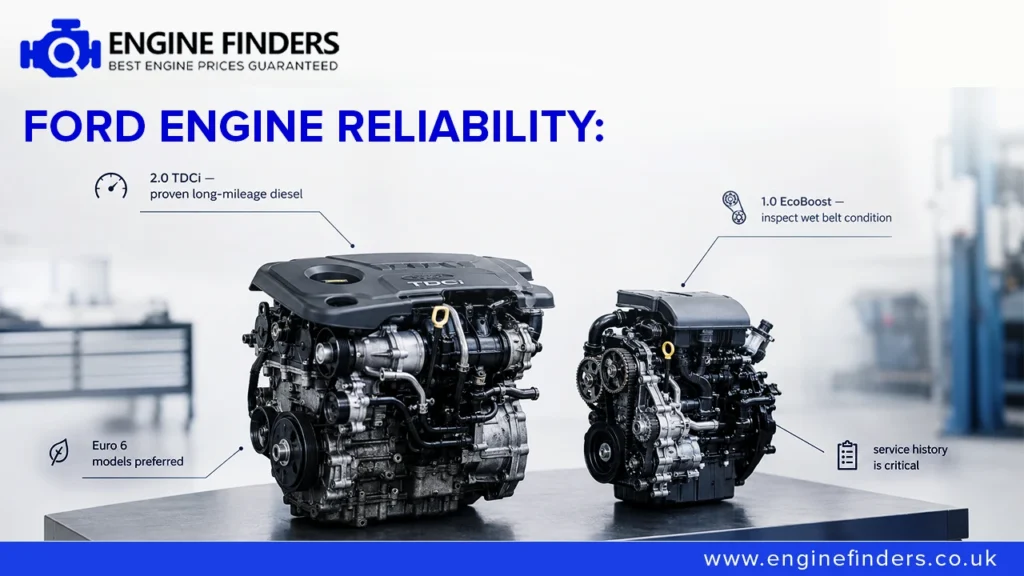
Ford’s engine lineup from 2015-2025 spans efficient small-capacity petrols, robust diesels, and performance variants. Understanding which engines deliver longevity versus which carry known risks is essential for used buyers navigating the UK market.
Comparison Criteria for Used Ford Engines
When evaluating Ford engine reliability, we assess several factors: documented failure modes, maintenance costs, parts availability in the UK, emissions compliance (critical for ULEZ/CAZ zones), and real-world longevity data from workshops and owner communities.
The 2.0-Litre TDCi Diesel: Ford’s Most Reliable Workhorse
The 2.0 TDCi (engine codes DW10, later TDCi Duratorq) remains Ford’s most dependable diesel offering, particularly in Focus, Mondeo, Kuga, and Transit applications. Post-2018 Euro 6 versions feature improved emissions systems and reduced EGR-related problems compared to earlier units.
Engine specifications:
- Displacement: 1,997cc
- Power output: 118-187 bhp (varies by tune)
- Production: 2015-present (Euro 5/Euro 6)
- Common applications: Focus (MK3/MK4), Mondeo (MK5), Kuga (MK2/MK3), Transit Custom
Known failure modes:
- EGR cooler leaks (symptom: coolant loss, white smoke) – more common on pre-2018 Euro 5 units
- DPF clogging in urban-use vehicles (symptom: reduced power, DPF warning light)
- Dual-mass flywheel wear (symptom: rattling noise, clutch judder) typically after 100,000 miles
Maintenance requirements:
- Oil changes every 12,500 miles or 12 months (Ford’s official interval, though many specialists recommend 10,000 miles)
- Timing belt replacement every 125,000 miles or 10 years
- EGR system cleaning every 60,000 miles for urban drivers
Replacement costs (UK market): Used 2.0 TDCi engines range from £600-£1,200 depending on mileage and vehicle source. Reconditioned units typically cost £1,500-£2,500 including VAT. Labour for replacement adds £600-£1,000 depending on garage rates. Learn more about Ford 2.0 TDCi engine replacement options.
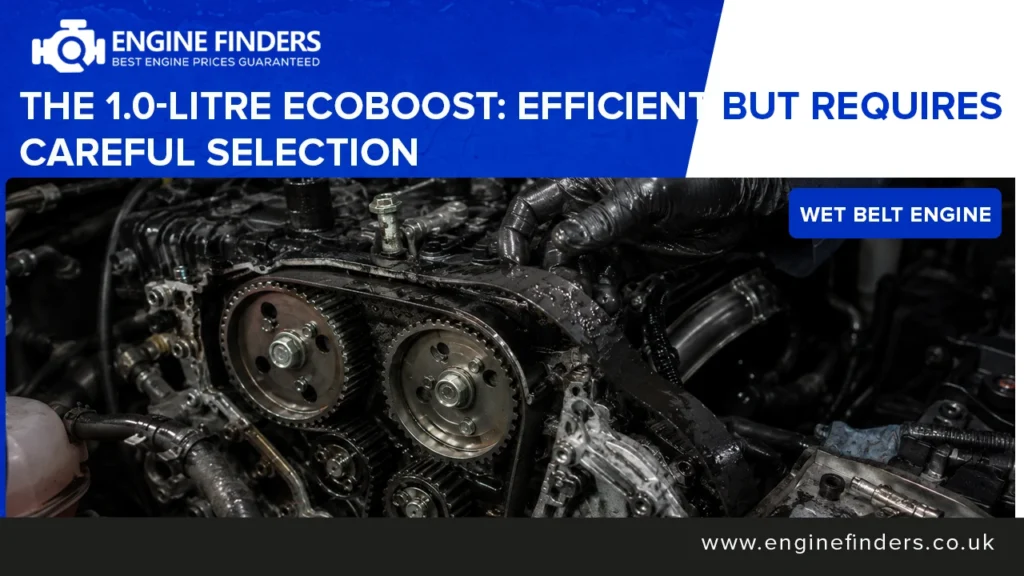
The 1.0-Litre EcoBoost: Efficient but Requires Careful Selection
The 1.0-litre EcoBoost three-cylinder petrol engine revolutionised Ford’s lineup, offering impressive fuel economy without sacrificing performance. However, reliability varies significantly between early and late production units.
Engine specifications:
- Displacement: 999cc
- Power output: 100-125 bhp (standard); 140 bhp (Red/ST variants)
- Production: 2012-present (focus on 2015-2025 for this guide)
- Common applications: Fiesta (MK7/MK8), Focus (MK3/MK4), EcoSport, Puma
Critical distinction: Wet belt vs. updated systems Early 1.0 EcoBoost engines (2012-2017) use a wet timing belt that runs in oil. These belts can degrade prematurely, particularly with extended oil change intervals or incorrect oil specification. Symptoms include metallic debris in the sump, oil pressure warnings, and in severe cases, complete engine failure.
Post-2018 engines feature improved belt materials and Ford revised service intervals. The 2020+ units received further refinements with enhanced belt durability.
Known failure modes:
- Wet belt degradation (2012-2017 models) – symptom: rattling noise, oil pressure loss
- Carbon buildup on intake valves (all direct-injection engines) – symptom: rough idle, reduced power after 80,000 miles
- Coolant leaks from thermostat housing (symptom: low coolant warning, overheating)
Maintenance requirements:
- Oil changes every 10,000 miles maximum (not Ford’s 18,000-mile LongLife interval) using Ford WSS-M2C948-B specification oil
- Timing belt inspection at 80,000 miles, replacement every 150,000 miles or 10 years (whichever comes first)
- Walnut blasting for carbon removal recommended at 100,000 miles
Replacement costs (UK market): Used 1.0 EcoBoost engines: £500-£1,000. Reconditioned units: £1,200-£2,000. For Ford EcoBoost reliability, post-2018 units command a £200-£400 premium but offer better long-term security. Learn more about Ford 1.0 EcoBoost engine replacement options and specific carbon buildup treatments for Puma EcoBoost engines.
The 1.5-Litre EcoBoost: A Balanced Alternative
The 1.5-litre EcoBoost (engine codes M1JA, M1JJ) bridges the gap between the 1.0 and larger engines, offering improved refinement over the three-cylinder while maintaining reasonable efficiency.
Engine specifications:
- Displacement: 1,497cc
- Power output: 150-182 bhp
- Production: 2015-present
- Common applications: Focus (MK4), Kuga (MK3), Puma, Fiesta ST
Known failure modes:
- Coolant intrusion into cylinders (primarily 2015-2018 units) – symptom: white smoke, coolant loss without external leak
- Carbon buildup (typical of direct injection)
- Turbocharger wastegate rattle (symptom: rattling noise on deceleration)
Ford issued technical service bulletins addressing coolant intrusion on certain production batches. Engines manufactured after 2018 appear to have resolved this issue.
Maintenance requirements:
- Oil changes every 10,000 miles
- Spark plugs every 40,000 miles
- Coolant system inspection every 60,000 miles
Replacement costs (UK market): Used 1.5 EcoBoost: £700-£1,300. Reconditioned: £1,800-£2,800. Learn more about Ford 1.5 EcoBoost engine replacement options.
The 1.6-Litre TDCi: Compact Diesel Efficiency
The 1.6 TDCi (DV6 engine family) powers smaller Ford models and offers excellent fuel economy, though it lacks the robustness of the 2.0-litre unit.
Engine specifications:
- Displacement: 1,560cc
- Power output: 95-120 bhp
- Production: 2015-2020 (phased out in favour of 1.5 EcoBlue)
- Common applications: Fiesta (MK7/MK8), Focus (MK3), Tourneo Connect
Known failure modes:
- Turbocharger failures (symptom: blue smoke, whining noise) often linked to oil starvation
- EGR valve clogging (symptom: reduced power, rough running)
- Injector failures (symptom: hard starting, uneven idle)
Replacement costs (UK market): Used 1.6 TDCi: £400-£800. Reconditioned: £1,200-£1,800.
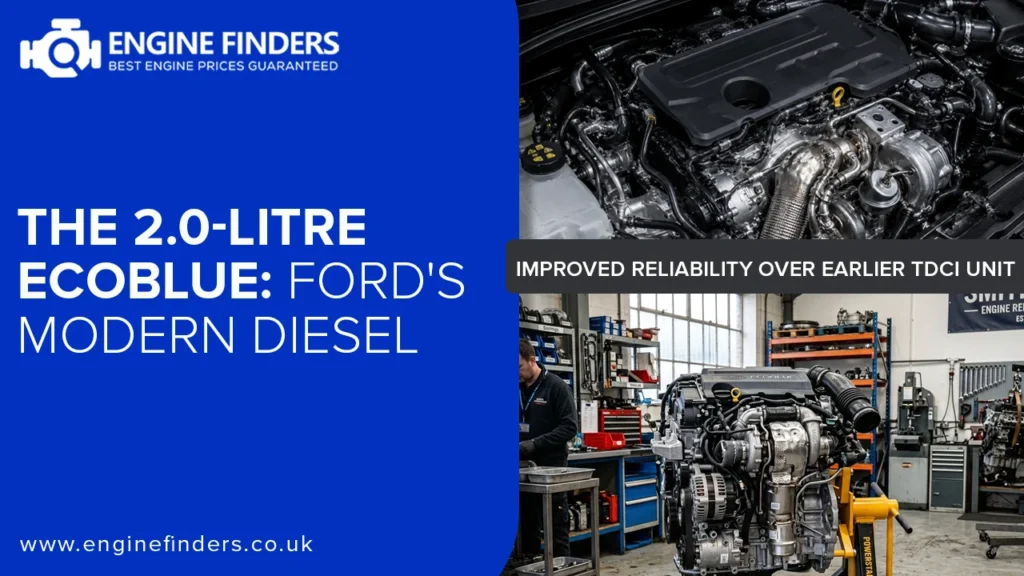
The 2.0-Litre EcoBlue: Ford’s Modern Diesel
Introduced in 2018, the 2.0 EcoBlue replaces the older TDCi in many applications, featuring twin-scroll turbocharging and improved emissions systems.
Engine specifications:
- Displacement: 1,996cc
- Power output: 105-190 bhp
- Production: 2018-present
- Common applications: Transit Custom, Ranger, Focus (MK4), Kuga (MK3)
Known failure modes:
- Too recent for comprehensive failure data
- Early reports suggest improved reliability over TDCi
- AdBlue system faults (symptom: “engine start forbidden” warning)
Replacement costs (UK market): Used EcoBlue units command premium prices due to newer age: £1,500-£2,500. Reconditioned: £3,000-£4,500. Learn more about Ford 2.0 EcoBlue engine replacement options.
Engines to Approach with Caution
Not all Ford engines from this period inspire confidence. The 1.6-litre EcoBoost (2015-2018) in Focus ST applications experienced higher-than-average failure rates due to coolant intrusion and piston ring issues. While not universally problematic, these engines require thorough inspection and verification of service history.
The 2.3-litre EcoBoost in Focus RS and Ranger applications is generally robust but expensive to repair when issues occur. Turbocharger failures and oil consumption problems have been reported, though these affect a minority of units.
Practical Takeaways: Which Ford Engine Should You Buy?
- For maximum reliability and longevity: Choose a post-2018 2.0 TDCi or 2.0 EcoBlue diesel with full service history. These engines regularly exceed 150,000 miles with proper maintenance and remain ULEZ-compliant in Euro 6 form.
- For petrol efficiency: Select a 1.0 EcoBoost manufactured after 2018, verify timing belt condition, and commit to 10,000-mile oil changes. The 1.5 EcoBoost offers a refined alternative with lower risk of belt-related failures.
- Avoid or inspect carefully: Early 1.0 EcoBoost (2012-2015) without documented belt replacement, 1.6 EcoBoost with incomplete service records, or any Ford diesel used primarily for short urban journeys (DPF risk).
When to use EngineFinders: If your Ford engine has suffered catastrophic failure or requires replacement due to age-related wear, comparing quotes from vetted UK suppliers ensures competitive pricing and warranty protection. Get connected with vetted UK suppliers offering Ford-specific engine solutions.
Professional verification: Always request a compression test and leak-down test before purchasing a used Ford engine. For EcoBoost units, insist on oil inspection for metallic debris indicating belt degradation. Our comprehensive engine compatibility guide explains what to look for during pre-purchase inspections.
Cost Considerations for Ford Engine Replacement
Replacement costs vary significantly by engine type and condition. Used engines offer immediate savings but carry unknown history risks. Reconditioned units from reputable suppliers typically include 6-12 month warranties and represent better value for high-mileage vehicles you intend to keep.
Labour costs for Ford engine replacement typically range £600-£1,200 depending on model complexity. The Focus and Fiesta are generally straightforward, while Kuga and Transit applications require more labour time due to engine bay constraints. Our detailed engine replacement cost guide breaks down these costs by model and engine type.
For those concerned about emissions compliance, check the UK government’s ULEZ standards page to ensure your Ford diesel meets current requirements. For community insights and owner experiences, the PistonHeads Ford forum offers valuable real-world information.
Frequently Asked Questions
Which Ford engine is the most reliable overall?
The 2.0-litre TDCi diesel is Ford’s most reliable engine, consistently achieving 150,000+ miles with proper maintenance. Post-2018 Euro 6 versions offer the best combination of reliability and ULEZ compliance for UK buyers.
How much does a Ford 1.0 EcoBoost engine replacement cost?
A reconditioned 1.0 EcoBoost engine typically costs £1,200-£2,000 including VAT. Labour adds £600-£900. Compare quotes from vetted UK suppliers via EngineFinders for competitive pricing and warranty options.
Are Ford EcoBoost engines reliable long-term?
Post-2018 EcoBoost engines are generally reliable with proper maintenance. Early 1.0 EcoBoost units (2012-2017) had wet belt degradation issues requiring vigilant oil changes every 10,000 miles and belt inspection at 80,000 miles. Our reconditioned engines buyer’s guide provides detailed advice on assessing EcoBoost engine condition.
What Ford diesel engine should I avoid?
Avoid pre-2015 Euro 5 diesels if you drive in ULEZ zones. The 1.6 TDCi has higher turbo failure rates than the 2.0 TDCi. Any diesel used primarily for short urban journeys risks DPF clogging regardless of engine size.
How often should I change oil in a Ford EcoBoost engine?
Change oil every 10,000 miles maximum using Ford WSS-M2C948-B specification oil. Never follow Ford’s 18,000-mile LongLife interval for 1.0 or 1.5 EcoBoost engines, as extended intervals accelerate wet belt degradation.
Is it worth replacing a Ford engine or buying a new car?
For vehicles under 10 years old with good bodywork and interior condition, engine replacement is usually cost-effective. A reconditioned Ford engine costs £1,500-£3,000 versus £15,000+ for a new vehicle. Use EngineFinders to compare supplier quotes and make an informed decision based on your specific circumstances.