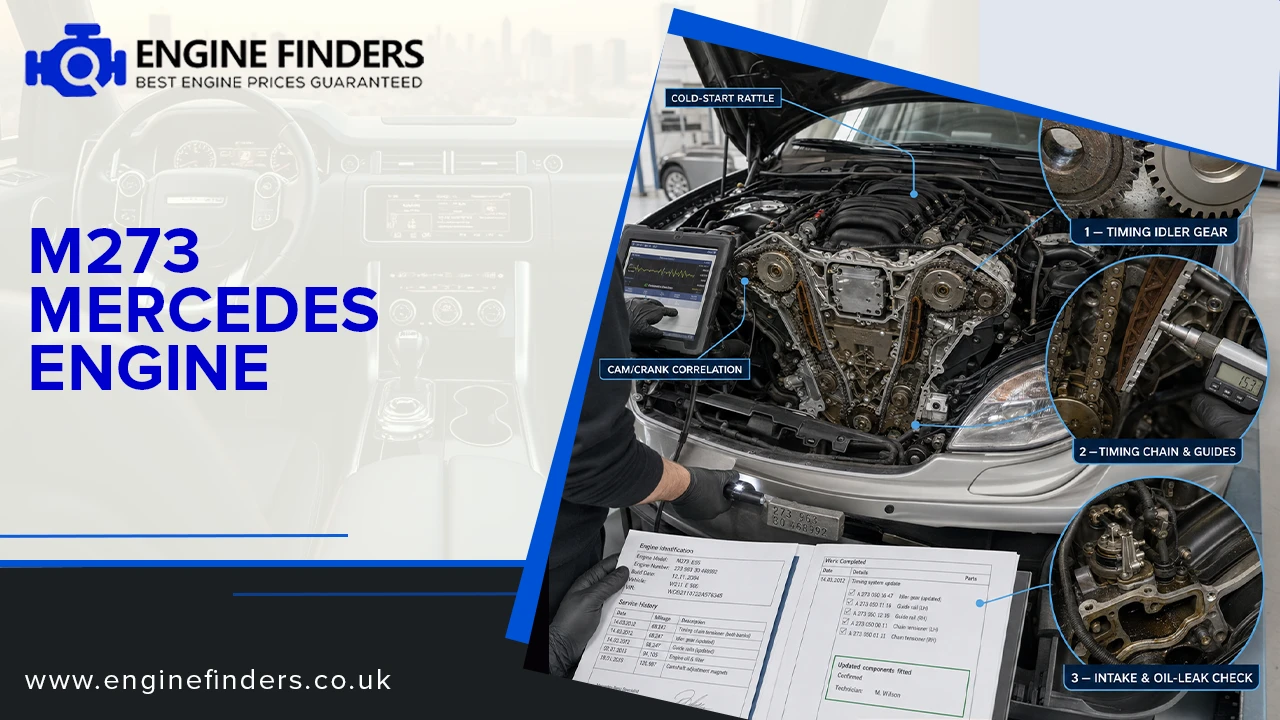
M273 Engine Overview: Specifications & Applications
The M273 was introduced in 2005 as the successor to the M113 V8. It features an all-aluminium block with Silitec cast cylinder liners, a forged steel crankshaft, fracture-split forged connecting rods, and Bosch ME9 engine management with twin micro-controllers. Both 4.7-litre and 5.5-litre variants use a 90-degree V8 configuration with four valves per cylinder and independent intake/exhaust camshaft timing.
| Specification | M273 E46 (4.7L) | M273 E55 (5.5L) |
|---|---|---|
| Displacement | 4,663 cc | 5,461 cc |
| Bore × Stroke | 92.9 mm × 86.0 mm | 98.0 mm × 90.5 mm |
| Peak Power | 250 kW (340 PS) at 6,000 rpm | 285 kW (388 PS) at 6,000 rpm |
| Peak Torque | 460 Nm at 2,700–5,000 rpm | 530 Nm at 2,800–4,800 rpm |
| Compression Ratio | 10.7:1 | 10.7:1 |
Applications (UK market):
- 4.7-litre (M273.923 etc.): GL 450 (X164, 2006 to 2012), S 450 (W221, 2006 to 2010)
- 5.5-litre (M273.963-.969 etc.): ML 500 (W164, 2007 to 2011), GL 500 (X164, 2006 to 2012), E 500 (W211 2006 to 2009 / W212 2009 to 2011), CLK 500 (2006 to 2010), CLS 500 (C219), SL 550 (R230)
The M273 was superseded by the twin-turbo M278 in 2010.
The Two Catastrophic Failures
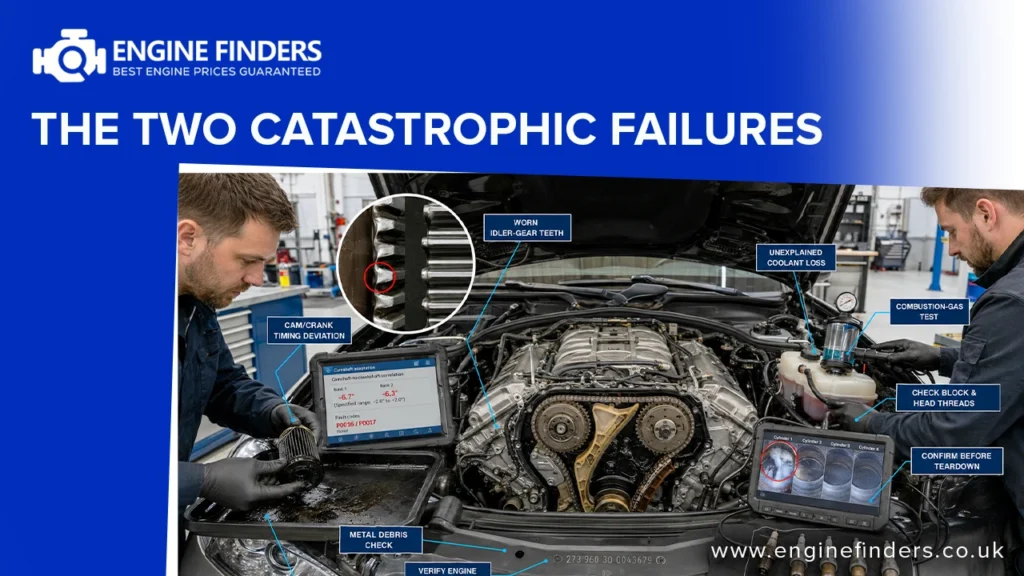
1. Balance Shaft / Idler Gear Wear (The M273 Achilles Heel)
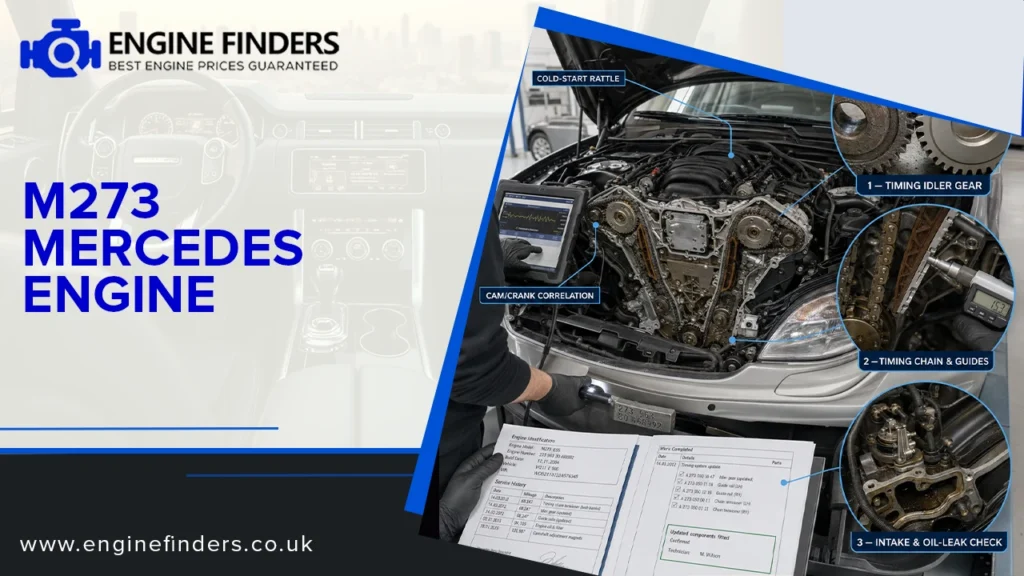
This is the single most notorious M273 problem. Early production engines, generally those manufactured before September 2006, used an idler gear sprocket with an inadequate surface coating. The gear wears prematurely, allowing the timing chain to slip and the camshaft timing to drift.
Symptoms:
- Metallic rattling or knocking from the engine bay, especially on cold start, that disappears once warm
- Check Engine Light with cam/crank correlation codes (P0016, P0017, P0018)
- Metal shavings in the engine oil
- In severe cases, sudden catastrophic failure with complete power loss
Consequences: The balance shaft bolts can back out, causing the gear to strip and shower metal debris through the entire engine. Once metal contamination occurs, bearings, oil galleries, and cylinder walls are compromised.
Fix: Complete engine teardown is required, including a new balance shaft assembly, timing chain, guides, tensioners, and a full oil system flush. Most specialists recommend a replacement short block or used engine swap rather than attempting in-chassis repair due to the risk of collateral damage. Labour: 25 to 35 hours.
2. Head Bolt Thread Failure
The M273’s aluminium block has a known weakness: the head bolt threads can strip or pull out of the block, causing the head gasket to fail.
Symptoms:
- Coolant loss with no visible external leaks
- White smoke from the exhaust on cold start
- Misfires and rough running
- Milky oil (coolant contamination)
- Overheating
Fix: You cannot simply replace the head gasket, as the block threads must be repaired with Timeserts or Helicoils on all bolt holes. Both cylinder heads must be removed, machined, and refitted with new bolts and gaskets. Labour: 20 to 28 hours.
A class action filed in 2010 alleged that M272 and M273 engines have defective balance shaft gears that wear out prematurely and without warning.
Other Common M273 Problems
Cylinder Wall Scoring (High Severity)
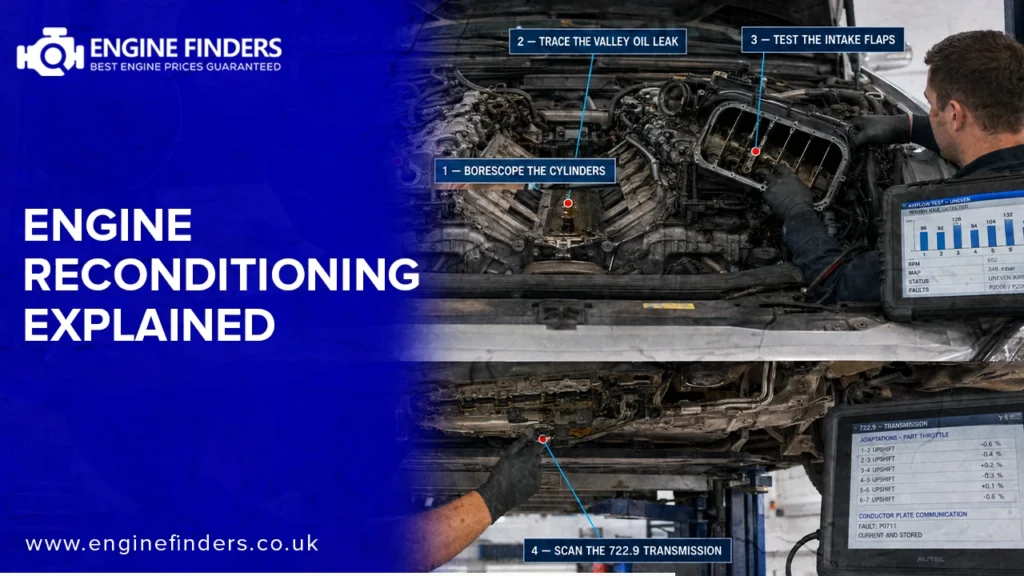
Some M273 engines develop bore scoring, particularly on cylinders 7 and 8 (driver side rear). Symptoms include cold-start rattling, blue smoke on startup, and excessive oil consumption (up to 1 litre per 800 to 1,600 km). Fix requires full engine replacement or a rebuild with sleeved cylinders and updated pistons. Labour: 40 to 50 hours on larger models like the G-Class.
Oil Cooler Seal Leaks (Common)
The oil cooler sits between the cylinder banks; its seals harden with heat exposure and begin leaking oil internally into the engine valley. Symptoms include a burning oil smell, oil pooling in the valley, and gradual oil loss without visible external drips. Repair requires intake manifold removal and is often misdiagnosed as a valve cover gasket leak.
Intake Manifold / Tumble Flap Failures
The M273’s variable-length intake manifold uses tumble flaps that can fail, causing rough idle, hesitation, and reduced fuel economy. Replacement manifolds are available but costly.
7G-Tronic (722.9) Transmission Issues
While not strictly engine problems, the M273 is paired with Mercedes’ 7G-Tronic transmission, which has its own failure points:
- Conductor plate failure, causing harsh shifts, limp mode, and delayed engagement
- Oil cooler line leaks, causing transmission fluid leaks and cross-contamination with coolant
M273 Reliability Verdict: Is It Worth Buying?
The Short Answer
The M273 is not a reliably safe purchase unless you have verified evidence that the critical failure points have been addressed.
The “Good” M273s
Later production engines (generally post-September 2006) received an improved idler gear with a better surface treatment. Engines from the 2008 model year onwards are widely considered to have overcome the balance shaft issue. However, the head bolt thread weakness affects all M273s regardless of production date.
What to Check Before Buying
- Engine serial number, which a Mercedes specialist can verify against the affected range for balance shaft issues
- Service history, as regular oil changes (every 8,000 to 10,000 miles) are critical and Mercedes’ long-life intervals are not recommended
- Cold start, listening carefully for any rattling or ticking on first start of the day
- Oil analysis, having the engine oil tested for metal particles
- Coolant level, monitoring for unexplained coolant loss
Owner Community Consensus
Based on owner-reported experiences across Mercedes forums, M273 engines without the balance shaft issue have proven solid for many owners. However, the risk of encountering a failed example is high enough that many specialists and enthusiasts recommend approaching the M273 with caution, in favour of the older M113 (less powerful but more durable) or the newer M278 (twin-turbo, but with its own set of issues). For a wider view, our guide to the most reliable Mercedes-Benz engines ranks the M273 against every major petrol and diesel unit.
M273 Engine Replacement Cost UK (2026)
| Option | Supply Only (inc. VAT) | Supply & Fitted |
|---|---|---|
| Used M273 (4.7L / 5.5L) | £1,200 – £2,500 | £3,000 – £5,000 |
| Reconditioned M273 | £2,500 – £4,500 | £4,500 – £7,500 |
| New / OEM M273 (main dealer) | £6,000 – £10,000+ | £10,000 – £15,000+ |
Labour: Engine replacement typically requires 25 to 35 hours. At UK independent specialist rates of £80 to £120 per hour, labour alone ranges from £2,000 to £4,200 plus VAT.
Browse used Mercedes engines and reconditioned Mercedes engines from vetted UK suppliers, or see our full Mercedes engine replacement cost guide for a model-by-model breakdown. Compare quotes from vetted UK suppliers for no-obligation pricing on M273 replacement engines.
Cost Comparison: Repair vs Replace
| Scenario | Estimated Cost (UK) |
|---|---|
| Balance shaft repair (in-chassis) | £4,000 – £6,000 |
| Head bolt thread repair (both heads) | £3,500 – £5,500 |
| Full engine rebuild | £6,000 – £10,000+ |
| Used engine replacement | £3,000 – £5,000 (supply & fit) |
| Reconditioned engine replacement | £4,500 – £7,500 (supply & fit) |
In many cases, replacing the engine with a reconditioned unit that has already had the balance shaft and head bolt issues addressed is more cost-effective than attempting to repair a failed original unit. Our engine repair versus replacement guide helps you make the call.
Engines to Avoid & Alternatives
M273 Engines to Avoid
- Pre-September 2006 production, the highest risk of balance shaft failure
- High-mileage examples (over 100,000 miles) without documented chain/gear replacement, where multiple failure modes converge
- Any engine with cold-start rattle or unexplained coolant loss, as these are early warning signs
Better Alternatives
| Engine | Pros | Cons |
|---|---|---|
| M113 (1997 to 2006) | Bulletproof reliability, simpler design | Less powerful, older technology, higher emissions |
| M278 (2010 to present) | More powerful, better fuel economy | Twin-turbo complexity, timing chain issues |
| OM642 V6 Diesel | Excellent fuel economy, proven reliability | Diesel-specific issues (oil cooler seals, swirl flaps) |
If you are still deciding which Mercedes to buy, our guide to the best Mercedes-Benz engine to buy used compares these alternatives in detail.
Practical Takeaways for UK Owners
If You Already Own an M273
- Change oil every 8,000 to 10,000 miles and do not follow Mercedes’ LongLife 18,000-mile intervals
- Listen for cold-start rattle. If you hear it, get a specialist diagnosis immediately
- Monitor coolant levels, as unexplained loss may indicate head bolt failure
- Consider preventive timing chain service at 80,000 to 100,000 miles (cost £1,500 to £2,500)
- Have the oil analysed at each service for metal contamination
If You’re Considering Buying an M273-Equipped Car
- Only consider 2008 model year or later vehicles
- Obtain a full pre-purchase inspection from a Mercedes specialist
- Budget for major engine work, as even a “good” M273 can fail unexpectedly
- Factor in ULEZ compliance, as M273s are Euro 4 / Euro 5 and may face London ULEZ charges. Check your vehicle’s status on the GOV.UK clean air zones service
When to Use EngineFinders
If your M273 has failed and you are comparing replacement options, Engine Finders connects you with vetted UK suppliers for no-obligation quotes on used and reconditioned M273 engines. Always ensure any replacement unit comes with a warranty and has had the balance shaft and head bolt issues addressed. Our guide on what to check before buying a reconditioned engine online explains exactly what to ask any supplier.
Frequently Asked Questions
Is the Mercedes M273 engine reliable?
The M273 has a mixed reputation. Later engines (2008 onwards) with improved balance shaft gears are more reliable, but all M273s remain susceptible to head bolt thread failure in the aluminium block. With meticulous maintenance, some owners report 150,000+ miles without major issues. However, the risk of catastrophic failure is higher than most modern V8s.
How much does an M273 engine replacement cost in the UK?
A used M273 engine typically costs £1,200 to £2,500 supply only; reconditioned units with updated components range from £2,500 to £4,500. With labour (25 to 35 hours at £80 to £120/hour), total fitted costs range from £3,000 to £7,500. Main dealer new engines exceed £10,000 fitted. Compare quotes from vetted UK suppliers for accurate pricing.
What are the symptoms of M273 balance shaft failure?
Metallic rattling or knocking from the engine on cold start that disappears once warm. The Check Engine Light may illuminate with cam/crank correlation codes (P0016, P0017). Oil analysis may reveal metal shavings. In severe cases, sudden catastrophic failure occurs without warning.
Which Mercedes models have the M273 engine?
The M273 was fitted to numerous Mercedes models including the S-Class (W221), E-Class (W211, W212), CLS (C219), CLK (C209/A209), ML (W164), GL (X164), SL (R230), and G-Class (W463). Both 4.7-litre (GL450, S450) and 5.5-litre (E500, ML500, SL550, etc.) variants were available.
Should I buy a car with an M273 engine?
Only if the vehicle is 2008 model year or later (with improved balance shaft gear) and has a full service history with regular oil changes. A pre-purchase inspection by a Mercedes specialist is essential. Budget for potential major repairs, as the M273 is a high-risk, high-reward engine.
Where can I find a replacement M273 engine in the UK?
Engine Finders compares quotes from vetted UK suppliers for used and reconditioned M273 engines. Always verify that any replacement unit has had the balance shaft gear updated and head bolt threads inspected. A 12-month warranty is standard from reputable reconditioners.