Executive Summary
The BMW 535d, powered by the B57 3.0-litre inline-six turbo-diesel engine, represents the pinnacle of BMW’s diesel engineering for the 5 Series. The B57, produced since 2015, replaced the earlier N57 unit and offers improved refinement, efficiency and emissions compliance. In the G30-generation 535d (2017 to 2023), the B57 delivers 265 PS (pre-LCI) or 286 PS (post-LCI with 48V mild-hybrid), with real-world fuel economy of approximately 42 to 48 mpg.
Key verdict: The B57 is a fundamentally robust engine, but early examples (2015 to 2018) are prone to EGR cooler failures and timing chain stretch. The post-2020 LCI (Life Cycle Impulse) models with mild-hybrid technology are the sweet spot for reliability and efficiency. Replacement costs for a B57 unit range from £2,800 for used examples to over £5,500 for reconditioned units with warranty.
Engine Finders is a price comparison platform, not a direct engine seller. Final pricing, warranty terms, and availability vary by vetted UK supplier. Professional diagnosis is recommended before purchasing any replacement engine.
What is the BMW B57 Engine?
The B57 is BMW’s third-generation 3.0-litre straight-six turbo-diesel, part of the modular engine family that includes the B37 (three-cylinder) and B47 (four-cylinder) diesels. It features an aluminium alloy cylinder block with a closed-deck design for increased strength, DOHC valvetrain with four valves per cylinder, and common-rail direct fuel injection.
B57 Variants in the 5 Series
| Variant | Configuration | Power | Torque | 535d Application |
|---|---|---|---|---|
| B57D30O0 | Single turbo | 261 hp (195 kW) | 620 Nm | 530d (pre-LCI) |
| B57D30O1 | Single turbo (updated) | 286 hp (210 kW) | 650 Nm | 530d (LCI, 2020+) |
| B57D30T0 | Twin turbo | 315 hp (235 kW) | 680 Nm | 540d / M550d |
The 535d name was used across two generations:
- F10 535d (2011 to 2016), powered by the N57 engine (not covered in this guide)
- G30 535d (2017 to 2023), powered by the B57 engine (the focus of this article)
Note: In the G30 generation, the B57-powered model was officially badged as the 530d in most markets, with the 540d and M550d offering higher-output B57 variants. Some UK-market G30 models retained the “535d” naming for the 261 to 265 PS B57D30O0 variant, though BMW’s nomenclature shifted during this period. For a full look at the model’s real-world performance, see our BMW 535d performance and features guide.
BMW 535d (B57) Reliability: What You Need to Know
Overall Reliability Verdict
The B57 is widely considered more reliable than its N57 predecessor and significantly better than the notorious N47 four-cylinder diesel. However, like all modern diesel engines with complex emissions systems, it has specific vulnerabilities that UK owners should understand. Our BMW engine reliability data compares failure rates and repair costs across the modern diesel range.
Strengths:
- Robust aluminium block construction with closed-deck design
- Refined and smooth power delivery
- Strong real-world fuel economy (42 to 48 mpg)
- Better timing chain design than earlier N-series diesels
Weaknesses:
- EGR cooler failures (subject to multiple recalls)
- Carbon build-up on intake valves (short-trip driving)
- Timing chain stretch in high-mileage or poorly serviced examples
- DPF and AdBlue system complexity
Known B57 Engine Problems in the 535d
1. EGR Cooler Leaks (Most Common)
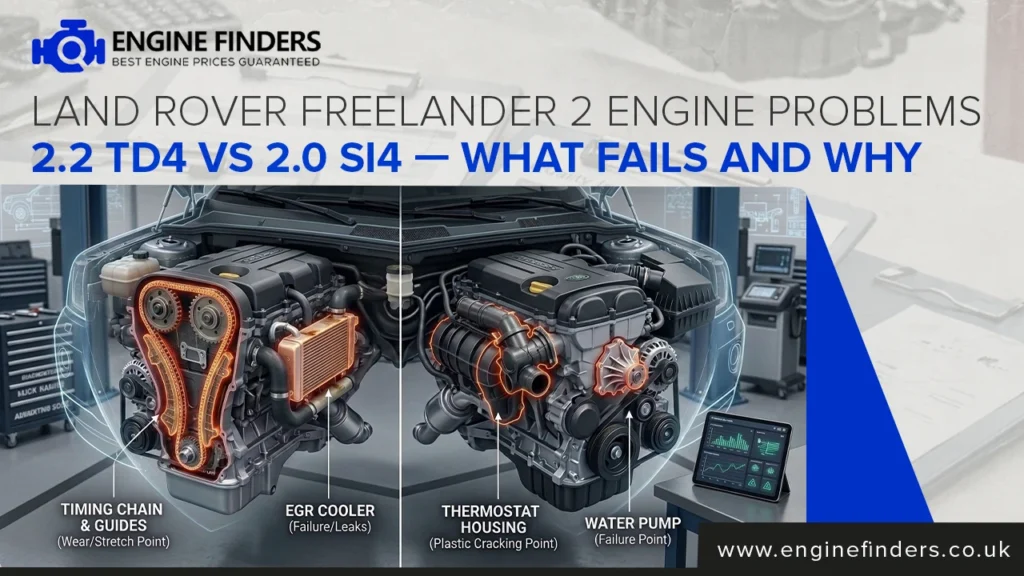
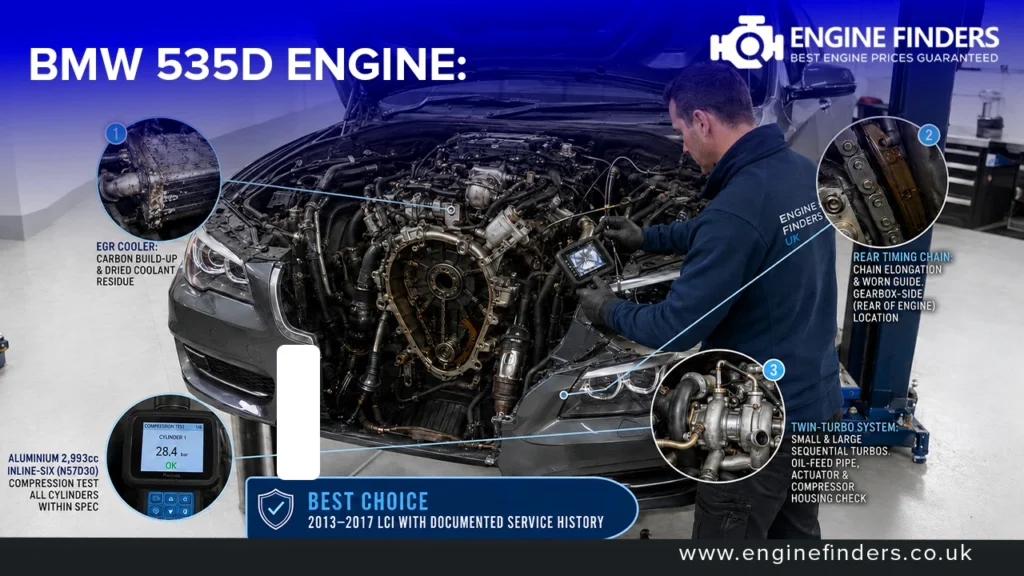
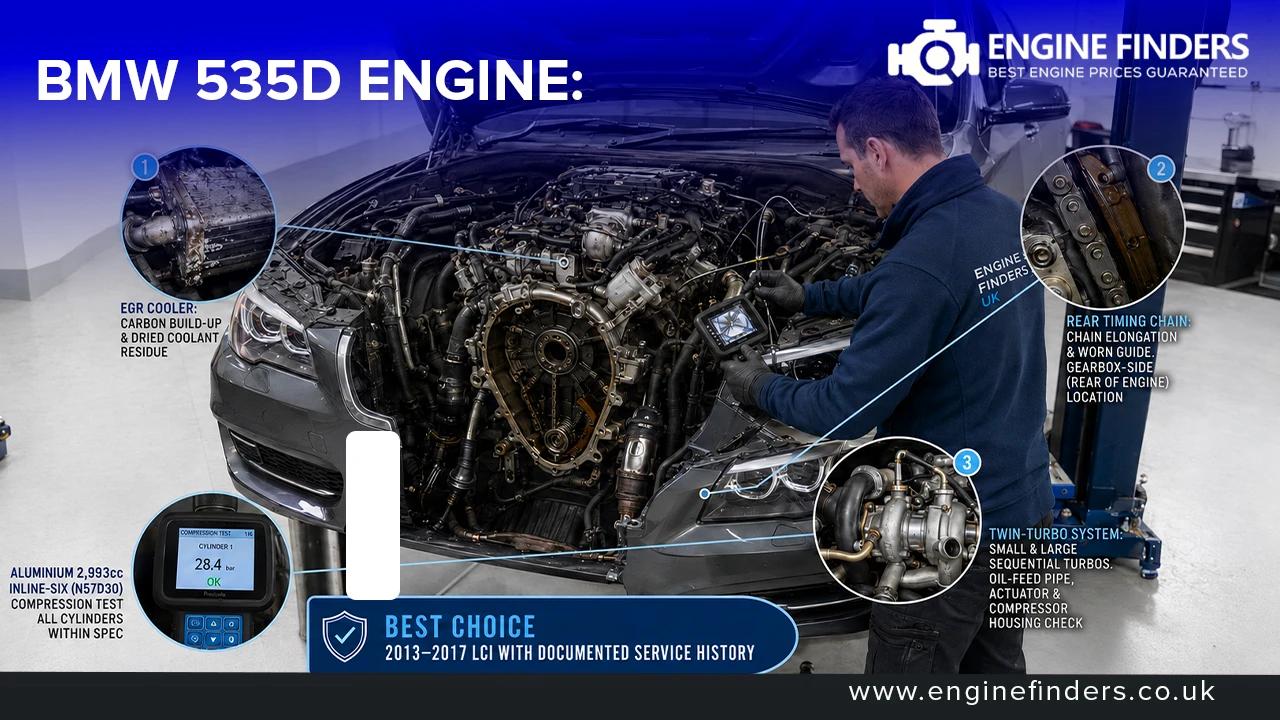
The most prevalent issue affecting the B57 is EGR (Exhaust Gas Recirculation) cooler failure. The cooler can develop internal leaks, allowing coolant to mix with diesel soot, potentially causing white exhaust smoke, rough idling, and in severe cases, melting of the intake manifold and fire risk.
Symptoms:
- White or grey exhaust smoke
- Burning smell from engine bay
- Coolant loss without visible external leaks
- Engine management light
- Rough idle or misfire
Recall History: BMW issued multiple recalls for EGR cooler issues across diesel models. Recall R/2018/341 (issued December 2018) affected 225,449 vehicles. A later recall, R/2023/174 (June 2023), addressed glycol leakage from EGR coolers that could melt the intake manifold. The issue affected approximately 800,000 BMW diesel engines globally.
UK-Specific: UK owners should check their vehicle’s recall status using the DVSA vehicle recall lookup on GOV.UK. Run the VIN before purchasing any used 535d.
Remedial Action: Affected vehicles require EGR cooler replacement. This should be completed free of charge if the recall is outstanding. If the recall has been performed but issues persist, further inspection by a BMW specialist is recommended.
2. Timing Chain Stretch
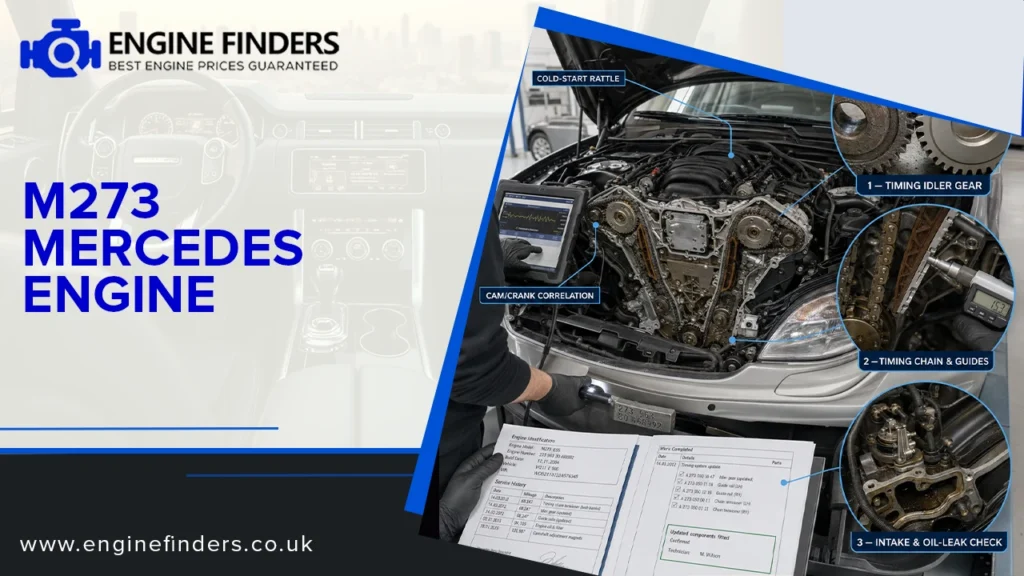
While the B57’s timing chain design is more robust than the N47’s infamous chain, stretch can still occur, particularly in high-mileage or poorly serviced engines.
Symptoms:
- Rattling or ticking noise from the engine, especially on cold starts
- Timing-related fault codes stored in the ECU
- Rough or uneven engine operation
- Loss of power or reduced performance
- Engine management warning lights
Prevention: Regular oil changes using the correct BMW LongLife-04 or LL-12 FE specification oil are critical. BMW’s official 18,000-mile service interval is considered too long by many UK specialists; 8,000 to 10,000-mile intervals are recommended for high-mileage or performance-oriented use.
Replacement Cost: Timing chain replacement typically costs £1,200 to £1,800 including labour at an independent specialist. If the chain fails catastrophically, engine replacement becomes necessary. Our cold-start rattle diagnosis guide describes exactly what to listen for.
3. Carbon Build-Up in the Intake System
Direct-injection diesel engines like the B57 are susceptible to carbon deposits on intake valves and manifolds. This is exacerbated by short-trip driving where the engine does not reach optimal operating temperature.
Symptoms:
- Reduced throttle response
- Poorer fuel economy
- Hesitation on acceleration
- Rough idle
Prevention: Regular longer journeys (20+ miles) at motorway speeds allow the engine to reach and maintain operating temperature, helping to burn off deposits. Some owners opt for walnut blasting or chemical intake cleaning at 60,000 to 80,000 miles.
4. DPF and AdBlue System Issues
Like all modern diesels, the B57 is equipped with a Diesel Particulate Filter (DPF) and Selective Catalytic Reduction (SCR) system using AdBlue.
Symptoms:
- DPF warning light
- Reduced power (limp mode)
- AdBlue warning or system errors
- Increased fuel consumption
Prevention: Ensure regular longer journeys for DPF regeneration. Short trips are the enemy of modern diesel engines. AdBlue quality and levels should be maintained, and the system should be checked regularly.
UK Consideration: Euro 6 B57 engines (all G30 535d models) are ULEZ compliant, making them suitable for London and other UK clean air zones, a significant advantage over older Euro 5 diesels.
5. Prolonged Engine Crank / Starting Issues
Some B57 engines have experienced prolonged cranking during cold or hot starts. This has been linked to a leaking fuel temperature/pressure sensor connector in the fuel supply line.
Symptoms:
- Extended cranking time before engine starts
- Intermittent starting issues
- Fuel system fault codes
Remedial Action: Diagnosis requires specialist BMW ISTA diagnostic equipment. The faulty sensor or fuel line connector may need replacement.
BMW 535d Engine Replacement Cost (UK)
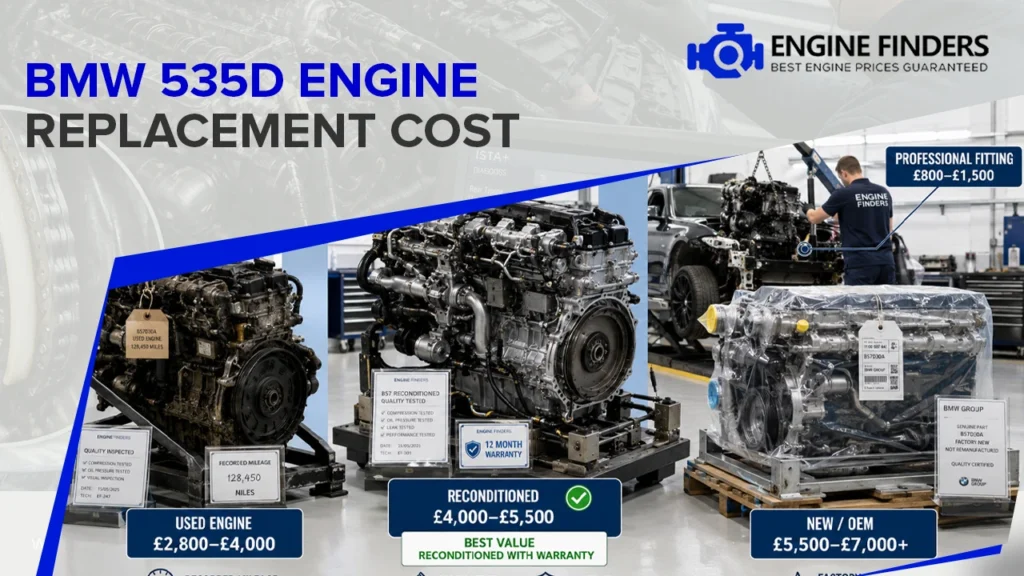
Price Ranges by Engine Type
| Engine Type | Price Range (inc. VAT) | Warranty | Notes |
|---|---|---|---|
| Used B57 | £2,800 – £4,000 | Typically 3-6 months | Mileage varies; condition critical |
| Reconditioned B57 | £4,000 – £5,500 | 12 months typical | Professionally rebuilt to OEM spec |
| New B57 | £5,500 – £7,000+ | 24 months (BMW) | Genuine BMW supply only |
Browse used BMW engines and reconditioned BMW engines from vetted UK suppliers, or see our full BMW engine replacement cost guide for a model-by-model breakdown.
Additional Costs to Consider
Labour: Engine replacement typically requires 15 to 25 hours of labour. At UK independent specialist rates of £60 to £100 per hour (excluding VAT), expect £900 to £2,500 for fitment. Main dealer rates are significantly higher (£150 to £200 per hour).
Additional Parts: Replacement often requires new:
- Engine mounts (£200 to £400)
- Coolant and oil (£150 to £200)
- Belts and tensioners (£100 to £200)
- Gaskets and seals (£100 to £300)
- DPF and AdBlue system checks (£200 to £500)
Total Estimated Cost: A full B57 engine replacement with labour and parts typically ranges from £4,000 to £8,500, depending on engine condition, supplier, and workshop rates.
Regional Variations
- South East / London: Higher labour rates (£80 to £120/hour), so expect costs at the upper end
- Midlands / North: More competitive rates (£50 to £80/hour), with potential savings of £500 to £1,000
- Scotland: Specialist availability varies; main dealer costs may be the only option in remote areas
Used vs Reconditioned vs New: Which is Best Value?
| Option | Pros | Cons | Best For |
|---|---|---|---|
| Used | Lower upfront cost | Unknown history; limited warranty | Budget-conscious; low-mileage donor |
| Reconditioned | Professionally rebuilt; 12-month warranty | Higher cost than used | Most UK owners seeking reliability |
| New | Full OEM specification; comprehensive warranty | Highest cost | Insurance claims; high-value vehicles |
Recommendation: For most UK 535d owners, a reconditioned B57 with a 12-month warranty offers the best balance of cost and peace of mind. Before buying, read our guide on what to check before buying a reconditioned engine online to ensure comprehensive warranty coverage.
G30 5 Series: Which B57 Model to Choose?
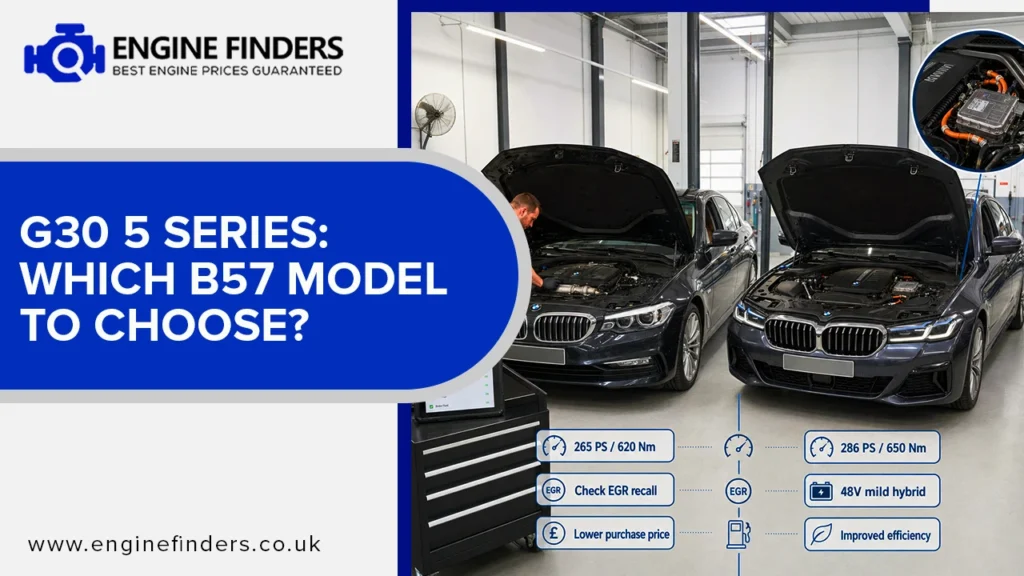
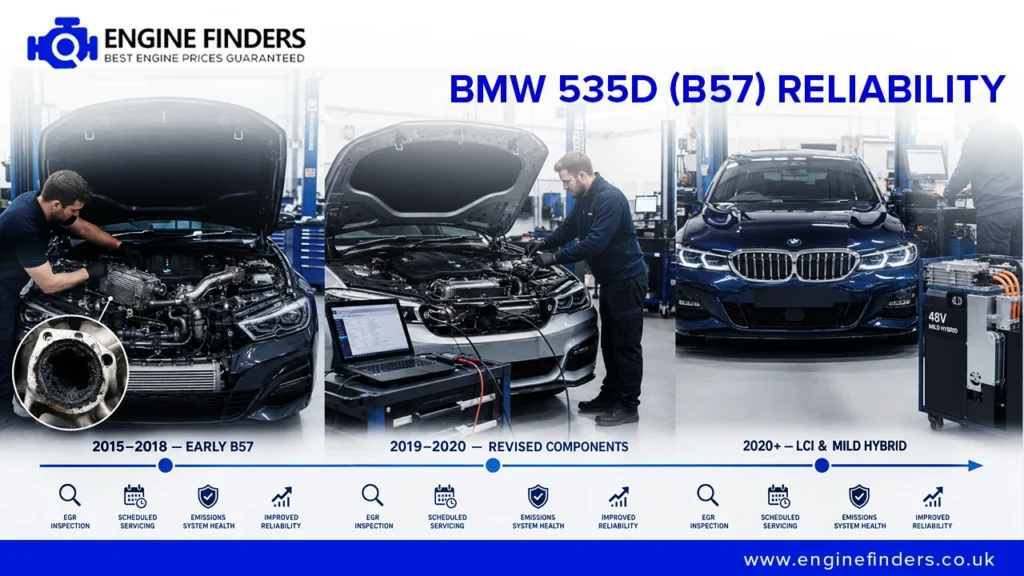
Pre-LCI (2017 to 2020)
- Engine: B57D30O0 (265 PS / 620 Nm)
- Pros: Lower purchase price; proven platform
- Cons: EGR cooler recall risk; no mild-hybrid; timing chain concerns on early examples
- Verdict: Good value if recall work completed and service history impeccable
LCI (2020 to 2023)
- Engine: B57D30O1 with 48V mild-hybrid (286 PS / 650 Nm)
- Pros: Improved reliability; better fuel economy (47.8 mpg owner-reported); smoother start-stop
- Cons: Higher purchase price; more complex electrical systems
- Verdict: Best overall choice for reliability and efficiency
Models to Avoid
- 2017 to 2018 B57 examples with incomplete EGR recall history
- High-mileage (100,000+ miles) examples with patchy service history
- Vehicles used primarily for short trips, where DPF and carbon build-up risks are significantly higher
For a wider comparison of BMW diesel options, our best BMW diesel engine guide ranks the B57 alongside the N57, B47, and M57.
Practical Takeaways for UK Owners
For Current 535d Owners
- Check your EGR recall status immediately using the DVSA vehicle recall checker. If outstanding, book with a BMW dealer, as it is free.
- Reduce oil change intervals from BMW’s 18,000-mile recommendation to 8,000 to 10,000 miles.
- Take regular longer journeys (20+ miles at motorway speeds) to allow DPF regeneration and reduce carbon build-up.
- Listen for timing chain rattles on cold starts. If present, have it inspected immediately.
- Monitor coolant levels, as unexplained loss may indicate EGR cooler issues.
For Prospective Buyers
- Prioritise 2020+ LCI models with mild-hybrid, as these have the best reliability record.
- Verify EGR recall completion by running the VIN through the DVSA checker before purchase.
- Request full service history, as regular oil changes are non-negotiable. Our used engine buying checklist covers what documents to demand.
- Consider ULEZ compliance, as all B57 G30 models are Euro 6 and ULEZ compliant, a significant advantage.
- Budget for maintenance. Modern diesels require attentive servicing; factor in £500 to £1,000 annually for maintenance.
When to Compare Quotes for Replacement
If your B57 exhibits any of the following, professional diagnosis is essential:
- Metallic rattling from the engine (potential timing chain failure)
- Persistent white smoke or coolant loss (EGR cooler failure)
- Loss of power or engine management lights
- DPF or AdBlue system failures that recur after repair
Compare quotes from vetted UK suppliers for no-obligation pricing on used and reconditioned B57 engines. Always obtain a professional diagnosis before committing to replacement. Our engine repair versus replacement guide helps you decide which route makes financial sense.
Frequently Asked Questions
What is the most reliable BMW 535d engine?
The B57 in post-2020 LCI G30 models with 48V mild-hybrid is the most reliable 535d engine. Earlier B57 units (2015 to 2018) have EGR cooler and timing chain concerns, though they are still more dependable than the N57 predecessor. Regular oil changes at 8,000 to 10,000 miles are critical for longevity. For a wider view, see our guide to the most reliable BMW engines.
How much does a BMW 535d (B57) engine replacement cost?
A reconditioned B57 engine typically costs £4,000 to £5,500 including VAT, with a 12-month warranty from UK suppliers. Labour adds £900 to £2,500 depending on the workshop. Used engines range from £2,800 to £4,000, while new BMW-supplied units exceed £5,500. Compare quotes from vetted UK suppliers for accurate pricing.
Does the BMW 535d B57 have timing chain issues?
The B57’s timing chain is more robust than the infamous N47 chain, but stretch can occur in high-mileage or poorly serviced engines. Symptoms include rattling on cold starts and timing-related fault codes. Replacement costs £1,200 to £1,800 at independent specialists. Prevention requires regular oil changes with correct BMW-spec oil.
Is the BMW 535d B57 ULEZ compliant?
Yes, all G30 535d models with the B57 engine are Euro 6 compliant, making them ULEZ-compliant for London and other UK clean air zones. This is a significant advantage over earlier Euro 5 diesel 5 Series models, which face daily charges in ULEZ zones.
What should I check before buying a used BMW 535d?
Check the EGR recall status using the DVSA vehicle recall checker. Verify full service history with oil changes at 8,000 to 10,000-mile intervals. Listen for timing chain rattles on cold starts. Avoid examples used primarily for short trips, as DPF and carbon build-up issues are common. Prioritise 2020+ LCI models for best reliability.
How can I get a no-obligation quote for a B57 replacement?
Use the Engine Finders comparison tool to compare quotes from vetted UK suppliers for used, reconditioned and new B57 engines. All quotes are no-obligation, and suppliers are vetted for quality and warranty terms. Compare quotes now. Professional diagnosis is recommended before purchasing any replacement engine.