The Mercedes-Benz OM651 is a widely used four-cylinder diesel engine found in several popular Mercedes models, including the C-Class, E-Class, A-Class, B-Class, CLA, Sprinter and Vito. Available in different power outputs and turbocharging configurations, the OM651 is known for its strong torque, fuel efficiency and suitability for both everyday driving and long-distance use.
However, Mercedes OM651 turbo failure is an important concern for owners of older and higher-mileage vehicles, particularly when the engine develops boost-pressure problems, actuator faults, oil leaks or unusual turbocharger noises.
Common warning signs include reduced acceleration, excessive exhaust smoke, a whistling noise, engine warning lights and limp mode. However, these symptoms do not always mean the turbocharger itself has failed. Vacuum leaks, damaged seals, boost-control valves and charge-air system faults can produce similar problems.
This distinction is particularly important on the OM651 because certain versions use a more complicated two-stage turbocharging arrangement.
In this guide, we explain the most common Mercedes OM651 turbo problems, their symptoms, the difference between actuator failure and complete turbocharger failure, which models are affected, how much repairs cost in the UK, and whether repairing or replacing the turbo is the better option.
Quick Summary: Mercedes OM651 Turbo Problems
| Factor | Details |
|---|---|
| Engine family | Mercedes-Benz OM651 |
| Engine capacity | 1.8L and 2.1L diesel |
| Engine configuration | Four-cylinder common-rail diesel |
| Turbocharging | Single or two-stage arrangements, depending on version |
| Main concerns | Boost-control faults, actuator problems, air leaks and turbo wear |
| Common warning sign | Reduced engine power |
| Other symptoms | Limp mode, whistling, smoke and oil consumption |
| Common diagnostic code | P0299 – Turbocharger underboost |
| Diagnostic methods | XENTRY diagnostics, boost-pressure testing and physical inspection |
| Indicative UK turbo repair cost | £400–£900, depending on the fault |
| Indicative UK turbo replacement cost | £900–£1,800+ |
| Risk if ignored | Further turbocharger, engine or emissions-system damage |
| Prevention | Correct oil, regular servicing and early diagnosis |
Prices are indicative estimates rather than fixed quotations. Actual costs depend on the turbocharger configuration, vehicle, parts quality and labour requirements.
What Is the Mercedes OM651 Turbocharger System?
The Mercedes-Benz OM651 is a four-cylinder common-rail diesel engine introduced in 2008.
For broader model-specific context, see our Mercedes C-Class engine guide.
It was designed to deliver strong torque, improved fuel economy and lower emissions compared with some of the previous Mercedes diesel generations.
Turbocharging is an important part of its design because it allows the engine to produce useful power from a relatively compact displacement.
However, not every OM651 uses an identical turbocharger arrangement.
Single Turbo OM651 Versions
Some OM651 configurations use a single turbocharger.
The turbocharger uses exhaust gas energy to drive a turbine, which turns a compressor and forces additional air into the engine.
The increased airflow allows more fuel to be burned efficiently, producing additional power and torque.
Two-Stage Turbo OM651 Versions
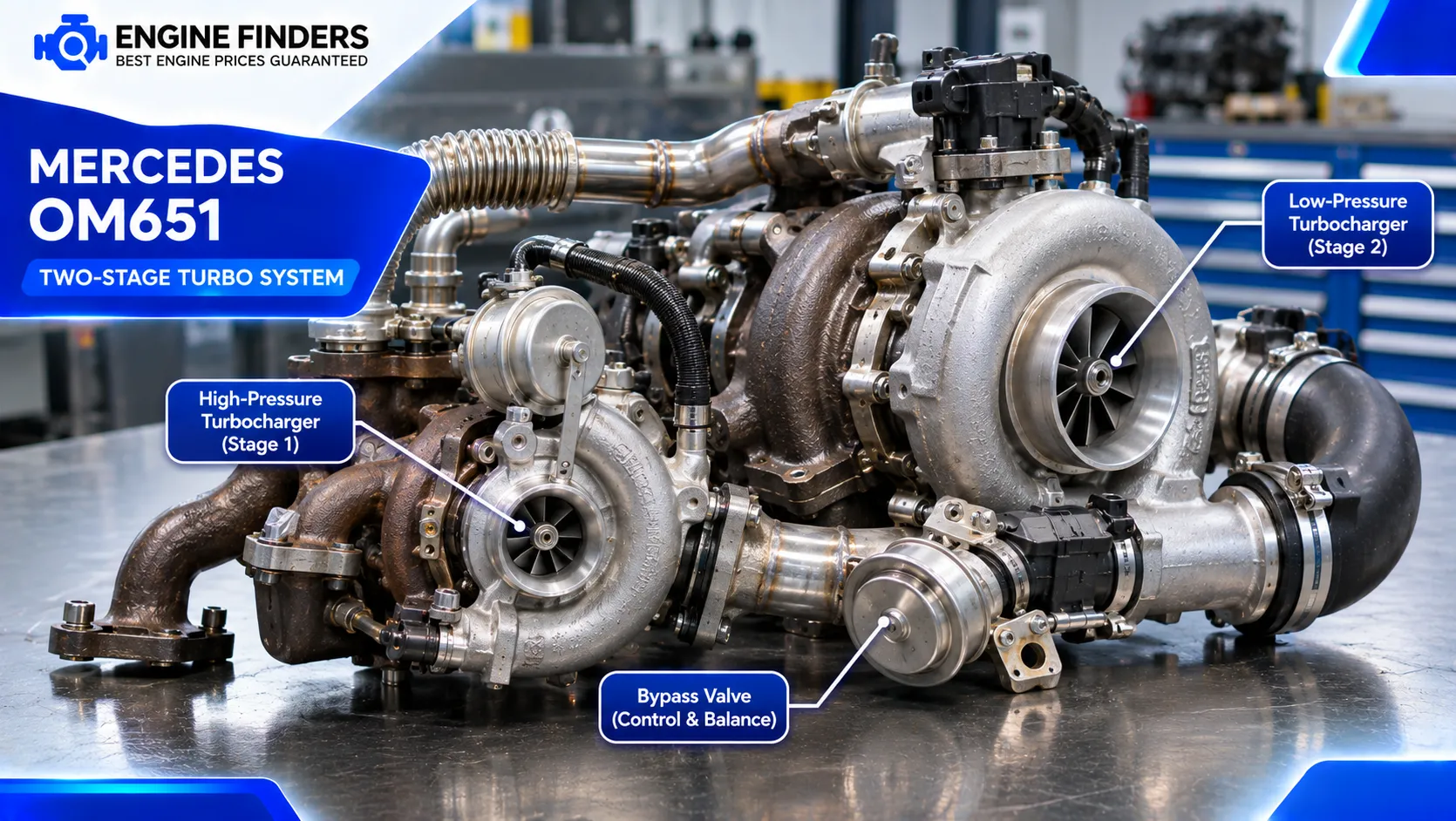
Higher-output OM651 applications use a two-stage turbocharging arrangement.
This system uses two turbocharging stages to improve boost response and power delivery across different engine speeds.
The system includes additional control components, such as:
- High-pressure turbocharger stage.
- Low-pressure turbocharger stage.
- Boost-pressure control components.
- Bypass valves and associated air ducting.
- Vacuum control components on relevant versions.
- Charge-air pipes and intercooler connections.
The additional components improve the engine’s performance characteristics but also make diagnosis more complicated.
A fault in the control system can produce symptoms similar to a failed turbocharger.
This is why the exact OM651 engine version should be identified before ordering replacement components.
Mercedes OM651 Turbo Failure: What Actually Goes Wrong?
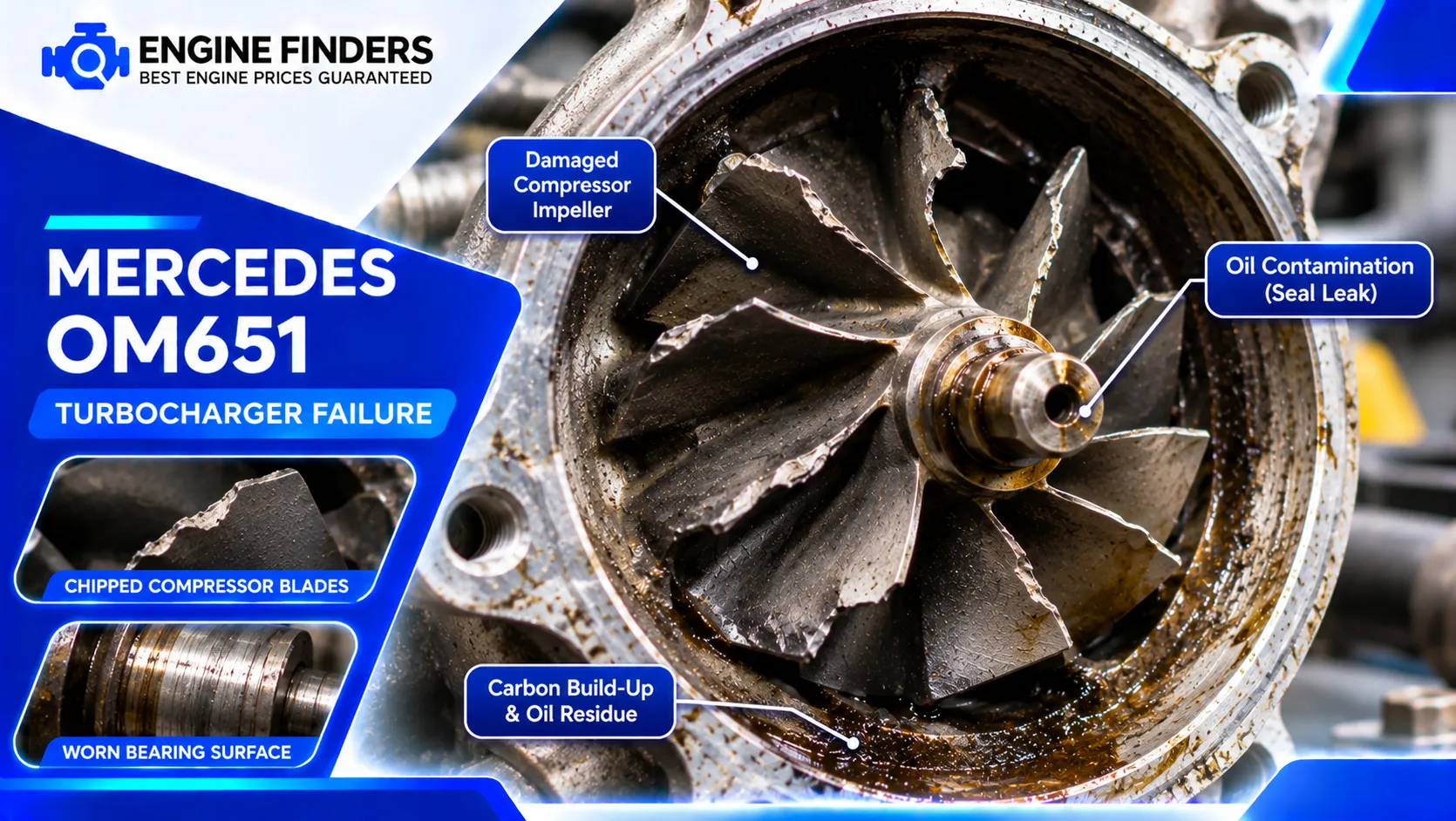
Turbocharger problems can develop for several reasons. Some involve the turbocharger itself, while others originate from the systems controlling boost pressure.
1. Turbocharger Actuator Failure
The turbocharger actuator controls aspects of turbocharger operation, depending on the specific configuration.
On relevant OM651 versions, the boost-control system uses vacuum-operated components and control valves to regulate turbocharger operation.
If an actuator or its control system fails, the turbocharger may not deliver the requested boost pressure.
Possible symptoms include:
- Reduced engine power.
- Poor acceleration.
- Intermittent limp mode.
- Engine warning lights.
- Underboost fault codes.
- Inconsistent turbocharger response.
An actuator fault does not automatically mean that the complete turbocharger needs replacing.
The actuator, linkage, vacuum supply and turbocharger mechanism should be tested separately where the design permits.
2. Vacuum Leak and Boost-Control Problems
Vacuum leaks are an important diagnostic consideration on certain OM651 applications.
Mercedes-Benz technical information documents OM651 low-boost faults associated with vacuum leaks, damaged O-rings and contamination.
Possible symptoms include:
- Poor acceleration.
- Reduced boost pressure.
- Engine warning lights.
- Limp-home mode.
- Intermittent boost delivery.
A damaged vacuum hose, leaking connection or faulty control valve can prevent the turbocharger system from operating correctly.
Replacing an expensive turbocharger without checking the vacuum system can result in unnecessary repair costs.
3. Turbocharger Bearing Wear
The turbocharger operates at extremely high rotational speeds and temperatures.
Its shaft and bearings depend on a consistent supply of clean engine oil.
Over time, wear can develop in the bearing assembly, particularly where lubrication has been inadequate or contaminated.
Possible warning signs include:
- Increasing whining or siren-like noises.
- Excessive shaft movement.
- Oil leakage from the turbocharger.
- Increased oil consumption.
- Blue-grey exhaust smoke.
Severe bearing damage may eventually require complete turbocharger replacement.
4. Turbocharger Oil Seal Problems
Turbochargers contain sealing arrangements that help control oil around the rotating shaft.
When the bearing or sealing system deteriorates, engine oil may enter the intake or exhaust side.
Possible symptoms include:
- Oil residue in charge-air pipes.
- Increased oil consumption.
- Blue-grey exhaust smoke.
- Oil accumulation around turbocharger connections.
A small amount of oil mist in the intake system does not automatically prove that the turbocharger has failed.
The crankcase ventilation system, oil separator and charge-air pipework should also be checked.
5. Blocked or Restricted Turbo Oil Feed
The turbocharger requires adequate oil supply for lubrication and heat management.
A restricted oil feed, low engine oil level or contaminated lubrication system can cause accelerated bearing wear.
Potential causes include:
- Infrequent oil changes.
- Incorrect engine oil.
- Oil contamination.
- Restricted oil feed pipes.
- Previous engine damage.
- Incorrect installation during an earlier turbocharger replacement.
If a turbocharger fails because of oil starvation, fitting another turbo without addressing the original lubrication problem can lead to another failure.
6. Variable Geometry or Boost-Control Mechanism Problems
Depending on the exact turbocharger fitted, the system may use variable geometry or other controlled mechanisms to regulate exhaust flow and boost pressure.
Carbon deposits, mechanical wear or actuator problems can prevent the mechanism from moving correctly.
The resulting symptoms can include:
- Underboost.
- Overboost.
- Delayed acceleration.
- Limp mode.
- Inconsistent turbocharger response.
The correct diagnostic procedure depends on the specific turbocharger fitted to the engine.
7. Damaged Charge-Air Pipes and Intercooler Connections
Not every low-boost problem is caused by the turbocharger.
The pressurised air system includes pipes, hoses, seals and intercooler connections.
A split hose or damaged seal can allow compressed air to escape before it reaches the engine.
This can cause:
- Hissing or blowing noises.
- Reduced acceleration.
- Low boost pressure.
- Excessive smoke.
- Engine management warning lights.
A pressure or smoke test of the charge-air system can help identify leaks.
Mercedes OM651 Turbo Failure Symptoms: 8 Warning Signs
Recognising early warning signs can help prevent a minor boost-control problem from becoming an expensive turbocharger repair.
1. Loss of Engine Power
One of the most common symptoms of an OM651 boost-pressure problem is reduced engine performance.
The vehicle may feel slower than usual, particularly when accelerating or climbing hills.
Drivers may notice that the engine struggles to deliver its normal torque.
This can result from:
- Turbocharger actuator faults.
- Vacuum leaks.
- Boost leaks.
- Turbocharger wear.
- Restricted intake or exhaust flow.
2. Limp Mode
If the engine management system detects that the turbocharger is not producing the expected boost pressure, it may limit engine output.
This protective operating mode is commonly known as limp mode.
The vehicle may:
- Accelerate slowly.
- Struggle to exceed certain speeds.
- Lose power during motorway driving.
- Temporarily recover after restarting the engine.
Restarting the vehicle may temporarily clear the symptom, but it does not repair the underlying fault.
3. Whistling or Siren-Like Turbo Noise
A healthy turbocharger can produce a noticeable airflow or spool noise.
However, a new or increasingly loud whistling noise should be investigated.
Possible causes include:
- Air leaks in charge-air hoses.
- Damaged pipe connections.
- Turbocharger bearing wear.
- Compressor wheel damage.
- Leaking seals.
A high-pitched siren-like noise accompanied by power loss or oil consumption deserves particular attention.
4. Black Exhaust Smoke
Black smoke can indicate that the engine is receiving insufficient air relative to the amount of fuel being injected.
If the turbocharger is not delivering the required boost, combustion efficiency may be affected.
Other possible causes include:
- Boost leaks.
- EGR faults.
- Injector problems.
- Restricted air filters.
- DPF or exhaust-related problems.
Black smoke should not automatically be attributed to turbocharger failure.
5. Blue or Grey Exhaust Smoke
Blue-grey smoke can indicate that engine oil is entering the combustion or exhaust system.
If the turbocharger bearings or sealing arrangements are worn, oil may pass into the intake or exhaust.
Other potential causes include crankcase ventilation problems and internal engine wear.
If blue smoke is accompanied by increasing oil consumption, arrange an inspection promptly.
6. Excessive Oil Consumption
A deteriorating turbocharger can allow oil to enter the intake or exhaust system.
The driver may notice that the engine requires more frequent oil top-ups.
Check for:
- Oil residue around turbocharger connections.
- Excessive oil in the charge-air system.
- Blue-grey exhaust smoke.
- External oil leaks.
- Changes in engine oil level.
A specialist should determine whether the oil is coming from the turbocharger or another part of the engine.
7. Check Engine Light
Turbocharger and boost-control problems can trigger engine management warning lights.
One particularly relevant diagnostic code is:
P0299 – Turbocharger/Supercharger Underboost.
This indicates that the measured boost pressure is below the expected level.
Other potentially relevant codes include:
- P0234 – Turbocharger overboost condition.
- P2263 – Turbocharger or boost-system performance.
- P0101 – Mass or volume air-flow range/performance.
The exact code interpretation depends on the engine control system and diagnostic equipment.
These codes identify a problem area rather than proving that the turbocharger itself has failed.
8. Rattling Noise Around the Turbocharger
A rattling noise around the turbocharger area does not necessarily mean that the turbocharger is damaged.
Mercedes-Benz technical information specifically addresses certain OM651 two-stage turbocharger-area rattles during cold starts.
The documented possible causes include the belt tensioner and vibrations from an aluminium bypass valve inside the air duct housing.
Therefore, the noise should be diagnosed using the appropriate Mercedes procedure before replacing the turbocharger.
OM651 Turbo Actuator Failure vs Complete Turbocharger Failure
One of the most important distinctions when diagnosing the OM651 is whether the problem is with the actuator or the turbocharger itself.
| Diagnostic area | Actuator or control fault | Complete turbocharger fault |
|---|---|---|
| Loss of power | Possible | Possible |
| Limp mode | Common symptom | Possible |
| Underboost code | Possible | Possible |
| Excessive turbo noise | Not necessarily | Possible |
| Blue smoke | Not typical by itself | Possible |
| Oil consumption | Not typical by itself | Possible |
| Mechanical shaft damage | No, not from actuator alone | Possible |
| Repair | Control component repair | Turbo repair or replacement |
Can You Replace Only the OM651 Turbo Actuator?
In some situations, yes.
If the actuator or control mechanism has failed but the turbocharger’s mechanical components remain serviceable, replacing the affected component may be more economical.
However, the actuator must be compatible with the exact turbocharger.
Some configurations require calibration or adaptation after replacement.
If the variable geometry mechanism or internal turbocharger components are damaged, replacing the actuator alone will not resolve the fault.
A specialist should establish the exact failure before recommending parts.
Which Mercedes Models Are Affected by OM651 Turbo Problems?
The OM651 was installed in numerous Mercedes passenger vehicles and commercial models.
Before ordering parts, use our Mercedes engine compatibility and code lookup guide to verify the exact engine application.
The following table provides examples of applications where OM651 versions were used.
| Mercedes model | Chassis | Example diesel applications |
|---|---|---|
| A-Class | W176 | A180 CDI, A200 CDI, A220 CDI |
| B-Class | W246 | B180 CDI, B200 CDI, B220 CDI |
| C-Class | W204 / W205 | C180 CDI, C200 CDI, C220 CDI, C250 CDI |
| E-Class | W212 | E200 CDI, E220 CDI, E250 CDI |
| CLA | C117 | CLA 200 CDI, CLA 220 CDI |
| GLA | X156 | GLA 200 CDI, GLA 220 CDI |
| GLK | X204 | Selected 2.1 CDI variants |
| Sprinter | W906 | Selected 2.1 CDI variants |
| Vito | W639 / W447 | Selected OM651 diesel versions |
Important: This is an illustrative list, not a guarantee that every model, year or power output uses the same turbocharger.
Turbocharger specifications, single-stage or two-stage arrangements, actuators and ancillary components vary by engine code and vehicle application.
Always confirm the full engine code and turbocharger identification before ordering replacement parts.
For help identifying the correct engine, see our Mercedes engine compatibility and code lookup guide.
Mercedes OM651 Turbo Replacement Cost UK (2026)
The cost of repairing or replacing an OM651 turbocharger depends on the specific failure and vehicle configuration.
For wider repair budgeting, see our Mercedes engine replacement cost UK guide.
A faulty vacuum connection or boost-control valve may be considerably cheaper to repair than a complete turbocharger failure.
The following figures are indicative UK estimates.
| Repair | Estimated UK cost |
|---|---|
| Initial diagnostic inspection | £60–£150 |
| Vacuum hose or boost connection repair | £80–£250 |
| Boost-control valve replacement | £150–£350 |
| Turbo actuator repair or replacement | £200–£500 |
| Turbocharger reconditioning | £400–£900 |
| Replacement turbocharger fitted | £900–£1,800 |
| Complex two-stage turbocharger repair | £1,500–£2,500+ |
These are planning estimates, not verified national averages. Prices vary by vehicle, turbocharger specification, parts supplier and labour. VAT and additional repairs should be confirmed in the quotation.
Why Is OM651 Turbo Replacement Expensive?
The cost depends on more than the price of the turbocharger.
A repair may involve:
- Removing surrounding engine components.
- Accessing the turbocharger assembly.
- Disconnecting exhaust and intake connections.
- Replacing oil feed and return components where necessary.
- Cleaning the charge-air system.
- Checking the intercooler.
- Replacing seals and gaskets.
- Checking the vacuum and boost-control system.
- Performing diagnostic tests after installation.
Two-stage turbocharger configurations can require additional diagnostic and repair work.
Should You Buy a New, Reconditioned or Used OM651 Turbo?
Each option has different advantages.
New turbocharger
A new turbocharger can be a good choice when the original unit has suffered significant mechanical damage. Confirm the manufacturer, specification and warranty.
Reconditioned turbocharger
A professionally reconditioned unit can offer a more economical alternative. Check that the reconditioning includes appropriate inspection, balancing and testing.
Used turbocharger
A used unit may have a lower purchase price, but its mileage, oil condition, bearing condition and service history may be unknown.
Before choosing a replacement, confirm that the turbocharger matches the exact engine and vehicle specification.
How Is Mercedes OM651 Turbo Failure Diagnosed?
A proper diagnosis should identify whether the problem is caused by the turbocharger, its actuator, the vacuum system or the wider charge-air system.
Step 1: Diagnostic Scan Using Mercedes XENTRY
The technician should scan the engine control module and retrieve stored and current fault codes.
Relevant information may include:
- Requested boost pressure.
- Actual boost pressure.
- Relevant actuator operation.
- Airflow measurements.
- Stored boost-control faults.
Step 2: Check for Vacuum Leaks
On relevant vacuum-controlled configurations, inspect the vacuum hoses, connections, reservoirs and control valves.
Mercedes-Benz technical information identifies vacuum leaks, damaged O-rings and contamination as possible causes of OM651 low-boost faults.
Step 3: Inspect Charge-Air Pipes and Intercooler
Check the pipes, hoses, seals and intercooler for:
- Splits.
- Loose connections.
- Oil leakage.
- Damaged seals.
- Pressure leaks.
A pressure or smoke test can help identify escaping boost air.
Step 4: Test the Turbocharger Actuator
The actuator and its control system should be tested according to the turbocharger specification.
The technician should check that the linkage operates correctly and that the actuator responds to the appropriate commands.
Step 5: Inspect the Turbocharger Mechanically
If the earlier checks do not identify the fault, inspect the turbocharger itself.
This may include checking:
- Compressor wheel condition.
- Turbine wheel condition.
- Shaft movement.
- Bearing condition.
- Oil leakage.
- Variable geometry mechanism, where fitted.
Step 6: Check the Lubrication System
If turbocharger damage is confirmed, investigate why it occurred.
Check engine oil level, oil quality, oil feed and return arrangements and any signs of contamination.
Installing a replacement turbocharger without correcting an oil supply problem can result in repeat failure.
Step 7: Confirm the Repair and Test the Vehicle
After completing the repair, the technician should clear relevant faults, verify boost pressure and carry out an appropriate road test.
The vehicle should be checked for leaks, unusual noises and correct engine performance.
Can You Drive a Mercedes OM651 with a Failing Turbo?
This depends on the fault and its severity.
A minor boost-control fault may allow the vehicle to operate, although power may be reduced.
However, continuing to drive with mechanical turbocharger damage can increase the risk of further engine damage.
Avoid driving if you notice:
- Heavy blue-grey exhaust smoke.
- Sudden and significant oil loss.
- Loud siren-like turbo noises.
- Severe mechanical knocking.
- Rapidly worsening power loss.
- Engine runaway or uncontrolled engine speed.
If these symptoms occur, stop the engine safely and arrange professional recovery.
A turbocharger failure involving substantial oil leakage can be particularly serious because engine oil may enter the intake system.
What Happens If You Ignore OM651 Turbo Problems?
Ignoring turbocharger warning signs can result in more expensive repairs.
Depending on the underlying fault, continued operation may cause:
- Complete turbocharger bearing failure.
- Compressor or turbine wheel damage.
- Oil entering the intake or exhaust.
- Charge-air system contamination.
- Excessive exhaust smoke.
- Increased engine oil consumption.
- Additional emissions-system problems.
In severe circumstances, oil entering a diesel engine’s intake can create a risk of uncontrolled engine running.
This is why heavy smoke, sudden oil loss and abnormal turbocharger noises should never be ignored.
How to Prevent Mercedes OM651 Turbo Failure
Although turbocharger wear cannot be eliminated completely, appropriate maintenance can help reduce unnecessary damage.
For a wider view of long-term ownership, read our Mercedes engine reliability guide and Mercedes OM654 engine lifespan and mileage guide.
1. Use the Correct Mercedes-Approved Engine Oil
Always use engine oil meeting the Mercedes-Benz approval specified for the exact OM651 version.
The correct oil helps maintain lubrication and protect the turbocharger’s rotating components.
Do not select oil based on viscosity alone.
2. Maintain Regular Oil and Filter Changes
Old or contaminated oil can increase the risk of turbocharger bearing wear.
Follow the applicable service schedule and consider more frequent servicing where the vehicle’s operating conditions justify it.
3. Check for Oil Leaks
Inspect the engine and turbocharger area for signs of oil leakage.
Pay attention to oil feed connections, return pipes and surrounding seals.
4. Investigate Boost Pressure Problems Early
Do not ignore reduced acceleration, repeated limp mode or underboost fault codes.
A small vacuum leak or damaged connection may be much cheaper to repair than a damaged turbocharger.
5. Allow Appropriate Cool-Down After Heavy Driving
After sustained high-load driving, avoid immediately switching off a very hot engine where practical.
Allowing the engine to settle at normal idle for a short period can help the turbocharger’s temperature and lubrication conditions stabilise.
Follow the vehicle manufacturer’s operating guidance.
6. Keep the Air Intake System Clean and Properly Sealed
Check the air filter, intake pipes and connections.
Foreign objects entering the compressor can damage the turbocharger wheel.
7. Maintain the DPF and EGR Systems
The turbocharger works as part of a wider engine and exhaust system.
Faults elsewhere, including restricted exhaust flow and emissions-system problems, can affect engine performance and turbocharger operation.
Other Common Mercedes OM651 Engine Problems
Turbocharger faults are only one category of problems associated with the OM651.
Owners should also understand several other areas that may affect reliability and repair costs.
1. Timing Chain Problems
Timing-chain wear can produce metallic rattling during cold starts and may eventually affect engine timing.
Read our detailed guide to Mercedes OM651 timing chain problems for symptoms, diagnosis and replacement costs.
2. Injector Problems
Some earlier OM651 versions experienced injector-related reliability concerns.
Depending on the exact fuel system, injector faults can cause:
- Difficult starting.
- Rough idling.
- Misfires.
- Excessive smoke.
- Poor fuel economy.
3. EGR Valve and EGR Cooler Problems
Carbon accumulation and component faults in the EGR system can cause warning lights, poor performance and limp mode.
Coolant loss should also be investigated where EGR cooler leakage is suspected.
4. DPF Problems
Vehicles predominantly used for short journeys may struggle to complete DPF regeneration cycles.
A restricted DPF can contribute to reduced engine performance and increased exhaust backpressure.
5. Fuel System Problems
High-pressure fuel system faults can also produce poor acceleration, starting problems and reduced engine performance.
A complete diagnostic check is important because these symptoms can overlap with turbocharger faults.
For a wider assessment of Mercedes diesel reliability, see our Mercedes engine reliability guide.
Should You Repair or Replace a Mercedes OM651 Engine?
If your OM651 has suffered turbocharger failure, replacing the turbo does not necessarily mean replacing the entire engine.
The correct decision depends on the condition of the engine and the extent of any secondary damage.
When Turbocharger Repair Makes Sense
Repairing the turbocharger or replacing an individual control component is normally preferable when:
- The engine itself is mechanically healthy.
- The turbocharger has not suffered extensive internal damage.
- The fault is limited to an actuator or boost-control component.
- There is no significant oil contamination.
- The vehicle is otherwise worth keeping.
When Complete Turbocharger Replacement Is Better
A complete replacement may be necessary when:
- The turbocharger shaft or bearings are severely damaged.
- The compressor or turbine wheel is damaged.
- Internal components have suffered extensive wear.
- The turbocharger cannot be economically reconditioned.
- The correct repair requires replacement of the complete assembly.
When Engine Replacement May Be Necessary
Engine replacement should generally be considered only when the engine has suffered substantial internal damage or has additional serious mechanical faults.
For example, severe turbocharger failure accompanied by oil ingestion, uncontrolled engine running or internal mechanical damage may change the financial calculation.
Compare the complete repair quotation with the cost of a suitable used or reconditioned engine, including fitting and warranty.
Our Mercedes engine replacement cost UK guide explains the financial considerations.
You can also explore Mercedes-Benz replacement engines if replacing the original engine becomes the more economical option.
Buying a Used Mercedes with an OM651 Engine: What Should You Check?
If you are considering a used Mercedes fitted with the OM651, the turbocharger should be included in your pre-purchase inspection.
You may also find our guide to the best Mercedes-Benz engine to buy used useful when comparing vehicles. For a related model-specific case, see the Mercedes GLE 350d OM651 engine failure guide.
Use this checklist:
- Start the engine from completely cold.
- Listen for unusual turbocharger noises.
- Check for whistling or siren-like sounds.
- Test acceleration under normal driving conditions.
- Check whether the engine enters limp mode.
- Look for blue, grey or excessive black smoke.
- Inspect the turbocharger and surrounding connections for oil leaks.
- Check the charge-air hoses and intercooler connections.
- Request a diagnostic scan.
- Check for underboost and overboost fault codes.
- Review the engine oil and service history.
- Confirm the exact OM651 engine and turbocharger specification.
- Arrange an independent Mercedes specialist inspection if warning signs are present.
A properly maintained OM651 with a documented turbocharger repair may be a better purchase than a lower-mileage vehicle with unknown boost-pressure problems.
Enter Your REG to Get a Free Engine Quote

Frequently Asked Questions
What are the symptoms of Mercedes OM651 turbo failure?
Common symptoms include reduced engine power, limp mode, excessive turbocharger whistling, engine warning lights, underboost fault codes, blue-grey smoke and increased oil consumption. However, these symptoms can also be caused by actuator, vacuum or charge-air system faults.
How much does Mercedes OM651 turbo replacement cost in the UK?
A complete OM651 turbocharger replacement may cost approximately £900–£1,800 or more at an independent specialist. The price depends on the vehicle, turbocharger arrangement, parts quality and labour required.
Does the Mercedes OM651 have one turbo or two?
The OM651 was produced in different turbocharging configurations. Some versions use a single turbocharger, while certain higher-output versions use a two-stage arrangement. The exact configuration should be confirmed using the full engine code and vehicle specification.
Can an OM651 turbo actuator fail without the turbo failing?
Yes. An actuator or boost-control fault can prevent the turbocharger from producing the required boost even when its internal mechanical components remain serviceable. The actuator, linkage, vacuum system and turbocharger should be tested before replacing the complete unit.
What does P0299 mean on a Mercedes OM651?
P0299 indicates that the turbocharger is producing less boost pressure than the engine management system expects. Possible causes include vacuum leaks, boost pipe leaks, faulty control components, actuator problems and internal turbocharger damage.
Why does my Mercedes OM651 go into limp mode?
Limp mode can be triggered by low boost pressure, overboost, actuator faults, air leaks, EGR problems, DPF restrictions and other engine-management faults. A diagnostic scan is needed to identify the actual cause.
Why is my OM651 turbo whistling?
A new or unusually loud whistling noise may indicate a leaking boost hose, damaged pipe connection, turbocharger bearing wear or compressor damage. The sound should be investigated, particularly if accompanied by smoke or reduced engine power.
Can I drive with an OM651 turbo underboost fault?
A minor control-system fault may allow the vehicle to drive with reduced performance, but the underlying problem should be diagnosed promptly. Avoid driving if there is heavy smoke, substantial oil loss or severe mechanical noise.
Can an OM651 turbo be reconditioned?
Some OM651 turbochargers can be professionally reconditioned if their housings and major components remain suitable. The turbocharger must be inspected, repaired and balanced by an appropriately equipped specialist.
What causes OM651 turbo oil leakage?
Possible causes include bearing wear, damaged sealing arrangements, restricted oil return, excessive crankcase pressure and problems with the engine’s ventilation system. A small amount of oil mist does not automatically prove turbocharger failure.
Is the OM651 engine reliable?
The OM651 can deliver good fuel economy and strong torque when maintained correctly. However, owners should pay attention to timing-chain wear, injector concerns, turbocharger and boost-control faults, EGR operation and DPF condition.
Is a used OM651 engine worth buying?
It can be a sensible option if the engine has been properly tested, its full engine code is verified and its mechanical condition is documented. Always check turbocharger, injector, timing-chain and emissions-system condition before purchasing.
Final Verdict: Are Mercedes OM651 Turbo Problems Serious?
Mercedes OM651 turbo problems can range from relatively inexpensive boost-control faults to major turbocharger mechanical failure.
The most important point is that not every underboost code, loss of power or unusual noise means the turbocharger needs replacing.
Vacuum leaks, damaged O-rings, faulty actuators, bypass valves and charge-air leaks can all produce similar symptoms.
A proper diagnosis should identify the exact fault before expensive components are ordered.
Regular servicing, correct engine oil, early investigation of unusual turbocharger noises and prompt attention to boost-pressure faults can help reduce the risk of serious damage.
If the turbocharger has failed beyond economical repair, compare the cost of a new or reconditioned turbo with a suitable replacement engine only if the original engine has also suffered substantial damage.
Need a replacement Mercedes engine? Engine Finders helps UK motorists compare suitable replacement engine options from suppliers. Visit our Mercedes-Benz replacement engines page to explore available options and request a quote. Learn more at Engine Finders