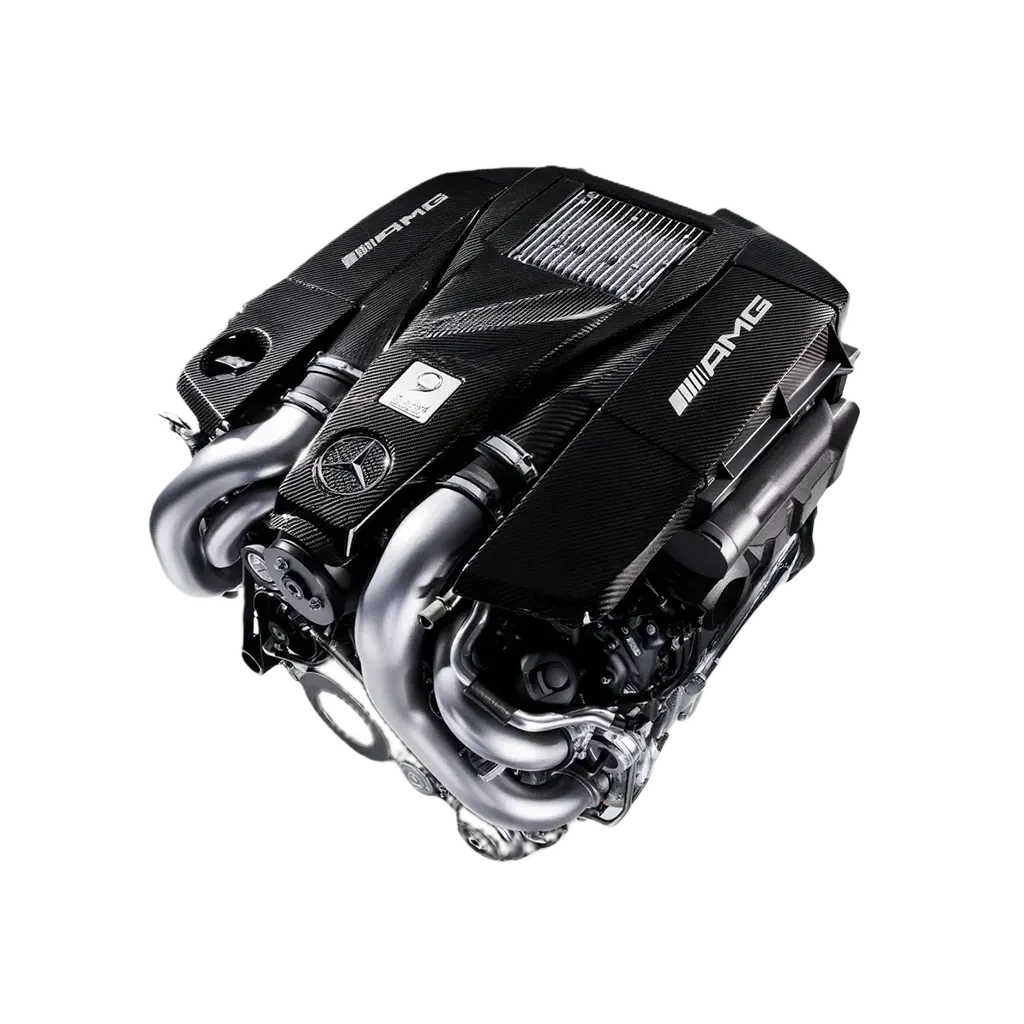
Matching the badge only
A model badge can span multiple generations and engine versions. Use the vehicle identity and engine code together.
A Mercedes engine family name is only the starting point. The useful match is the exact engine version against the exact vehicle application, so the safest lookup combines the engine code with the vehicle's registration or VIN details.
Compatibility is not established by the engine-family name alone. A usable match starts with the exact Mercedes engine code and then checks the vehicle application, generation, fuel type, drivetrain and the specific equipment fitted to that vehicle. The same broad engine family can have different sub-codes and applications, so a physically similar engine is not automatically a direct replacement.
Use these identifiers together rather than relying on a badge such as C 220, E 220 or A 200 on its own.
| Identifier | Why it matters | Example of useful detail |
|---|---|---|
| Full engine code | Narrows the engine family to the specific version that needs to be checked. | OM651 or M274, followed by the applicable sub-code where available |
| Vehicle generation / chassis | The same badge can cover different engines and specifications across generations. | W176, W205, W213, W166 |
| Model and badge | Confirms the intended vehicle application and powertrain context. | C-Class, E-Class, GLE, A-Class |
| Fuel and powertrain type | Separates petrol, diesel and electrified configurations that are not interchangeable by family name. | Petrol, diesel or plug-in hybrid |
| VIN / registration details | Provides the vehicle-specific identification needed to narrow the exact specification. | Vehicle registration lookup or VIN record |
Mercedes engine codes identify an engine family, but the application still has to be established. The supplied Mercedes application data shows major families appearing across multiple models: OM651 is represented in C-Class, E-Class, GLC, GLA, A-Class and B-Class applications; OM642 appears in E-Class, GLE, GL, ML and CLS records; M276 appears in E-Class, CLS, GLE and S-Class records; and OM654 appears across newer C-Class, E-Class, GLC and GLA records. These relationships show why the code is useful for narrowing a match, but they do not make every vehicle-to-engine combination interchangeable.
This is a practical family-level lookup, not a complete list of every Mercedes sub-code or market application.
| Engine family | Applications represented in the supplied data | How to use the map |
|---|---|---|
| OM651 | C-Class; E-Class; GLC; GLA; A-Class; B-Class | Use the vehicle generation and full OM651 sub-code to narrow the replacement match. |
| OM642 | E-Class; GLE; GL; ML; CLS; S-Class | Confirm chassis, exact sub-code and vehicle specification before treating another OM642 as a replacement. |
| M276 | E-Class; CLS; GLE; S-Class | Family-level similarity is not enough; confirm the exact vehicle application and specification. |
| OM654 | C-Class; E-Class; GLC; GLA | Use the exact engine version and vehicle details, particularly on newer applications. |
| M274 | Mercedes petrol applications including C-Class/E-Class-era applications represented by the engine route | Confirm the exact M274 sub-code and vehicle before ordering. |
| M270 | A-Class and other compact Mercedes applications represented by the engine route | Use the exact M270 version and vehicle identification rather than the family name alone. |
Mercedes engine compatibility flow from engine family and sub-code to vehicle application
The family code is a useful first filter, but the full code is the stronger identifier for a replacement-engine enquiry. Mercedes applications can share a family while differing by generation, output, emissions equipment, ancillaries, electronics, transmission interface or other vehicle-specific equipment. For that reason, compatibility should be confirmed at the exact application level rather than inferred from a matching family name.
A model badge can span multiple generations and engine versions. Use the vehicle identity and engine code together.
Two engines carrying the same family designation can still require different application-level checks.
A family such as OM651 or M274 is not the same as proving that a particular sub-code is correct for the vehicle.
Mounting or visual similarity does not establish complete compatibility with the vehicle's electronics, emissions system or drivetrain.
Start with the registration or VIN, model, generation and fuel type. Do not begin with a replacement engine listing alone.
Use the vehicle information to establish the likely Mercedes engine family, such as OM651, OM642, OM654, M274 or M276.
Record the complete engine code and any available sub-code. This is the critical bridge between a family-level match and an application-level check.
Confirm that the engine version is associated with the same vehicle generation and specification. Do not assume that a shared family makes every application interchangeable.
Before purchase or fitting, have the supplier match the donor engine's code and specification against the vehicle details.
Use the vehicle registration lookup to identify the vehicle before you select a replacement engine. The vehicle details provide the starting point for an exact compatibility check.
An exact compatibility check can require more than the engine family and sub-code. Depending on the application, the relevant checks can include the vehicle generation, emissions specification, engine management and electronics, transmission interface, ancillary equipment and electrification or 48-volt system requirements. These checks are especially important when the donor engine comes from a different model, facelift or market.
Mercedes replacement engine compatibility checklist showing vehicle identification, full engine code and application verification
Enter your vehicle registration to start the identification process, then use the vehicle and engine details for a compatibility-checked replacement-engine enquiry.
To Find The Best Supplier Near You
