Executive Summary
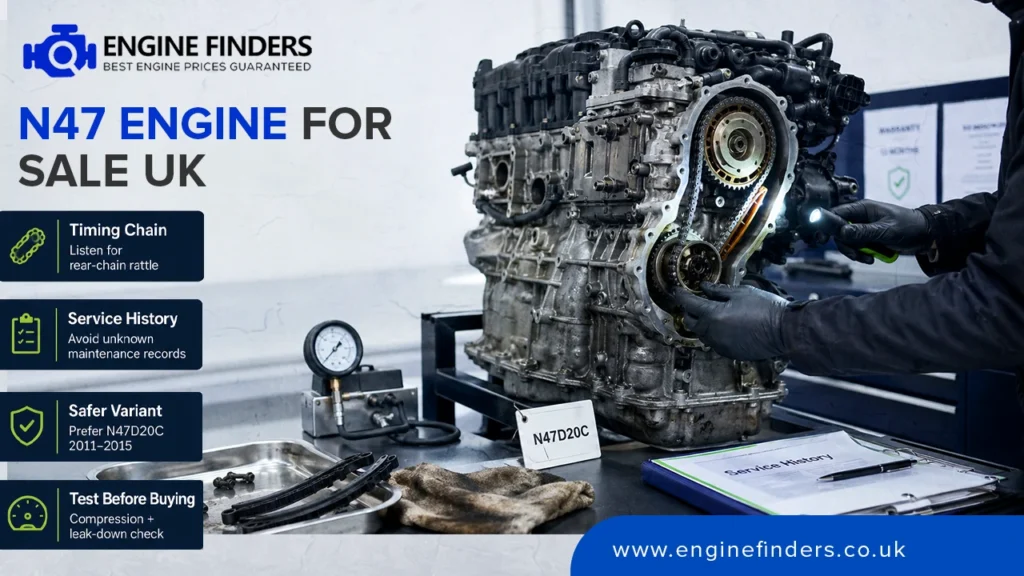
The BMW N47 is a 2.0-litre diesel engine produced from 2007 to 2015, widely used in 1 Series, 3 Series, and 5 Series models. While capable of 150,000+ miles with proper maintenance, the N47 is notorious for timing chain failures, particularly in pre-2011 units, making careful inspection essential before purchase. The later N47D20C variant (2011-2015) features improved timing chain components and represents the safer option for buyers.
Key verdict: Avoid N47 engines with unknown service history or those showing timing chain rattle symptoms. If purchasing, prioritise N47D20C units with documented maintenance records, or consider a reconditioned engine with upgraded timing chain components and warranty coverage.
Critical caveats: Timing chain replacement costs £1,200-£1,800 if not already completed. Many N47 engines have already been replaced under warranty or recall programmes; verify the engine’s history. EGR cooler failures and DPF issues are common on high-mileage examples. Always obtain a compression test and leak-down test before purchase.
Engine Finders is a price comparison platform, not a direct engine seller. Final pricing, warranty terms, and availability vary by vetted UK supplier. Professional diagnosis is recommended before purchasing any replacement engine.
Understanding the BMW N47 Engine
The BMW N47 is a 2.0-litre (1,995cc) four-cylinder turbodiesel engine that replaced the M47 unit in 2007. It features an aluminium block with cast-iron cylinder liners, DOHC configuration with 16 valves, and a variable geometry turbocharger. The engine was produced in three main variants: N47D20A (2007-2010), N47D20B (2010-2011), and N47D20C (2011-2015), with power outputs ranging from 116hp to 218hp depending on turbocharging configuration.

The N47 powers numerous BMW models including the E81/E82/E87/E88 1 Series (118d, 120d, 123d), E90/E91/E92/E93 3 Series (318d, 320d, 325d), and E60/E61 5 Series (520d). It also appears in MINI Countryman Cooper SD and various Land Rover applications (though these use a Ford-derived variant).
The engine’s rear-mounted timing chain design, positioned between the engine and gearbox, represents its most significant engineering flaw. This configuration requires gearbox removal for timing chain access, dramatically increasing labour costs for what should be routine maintenance.
N47 Engine Variants Explained
N47D20A (2007-2010): The original variant with the highest failure rate. Early production units (2007-2009) exhibit the most severe timing chain tensioner and guide wear. These engines typically produce 143hp (318d/118d) or 177hp (320d/120d).
N47D20B (2010-2011): Transitional variant with minor updates to the timing chain tensioner design. Failure rates remain elevated compared to later versions, though slightly improved over the N47D20A.
N47D20C (2011-2015): The most reliable N47 variant, featuring upgraded timing chain guides, tensioner, and sprockets. BMW issued technical service bulletins addressing earlier failures, and this variant incorporated many of those improvements into standard production. If you are looking to buy a replacement N47 engine, prioritise this variant.
N47TU (Technical Update, 2014-2015): Final evolution with further refinements before replacement by the B47 engine in 2015. Shares most components with N47D20C but features updated engine management and emissions equipment.
Critical Failure Modes: What Kills N47 Engines
Timing Chain Failure (The Primary Concern)
The N47’s timing chain system represents the engine’s Achilles’ heel. The chain runs at the rear of the engine, adjacent to the flywheel, making it inaccessible without removing the transmission. This design flaw affects all N47 variants but is most severe in pre-2011 units.
Symptoms of timing chain wear:
- Rattling or whining noise from the rear of the engine, particularly noticeable at idle or during cold starts
- Engine management light illumination with camshaft/crankshaft correlation fault codes (P0016, P0017)
- Rough running, misfires, or difficulty starting
- In severe cases, complete engine failure due to valve-to-piston contact
The timing chain tensioner can fail as early as 60,000 miles in worst cases, though 80,000-120,000 miles is more typical. When the tensioner fails, the chain loses tension and can skip teeth on the sprockets, causing catastrophic engine damage. For a full breakdown of symptoms, repair options, and costs, see our dedicated BMW N47 timing chain failure guide.
Cost implications: Timing chain replacement typically costs £1,200-£1,800 including labour, with the majority of expense attributed to gearbox removal and refitting. If you are comparing a used N47 engine against replacement costs, factor this in immediately.
EGR Cooler Failures
The exhaust gas recirculation (EGR) cooler on N47 engines is prone to internal leaks, allowing coolant to mix with exhaust gases. BMW issued recall R/2016/035 affecting certain N47 engines manufactured between 2010-2014 due to fire risk from EGR cooler leaks.
Symptoms:
- Coolant loss without visible external leaks
- White smoke from exhaust with sweet smell
- Engine overheating
- Coolant contamination with soot
Replacement EGR coolers cost £300-£500 plus labour. Some owners opt for EGR blanking plates and software remaps, though this may affect MOT emissions testing and is technically non-compliant with road vehicle regulations.
DPF (Diesel Particulate Filter) Issues
N47 engines in urban-use vehicles frequently suffer from DPF clogging, particularly on cars used primarily for short journeys. The regeneration cycle requires sustained high-speed driving, which many urban BMWs do not receive.
Symptoms:
- Reduced power and throttle response
- Increased fuel consumption
- Frequent DPF regeneration attempts (noticeable as extended idle after shutdown)
- DPF warning light illumination
DPF replacement costs £800-£1,500. Removal is illegal for road use and will result in MOT failure since 2018 when emissions testing became more stringent.
Swirl Flap Failure
The intake manifold features swirl flaps that can wear and break, potentially entering the engine and causing severe damage. Later N47 variants improved the flap design, but early units remain vulnerable.
Symptoms:
- Rattling noise from intake manifold
- Engine management light with airflow-related fault codes
- In worst cases, metallic debris ingestion causing piston or cylinder damage
Swirl flap removal and intake manifold cleaning costs £400-£600. Some specialists recommend complete intake manifold replacement with updated parts.
Turbocharger Wear
The variable geometry turbocharger on N47 engines typically lasts 120,000-150,000 miles with proper maintenance. Oil starvation or delayed oil changes accelerate wear significantly.
Symptoms:
- Blue or grey smoke from exhaust
- Whining or grinding noise from turbo
- Reduced boost pressure and power
- Oil consumption increase
Reconditioned turbochargers cost £400-£700 plus labour. Always verify oil supply lines are clear when replacing a turbo.

What to Check Before Buying an N47 Engine
When evaluating a used N47 engine for sale, systematic inspection prevents costly mistakes. Use this checklist whether purchasing from a breaker, private seller, or supplier.
Documentation and History
Service records: Demand complete service history showing oil changes at maximum 10,000-mile intervals (not BMW’s 18,000-mile LongLife schedule). N47 engines demand frequent oil changes; every 8,000-10,000 miles maximum using the correct BMW specification oil to prevent timing chain wear.
Timing chain replacement proof: If the seller claims timing chain work has been completed, request invoices showing:
- Timing chain kit replacement (not just tensioner)
- Sprocket replacement (essential; worn sprockets will destroy new chains)
- Oil pump chain replacement (often done simultaneously)
- Labour time of 8-12 hours (proper job requires gearbox removal)
Recall completion: Verify recall R/2016/035 (EGR cooler) has been completed. Check the DVSA recall database using the vehicle’s VIN number.
Mileage verification: Cross-reference mileage on the engine (if visible) with the donor vehicle’s odometer. N47 engines with over 150,000 miles carry higher risk unless comprehensively rebuilt.
Physical Inspection
Compression test: Essential before purchase. All cylinders should read within 10% of each other, typically 350-450 PSI for a healthy N47. Lower readings indicate worn rings, valves, or head gasket failure.
Leak-down test: More diagnostic than compression testing. Reveals whether compression loss stems from rings, valves, or head gasket. Acceptable leak-down is under 10% per cylinder.
Oil inspection: Drain a small amount of oil and check for:
- Metallic particles (indicates bearing wear or timing chain guide failure)
- Coolant contamination (milky appearance suggests head gasket or EGR cooler failure)
- Excessive diesel dilution (indicates DPF regeneration issues or injector problems)
Coolant inspection: Check for oil contamination or exhaust gas presence (combustion leak test). Blue coolant indicates EGR cooler failure; oil indicates head gasket issues.
Visual examination:
- Check for oil leaks around the timing chain cover (rear of engine)
- Inspect turbocharger oil supply and return lines for sludge
- Examine EGR valve and cooler for excessive carbon buildup
- Verify all engine mounts are intact
Running Tests (If Possible)
Cold start: Listen carefully for timing chain rattle during the first 3-5 seconds after cold start. A brief rattle is normal; persistent rattling indicates worn tensioner or guides.
Idle quality: Engine should idle smoothly at 750-850 RPM. Rough idle suggests injector issues, compression problems, or timing chain stretch.
Boost test: Under load (road test or rolling road), verify boost pressure reaches specified levels (typically 1.2-1.5 bar depending on variant). Low boost indicates turbo wear, boost leaks, or DPF restriction.
Exhaust smoke:
- Blue smoke: oil burning (turbo seals, piston rings, valve guides)
- White smoke: coolant burning (head gasket, EGR cooler)
- Black smoke: over-fuelling (injectors, MAF sensor, DPF issues)
Noise assessment: Listen for:
- Ticking from injectors (normal to a slight degree)
- Whining from turbo (indicates bearing wear)
- Knocking from bottom end (catastrophic; avoid)
- Rattling from timing cover (chain tension failure)
Electronic Diagnostics
Connect BMW-compatible diagnostic equipment (ISTA, INPA, or quality aftermarket scanner) and check:
Fault codes: Even cleared codes leave shadow codes. Look for:
- Camshaft/crankshaft correlation codes (timing chain stretch)
- Turbocharger boost control faults
- EGR valve position faults
- DPF differential pressure codes
- Injector coding/correction values
Live data:
- Fuel rail pressure (should reach 1,600+ bar under load)
- Turbocharger boost pressure vs. requested
- EGR valve position and flow rate
- DPF differential pressure (should be under 50 mbar when clean)
- Oil temperature (overheating indicates cooling system issues)
Injector correction values: Each injector should have correction values within plus or minus 4 mg/stroke. Higher values indicate worn injectors requiring coding or replacement.
Cost Analysis: Used vs Reconditioned vs New N47 Engines
Understanding the true cost of buying an N47 engine requires factoring in more than purchase price. Here is what UK buyers can expect in 2025.

Used N47 Engines
Price range: £600-£1,500 depending on mileage, variant, and supplier.
What you get:
- Untested or minimally tested engine from breaker/donor vehicle
- Typically 30-90 day warranty (breakers only)
- Unknown timing chain condition
- No upgrades or improvements
Hidden costs:
- Timing chain replacement (likely needed): £1,200-£1,800
- Clutch replacement (recommended while gearbox is out): £600-£900
- Flywheel inspection/replacement: £400-£700
- Oil, filters, coolant: £150-£200
- Labour for removal/refit: £600-£900
- Total realistic cost: £2,550-£4,900
Best for: Budget-conscious buyers with access to trusted breakers, willing to accept risk, or planning immediate timing chain replacement regardless.
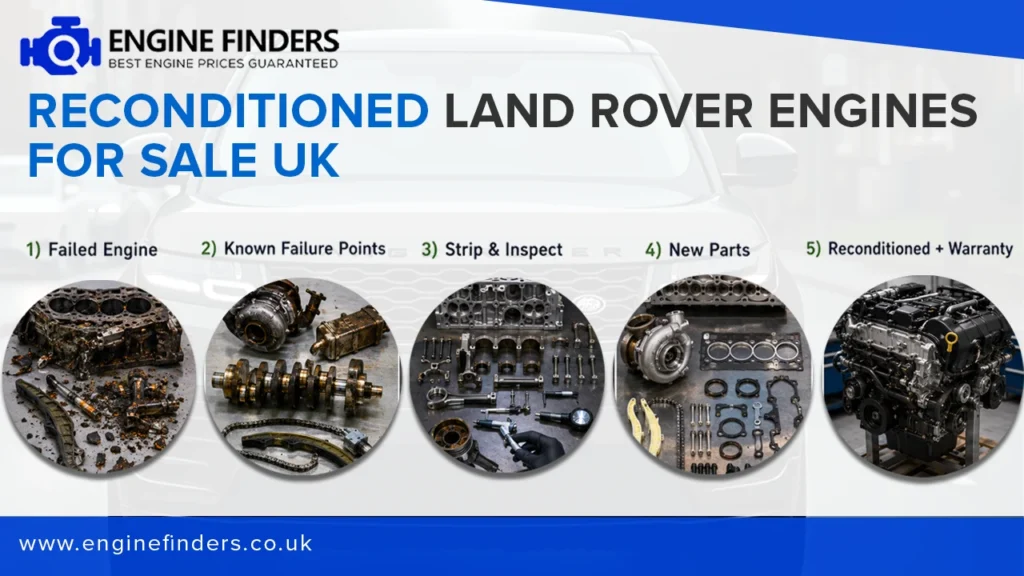
Reconditioned N47 Engines
Price range: £1,800-£3,200 including VAT, depending on supplier and warranty terms.
What you get:
- Complete strip, clean, and inspection
- New/renewed timing chain kit (essential; verify this is included)
- New/renewed oil pump chain
- Reconditioned or replaced turbocharger
- New/renewed injectors (or tested and coded)
- New gaskets and seals throughout
- Pressure testing of head and block
- 6-12 month warranty (some suppliers offer 24 months)
- Compression test certificate
Hidden costs:
- Clutch and flywheel (recommended): £600-£1,200
- Labour for removal/refit: £600-£900
- Oil, filters, coolant: £150-£200
- Total realistic cost: £3,210-£5,500
Reconditioned N47 engines from reputable suppliers offer the best balance of reliability and value for most UK buyers. Before purchasing, read our guide on what to check before buying a reconditioned engine online, then compare quotes from vetted UK suppliers to find competitive pricing with strong warranty terms.
Best for: Buyers seeking reliability and warranty protection.
New/Remanufactured N47 Engines
Price range: £4,500-£6,500 (rare; BMW discontinued N47 in favour of B47)
What you get:
- BMW remanufactured unit (if available)
- Full OEM specification
- Comprehensive warranty (typically 24 months)
- Latest updated components
Hidden costs: Same as reconditioned for installation; often unavailable as BMW pushes B47 conversion.
Total realistic cost: £5,850-£8,100
Best for: Purists wanting OEM specification, though B47 conversion may offer better long-term value.
B47 Engine Conversion
Since BMW replaced the N47 with the B47 in 2015, some owners consider upgrading. The B47 addresses many N47 weaknesses, particularly timing chain design.
Cost: £6,000-£9,000 including engine, ECU, wiring, and labour.
Considerations:
- Requires ECU coding and immobiliser work
- May affect insurance and vehicle valuation
- Improved reliability and emissions
- Better fuel economy (10-15% improvement typical)
For a detailed comparison of both options, see our used versus reconditioned engine guide.
N47 Engine Compatibility: Which Models Fit?
The N47 engine family shares common architecture but features variant-specific components. When searching for an N47D20C engine, ensure compatibility with your vehicle.
Chassis Code Compatibility
N47D20A/B/C engines fit:
- 1 Series: E81/E82/E87/E88 (2007-2013) 116d, 118d, 120d, 123d
- 3 Series: E90/E91/E92/E93 (2007-2013) 316d, 318d, 320d, 325d
- 5 Series: E60/E61 (2007-2010) 520d
- X1: E84 (2009-2015) sDrive18d, sDrive20d, xDrive20d
- X3: F25 (2010-2015) sDrive18d, xDrive20d
- MINI: R60 Countryman Cooper SD (2010-2016)
Critical compatibility factors:
- Engine management system: Early N47D20A uses different ECU software than N47D20C. Swapping requires ECU coding or replacement.
- Turbocharger configuration: Single-turbo (118d/318d/520d) vs. twin-turbo (123d/325d) engines are not interchangeable without major modifications.
- Ancillary mounting points: X1/X3 engines feature different sump design and oil pickup for all-wheel-drive applications.
- Emissions equipment: Euro 4 (pre-2010) vs. Euro 5 (2010+) engines have different EGR and DPF systems affecting ULEZ compliance.
- Gearbox compatibility: Manual vs. automatic (ZF 6HP or GM 6L45) affects flywheel and starter motor configuration.
Before purchasing, use our engine compatibility guide or consult a BMW specialist to verify the donor engine matches your vehicle’s specification.
ULEZ and Emissions Compliance
N47 engines appear in both Euro 4 and Euro 5 vehicles, affecting ULEZ charges in London and other UK clean air zones.
Euro 4 N47 (2007-2010):
- Does not meet ULEZ diesel standard (Euro 6 required)
- Daily ULEZ charge: £12.50 in London
- Subject to Clean Air Zone charges in Birmingham, Bristol, Manchester, etc.
Euro 5 N47 (2010-2015):
- Does not meet ULEZ diesel standard (Euro 6 required)
- Same charges as Euro 4
- No exemption available
Euro 6 B47 (2015+):
- Meets ULEZ standard
- No charges apply
If your N47-powered BMW faces ULEZ charges, replacing the engine with a B47 unit may be cost-effective versus daily charges. Alternatively, consider selling the vehicle and upgrading to a Euro 6 model. For guidance on diesel reliability and ULEZ options across the full BMW diesel range, professional advice is recommended.
Practical Takeaways: Making the Right Decision
Engines to Avoid
N47D20A (2007-2010) with unknown history: Highest timing chain failure rate; avoid unless comprehensively reconditioned with documentation.
Engines showing timing chain rattle: Do not purchase bargain engines with known chain issues. The £400-£600 saving is not worth £1,500+ in immediate repairs.
Engines with incomplete service history: N47 engines demand meticulous maintenance. Missing records suggest potential neglect.
High-mileage urban-use engines: DPF and EGR issues plague city-driven N47s. Prefer motorway-mileage examples.
Engines with EGR fault codes: Indicates active EGR cooler problems requiring immediate attention.
Recommended Approach
Prioritise N47D20C (2011-2015): Best variant with improved timing chain components and lower failure rates.
Demand proof of timing chain replacement: Invoices showing complete kit replacement (chain, guides, tensioner, sprockets) are essential.
Choose reconditioned engines with warranty: The £1,000-£1,500 premium over used engines buys peace of mind and typically includes timing chain upgrades. Our reconditioned engines buyers guide explains exactly what to insist on.
Verify compression and leak-down: Never purchase without these tests, regardless of seller assurances.
Replace clutch and flywheel simultaneously: Since the gearbox must be removed for timing chain work, preventative maintenance saves significant labour costs.
When to Use Engine Finders
Ready to compare quotes? Engine Finders connects you with vetted UK suppliers for no-obligation quotes on N47 engines. The platform allows you to:
- Compare prices from multiple verified suppliers
- Review warranty terms side by side
- Filter by engine variant (N47D20A/B/C)
- Access suppliers offering timing chain upgrades
- Request compression test certificates before purchase
For BMW 318d engine replacement or other model-specific needs, our supplier network covers all N47 applications.
Professional Verification Requirements
Before finalising any N47 engine purchase:
- Independent inspection: Hire a BMW specialist to inspect the donor vehicle or engine. Cost: £100-£150, potentially saving thousands.
- Compression test: Non-negotiable. Require written results before payment.
- Oil analysis: Send oil sample to laboratory (e.g., Castrol Oil Analysis, £50-£80) to detect internal wear metals.
- Diagnostic scan: Full BMW ISTA/INPA diagnostic revealing fault codes, adaptation values, and component wear indicators.
- MOT history check: Use the GOV.UK MOT history service to verify mileage consistency across MOT records and spot any engine-related advisories.
- Warranty terms review: Ensure warranty covers timing chain failure, not just “manufacturing defects.” Many suppliers exclude the N47’s primary failure mode.
Frequently Asked Questions
How much does an N47 engine replacement cost in the UK?
A reconditioned N47 engine typically costs £1,800-£3,200 including VAT, depending on supplier and warranty terms. Labour adds £600-£900, plus clutch and flywheel replacement (£600-£1,200) if needed. Total realistic cost is £3,000-£5,500. Used engines cost £600-£1,500 but often require immediate timing chain replacement adding £1,200-£1,800. Compare quotes from vetted UK suppliers for competitive pricing.
Is the N47 engine reliable after timing chain replacement?
Yes. N47 engines with properly replaced timing chains (including guides, tensioner, and sprockets) can achieve 150,000-200,000 miles reliably. The N47D20C variant (2011-2015) features upgraded components from the factory and shows significantly improved reliability. Key maintenance includes oil changes every 8,000-10,000 miles and monitoring for EGR cooler issues. However, other failure points like DPF clogging and turbo wear remain concerns on high-mileage examples.
What is the difference between N47D20A, N47D20B, and N47D20C?
The N47D20A (2007-2010) is the original variant with the highest timing chain failure rates. N47D20B (2010-2011) features minor tensioner improvements but remains problematic. N47D20C (2011-2015) incorporates upgraded timing chain guides, tensioner, and sprockets, representing the most reliable variant. All produce similar power (143-177hp depending on tune) but the N47D20C is strongly preferred for replacements. When sourcing a replacement N47D20C engine, always confirm the build date before purchase.
Can I replace the N47 timing chain myself?
Technically possible but not recommended for DIY mechanics. The timing chain sits between the engine and gearbox, requiring complete gearbox removal, flywheel removal, and specialised timing tools. Labour time is 8-12 hours for professionals. Incorrect installation causes catastrophic engine damage. Cost of professional replacement (£1,200-£1,800) is justified by complexity. If purchasing an engine with unknown chain condition, factor replacement cost into your budget or choose a reconditioned unit with a new chain already installed.
Will an N47 engine pass ULEZ emissions standards?
No. N47 engines were produced from 2007-2015 in Euro 4 and Euro 5 configurations. ULEZ requires Euro 6 emissions standard for diesel vehicles (typically 2015+). All N47-powered vehicles face the £12.50 daily ULEZ charge in London and similar Clean Air Zone charges in other UK cities. The replacement B47 engine (2015+) meets Euro 6 standards. If ULEZ compliance is essential, consider B47 conversion or vehicle replacement rather than N47 engine replacement.
What mileage should the N47 timing chain be replaced?
BMW does not specify a replacement interval, but workshop consensus recommends inspection at 80,000-100,000 miles and replacement by 120,000 miles on N47D20A/B variants. N47D20C engines may last 120,000-150,000 miles. However, many failures occur before 100,000 miles, particularly on engines with extended oil change intervals. Listen for rattling at cold start; if present, replace immediately regardless of mileage. Proactive replacement costs £1,200-£1,800 versus £3,000+ for engine replacement after failure.