Executive Summary
Choosing between a reconditioned engine and a new engine is one of the most critical decisions facing UK car owners facing engine failure. For most drivers, a professionally reconditioned engine offers the best balance of reliability, warranty protection, and cost-effectiveness – typically costing 40-60% less than a brand-new OEM unit while delivering comparable performance and longevity when sourced from reputable suppliers.
The right choice depends on your vehicle’s age, remaining value, intended ownership period, and budget. New engines make sense for late-model vehicles under warranty or classic cars where originality matters. Reconditioned engines are ideal for vehicles 5-15 years old where a new engine would exceed the car’s value.
Critical considerations: Always verify warranty terms (reconditioned engines typically offer 6-24 months vs. new engine OEM warranties), ensure professional fitment regardless of choice, and confirm emissions compliance for your specific vehicle and region.
Engine Finders is a price comparison platform, not a direct engine seller. Final pricing, warranty terms, and availability vary by vetted UK supplier. Professional diagnosis is recommended before purchasing any replacement engine.
Understanding Your Engine Replacement Options
What Is a Reconditioned Engine?
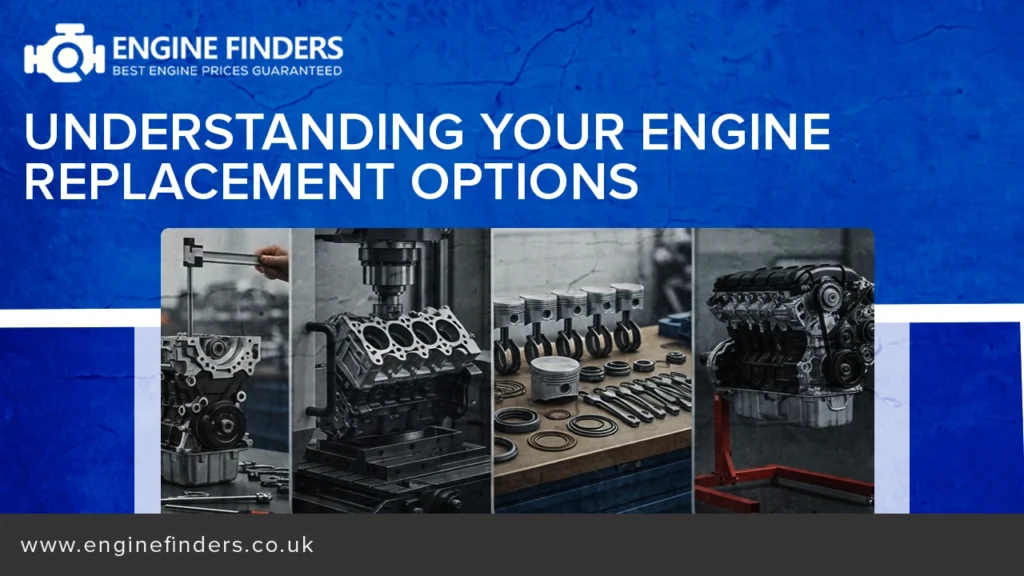
A reconditioned engine (also called “recon” or “rebuilt” engine) undergoes complete disassembly, thorough cleaning, and systematic replacement of worn components. The process includes:
Core inspection and assessment: The engine block is checked for cracks, warping, and wear using precision measuring tools. Cylinder bores are measured for out-of-round and taper conditions.
Machining operations: Depending on wear patterns, blocks may require:
- Cylinder reboring or honing to restore proper surface finish
- Crankshaft grinding to undersize specifications
- Cylinder head resurfacing to ensure proper gasket sealing
- Valve seat cutting and guide replacement
Component replacement: Standard practice includes new pistons, rings, bearings, gaskets, seals, oil pump, and timing components. Higher-spec rebuilds may include upgraded parts addressing known failure points.
Testing and quality control: Reputable suppliers perform pressure testing, dyno runs, or at minimum cold-test rotation to verify proper assembly before dispatch.
What Qualifies as a “New” Engine?
OEM New Engine: A brand-new engine manufactured by the original equipment manufacturer (BMW, Mercedes, Ford, etc.) to exact factory specifications. These are increasingly rare for engines older than 5-7 years as manufacturers discontinue production.
Remanufactured Engine: Often confused with reconditioned, but technically different. Remanufactured engines are rebuilt to original OEM specifications using a combination of new and reconditioned parts. You can find more details in our 2026 reconditioned engines buyer’s guide.
Crate Engine: A complete new engine sold as a unit, typically from aftermarket manufacturers or OEM performance divisions. Common in motorsport and restoration contexts.
Key Differences at a Glance
| Factor | Reconditioned Engine | New OEM Engine |
| Cost | £800-£3,500 (typical) | £2,500-£8,000+ |
| Warranty | 6-24 months typical | 12-36 months OEM |
| Availability | 1-4 weeks typical | 2-12 weeks (if available) |
| Originality | Your original block (usually) | Brand new unit |
| Emissions compliance | Matches original spec | Matches original spec |
| Lead time | Often in stock | May require ordering |
Cost Comparison: The Financial Reality
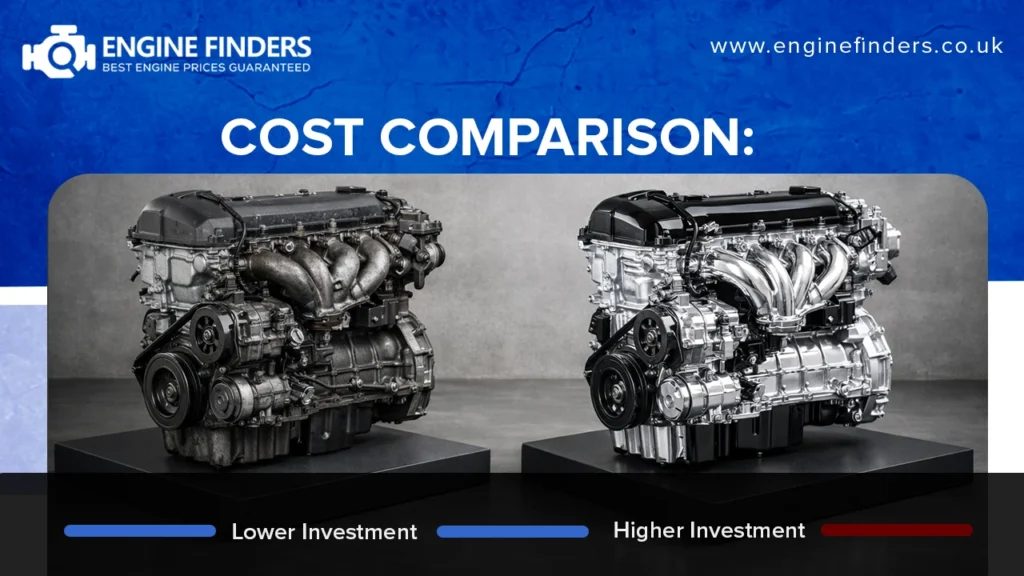
Typical UK Pricing (2026)
Reconditioned Engine Costs:
- 4-cylinder petrol (e.g., Ford EcoBoost, VW EA888): £1,200-£2,200
- 4-cylinder diesel (e.g., BMW B47, Ford Duratorq): £1,500-£2,800
- 6-cylinder petrol (e.g., BMW B58, Audi V6): £2,000-£3,500
- 6-cylinder diesel (e.g., BMW B57, Mercedes OM642): £2,200-£4,000
- V8 engines: £3,000-£6,000+
New OEM Engine Costs:
- 4-cylinder units: £2,500-£4,500 (when available)
- 6-cylinder units: £4,000-£7,000 (when available)
- V8 units: £6,000-£12,000+ (when available)
Labour Costs (Professional Fitment):
- Standard front-wheel-drive vehicles: £600-£1,200
- Rear-wheel-drive luxury vehicles (BMW 5 Series, Mercedes E-Class): £900-£1,800
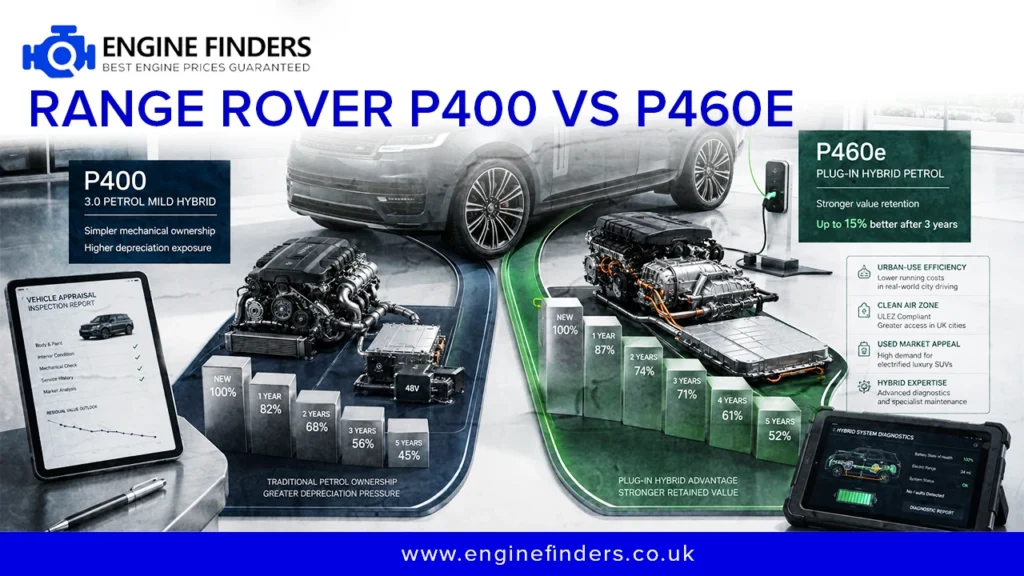
- 4WD/AWD vehicles (Range Rover, Audi Quattro): £1,200-£2,500
- Transverse V6/V8 installations: £1,500-£3,000
Labour rates vary significantly based on vehicle complexity. For a detailed breakdown by vehicle type, consult our Engine Replacement Cost UK guide.
Total Investment Comparison
Scenario: 2015 BMW 320d (B47 engine failure)
- Reconditioned B47 engine: £1,800-£2,400
- Labour (specialist BMW garage): £900-£1,200
- Additional parts (mounts, fluids, belts): £200-£400
- Total: £2,900-£4,000
- New OEM B47 engine: £3,500-£4,500 (if available)
- Labour: £900-£1,200
- Additional parts: £200-£400
- Total: £4,600-£6,100
Savings with reconditioned: £1,700-£2,100 (37-40% reduction)
Hidden Costs to Consider
Core Charge: Most reconditioned engine suppliers require a refundable core deposit (£200-£800) to ensure you return your old engine for rebuilding. This is refunded upon receipt of your exchange unit.
Delivery Charges: £50-£150 depending on supplier location and engine size. Some suppliers include delivery in the quoted price.
Old Engine Disposal: If not exchanging, disposal fees range £50-£150 at licensed waste facilities.
Unexpected Repairs: Once the engine is out, technicians often discover:
- Worn clutch/flywheel (add £400-£900)
- Leaking rear main seal (often done while engine is out)
- Worn engine mounts (add £150-£400)
- Cooling system components (add £100-£300)
Review our New vs Reconditioned vs Used Engines guide to understand all potential variables.
Reliability and Longevity: What the Data Shows
How Long Does a Reconditioned Engine Last?
A professionally reconditioned engine from a reputable supplier should deliver 80,000-150,000 miles of reliable service when properly maintained and installed. The actual lifespan depends on several factors:
Quality of rebuild:
- Budget rebuilds (£800-£1,500): May use minimal machining and basic replacement parts. Lifespan: 40,000-80,000 miles typical.
- Standard rebuilds (£1,500-£2,500): Includes proper machining, quality replacement parts, and addresses known failure points. Lifespan: 80,000-120,000 miles typical.
- Premium rebuilds (£2,500+): Comprehensive machining, upgraded components, blueprinted assembly, dyno testing. Lifespan: 120,000-200,000 miles possible.
Installation quality: Even the best reconditioned engine will fail prematurely if installed incorrectly. Critical factors include:
- Proper torque sequences and specifications
- Correct timing alignment
- Adequate break-in procedure
- Flushing of cooling and oil systems
- Replacement of ancillary components (water pump, thermostat, hoses)
Maintenance post-installation:
- First oil change at 500-1,000 miles (critical for removing break-in debris)
- Subsequent changes every 8,000-10,000 miles (not manufacturer extended intervals)
- Regular coolant system inspection
- Monitoring for leaks or unusual noises
New Engine Reliability
New OEM engines come with the advantage of:
- Zero-mileage components throughout
- Latest manufacturer updates and revisions
- Full OEM warranty coverage (typically 2-3 years unlimited mileage)
- Known quality from factory production
However, new engines are not immune to:
- Manufacturing defects (rare but possible)
- Design flaws carried over from the failed original
- Damage from improper installation or break-in
Warranty Comparison
Reconditioned Engine Warranties:
- Budget suppliers: 3-6 months parts and labour (often limited to supplier’s garage)
- Mid-tier suppliers: 12 months parts and labour (UK-wide coverage typical)
- Premium suppliers: 18-24 months parts and labour, sometimes unlimited mileage
Critical warranty terms to verify:
- Does warranty cover labour costs or parts only?
- Is labour covered at any garage or only the supplier’s facility?
- What voids the warranty? (Common: improper installation, missed oil changes, overheating)
- Is there a mileage limit?
- Who pays for diagnostic time if a claim arises?
Reconditioned warranties vary by tier. For a full breakdown of coverage, see our reconditioned engine warranty guide.
New Engine Warranties:
- OEM standard: 2-3 years unlimited mileage (varies by manufacturer)
- Coverage: Full parts and labour at any authorised dealer
- Transferability: Usually transfers to subsequent owners
- Additional benefits: May include roadside assistance, courtesy vehicle
Quality Variations: Not All Reconditioned Engines Are Equal
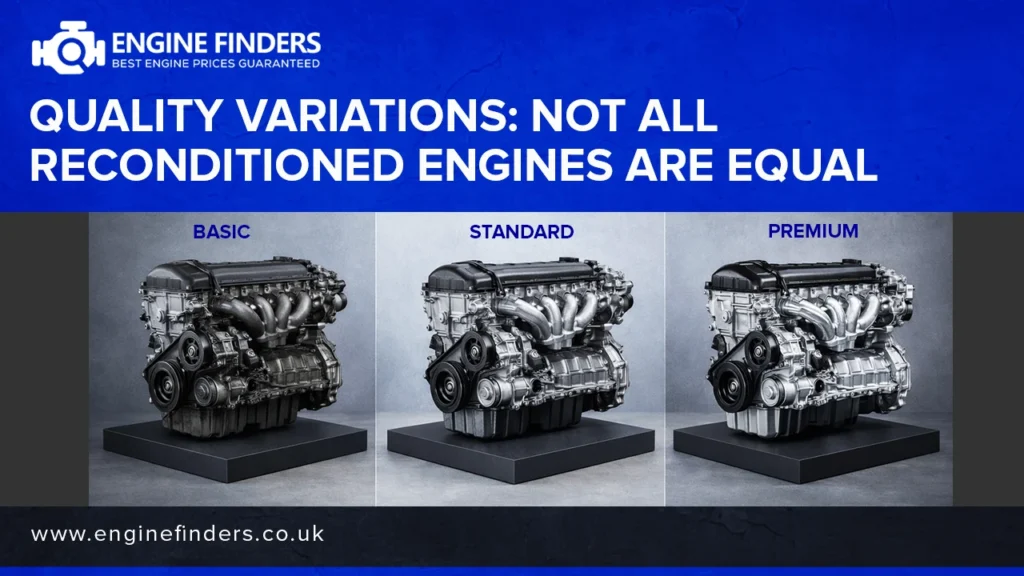
The Reconditioning Spectrum
The term “reconditioned engine” covers a wide range of quality levels. Understanding these distinctions is crucial when looking to buy a reconditioned engine in the UK and comparing quotes.
Level 1: Basic Rebuild (£800-£1,500)
- Minimal disassembly and cleaning
- Visual inspection only
- Replacement of obvious worn parts (rings, bearings, gaskets)
- No machining unless absolutely necessary
- Basic testing (rotation, compression check)
- Best for: Low-value vehicles, short-term ownership, budget constraints
- Risk: Higher failure rate, shorter lifespan
Level 2: Standard Professional Rebuild (£1,500-£2,800)
- Complete disassembly
- Hot tank or chemical cleaning
- Magnaflux inspection for cracks
- Precision measurements of all critical dimensions
- Machining as needed (bore, hone, grind, resurface)
- Replacement of all wear items with quality parts
- Pressure testing of block and head
- Cold test rotation
- Best for: Most vehicles, 5-10+ year ownership plans
- Risk: Moderate, depends on supplier reputation
Level 3: Premium/Blueprint Rebuild (£2,800-£5,000+)
- Everything in Level 2, plus:
- Upgraded components addressing known weaknesses
- Blueprinting (assembly to tighter tolerances than OEM)
- Balancing of rotating assembly
- Dyno testing and break-in
- Detailed documentation of measurements
- Often includes performance enhancements
- Best for: Performance vehicles, classics, maximum longevity
- Risk: Lowest when done by reputable specialist
Red Flags When Evaluating Suppliers
Avoid suppliers who:
- Cannot provide detailed written specifications of what’s included
- Offer warranties significantly shorter than industry standard
- Have no physical address or verifiable business history
- Pressure you to decide immediately
- Cannot explain their reconditioning process in detail
- Have consistently poor reviews mentioning premature failures
- Quote prices significantly below market average (often indicates cutting corners)
Look for suppliers who:
- Provide itemised lists of replaced components
- Explain machining operations performed
- Offer transparent warranty terms
- Have established presence (5+ years minimum)
- Welcome questions and technical discussion
- Can provide references or case studies
- Ensure the supplier is a member of a trade association such as the Federation of Engine Remanufacturers (FER).
Questions to Ask Every Supplier
- “What exactly is included in the reconditioning process?”
- “Which components are replaced as standard?”
- “What machining operations do you perform?”
- “Do you address known failure points for this engine code?”
- “What warranty do you offer and what does it cover?”
- “Is the warranty parts-only or parts and labour?”
- “Where must the engine be fitted to maintain warranty?”
- “What is your core return policy and timeline?”
- “Do you test the engine before dispatch?”
- “Can you provide a written specification of the rebuild?”
When to Choose a Reconditioned Engine
Ideal Scenarios for Reconditioned Engines
Vehicle age 5-15 years: This is the sweet spot where a new engine often costs more than the vehicle’s value, but the car still has significant life remaining.
Budget-conscious ownership: When you need reliable transportation but cannot justify £4,000-£8,000 for a new engine.
Out-of-warranty vehicles: Once manufacturer warranty has expired, the cost-benefit heavily favours reconditioned units.
Known reliable engine designs: If your engine failed due to maintenance neglect rather than design flaw, a proper rebuild should serve well. Examples include:
- BMW M57 diesel
- Ford Duratorq TDCi units
- VW/Audi EA189 TDI (pre-emissions scandal versions)
- Honda K-series petrol engines
Planned moderate ownership: If you plan to keep the vehicle 3-7 more years, a quality reconditioned engine makes financial sense.
Classic or enthusiast vehicles: Where originality matters but new OEM engines are unavailable or prohibitively expensive.
Real-World Example: When Reconditioned Makes Sense
Case: 2012 Range Rover Sport TDV6 (3.0L diesel)
- Vehicle value (good condition): £8,000-£10,000
- New OEM engine cost: £6,500-£8,000 (if available)
- Quality reconditioned engine: £2,800-£3,500
- Labour: £1,200-£1,800
Analysis: A new OEM engine would cost nearly the entire vehicle’s value. A Range Rover TDV6 engine replacement solution at £4,000-£5,300 total preserves significant equity while delivering comparable reliability.
When to Choose a New Engine
Scenarios Where New Makes Financial Sense
Late-model vehicles (0-5 years old): If your 2023 BMW 3 Series develops engine failure under warranty dispute, a new OEM engine preserves resale value and ensures compatibility with latest software updates.
Manufacturer defects or recalls: When engine failure stems from known manufacturing defects, manufacturers may provide new engines at reduced cost or through warranty extensions.
Classic car restoration: When originality and authenticity are paramount for concours competition or historical significance.
Performance builds: When building a high-performance vehicle where you need guaranteed strength margins and cannot accept variability in component quality.
Fleet vehicles with strict maintenance policies: Some commercial operators mandate new OEM parts for liability and consistency reasons.
When reconditioned options are unavailable: For very new engines (less than 3-4 years old), the reconditioned market hasn’t developed sufficient supply.
The Availability Challenge
Critical reality: For many modern engines, particularly those with complex emissions systems (Euro 6d-TEMP, Euro 6d), new OEM engines may be:
- Discontinued by the manufacturer
- Available only as complete assemblies including turbo, injectors, ECU (driving cost higher)
- Subject to 8-16 week lead times
- Restricted to authorised dealer fitment
Always verify availability before committing to a new engine purchase. A reconditioned unit available in 2 weeks often beats a new engine with 12-week lead time if you need your vehicle.
Environmental and Ethical Considerations
The Sustainability Case for Reconditioned Engines
Choosing a reconditioned engine over new has significant environmental benefits:
Resource conservation: Engine blocks contain 80-150kg of aluminium or cast iron. Reusing the block saves the energy and emissions associated with mining, refining, and casting new metal.
Reduced manufacturing emissions: Producing a new engine generates approximately 400-600kg CO₂ equivalent. Reconditioning generates 80-120kg CO₂ equivalent – an 80% reduction.
Waste diversion: Approximately 200,000 engines reach end-of-life annually in the UK. Reconditioning diverts this material from landfill or energy-intensive recycling.
Circular economy: The reconditioning industry supports skilled UK manufacturing jobs and keeps value within the domestic economy.
When New Might Be Justified Environmentally
Emissions compliance upgrades: In rare cases, a newer engine variant may offer significantly lower emissions, potentially allowing access to low-emission zones where the original engine would be restricted.
Efficiency improvements: Modern engine designs can offer 15-25% better fuel economy, which over 100,000 miles could offset the manufacturing emissions of a new unit.
However, for most vehicles, the carbon payback period for a new engine exceeds the remaining useful life of the vehicle, making reconditioned the environmentally superior choice.
Making the Decision: A Practical Framework
Decision Matrix
Use this framework to determine which option suits your situation:
Question 1: What is your vehicle’s current market value?
- Under £5,000 → Strong case for reconditioned or used
- £5,000-£15,000 → Reconditioned typically optimal
- Over £15,000 → Consider both options based on other factors
Question 2: How long do you plan to keep the vehicle?
- Under 2 years → Used engine or budget reconditioned
- 2-5 years → Standard reconditioned
- 5+ years → Premium reconditioned or new (if under £15k value)
Question 3: What is your total budget (engine + labour + ancillaries)?
- Under £3,000 → Reconditioned (possibly used)
- £3,000-£6,000 → Quality reconditioned
- Over £6,000 → Consider new if vehicle value justifies
Question 4: Does the engine have known design flaws?
- Yes → Seek reconditioned unit with design improvements
- No → Either option viable
Question 5: Is the vehicle under warranty or part of a recall?
- Yes → New OEM likely covered or subsidised
- No → Reconditioned typically better value
The Value Threshold Rule
A practical guideline: If the total cost of a new engine exceeds 60% of your vehicle’s current market value, choose reconditioned.
Example:
- 2014 Mercedes C220 CDI value: £7,500
- New engine total cost: £5,500 (73% of value) → Choose reconditioned
- Reconditioned total cost: £3,200 (43% of value) → Financially sensible
Practical Takeaways
Clear Recommendations by Use Case
Choose a reconditioned engine if:
- Your vehicle is 5-15 years old
- The vehicle value is under £15,000
- You plan to keep it 3+ more years
- You need the car back quickly (reconditioned often in stock)
- Budget is a primary concern
- The engine design is known to be reliable
Choose a new engine if:
- Your vehicle is under 5 years old
- The vehicle value exceeds £20,000
- You require maximum warranty protection
- The engine is too new for reconditioned market supply
- You’re restoring a classic where originality is paramount
- Manufacturer is offering warranty coverage or goodwill contribution
Engines Where Reconditioned Excels
Based on UK workshop consensus and reliability data:
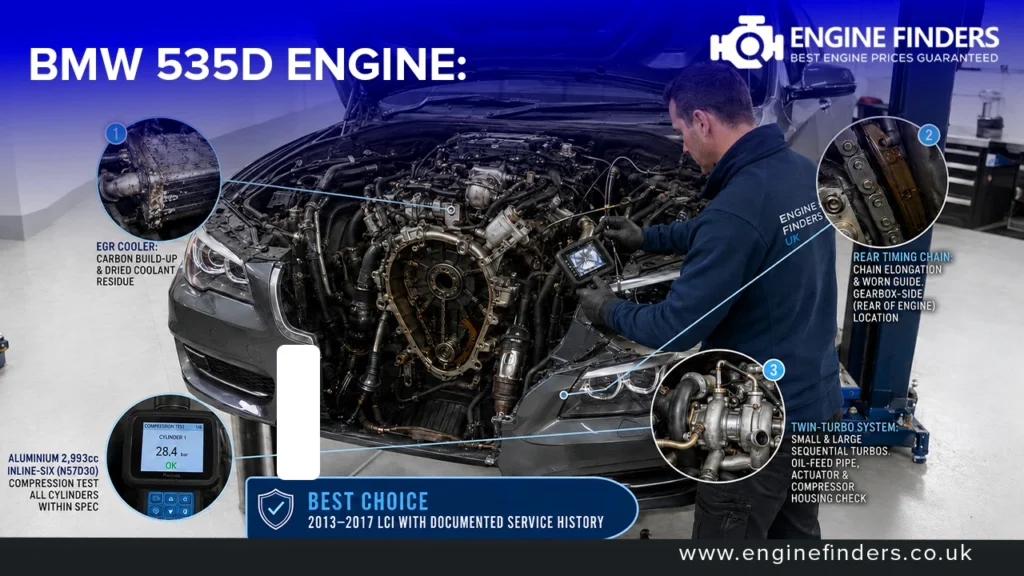
- BMW M57 3.0 diesel (add BMW M57 Engine Replacement link here) – legendary reliability when properly rebuilt
- Ford 2.0 TDCi Duratorq – robust design, widely reconditioned
- VW/Audi 2.0 TDI (EA189) – good rebuild potential, avoid pre-2015 emissions equipment
- Honda 2.2 i-DTEC – solid rebuild candidate
- Mercedes OM642 3.0 V6 diesel – address oil cooler and injector issues during rebuild
Engines Requiring Caution
- BMW N47 2.0 diesel – Ensure rebuild includes updated timing chain systems.
- Ford 1.6 EcoBoost – known coolant intrusion issues, verify rebuild addresses this
- VAG 2.0 TFSI (early EA888) – oil consumption issues, ensure piston ring updates included
- Range Rover TDV8 – complexity and cost often favour used low-mileage engine
When to Use EngineFinders
Compare quotes from vetted UK suppliers on EngineFinders to verify competitive pricing and warranty terms. Use our Engine Compatibility Checker to find the exact match for your chassis before committing.
Professional Verification Requirements
Before purchasing any engine:
- Obtain written diagnosis from a qualified mechanic confirming engine failure (not ancillary component failure)
- Verify engine code matches your vehicle exactly (chassis number lookup)
- Confirm emissions compliance for your vehicle’s registration date and intended use (ULEZ, Clean Air Zones)
- Check supplier credentials – minimum 5 years trading, physical address, verifiable reviews
- Read warranty terms carefully – understand exclusions and claim procedures
- Budget for professional fitment – DIY installation voids most warranties and risks catastrophic failure
Frequently Asked Questions
Is a reconditioned engine worth it compared to buying new?
Yes, for most UK car owners, a reconditioned engine offers excellent value. You typically save 40-60% versus new while achieving 80,000-150,000 miles of reliable service. The key is choosing a reputable supplier offering 12+ month warranty and proper machining. For vehicles worth under £15,000, reconditioned engines almost always make more financial sense than new OEM units.
How much does a reconditioned engine cost in the UK?
Typical UK prices range from £1,200-£2,800 for 4-cylinder engines and £2,000-£4,000 for 6-cylinder units, including VAT. Labour adds £600-£1,800 depending on vehicle complexity. Total installed cost typically runs £2,500-£5,000 for most common vehicles. Compare quotes from vetted suppliers to ensure competitive pricing.
How long does a reconditioned engine last with proper maintenance?
A professionally reconditioned engine should deliver 80,000-150,000 miles when properly maintained. Critical factors include: first oil change at 500-1,000 miles, subsequent changes every 8,000-10,000 miles, quality installation by experienced technician, and addressing all ancillary components during fitment. Premium rebuilds with upgraded components can exceed 150,000 miles.
What’s the difference between reconditioned, rebuilt, and remanufactured engines?
These terms are often used interchangeably in the UK, but technically: “Reconditioned” means complete disassembly, cleaning, machining as needed, and replacement of worn parts. “Remanufactured” implies rebuilding to original OEM specifications, often on production lines. “Rebuilt” is less defined – can range from minimal work to full reconditioning. Always ask for detailed specifications rather than relying on terminology.
Will a reconditioned engine affect my car’s MOT or emissions compliance?
No, a properly installed reconditioned engine maintains your vehicle’s original emissions certification. The engine must match your vehicle’s original specification (same engine code, emissions standard). Your MOT tester will check emissions levels, not whether the engine is new or reconditioned. Keep documentation proving the replacement engine matches original specifications for V5C updates if required.
Can I install a reconditioned engine myself to save money?
While technically possible, DIY installation is strongly discouraged. Most supplier warranties require professional fitment by qualified technicians. Incorrect installation can cause catastrophic failure within miles, voiding all warranties. Labour represents 25-35% of total cost – saving £800-£1,200 isn’t worth risking a £2,000+ engine. Use EngineFinders to find suppliers offering fitted packages that include professional installation and full warranty protection.