The current-generation Range Rover Sport (L461) faces a critical powertrain crossroads, with Jaguar Land Rover’s Ingenium engine family dictating long-term ownership costs that can easily exceed £10,000 if major internal components fail. Choosing the right powertrain requires looking past brochure horsepower and examining real-world mechanical durability.
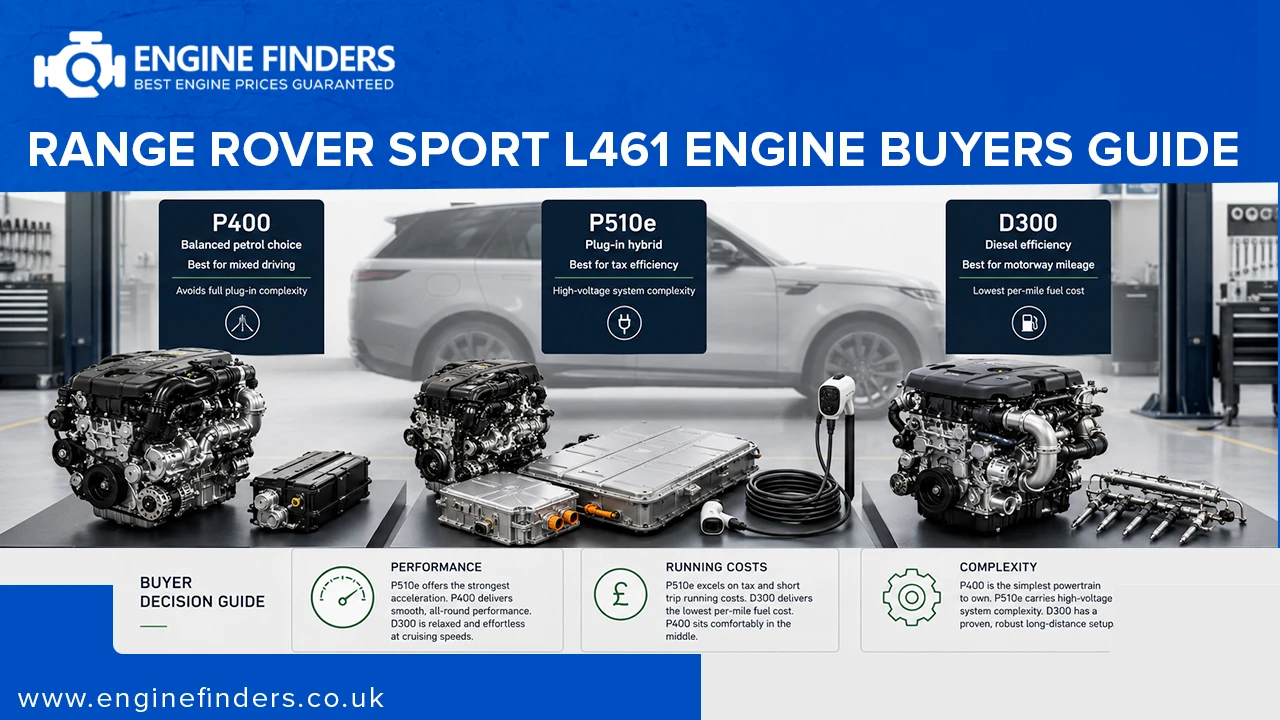
For high-mileage motorway drivers, the D300 diesel offers the lowest per-mile fuel cost, while the P510e plug-in hybrid dominates company car tax efficiency. The P400 mild-hybrid remains the balanced choice for mixed-use petrol buyers who want to avoid complex high-voltage systems.
Quick Summary: L461 Powertrain Facts
- P400 (Petrol MHEV): Best for mixed driving; 3.0L inline-6 with 48-volt system. Watch for timing chain wear.
- P510e (PHEV): Best for company car drivers; 503 bhp with 38.2 kWh battery. 113 km WLTP electric range.
- D300 (Diesel MHEV): Best for high mileage; 3.0L inline-6 diesel. Requires active DPF and EGR maintenance.
- Replacement Costs: £8,000 to £14,000 depending on the powertrain and labour rates.
Range Rover Sport L461 Engine Specifications and Power Output
The L461 sits on the MLA-Flex architecture, designed to accommodate JLR’s modular Ingenium engine family. Unlike the older V6 configurations, these inline-6 units integrate directly with electrification hardware.
P400 3.0L Inline-6 Mild Hybrid Performance Data
The P400 utilizes a 2996cc turbocharged petrol engine paired with a 48-volt Mild Hybrid Electric Vehicle (MHEV) system. This setup produces 395 bhp and 500 Nm of torque.
The integrated starter-generator smooths out stop-start functions and provides torque fill during turbo spool-up. While smoother than the previous generation, owners should still review previous generation L494 SDV6 engine problems to understand how JLR has evolved its powertrain durability.
P510e Plug-In Hybrid Electric Powertrain Metrics
The P510e combines the 3.0L inline-6 petrol engine with a 105 kW electric motor embedded in the transmission. Total system output reaches 503 bhp.
A 38.2 kWh lithium-ion battery provides up to 113 km of WLTP-certified electric range. When evaluating long-term ownership, it is vital to research hybrid battery and engine replacement options to understand the financial exposure once the factory warranty expires.
D300 3.0L Inline-6 Diesel MHEV Technical Specs

The D300 features a 2997cc inline-6 diesel utilizing sequential twin-scroll turbocharging and a 48-volt MHEV system. It delivers 299 bhp and a massive 650 Nm of torque.
This 3.0-litre Ingenium diesel architecture relies on a compacted graphite iron block to handle extreme cylinder pressures. It remains the most thermally efficient option for sustained high-speed cruising.
Range Rover Sport L461 Engine Reliability and Common Problems
Modern powertrains are highly complex. Understanding failure points is essential before purchasing, as out-of-warranty repairs can be financially devastating.
Ingenium 3.0L Petrol Timing Chain and Oil Consumption
The 3.0L petrol engine locates the timing chain at the rear of the block, adjacent to the transmission. OEM service bulletins confirm that early tensioner designs can stretch under high thermal loads.
This stretching causes rattling on cold starts and eventual P400 petrol engine misfire diagnostics. If left unaddressed, the chain can skip teeth, leading to catastrophic piston-to-valve interference.
P510e High-Voltage Battery Degradation and Warranty
The P510e’s high-voltage battery is liquid-cooled, which helps maintain optimal operating temperatures. JLR provides an 8-year/160,000 km warranty covering capacity drops below 65%.
According to real-world mileage data for JLR powertrains, battery degradation is minimal if the vehicle is regularly charged. However, prolonged periods of sitting at 0% or 100% state-of-charge can accelerate chemical aging.
D300 Diesel EGR Cooler and DPF Blockage Risks

The D300 is equipped with an Exhaust Gas Recirculation (EGR) cooler and a Diesel Particulate Filter (DPF). EGR coolers can leak internally, allowing coolant to mix with exhaust soot.
This creates a thick sludge that restricts airflow and triggers limp mode. Furthermore, DPF blockage is common if the vehicle fails to complete active regeneration cycles, directly impacting MOT emissions inspection guidelines.
D300 AdBlue System Faults
The Selective Catalytic Reduction (SCR) system injects AdBlue to reduce NOx emissions. Crystallization around the injector nozzle is a frequent issue, causing warning lights and preventing the vehicle from restarting if the tank fails to refill.
Running Costs: Fuel Economy, VED, and Maintenance
Fuel type dictates your tax liability and per-mile running costs. The L461’s weight means efficiency varies wildly based on driving environments.
P510e Benefit in Kind (BIK) and EV Range Economics
For business users, the P510e is the undisputed champion. Its low CO2 emissions place it in a highly favourable Benefit in Kind (BIK) tax bracket.
When calculating annual tax, you must cross-reference the vehicle’s CO2 output with current DVLA vehicle tax bands. The P510e’s ability to commute on electric power alone drastically reduces fleet taxation compared to the P400 or D300.
D300 Real-World MPG and MOT Emissions Compliance
On the motorway, the D300 can achieve over 35 MPG in real-world conditions. However, urban driving sees this drop to below 20 MPG due to the vehicle’s 2,500 kg kerb weight.
Diesel owners must also consider urban penalties. Ensuring your D300 meets the latest Euro 6d-TEMP standards is mandatory for UK clean air zone compliance, preventing daily charges in major cities like London and Birmingham.
Which Range Rover Sport L461 Engine Should You Buy?
Your choice depends entirely on your driving profile and tax status.
- Choose the P510e if: You have access to home charging, drive mostly in urban areas, or are purchasing through a limited company to minimize BIK tax.
- Choose the D300 if: You cover over 20,000 miles annually, primarily on motorways, and want maximum towing capacity and low-end torque.
- Choose the P400 if: You do a mix of city and motorway driving, lack charging infrastructure, and prefer the refinement of a petrol engine without high-voltage battery anxiety.
Evaluating the best Range Rover Sport engine variants confirms that no single powertrain is perfect; each demands a specific ownership style to maximize reliability.
Range Rover Sport L461 Engine Replacement and Rebuild Costs
Image
When an Ingenium engine fails outside of warranty, the financial impact is severe. A complete P510e replacement can exceed £18,000 due to the integrated high-voltage components.
For the P400 and D300, you have more flexibility. Sourcing reconditioned Range Rover engines from specialist workshops can reduce costs by up to 40% compared to main dealer pricing. These units are stripped, cleaned, and fitted with updated OEM tensioners and seals.
Alternatively, importing low-mileage used replacement units from salvage yards is a viable option for older L461 models. However, you must verify the compression test results and service history before purchasing.
Always be aware of the hidden costs of engine replacement, such as ECU coding, AdBlue recalibration, and new fluid flushes. Ensuring proper Range Rover Sport engine compatibility is critical, as JLR frequently updates software maps mid-production year.
Consulting with experienced Land Rover engine specialists ensures your replacement meets factory standards. If you are currently facing a catastrophic failure, you can compare live engine replacement quotes to find the most competitive pricing from verified UK suppliers.
Enter Your REG to Get a Free Engine Quote

Frequently Asked Questions
How long does the P510e battery last?
The P510e uses a 38.2 kWh lithium-ion battery backed by an 8-year/160,000 km OEM warranty. Based on UK supplier data (2026), thermal management systems effectively prevent premature degradation, provided the vehicle is regularly charged and serviced according to manufacturer schedules.
Is the D300 diesel reliable for short trips?
No. The D300 requires active exhaust temperatures to regenerate the Diesel Particulate Filter (DPF). Frequent short motorway trips prevent this cycle, leading to soot accumulation, blocked filters, and potential oil dilution, which drastically increases the risk of premature engine failure.
What causes timing chain failure in the P400?
The Ingenium 3.0L petrol engine locates the timing chain at the rear. OEM service bulletins indicate that early tensioner designs can stretch under high thermal loads. This causes misfires, rattling on cold starts, and catastrophic engine interference if the chain snaps.
Can I replace just the engine block on the L461?
While technically possible, JLR’s modular Ingenium design integrates complex 48-volt and high-voltage systems. Most UK specialists recommend replacing the entire long block to ensure internal component compatibility, proper ECU mapping, and adherence to warranty standards, avoiding future integration faults.
Does a replacement engine affect my MOT status?
Like-for-like engine replacements maintain your original vehicle identification and tax band. However, the replacement unit must meet the original emissions standards. Inspectors follow strict MOT emissions inspection guidelines to ensure the exhaust output matches the manufacturer’s WLTP certification data.
How much does a D300 DPF replacement cost?
Replacing a blocked Diesel Particulate Filter on a D300 typically costs between £1,200 and £1,800 in the UK, including labour and ECU recalibration. If soot accumulation has caused secondary turbocharger damage, total repair bills can easily exceed £4,500 based on 2026 workshop averages.