Executive Summary
Determining whether an engine will fit your car requires checking engine codes, mounting points, electronics systems, and transmission compatibility. Never assume engines from the same manufacturer will swap directly. The most reliable method is matching exact engine codes and verifying chassis compatibility through manufacturer documentation or specialist databases. Critical factors include ECU programming, immobiliser systems, emissions compliance, and legal notification to the DVLA.
Engine Finders is a price comparison platform, not a direct engine seller. Final pricing, warranty terms, and availability vary by vetted UK supplier. Professional diagnosis is recommended before purchasing any replacement engine.
This guide explains exactly how to check engine compatibility step by step, whether you are replacing a failed unit, upgrading performance, or simply verifying a used engine purchase. We cover everything from engine codes and physical fitment to ECU compatibility and UK legal requirements.
What Is an Engine Swap Compatibility Checker?
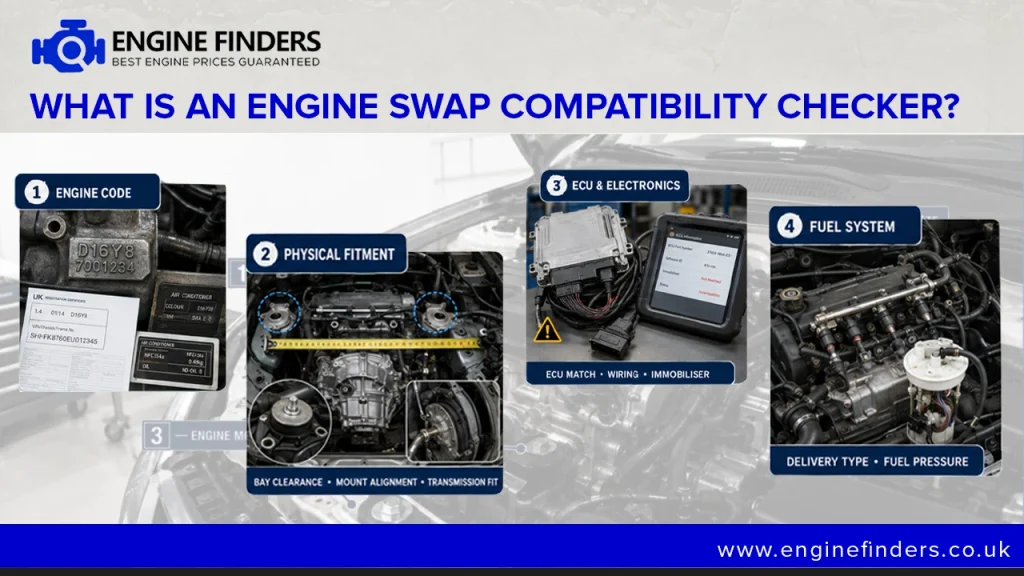
An engine swap compatibility checker is a systematic approach to verifying that a replacement engine will physically fit your vehicle, connect to your transmission, communicate with your electronics, and meet UK legal requirements. It is not a single tool but a process of checks across multiple vehicle systems.
Modern engines require matching engine control units (ECUs), wiring harnesses, sensors, and proper calibration. Electrical compatibility is one of the biggest challenges in late-model engine swaps. If you are weighing up the wider process, our engine swap guide covering costs and the legal process provides the full picture.
Step 1: Find Your Engine Code
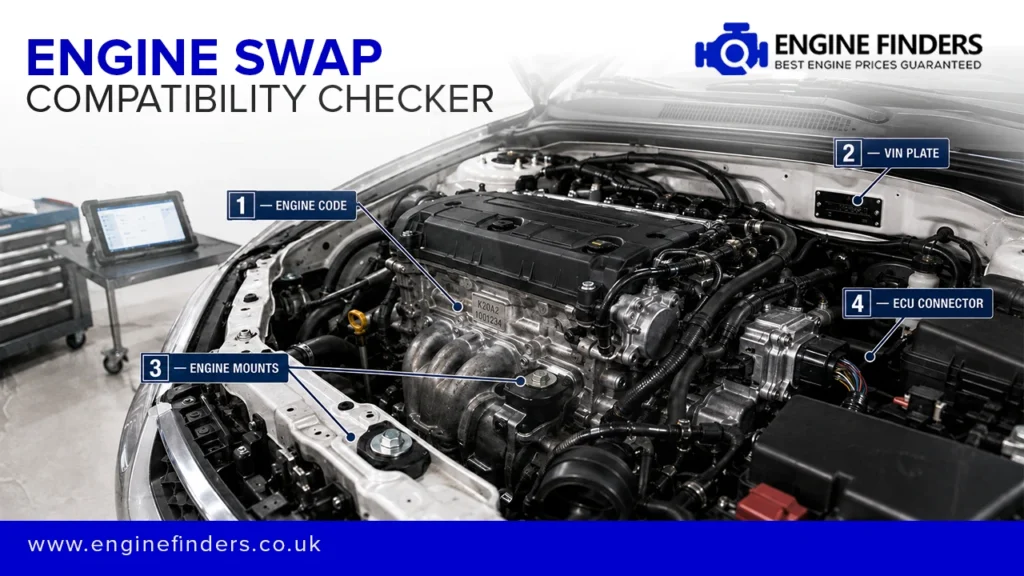
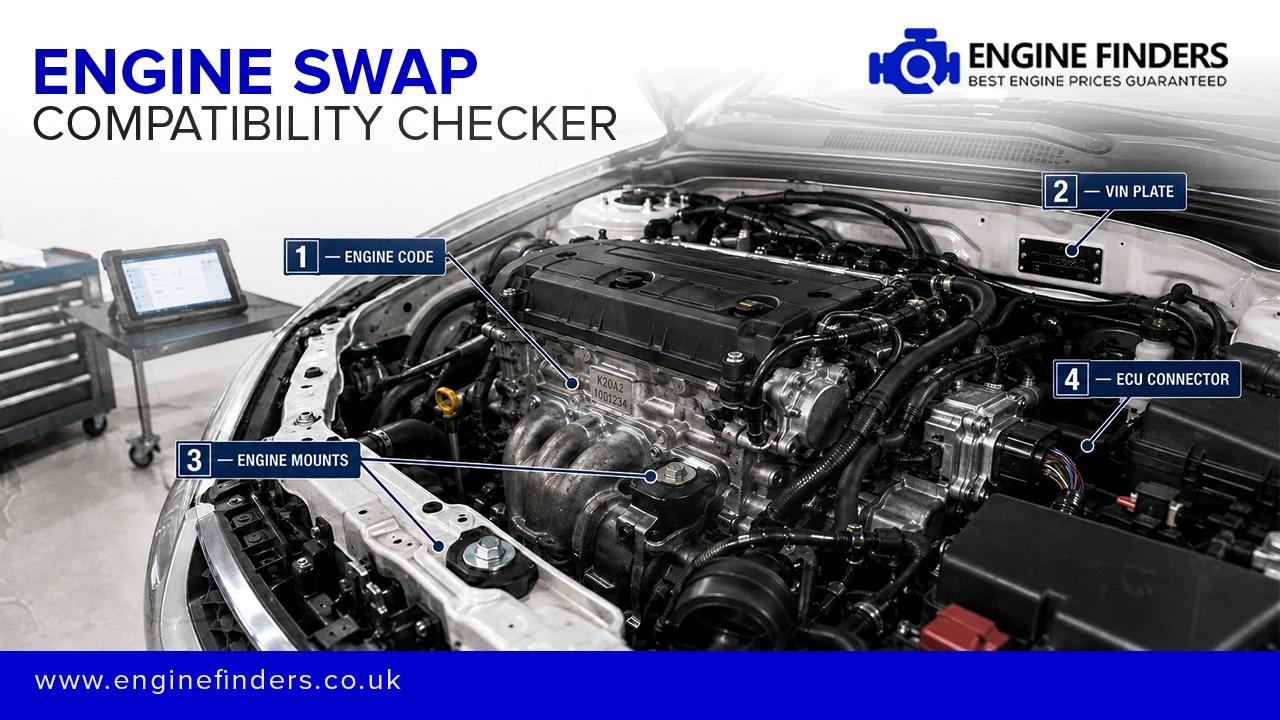
The engine code is the single most important piece of information for compatibility checking. It identifies the exact engine variant, including displacement, fuel system, and emissions hardware.
Where to Find Your Engine Code
| Location | Details |
|---|---|
| V5C logbook | The engine number (including engine code) is printed on the registration certificate |
| Engine block stamp | Usually on a flat surface near the cylinder head or timing cover |
| Vehicle data sticker | Often found in the boot, door jamb, or service book |
| Under-bonnet label | Look on the cam cover or timing cover |
The engine code may form part of the engine serial number (e.g., K9K, M57, B58) printed on the logbook. If you cannot find it on the car itself, check the handbook or vehicle data sticker.
What to Do with Your Engine Code
Once you have the engine code, cross-reference it with the supplier’s listing. Ask the seller to confirm compatibility against your VIN and your car’s build date. Matching the engine code stamped on the original block is more reliable than just matching the model year.
Compare engine options from vetted UK suppliers by entering your vehicle details.
Step 2: Check Physical Fitment
Physical fitment is about more than just “will it fit in the engine bay.” You need to verify multiple mechanical interfaces.
Engine Bay Dimensions
Will the engine physically fit between the frame rails and allow for hood closure? Height, width, and length all matter. For example, popular swap engines like the GM LS series have published dimensions of approximately 29.5 inches long, 24 inches wide, and 28 inches high. These dimensions vary between engine families and even between variants of the same family.
Engine Mounting Points
Engine mount positions must align with your vehicle’s subframe. Even within the same model generation, differences in suspension points may exist for facelifted models. Mountings with different part numbers can look identical but have subtle yet critical differences affecting compatibility and longevity.
Key considerations:
- Mount pattern, where bolt holes must align with your subframe
- Mount height, which affects drivetrain alignment and oil pan clearance
- Rubber vs polyurethane, which affects Noise, Vibration, Harshness (NVH) levels
Transmission Compatibility
The engine must mate with your gearbox. Verify:
- Bellhousing pattern, which must match the transmission
- Flywheel/flexplate, which must be correct for your transmission type (manual or automatic)
- Starter motor position, which must align with the flywheel ring gear
Our engine compatibility and fitment guide explains how to verify mounting patterns before purchasing.
Step 3: Verify Electronics and ECU Compatibility
This is where many engine swaps fail. Modern engines are heavily reliant on their engine management systems.
ECU Compatibility
The ECU must match the engine code. Swapping to a different engine family usually requires the donor ECU and sometimes the immobiliser and key chip. Reprogramming may be needed.
For modern vehicles with immobiliser-linked ECUs, if the replacement engine comes from a different code or generation, you will need:
- The donor ECU
- Transponder chip
- Sometimes the ignition barrel
Wiring Harness
Verify that you have a compatible wiring harness and engine management solution. Differences in sensors, ECU pinouts, and communication protocols exist even within the same generation.
Common ECU Issues
- Immobiliser lockout, where mismatched ECUs can immobilise the car or trigger fault codes
- Non-start, where without correct programming you can expect non-starts or persistent warning lights
- Warning lights, as ECU mismatches often trigger check engine lights
ECU programming is not optional on modern vehicles. Without it, expect non-starts, immobiliser lockout, or persistent warning lights.
Step 4: Check Fuel System Compatibility
Fuel Delivery
Verify the fuel delivery type, comparing direct injection vs port injection. A direct-injection engine requires high-pressure fuel pumps and different fuel rail configurations.
Fuel Pressure
Different engines require different fuel pressures. Ensure your vehicle’s fuel pump and fuel lines can supply the required pressure and volume.
Step 5: Verify Cooling System Capacity
The replacement engine may have different cooling requirements. Check:
- Coolant flow direction, as some engines have reverse-flow cooling
- Radiator capacity, as a more powerful engine may need a larger radiator
- Water pump compatibility, which may need matching pulley systems
Step 6: Consider Emissions and MOT Requirements
UK emissions regulations are critical. If your vehicle was first used before 1 September 2002 and is fitted with an engine older than the vehicle, you must test it to the standards applicable for the engine. If your vehicle was first used on or after 1 September 2002 with a different engine, you must test it to the emissions standards for the age of the vehicle.
In practice, this means:
- Pre-2002 vehicles are emissions tested to the engine’s age
- Post-2002 vehicles are emissions tested to the vehicle’s age
- You must prove the age of the engine if it is older than the vehicle
You can review the full MOT emissions rules on GOV.UK before booking a test.
Step 7: Legal Requirements: DVLA Notification
There is a legal requirement to notify DVLA of any changes made to a vehicle which affects the information shown on the V5C registration certificate, such as replacing the engine.
What You Need to Provide
When changing the engine number or cylinder capacity (cc), you must provide one of the following:
- A receipt for the replacement engine that includes the engine number and cylinder capacity
- Written evidence from the manufacturer
- An inspection report provided for insurance purposes
- Written confirmation on headed paper from a garage (if the change took place before you bought the vehicle)
Full details of what to send are on the GOV.UK guide to changing vehicle details on a V5C.
Insurance
It is also recommended that you contact your vehicle insurance provider to check whether the changes affect your motor insurance cover. Failing to update your insurer can invalidate your insurance and risk prosecution.
For professional guidance on costs, our engine replacement cost guide breaks down what to budget across parts and labour.
Step 8: Consider ULEZ and Clean Air Zone Compliance
If you are changing engine type (e.g., diesel to petrol or to a newer Euro standard), consider how this affects ULEZ and Clean Air Zone compliance. The emissions standard of the fitted engine determines compliance.
Check your engine’s Euro emissions standard using the GOV.UK clean air zones service before purchasing.
Practical Takeaways
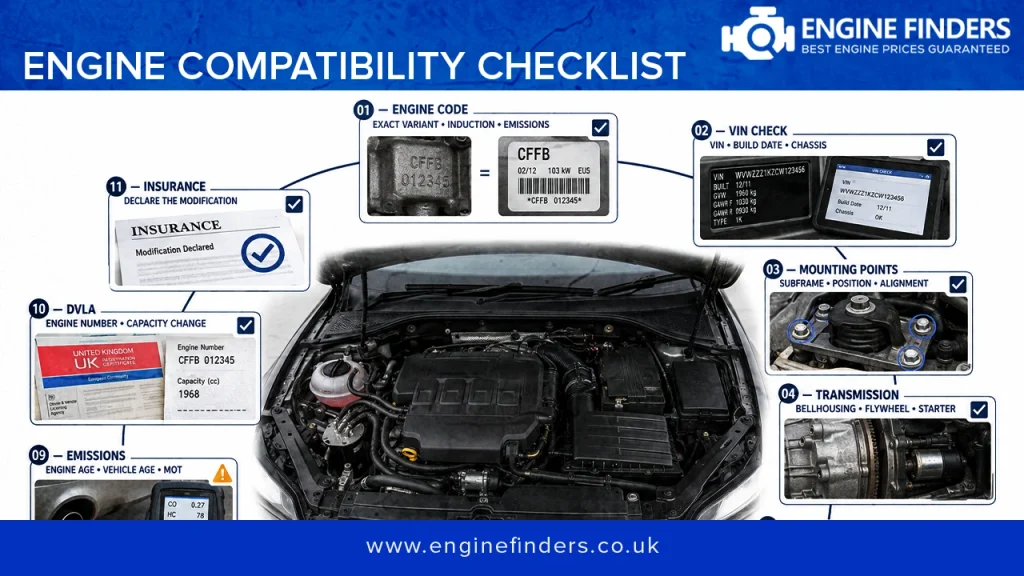
Engine Compatibility Checklist
Use this checklist when verifying a replacement engine:
| Check | What to Verify |
|---|---|
| Engine Code | Must match exact variant including induction and emissions hardware |
| VIN Check | Confirm compatibility against your VIN and build date |
| Mounting Points | Verify subframe alignment and mount positions |
| Transmission | Bellhousing pattern, flywheel/flexplate, starter position |
| ECU | Must match engine code; immobiliser and key chip compatibility |
| Wiring Harness | Compatible pinouts and sensor configurations |
| Fuel System | Direct vs port injection; fuel pressure requirements |
| Cooling | Radiator capacity, water pump, coolant flow direction |
| Emissions | MOT test standards based on vehicle or engine age |
| DVLA | Notify of engine number and/or capacity change |
| Insurance | Inform insurer of the change |
Engines to Approach With Caution
- Engines from different model generations, where even within the same manufacturer, mountings and electronics often change
- Engines without documented history, where you cannot verify ECU compatibility or emissions standards
- Engines requiring major fabrication, where if mounts, subframe, or wiring need extensive modification, costs escalate rapidly
When to Use EngineFinders
If you are replacing a failed engine or planning a swap, compare quotes from vetted UK suppliers who can verify compatibility before purchase.
For guidance on choosing between used, reconditioned, or new engines, our reconditioned versus new engine guide explains the trade-offs. Before buying second-hand, our used engine buying checklist covers every document to demand.
Professional Verification Requirements
- Always have compatibility verified by a specialist before purchasing a replacement engine
- Confirm ECU programming requirements with a specialist, as this is not optional on modern vehicles
- Check emissions test requirements based on your vehicle’s age and the engine’s age
Frequently Asked Questions
What is an engine swap compatibility checker?
An engine swap compatibility checker is a systematic verification process covering engine codes, mounting points, transmission fitment, ECU compatibility, wiring, fuel systems, cooling, and legal requirements. It helps ensure a replacement engine will fit, run, and pass MOT before you purchase.
How do I check if an engine will fit my car?
Check the engine code matches your vehicle’s specifications, verify mounting points align with your subframe, confirm transmission bellhousing compatibility, and ensure the ECU and wiring harness are compatible. Use your VIN to cross-reference with manufacturer data.
Where can I find my car’s engine code for free?
Your engine code is on your V5C logbook, stamped on the engine block (usually near the cylinder head), on the vehicle data sticker, or in your service book. The V5C is the most accessible source for most UK drivers.
Do I need to tell the DVLA if I change my engine?
Yes, there is a legal requirement to notify DVLA of any changes affecting the V5C, including engine replacement. You must provide evidence such as a receipt, manufacturer confirmation, or garage letter. Failure to do so can invalidate your insurance.
Will an engine swap affect my MOT emissions test?
Yes. For vehicles first used before 1 September 2002 with an older engine, emissions are tested to the engine’s age. For vehicles first used on or after 1 September 2002, emissions are tested to the vehicle’s age. The emissions standard of the fitted engine determines compliance.
How much does an engine swap cost in the UK?
Engine swaps typically cost £800 to £2,500 for labour plus the price of the engine itself. Costs vary significantly based on engine type, vehicle, and whether ECU programming is required. Compare quotes from vetted UK suppliers for accurate pricing.