When a BMW engine fails, the immediate question is whether a replacement is financially viable or if the vehicle should be scrapped. For most BMWs under 10 years old or with under 100,000 miles, replacing the engine with a reconditioned or low-mileage used unit is significantly more cost-effective than scrapping. This approach often saves thousands compared to purchasing a new vehicle, provided the rest of the car is in good mechanical order. However, the decision hinges entirely on the specific model, engine code, and current market value of the car.
Quick Summary
- The 50% Rule: If the total replacement cost exceeds 50–60% of the vehicle’s current market value, scrapping or part-exchanging is usually the more logical financial decision.
- Engine Codes Matter: Models with known, isolated faults (such as the N47 timing chain) are prime candidates for replacement, whereas catastrophic block failures in older, high-mileage cars may not justify the expense.
- Best Value Option: Reconditioned engines typically offer the optimal balance of reliability and cost, frequently backed by 12-month warranties, unlike most used alternatives.
- Hidden Costs: Always factor in labour, ancillary parts (water pumps, belts, seals), and fluids, which can add £500–£1,000 to the base engine price.
The Financial Tipping Point: Replacement vs. Scrapping
Deciding whether to repair or scrap a vehicle requires a clear-eyed assessment of its overall value. A common industry benchmark is the 50% rule. If the total cost of sourcing and fitting a replacement engine exceeds half the car’s current market value, the investment rarely makes financial sense.
For example, if your BMW is valued at £4,000 and a full engine replacement will cost £3,000, you are overcapitalising. In this scenario, exploring options to replace engine vs buying a new car may reveal that part-exchanging the vehicle in its current state is more prudent.
Conversely, if your BMW is valued at £12,000 and the replacement costs £2,500, retaining the vehicle is a highly economical choice. Understanding the engine replacement cost versus car value is the critical first step in making an informed, stress-free decision.
Understanding BMW Engine Replacement Costs in the UK
Replacement costs vary significantly based on the engine family, the source of the replacement unit, and regional labour rates. Below is an indicative breakdown of what UK owners can expect to pay in 2026.
- Used Engines: Typically range from £800 to £1,500. These are pulled from written-off or high-mileage donor vehicles. While cost-effective, they carry higher risk regarding remaining lifespan.
- Reconditioned Engines: Generally cost between £1,500 and £3,000+. These units are stripped, inspected, and rebuilt with new wear components (piston rings, bearings, seals, gaskets). They offer the best balance of cost and reliability.
- Labour and Fitting: Expect to pay between £600 and £1,200 for professional installation, depending on the complexity of the engine bay and the garage’s hourly rate.
- Ancillary Components: It is highly recommended to replace the water pump, thermostat, timing components, and all fluids during the swap. Budget an additional £400 to £800 for these essentials.
For a detailed breakdown, review our comprehensive guide on BMW engine replacement costs. Additionally, factoring in engine replacement labour costs in the UK will help you avoid unexpected workshop bills.
Evaluating Your BMW: When Replacement Makes Sense
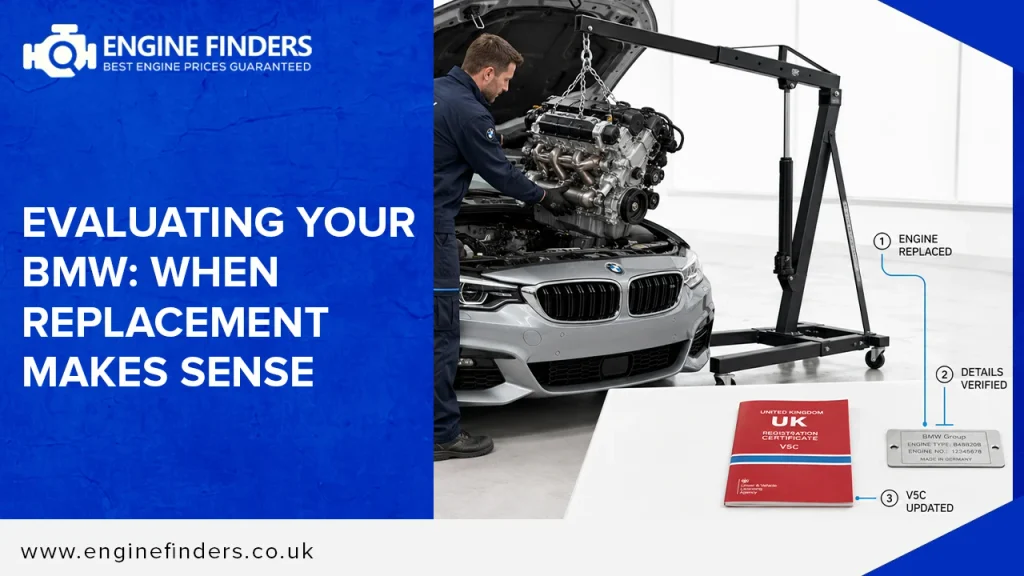
Not all engine failures are equal. The viability of a replacement depends heavily on the vehicle’s overall condition and the specific nature of the fault.
The Vehicle’s Overall Condition
Before committing to an engine swap, assess the rest of the car. If the gearbox is slipping, the suspension is worn, or the interior is heavily degraded, pouring money into a new engine may not be wise. A replacement is most justifiable when the chassis, transmission, and electronics are in solid, well-maintained condition.
Engine Code and Known Faults
BMW has produced numerous engine families, each with distinct reliability profiles. For instance, the infamous N47 diesel engine (found in E90 3 Series and F10 5 Series models) is prone to timing chain failures. Replacing a failed N47 with an updated, reconditioned unit or upgrading to the newer B47 architecture can effectively resolve the design flaw.
Understanding common BMW 3 Series engine problems can help you determine if your specific fault is a known, fixable issue or a symptom of broader systemic neglect. Consulting data on the most reliable BMW engines can also guide you toward a smarter long-term ownership strategy.
Replacement Engine Options: Used, Reconditioned, or Remanufactured?
Choosing the right type of replacement engine is critical to the long-term success of the repair.
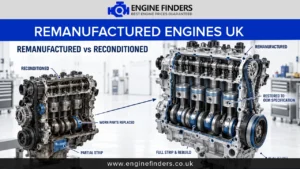
| Engine Type | Indicative Cost (UK) | Reliability | Warranty | Best Use Case |
| Used | £800 – £1,500 | Variable (depends on donor mileage) | 30–90 days (typical) | Tight budgets; older vehicles with low residual value. |
| Reconditioned | £1,500 – £3,000+ | High (worn parts replaced) | 12 months (standard) | Most owners; best balance of cost, reliability, and peace of mind. |
| Remanufactured | £3,000 – £5,000+ | Very High (built to OEM specs) | 12–24 months | High-value or classic models where longevity is the absolute priority. |
When sourcing a replacement, always verify the supplier’s credentials. Reputable suppliers will provide compression test results, leak-down test data, and clear warranty terms. You can explore verified used BMW engines or invest in a reconditioned BMW engine to ensure your vehicle returns to the road with dependable performance.
Model-Specific Considerations: 3 Series vs. 5 Series
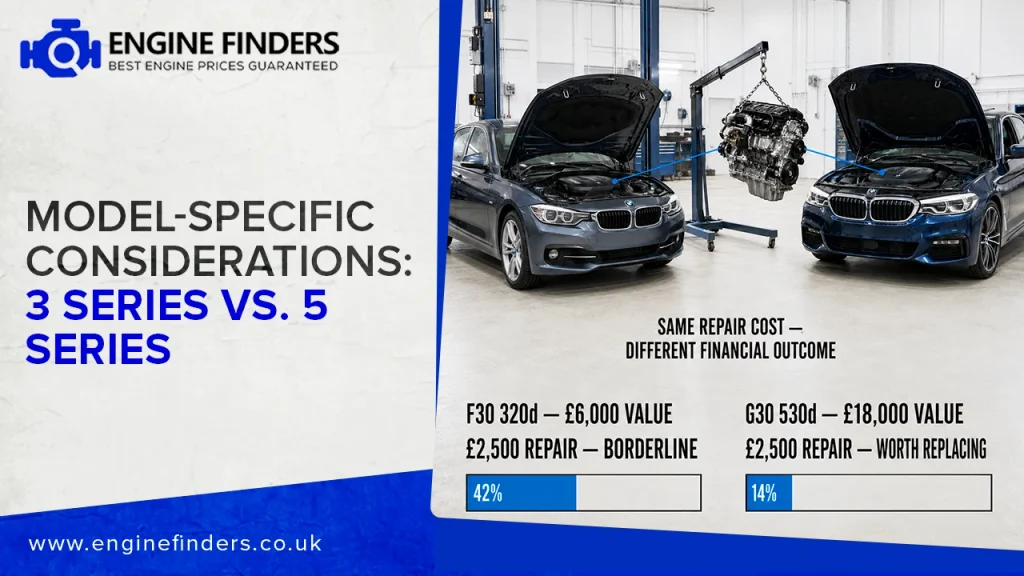
The cost-benefit analysis shifts depending on the model. A BMW 3 Series (such as the F30 generation) typically has a lower residual value than a contemporary 5 Series (G30 generation).
If an F30 320d requires a £2,500 engine replacement and the car is worth £6,000, the investment is borderline but often justifiable if the car is otherwise immaculate. However, for a G30 530d valued at £18,000, a £2,500 engine replacement is a highly logical investment that preserves significant equity.
When evaluating your options, ensure you are looking at parts specific to your chassis. Browse dedicated resources for BMW 3 Series engines or BMW 5 Series engines to confirm compatibility and accurate pricing for your exact vehicle.
Regulatory and DVLA Considerations for Engine Swaps
Changing an engine in the UK does not automatically alter your vehicle’s tax status or emissions classification. Ultra Low Emission Zone (ULEZ) and Clean Air Zone (CAZ) compliance are tied to the vehicle’s original registration date and emissions certification, not the replacement engine.
However, you must adhere to DVLA regulations. If the replacement engine has a different capacity or fuel type, you must update your V5C logbook. Even for a like-for-like swap, it is good practice to ensure your records are accurate. For official guidance, refer to the government’s vehicle registration and licensing information.
Furthermore, if you ultimately decide the car is beyond economical repair, follow the official guidance on selling or scrapping your vehicle to ensure you are legally released from liability. Always check your vehicle tax and registration details to confirm your car’s official status before and after any major mechanical work.
H2: Next Steps: Getting an Accurate Quote
Making an informed decision requires accurate, model-specific pricing. Rather than guessing, it is highly recommended to obtain tailored quotes from verified UK suppliers. Whether you are looking for a budget-friendly used unit or a fully reconditioned engine with a comprehensive warranty, comparing multiple options ensures you get fair market value.
You can easily get a free engine replacement quote today. Our network connects you with trusted specialists who can supply and fit the correct BMW replacement engines for your specific model, complete with transparent pricing and robust warranty coverage.
Enter Your REG to Get a Free Engine Quote

Frequently Asked Questions
Is it worth replacing a BMW engine?
Yes, for most vehicles under 10 years old or with under 100,000 miles, replacing the engine is significantly cheaper than buying a new car. It is highly recommended if the rest of the vehicle is in good mechanical condition and the replacement cost is under 50% of the car’s market value.
How much does a BMW engine replacement cost in the UK?
Indicative costs range from £800 to £1,500 for a used engine, and £1,500 to £3,000+ for a reconditioned unit. Professional labour and ancillary parts (fluids, belts, seals) typically add an additional £1,000 to £1,500 to the total bill.
Should I buy a used or reconditioned BMW engine?
A reconditioned engine is generally the better investment. While used engines are cheaper upfront, reconditioned units have worn internal components replaced and usually come with a 12-month warranty, offering far greater long-term reliability and peace of mind.
Does changing the engine affect my car’s MOT or ULEZ status?
No. ULEZ and MOT emissions compliance are tied to the vehicle’s original registration date and factory emissions certification. A like-for-like engine replacement does not change your car’s legal emissions classification or tax band.
How long does a reconditioned BMW engine last?
With proper maintenance, including strict adherence to oil change intervals using the correct BMW Longlife specification oil, a professionally reconditioned engine can reliably last another 80,000 to 100,000+ miles.
Do I need to inform the DVLA after an engine replacement?
If the new engine has a different capacity or fuel type, you must update your V5C logbook. For a direct like-for-like replacement, it is not strictly mandatory to notify the DVLA, but keeping accurate records is always advised.