Executive Summary
The Ford 1.0-litre EcoBoost engine, while award-winning for efficiency, has developed a reputation for several serious reliability concerns – most notably wet belt (timing belt in oil) degradation, coolant leaks, and turbocharger failures. These issues predominantly affect models from 2012-2020, with wet belt deterioration being the most costly and widespread problem, often requiring complete engine replacement if neglected.
Key verdict: If you own a 1.0 EcoBoost manufactured before 2020, immediate inspection of the wet belt and cooling system is essential. Engines showing symptoms of belt degradation, coolant contamination, or unusual noises should be professionally diagnosed before catastrophic failure occurs. For those facing replacement, comparing quotes from vetted UK suppliers can save £500-£1,000 versus dealer pricing.
Critical caveats: The wet belt replacement interval varies by model year (originally marketed as “lifetime” but now recommended at 10 years/150,000 miles by Ford). Coolant system failures can cause rapid overheating and engine seizure. Post-2020 engines feature improved belt materials but are not immune to all issues.
Engine Finders is a price comparison platform, not a direct engine seller. Final pricing, warranty terms, and availability vary by vetted UK supplier. Professional diagnosis is recommended before purchasing any replacement engine.
Understanding the Ford 1.0 EcoBoost Engine

Engine Overview and Applications
The Ford 1.0-litre EcoBoost is a three-cylinder, turbocharged petrol engine that debuted in 2012, winning International Engine of the Year awards consecutively from 2012-2017. Despite its compact displacement, it delivers power outputs ranging from 100 PS to 170 PS depending on tune and application.
Engine codes and production:
- M1DA/M1DD (2012-2018): First generation, 100-125 PS
- M1JC/M1JE (2018-present): Second generation with port and direct injection, 125-155 PS
- M2DA (2019-present): Mild-hybrid variant, 125-155 PS
Common UK applications:
- Ford Fiesta (Mk7/Mk8, 2012-present)
- Ford Focus (Mk3/Mk4, 2012-present)
- Ford Puma (2019-present)
- Ford Kuga (Mk3, 2019-present)
- Ford EcoSport (2017-2022)
The engine’s design prioritises fuel economy and reduced emissions through downsizing, turbocharging, and direct injection. However, this complexity introduces several failure modes uncommon in larger, naturally aspirated engines.
Technical Design Features
The 1.0 EcoBoost employs several advanced technologies:
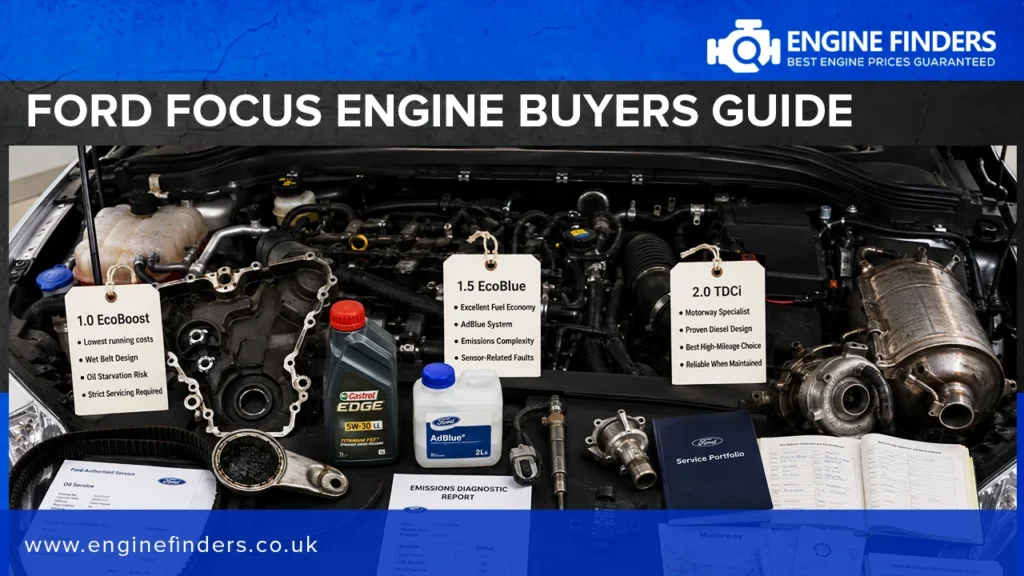
- Wet belt timing system: Unlike traditional timing chains or external belts, the camshaft drive belt runs immersed in engine oil. Ford marketed this as reducing friction and noise while eliminating external belt maintenance.
- Twin independent variable cam timing (Ti-VCT): Adjusts both intake and exhaust camshaft timing for optimal performance and efficiency.
- Direct fuel injection (later models use combined port/direct): High-pressure fuel injectors spray directly into combustion chambers, improving efficiency but increasing carbon buildup risk on intake valves.
- Integrated exhaust manifold: The cylinder head incorporates the exhaust manifold, reducing warm-up times but creating potential coolant leak points.
- Turbocharger with electric wastegate: Provides boost control but adds complexity and potential failure points.
Common Ford 1.0 EcoBoost Problems

1. Wet Belt (Timing Belt in Oil) Degradation
The most critical and costly failure mode
The wet belt represents the single most significant reliability concern for 1.0 EcoBoost owners. Ford originally claimed the belt was “lifetime” and required no scheduled replacement. However, real-world evidence and eventual Ford guidance revisions tell a different story.
The problem: The belt’s rubber compound degrades over time when exposed to heat cycles and oil contamination. As it deteriorates, the belt sheds material that clogs the oil pickup strainer, starving the engine of lubrication. In severe cases, the belt can skip teeth or snap entirely, causing catastrophic valve-to-piston contact.
Symptoms to watch for:
- Dark, sludgy oil with visible rubber particles
- Low oil pressure warning light
- Rattling or ticking noise from timing cover
- Engine misfires or rough running
- Metallic particles in oil (indicating bearing wear from oil starvation)
Affected models: All 1.0 EcoBoost engines from 2012-2019 are susceptible. Ford updated belt material specifications around 2020, but long-term reliability of the revised design remains unproven.
Ford’s revised guidance: Following widespread failures and owner complaints, Ford now recommends wet belt inspection at 10 years or 150,000 miles, whichever comes first. However, many specialists recommend inspection or replacement as early as 8 years/100,000 miles, particularly for vehicles used primarily for short journeys.
Replacement cost:
- Belt replacement only: £800-£1,200 (labour-intensive, requires engine partial disassembly)
- If oil starvation has occurred: £2,500-£4,500 for reconditioned engine
- Dealer replacement: Often exceeds £1,500
Prevention:
- Use only Ford-specified oil (WSS-M2C948-B or later specification)
- Adhere to 10,000-mile oil change intervals maximum (not Ford’s 18,000-mile LongLife)
- Avoid excessive short journeys that prevent oil from reaching optimal temperature
- Consider belt inspection at 8 years regardless of mileage
For specific guidance on Ford engine replacements, see our Ford 1.0 EcoBoost engine replacement guide. If you’re experiencing symptoms of wet belt failure, it’s important to understand the broader context of Ford’s engine reliability.
2. Coolant System Failures
Rapid overheating and potential engine seizure
The 1.0 EcoBoost’s integrated exhaust manifold design creates multiple potential coolant leak points. Failures often occur suddenly with little warning, leading to rapid overheating and severe engine damage.
Common failure points:
- Coolant hose degradation: Plastic coolant hose connectors become brittle and crack, particularly the degas bottle hose and heater hoses. This affects primarily 2012-2017 models.
- Thermostat housing leaks: The plastic thermostat housing can warp or crack, causing external coolant loss. Symptoms include sweet-smelling coolant odour and visible leaks around the housing.
- Head gasket failure: Less common but serious, head gasket failures allow coolant into combustion chambers or oil passages. Symptoms include white exhaust smoke, coolant loss without visible leaks, and milky oil.
- Water pump failures: Electric water pump failures cause immediate overheating. The pump is driven independently of the engine, so failure can occur without warning.
Symptoms:
- Coolant warning light activation
- Rapid temperature gauge rise
- Visible coolant puddles under vehicle
- White smoke from exhaust
- Sweet odour from engine bay
- Overheating within minutes of driving
Affected models: All model years susceptible, but 2012-2017 show higher incidence rates. Ford issued Technical Service Bulletins related to coolant system components but no formal recall for most issues.
Repair costs:
- Coolant hose replacement: £150-£300
- Thermostat housing: £200-£400
- Water pump: £400-£600
- Head gasket: £1,200-£1,800 (often not economical versus engine replacement)
Prevention:
- Check coolant level weekly
- Use only Ford-specified coolant (Motorcraft Super Plus 4 or equivalent)
- Never top up with plain water except in emergencies
- Replace coolant every 5 years/100,000 miles
- Inspect hoses for cracks or swelling at each service
3. Turbocharger Failures
Loss of power and potential engine damage
The 1.0 EcoBoost’s small displacement relies heavily on turbocharging for performance. Turbo failures are relatively common, particularly on higher-mileage examples or those with inadequate maintenance.
Failure modes:
- Wastegate actuator failure: The electric wastegate can stick or fail, causing over-boost or under-boost conditions. Symptoms include reduced power, limp mode activation, and turbo-related fault codes.
- Bearing wear: Oil starvation (often from wet belt debris) accelerates turbo bearing wear. Symptoms include whining or grinding noises from the turbo, blue exhaust smoke, and excessive oil consumption.
- Carbon buildup: Direct injection combined with turbo heat creates carbon deposits on turbo components, reducing efficiency and potentially causing seizure.
Symptoms:
- Reduced power or boost
- Excessive exhaust smoke (blue or black)
- Whining, grinding, or rattling from turbo area
- Check engine light with turbo-related codes (P0299, P0046)
- Oil consumption exceeding 1 litre per 1,000 miles
- Limp mode activation
Affected models: All variants susceptible. Higher-output versions (140 PS+) and vehicles frequently driven hard show higher failure rates.
Replacement costs:
- Turbocharger unit: £600-£1,200 (parts only)
- Fitted and calibrated: £900-£1,500
- Reconditioned turbo exchange: £400-£700
Prevention:
- Allow turbo to cool after hard driving (idle for 30-60 seconds before switching off)
- Use correct oil specification and change every 10,000 miles maximum
- Address oil leaks immediately
- Avoid aggressive driving when engine is cold
For more information on turbocharger issues and their impact on engine reliability, see our turbocharged vs naturally aspirated engines guide. Understanding the broader context of engine reliability can help you make informed decisions about your 1.0 EcoBoost.
4. Carbon Buildup on Intake Valves
Reduced performance and fuel economy
Direct injection engines spray fuel directly into the combustion chamber, bypassing the intake valves. Without fuel washing over the valves, carbon deposits accumulate from crankcase ventilation gases.
The problem: Carbon buildup restricts airflow, disrupts fuel-air mixing, and can cause valve sticking. Symptoms develop gradually over 60,000-100,000 miles.
Symptoms:
- Rough idle or cold-start misfires
- Reduced power and throttle response
- Decreased fuel economy
- Engine hesitation under acceleration
- Increased emissions
Affected models: All direct-injection 1.0 EcoBoost variants (2012-present). The issue is inherent to the design rather than a defect.
Remediation costs:
- Walnut blasting (carbon removal): £300-£500
- Chemical cleaning (less effective): £150-£250
- Preventive fuel system cleaner: £20-£40 per treatment
Prevention:
- Use high-quality fuel (Shell V-Power, BP Ultimate)
- Install oil catch can to reduce crankcase vapour contamination
- Occasional high-RPM driving to increase intake velocity
- Regular use of quality fuel system cleaners
5. Oil Dilution and Consumption
Engine wear and potential failure
The 1.0 EcoBoost can experience both excessive oil consumption and oil dilution (fuel contaminating the oil), particularly in colder climates or with frequent short journeys.
Oil dilution causes:
- Incomplete combustion during cold starts
- Fuel washdown of cylinder walls
- PCV system issues allowing fuel vapour into crankcase
Oil consumption causes:
- Piston ring wear
- Valve stem seal degradation
- Turbocharger seal leakage
- PCV system malfunction
Symptoms:
- Oil level rising above maximum (dilution)
- Oil level dropping rapidly (consumption)
- Fuel smell in oil
- Black, thin oil consistency
- Increased oil consumption between services
Affected models: More common in 2012-2016 models and vehicles used primarily for short urban journeys.
Prevention:
- Check oil level fortnightly
- Use correct oil viscosity (typically 5W-20 or 5W-30 to Ford WSS-M2C948-B)
- Allow engine to reach operating temperature regularly
- Address PCV issues immediately
6. High-Pressure Fuel Pump Failures
Loss of power and difficult starting
The direct injection system operates at extremely high pressures (up to 200 bar). HPFP failures cause immediate performance loss and can leave the vehicle undriveable.
Symptoms:
- Difficult or impossible cold starting
- Severe power loss
- Engine stuttering under load
- Fuel pressure-related fault codes (P0087, P0088)
- Check engine light illumination
Replacement costs:
- HPFP unit: £300-£600
- Fitted and coded: £500-£800
Prevention:
- Use quality fuel only
- Replace fuel filter at recommended intervals
- Address fuel contamination immediately
Ford 1.0 EcoBoost Recall History

Official Recalls (DVSA Database)
Ford has issued several recalls affecting the 1.0 EcoBoost in the UK market. Always verify your vehicle’s recall status using the DVSA recall checker or Ford’s VIN lookup tool.
- Recall R/2019/241 (2019): Affected certain 2018-2019 Fiesta and Focus models with 1.0 EcoBoost engines for potential fuel rail crack that could cause fuel leak and fire risk.
- Recall R/2020/089 (2020): Addressed potential coolant leak on certain Kuga and Puma models that could cause engine overheating.
- Recall R/2021/156 (2021): Related to potential loss of drive on certain vehicles due to fuel pump module issues.
Important: These recalls address specific production batches. The absence of an open recall does not mean your engine is immune to the common problems described above.
Technical Service Bulletins (TSBs)
Ford has issued numerous TSBs to dealers addressing 1.0 EcoBoost issues, including:
- Coolant system bleeding procedures
- Wet belt inspection guidelines
- Turbocharger replacement procedures
- Engine noise diagnostic flows
TSBs are not recalls but represent Ford’s acknowledged solutions to common problems. Independent specialists may not automatically receive TSB updates.
Replacement Options and Costs
When Replacement Becomes Necessary
Engine replacement becomes the most economical option when:
- Wet belt failure has caused oil starvation and bearing damage
- Head gasket failure has caused warping or cracking
- Multiple major components have failed simultaneously
- Repair costs exceed 60-70% of reconditioned engine cost
Cost Comparison (UK Market, 2025)
Used 1.0 EcoBoost engine:
- Price range: £600-£1,200
- Typical mileage: 40,000-80,000 miles
- Warranty: 3-6 months typical
- Risk: Unknown history, may have same inherent issues
- Best for: Budget-conscious owners of lower-value vehicles
Reconditioned 1.0 EcoBoost engine:
- Price range: £2,200-£3,500
- Includes: New wet belt, seals, gaskets, often upgraded components
- Warranty: 12-24 months typical from reputable suppliers
- Best for: Most owners seeking reliability and warranty protection
New/remanufactured from Ford:
- Price range: £3,500-£5,000+
- Includes: Latest specification components
- Warranty: 24 months Ford warranty
- Best for: Newer vehicles under warranty or owners prioritising OEM specification
Labour costs:
- Independent specialist: £600-£1,000 (8-12 hours)
- Main dealer: £1,000-£1,500+
- Additional costs: Clutch, flywheel, ancillaries if replaced simultaneously
For a comprehensive overview of engine replacement costs across different makes, see our engine replacement cost guide. This resource provides detailed breakdowns of costs and helps you understand what to expect when replacing your 1.0 EcoBoost engine.
Value Assessment
For a Ford Fiesta or Focus valued at £3,000-£6,000, a £2,500-£3,000 reconditioned engine installation represents significant investment. However, compared to vehicle replacement costs and the reliability of a warrantied engine, it often remains the most economical choice.
Key considerations:
- Vehicle’s overall condition beyond the engine
- Remaining MOT duration
- Service history completeness
- Personal attachment to the vehicle
- Current used car market prices
Practical Takeaways
Immediate Actions for 1.0 EcoBoost Owners
If your vehicle is 8+ years old or has 100,000+ miles:
- Book wet belt inspection immediately – Don’t wait for symptoms. Prevention costs £800-£1,200; neglect costs £3,000+.
- Check coolant level weekly – Top up only with Ford-specified coolant. Investigate any loss immediately.
- Monitor oil condition – Check for rubber particles, fuel smell, or unusual consistency. Change oil every 10,000 miles maximum.
- Listen for unusual noises – Rattling from timing cover or turbo whine requires immediate professional diagnosis.
- Verify recall status – Use DVSA recall checker with your registration number.
Engines/Model Years to Approach with Caution
Highest risk:
- 2012-2015 models with original wet belt (now 9-12 years old)
- Vehicles with incomplete service history
- Examples used primarily for short urban journeys
- Vehicles showing any coolant loss or oil contamination
Lower risk:
- 2020+ models with updated belt material
- Vehicles with complete Ford service history
- Examples with documented belt replacement
- Vehicles used for mixed driving with regular longer journeys
When to Use EngineFinders Comparison Tool
Consider comparing quotes when:
- Your engine has suffered wet belt failure
- You’re facing a £2,000+ repair bill
- Multiple major components have failed
- Your main dealer quote exceeds £4,000
- You want to compare warranty terms from different suppliers
Get connected with vetted UK suppliers for no-obligation quotes, potentially saving £500-£1,000 versus dealer pricing.
Professional Verification Requirements
Before purchasing any replacement engine:
- Obtain written diagnosis from qualified technician
- Verify engine code matches your vehicle using our engine compatibility guide
- Confirm warranty terms in writing
- Check supplier credentials and reviews
- Ensure VAT invoice provided
- Verify delivery and core return arrangements
Frequently Asked Questions
How long does a Ford 1.0 EcoBoost engine typically last?
With proper maintenance, a 1.0 EcoBoost can reach 150,000-200,000 miles. However, wet belt degradation typically occurs at 8-10 years regardless of mileage. Engines with documented belt replacement and regular servicing show the best longevity. Neglecting the wet belt often causes catastrophic failure before 100,000 miles.
Is the Ford 1.0 EcoBoost wet belt covered under warranty?
Ford’s standard warranty is 3 years/60,000 miles. Wet belt failures outside this period are typically owner responsibility unless covered by specific goodwill gestures. Some 2019-2020 models received extended coverage following recalls. Always check with Ford UK customer service for potential goodwill assistance on out-of-warranty failures.
How much does a Ford 1.0 EcoBoost engine replacement cost?
A reconditioned 1.0 EcoBoost engine typically costs £2,200-£3,500 including VAT, depending on supplier and warranty terms. Labour adds £600-£1,500. Used engines cost £600-£1,200 but carry higher risk. Compare quotes from vetted UK suppliers through EngineFinders for competitive pricing and warranty options.
What are the symptoms of 1.0 EcoBoost wet belt failure?
Early symptoms include dark oil with rubber particles, low oil pressure warnings, and rattling from the timing cover. Advanced deterioration causes engine misfires, metallic noise from bearing wear, and eventual seizure. If you notice any symptoms, stop driving immediately and arrange professional inspection to prevent catastrophic damage.
Should I buy a used Ford with a 1.0 EcoBoost engine?
Proceed with caution. Verify complete service history, confirm wet belt replacement on pre-2020 models, and check coolant system integrity. A well-maintained example with documented belt replacement can be reliable. Avoid vehicles with incomplete history, evidence of overheating, or those approaching 10 years without belt service. Budget £1,000 for preventive belt replacement if purchasing a 2015-2019 model.
Can the 1.0 EcoBoost wet belt be replaced preventively?
Yes, and it’s strongly recommended at 8-10 years or 100,000-150,000 miles. Preventive replacement costs £800-£1,200 fitted. This is far more economical than the £3,000+ engine replacement required if the belt fails. Use only Ford-specified belt kits and ensure the oil system is thoroughly flushed to remove any debris.