Executive Summary
The choice between turbocharged and naturally aspirated engines depends on your driving needs, budget, and priorities. Turbocharged engines deliver superior power and torque from smaller displacements, making them ideal for modern efficiency standards and performance demands. Naturally aspirated (NA) engines offer simpler mechanics, more predictable power delivery, and often lower long-term maintenance costs – particularly valued by UK enthusiasts and high-mileage drivers.
For UK drivers, turbocharged engines dominate the modern market due to stricter emissions regulations and benefit-in-kind (BIK) tax advantages. However, naturally aspirated units remain preferable for those prioritising reliability, lower repair costs, and straightforward servicing.
Engine Finders is a price comparison platform, not a direct engine seller. Final pricing, warranty terms, and availability vary by vetted UK supplier. Professional diagnosis is recommended before purchasing any replacement engine.
This guide examines the technical differences, real-world costs, and UK-specific considerations to help you make an informed decision – whether you’re buying a car or replacing an engine.
Understanding the Core Difference
What Is a Naturally Aspirated Engine?
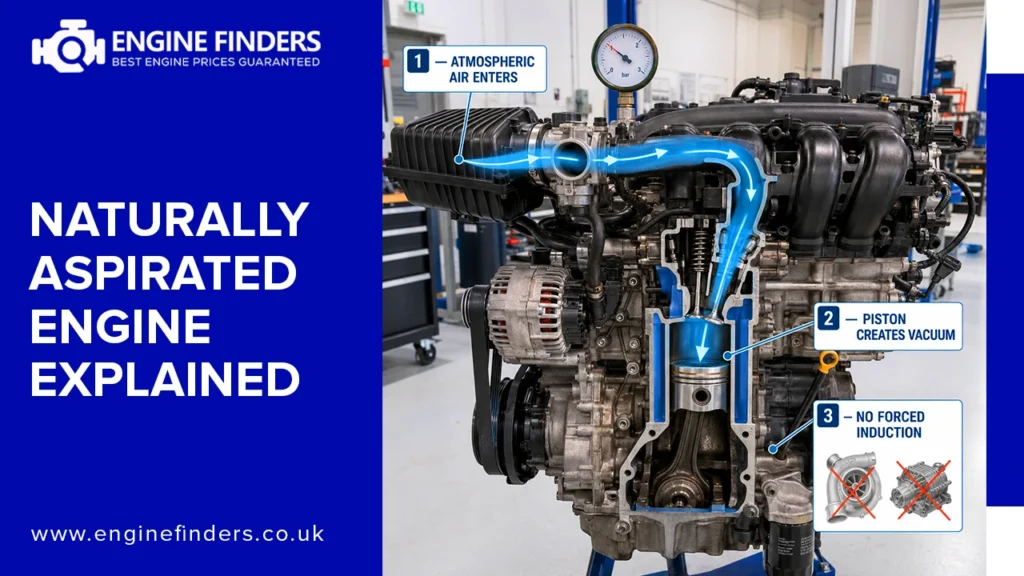
A naturally aspirated (NA) engine draws air into the combustion chamber solely through atmospheric pressure and piston movement. As the piston descends during the intake stroke, it creates a vacuum that pulls air through the intake manifold – no forced induction, no turbocharger, no supercharger.
This straightforward design has powered vehicles for over a century. The air-fuel mixture ratio depends entirely on engine displacement and RPM, making power output linear and predictable.
What Is a Turbocharged Engine?
A turbocharged engine uses exhaust gases to spin a turbine, which compresses intake air before it enters the combustion chamber. This forced induction allows a smaller engine to produce power comparable to a larger naturally aspirated unit.
Modern turbocharged engines – like BMW’s B58 or Mercedes-Benz’s M256 – dominate the UK market because they meet Euro 6 emissions standards while delivering strong performance from displacements as small as 1.0 to 2.0 litres.
How Twin-Turbo Systems Differ
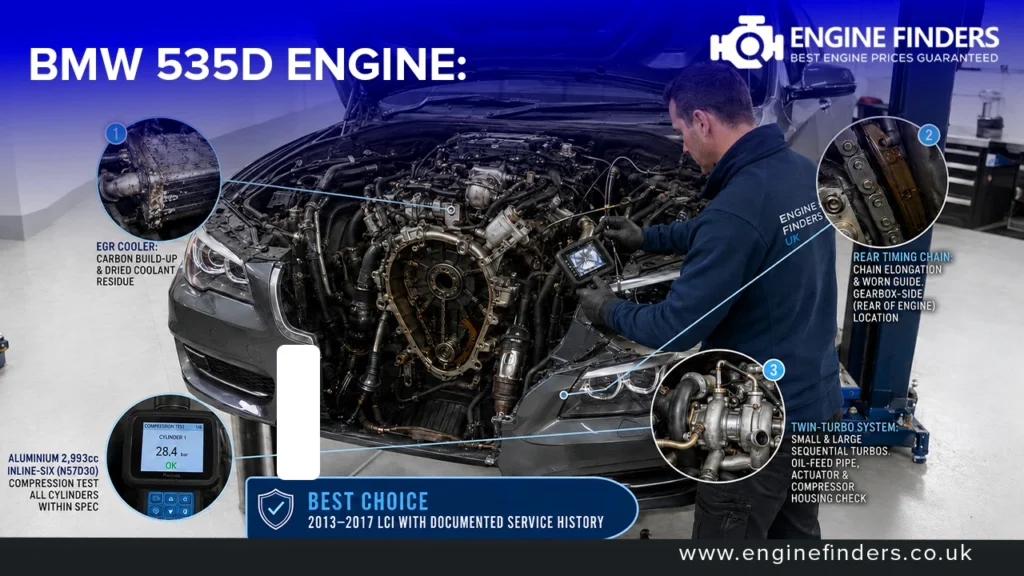
Twin-turbo configurations use two turbochargers instead of one, typically arranged in parallel (each serving half the cylinders) or sequentially (one for low RPM, one for high RPM). This setup reduces turbo lag and improves power delivery across the rev range.
When comparing twin turbo vs naturally aspirated at Engine Finders configurations, twin-turbo systems offer superior mid-range torque but add complexity.

Technical Breakdown: How Each System Works
Naturally Aspirated Engine Architecture
Key Components:
- Intake manifold
- Throttle body
- Combustion chambers
- Exhaust manifold
- Standard valve train
Operating Principle: Air enters at atmospheric pressure (approximately 14.7 psi at sea level). The engine’s volumetric efficiency – typically 75-95% for modern NA engines – determines how effectively it fills cylinders with air-fuel mixture.
UK Market Examples:
- Honda K20/K24 (Civic Type R, Accord)
- Toyota 2GR-FE (Auris, RAV4)
- BMW S54 (E46 M3)
- Mazda Skyactiv-G 2.0/2.5 (Mazda3, CX-5)
Turbocharged Engine Architecture
Key Components:
- Turbocharger (turbine + compressor wheel)
- Intercooler (air-to-air or air-to-water)
- Wastegate (controls boost pressure)
- Blow-off valve or diverter valve
- Reinforced internals (pistons, connecting rods)
- Enhanced cooling systems
Operating Principle: Exhaust gases spin the turbine at 100,000-200,000 RPM, driving the compressor wheel that forces air into the intake at increased pressure (boost). Modern turbos typically produce 8-15 psi of boost, though performance applications exceed 20 psi.
UK Market Examples:
- BMW B48/B58 (320i, 340i, 540i)
- Ford EcoBoost 1.0/1.5/2.0 (Fiesta, Focus, Mondeo)
- Volkswagen EA888 2.0 TSI (Golf GTI, Passat)
- Mercedes M256 3.0 turbo inline-6 (E450, S500)
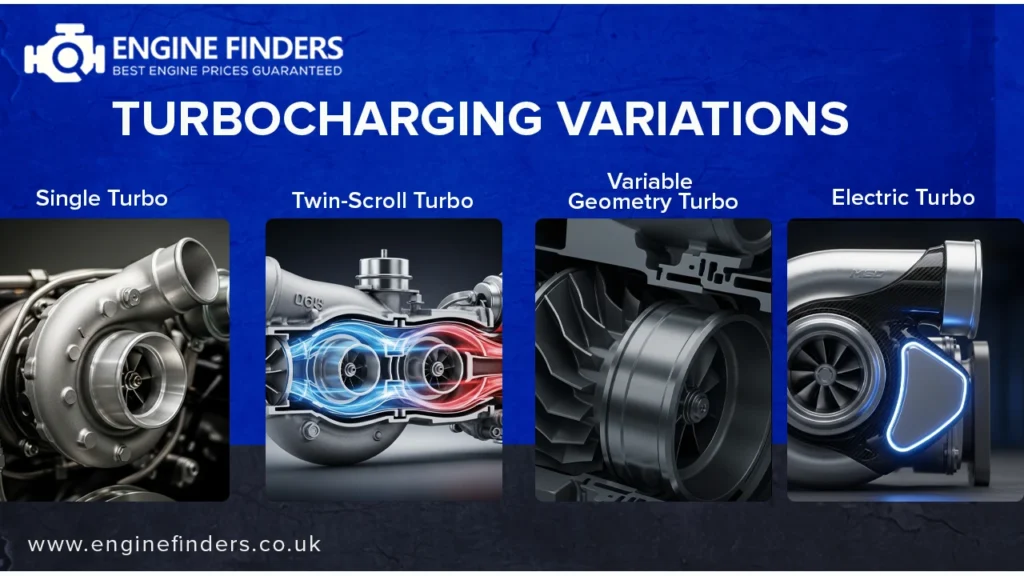
Turbocharging Variations
Single Turbo: Most common configuration; balances cost and performance.
Twin-Scroll Turbo: Separates exhaust pulses to improve spool-up and reduce lag.
Variable Geometry Turbo (VGT): Adjusts turbine vanes for optimal performance across RPM range – common in diesel engines like the BMW N57 replacement units.
Electric Turbo: Emerging technology using electric motors to spool the turbo instantly, eliminating lag entirely.
Advantages and Disadvantages: A Direct Comparison
Naturally Aspirated Engine Pros
1. Simpler Design, Lower Complexity
- No turbocharger, intercooler, or associated plumbing
- Fewer components to fail
- Easier diagnosis and repair
2. Predictable Power Delivery
- Linear throttle response
- No turbo lag
- Consistent power from idle to redline
3. Lower Maintenance Costs
- No turbo replacement (£800-£2,500 typical UK cost)
- Simpler oil requirements
- Less heat stress on components
4. Better Suited for Short Journeys
- Reaches operating temperature quickly
- Less carbon buildup from incomplete combustion
- Ideal for UK urban driving patterns
5. Easier to Modify
- Forced induction conversions possible
- Naturally aspirated tuning is straightforward
- Lower risk of catastrophic failure from modifications
Naturally Aspirated Engine Cons
1. Lower Specific Output
- Less power per litre of displacement
- Requires larger engines for equivalent performance
- Higher CO₂ emissions (affecting UK road tax)
2. Reduced Fuel Efficiency Under Load
- Larger displacement means more fuel consumption
- Less efficient at maintaining motorway speeds
- Poorer real-world economy when accelerating
3. Declining Market Availability
- Most manufacturers have abandoned NA engines
- Limited new car options post-2020
- Resale value uncertainty for older NA vehicles
Turbocharged Engine Pros
1. Superior Power-to-Displacement Ratio
- A 2.0-litre turbo can match a 3.5-litre NA engine
- Enables downsizing without performance loss
- Meets Euro 6 emissions standards
2. Better Fuel Economy (When Driven Gently)
- Smaller displacement reduces pumping losses
- Modern turbos achieve 15-25% better economy in real-world mixed driving
- Lower benefit-in-kind (BIK) tax for company car users
3. Strong Low-End Torque
- Peak torque available from 1,500-2,000 RPM
- Effortless overtaking on UK motorways
- Reduced need for downshifting
4. Altitude Compensation
- Maintains power at elevation better than NA engines
- Relevant for UK drivers travelling to European mountains
5. Modern Technology Integration
- Compatible with hybrid systems
- Supports cylinder deactivation
- Enables advanced emissions control
Turbocharged Engine Cons
1. Higher Complexity, Higher Failure Risk
- Turbocharger failure is common at 80,000-120,000 miles
- Oil starvation or contamination destroys turbos rapidly
- Intercooler leaks reduce performance and efficiency
2. Turbo Lag
- Delay between throttle input and power delivery
- Less predictable in performance driving
- Sequential or twin-scroll systems mitigate but don’t eliminate lag
3. Increased Maintenance Requirements
- Premium synthetic oil mandatory (typically 0W-20 or 5W-30)
- Oil changes every 8,000-10,000 miles (not manufacturer’s 18,000-mile intervals)
- Coolant system more critical due to heat management
4. Heat Management Challenges
- Higher operating temperatures stress components
- Increased risk of pre-ignition (knocking)
- Requires high-quality fuel (95+ octane minimum, 98 recommended)
5. Costly Repairs
- Turbo replacement: £800-£2,500 depending on engine
- Intercooler replacement: £300-£800
- High-pressure fuel pump issues: £600-£1,200
UK-Specific Considerations
Emissions Regulations and Road Tax
Vehicle Excise Duty (VED): UK road tax is calculated based on CO₂ emissions. Turbocharged engines typically emit 10-30 g/km less CO₂ than equivalent NA engines, placing them in lower tax bands.
For cars registered after April 2017:
- First-year rate: £0-£2,245 depending on CO₂
- Standard rate: £180/year (petrol/diesel) or £170/year (alternative fuel)
- Premium supplement: £390/year for years 2-6 if list price exceeded £40,000
ULEZ and Clean Air Zones: Both turbocharged and naturally aspirated engines must meet Euro 6 standards (typically petrol post-2005, diesel post-2015) to avoid London ULEZ charges (£12.50/day) and similar schemes in Birmingham, Bristol, and Manchester.
A turbocharged 1.5-litre engine meeting Euro 6 is ULEZ-compliant, while a naturally aspirated 2.5-litre from 2008 may not be – check your vehicle’s Euro standard using our compatibility tool before purchasing.
MOT Testing Implications
Smoke Emissions: Turbocharged diesel engines face stricter smoke testing. A failing turbo can cause excessive blue smoke (oil burning) or black smoke (incomplete combustion), resulting in MOT failure.
Noise Regulations: Turbocharged engines with modified exhausts or removed catalytic converters fail MOT noise and emissions tests. Naturally aspirated engines are easier to keep within legal limits during modification.
Fuel Quality and Availability
Octane Requirements: Most modern turbocharged engines require minimum 95 RON (unleaded), with manufacturers recommending 98 RON for optimal performance and fuel economy. Using 95 RON in a 98-recommended engine can reduce power by 5-10% and increase knock risk.
Naturally aspirated engines typically run satisfactorily on 95 RON, reducing fuel costs by 3-5 pence per litre – approximately £60-£100 annually for average UK mileage.
Diesel Considerations: UK diesel quality varies regionally. Turbocharged diesel engines (like the Mercedes OM651, read our failure guide) are more sensitive to fuel contamination and require regular diesel filter changes to prevent injector damage.
Insurance Groupings
Turbocharged engines typically fall into higher insurance groups due to:
- Increased performance potential
- Higher repair costs
- Greater theft desirability
A turbocharged Ford Focus ST (Group 30) costs significantly more to insure than a naturally aspirated Focus 1.6 (Group 12), even with identical driver profiles.
Real-World Cost Analysis
Purchase Price Comparison
New Vehicles: Turbocharged engines dominate the new car market, making direct comparisons difficult. However, turbocharged variants typically carry a £1,000-£3,000 premium over base NA models when both are available.
Used Vehicles:
- Naturally aspirated engines (pre-2015): Generally 10-20% cheaper than turbo equivalents
- Turbocharged engines (post-2015): Command premium due to efficiency and performance
- High-mileage turbo vehicles: Depreciate faster due to perceived reliability concerns
Running Costs: Fuel Economy
Real-World Testing Data: Based on UK owner reports and independent testing:
| Engine Type | Official MPG | Real-World MPG | Variance |
| NA 2.0L petrol | 38-42 mpg | 32-36 mpg | -15% |
| Turbo 1.5L petrol | 45-50 mpg | 38-44 mpg | -12% |
| NA 2.5L petrol | 32-36 mpg | 28-32 mpg | -12% |
| Turbo 2.0L diesel | 55-60 mpg | 48-54 mpg | -10% |
Annual Fuel Cost (12,000 miles, £1.45/litre petrol):
- NA 2.0L (34 mpg real-world): £2,047
- Turbo 1.5L (41 mpg real-world): £1,698
- Annual saving: £349
Maintenance and Repair Costs
Routine Servicing:
| Service Item | NA Engine | Turbo Engine |
| Oil change (5L synthetic) | £80-£120 | £100-£150 |
| Spark plugs (4-6 cyl) | £120-£200 | £150-£250 |
| Air filter | £40-£80 | £50-£100 |
| Coolant flush | £80-£120 | £100-£150 |
Major Repairs (UK Average Costs):
| Component | NA Engine | Turbo Engine |
| Engine replacement (used) | £800-£1,500 | £1,000-£2,000 |
| Engine replacement (reconditioned) | £1,500-£3,000 | £2,000-£4,500 |
| Turbocharger replacement | N/A | £800-£2,500 |
| Intercooler replacement | N/A | £300-£800 |
| High-pressure fuel pump | £200-£400 | £600-£1,200 |
Compare quotes from vetted UK suppliers at Engine Finders for accurate pricing on your specific engine.
Long-Term Ownership: 5-Year Cost Projection
Scenario: 60,000 miles over 5 years
Naturally Aspirated 2.0L:
- Fuel (34 mpg): £10,235
- Servicing: £1,200
- Repairs (estimated): £800
- Road tax: £900
- Total: £13,135
Turbocharged 1.5L:
- Fuel (41 mpg): £8,490
- Servicing: £1,400
- Repairs (estimated, including turbo): £1,800
- Road tax: £900
- Total: £12,590
Net saving with turbo: £545 over 5 years
However, this assumes no catastrophic turbo failure. A single turbo replacement at £2,000 eliminates the savings entirely.

Reliability and Longevity
Naturally Aspirated Engine Reliability
Strengths:
- Proven designs with decades of refinement
- Fewer failure points
- Tolerant of missed maintenance
- Typical lifespan: 150,000-250,000 miles with proper care
Common Failure Modes:
- Timing chain/belt wear (80,000-120,000 miles)
- Oil consumption from worn piston rings (high-mileage)
- Carbon buildup on intake valves (direct injection NA engines)
- Head gasket failure (overheating-related)
Most Reliable NA Engines (UK Market):
- Toyota 2GR-FE 3.5 V6 (200,000+ miles typical)
- Honda K24 2.4 i-VTEC (180,000+ miles typical)
- BMW M54 2.5/3.0 inline-6 (150,000+ miles with maintenance)
- Mazda Skyactiv-G 2.0 (emerging reliability data positive)
Turbocharged Engine Reliability
Strengths:
- Modern turbos are significantly more reliable than 1990s-2000s units
- Improved oil routing and cooling
- Better materials (ball-bearing turbos, ceramic coatings)
- Typical lifespan: 100,000-180,000 miles before turbo attention needed
Common Failure Modes:
- Turbocharger bearing wear (oil starvation or contamination)
- Intercooler leaks (reduced performance, increased EGTs)
- Carbon buildup on intake valves (all direct injection engines)
- High-pressure fuel pump failure (BMW N54, Ford EcoBoost)
- Wastegate rattle (common on BMW N54/N55)
- Oil leaks from turbo feed/return lines
Most Reliable Turbo Engines (UK Market):
- BMW B58 3.0 turbo inline-6 (2015-present, excellent reliability)
- Volkswagen EA888 Gen 3 2.0 TSI (2013-present, much improved)
- Mercedes M256 3.0 turbo inline-6 (2017-present, early data positive)
- Ford EcoBoost 2.3 (2015-present, generally reliable with maintenance)
Turbo Engines Requiring Caution:
- BMW N54 3.0 twin-turbo (2006-2013, multiple known issues)
- Ford EcoBoost 1.6 (2010-2017, overheating and head gasket concerns)
- PSA/BMW Prince 1.6 THP (2006-2014, timing chain and carbon issues)
- Early VW 2.0 TSI (2008-2012, oil consumption problems)
Maintenance Requirements: NA vs Turbo
Naturally Aspirated:
- Oil changes: Every 10,000-12,000 miles acceptable
- Oil specification: Standard 5W-30 or 10W-40
- Coolant: Standard replacement every 5 years
- Spark plugs: Every 60,000 miles
- Air filter: Every 30,000 miles
Turbocharged:
- Oil changes: Every 8,000-10,000 miles (not manufacturer’s 18,000-mile LongLife)
- Oil specification: Premium synthetic 0W-20 or 5W-30 (OEM-approved)
- Coolant: Critical – replace every 4-5 years, check level monthly
- Spark plugs: Every 40,000-50,000 miles (colder heat range)
- Air filter: Every 20,000 miles (restricted airflow damages turbo)
- Turbo inspection: Visual check for oil leaks at every service
Performance Characteristics
Power Delivery
Naturally Aspirated:
- Linear power curve
- Peak power at high RPM (6,000-8,000 RPM typical)
- Immediate throttle response
- Engaging driving experience for enthusiasts
- Better suited to track days and spirited driving
Turbocharged:
- Torque-rich from low RPM (1,500-2,000 RPM)
- Peak power at mid-RPM (5,000-6,500 RPM)
- Turbo lag on older or larger turbos
- Effortless cruising and overtaking
- Better suited to daily driving and motorway use
Modification Potential
Naturally Aspirated Tuning:
- Cold air intake: +5-10 hp
- Exhaust system: +5-15 hp
- ECU remap: +10-20 hp (limited without forced induction)
- Camshaft upgrade: +15-30 hp (requires supporting mods)
- Total realistic gain: 30-50 hp on stock internals
- Cost: £800-£2,000
Turbocharged Tuning:
- ECU remap (Stage 1): +30-60 hp, +40-80 Nm torque
- Downpipe + intercooler + remap (Stage 2): +60-100 hp
- Hybrid turbo + supporting mods (Stage 3): +100-200 hp
- Total realistic gain: 100-200+ hp on stock internals
- Cost: £500-£3,000+
Turbocharged engines offer far greater modification potential, but reliability decreases as power increases. For how to choose between turbo and naturally aspirated for maximum speed at Engine Finders, turbocharged platforms are the clear winner – provided you accept increased wear and potential component failure.
Which Should You Choose? Practical Recommendations
Choose a Naturally Aspirated Engine If:
✅ You prioritise long-term reliability over peak performance
✅ You do mostly short journeys (urban driving, school runs, local errands)
✅ You’re on a tight maintenance budget and can’t afford £2,000 turbo replacements
✅ You prefer predictable, linear power delivery for spirited driving
✅ You’re buying an older vehicle (pre-2015) where NA engines are more common
✅ You plan to keep the car 8+ years and want to avoid major repairs
✅ You’re a DIY enthusiast who wants straightforward repairs
Best Use Cases:
- First car for young drivers
- High-mileage commuter doing 15,000+ miles/year
- Classic or enthusiast car preservation
- Budget-conscious ownership
Choose a Turbocharged Engine If:
✅ You want modern efficiency and lower CO₂ emissions
✅ You do mixed or motorway driving where turbo efficiency shines
✅ You need strong low-end torque for towing or overtaking
✅ You’re buying a company car and want lower BIK tax
✅ You value performance and may want to modify the engine
✅ You’re buying new or nearly-new (under 60,000 miles)
✅ You follow strict maintenance schedules and use quality fluids
Best Use Cases:
- Modern family car (2016+)
- Company car with BIK tax considerations
- Performance enthusiast planning modifications
- Long-distance motorway commuter
Engines to Avoid
Naturally Aspirated:
- BMW N52 (2004-2015): Valvetronic and oil consumption issues
- Ford Duratec 1.8/2.0 (2000s): Head gasket and timing chain problems
- PSA 1.6 VTi (2006-2014): Timing chain and oil pump failures
Turbocharged:
- BMW N54 (2006-2013): HPFP, turbos, injectors, timing chain – expensive to maintain
- Ford EcoBoost 1.6 (2010-2017): Overheating, head gasket, carbon buildup
- VW 2.0 TSI EA113 (2008-2012): Oil consumption, timing tensioner failure
- PSA/BMW 1.6 THP (2006-2014): Timing chain, carbon, HPFP issues
For engines with known problems, compare reconditioned replacement options rather than repairing original units.
Practical Takeaways
Key Recommendations by Use Case
Urban Driver (5,000-8,000 miles/year, mostly short trips): → Naturally aspirated engine. Avoid turbocharged engines that never reach optimal temperature, leading to carbon buildup and premature wear.
Motorway Commuter (15,000+ miles/year): → Turbocharged diesel or petrol turbo. Efficiency gains and lower CO₂ emissions justify the complexity.
Performance Enthusiast: → Turbocharged platform for modification potential. BMW B58, VW EA888, or Ford EcoBoost 2.3 offer excellent tuning headroom.
Budget-Conscious Buyer: → Naturally aspirated engine from a reliable manufacturer (Toyota, Honda, Mazda). Lower purchase price, cheaper repairs, better long-term value.
Company Car User: → Turbocharged engine for lower BIK tax. The 20-30 g/km CO₂ advantage can save £500-£1,500 annually in tax.
When to Use EngineFinders Comparison Tool
If you’re experiencing:
- Turbocharger failure symptoms (blue smoke, whining noise, loss of power)
- Catastrophic engine damage requiring replacement
- Uncertainty about whether to repair or replace
Compare quotes from vetted UK suppliers for no-obligation pricing on used, reconditioned, or new engines. Our network includes specialists in both turbocharged and naturally aspirated units across all major manufacturers.
Professional Verification Requirements
Before purchasing any replacement engine:
- Confirm engine code compatibility (not just model/year)
- Verify mileage and service history on used units
- Check warranty terms (3-12 months typical for reconditioned)
- Get written confirmation of what’s included (turbo, manifolds, ancillaries)
- Use a qualified mechanic for diagnosis and fitment
Engine replacement is a significant investment. Professional diagnosis prevents costly mistakes and ensures you’re addressing the root cause, not just symptoms.
Frequently Asked Questions
What lasts longer: turbocharged or naturally aspirated engines?
Naturally aspirated engines typically last 150,000-250,000 miles with proper maintenance, while turbocharged engines average 100,000-180,000 miles before requiring turbo attention. NA engines have fewer failure points and tolerate missed maintenance better. However, modern turbocharged engines like the BMW B58 can exceed 200,000 miles with strict servicing.
Are turbocharged engines more expensive to maintain in the UK?
Yes, turbocharged engines cost 20-40% more to maintain annually. Oil changes require premium synthetic (£100-£150 vs £80-£120), and major repairs like turbo replacement (£800-£2,500) or intercooler replacement (£300-£800) add significant costs. Budget an extra £300-£500 per year for turbocharged engine ownership.
Can I convert a naturally aspirated engine to turbocharged?
Yes, but it costs £3,000-£8,000 for a proper conversion including turbocharger, intercooler, fuel system upgrades, ECU remap, and supporting modifications. It’s rarely cost-effective versus buying a factory-turbocharged vehicle. For performance gains, selling your NA car and purchasing a turbo model is usually more economical.
Do turbocharged engines require premium fuel in the UK?
Most modern turbocharged engines require minimum 95 RON unleaded, with manufacturers recommending 98 RON for optimal performance and fuel economy. Using 95 RON in a 98-recommended engine can reduce power by 5-10% and increase knock risk. Annually, this costs £60-£100 more in fuel but protects your investment.
Is a naturally aspirated engine better for short journeys?
Yes, naturally aspirated engines are better suited to short journeys typical of UK urban driving. They reach operating temperature faster, experience less carbon buildup from incomplete combustion, and avoid the turbo wear associated with frequent cold starts and short trips. For primarily urban use under 10 miles per journey, NA engines offer better long-term reliability.
How much does a turbocharged engine replacement cost in the UK?
A reconditioned turbocharged engine typically costs £2,000-£4,500 including VAT, depending on the make and model. Labour adds £800-£1,500. Compare quotes from vetted UK suppliers for no-obligation pricing. Naturally aspirated engine replacements are typically 20-30% less expensive at £1,500-£3,000 for reconditioned units.