
Rebuilt Kia Besta Engine for Sale - Save Up to 60% with 12m Warranty
Compare Besta engine prices. Rebuilt D25D/G27B & D4BH/G4GC units for commercial chassis (1998-2013) with 12m warranty from UK suppliers.
Enter Your Vehicle Registration To Find The Best Supplier Near You

Secure enquiry - no spam, no pressure. Genuine quotes only.
Kia Besta Specialists
Expert Solutions for Every Besta - 2.0 to 2.5
Need a reliable replacement engine for your Kia Besta ?
Engine Finders specializes in Besta engines with solutions for common head gasket and timing belt failures across all variants.
- ✔ Full Besta Engine Range - 2.0L & 2.5L petrol engines across all generations
- ✔ Series-Wide Compatibility - Correct mounts and ancillaries for every Besta chassis (KA1, KA2)
- ✔ Besta Pricing Advantage - Save up to £1,200 vs dealer on reconditioned longblocks

Kia Besta Replacement Engines Options - Verified Units (UK Supply)
All engines bench-tested, VAT-inclusive, with 12-month warranty. MoT-compliant. Nationwide delivery. Direct OEM fitment for KA1, KA2.
Includes updated head gaskets (OEM 21111-38100) to prevent overheating in KA1/KA2 vans.
Fully disassembled and rebuilt to Kia factory tolerances for 2.0L/2.5L FE engines.
Restored with upgraded timing belt kits (OEM 25212-38000) for extended reliability.
Plug-and-play longblocks compatible with all KA1/KA2 Besta chassis (1990-2002).
Tested and tuned to resolve common oil pressure drop in high-mileage FE engines.
Low-mileage donor units with verified service history and compression test reports.
Kia Besta Compatible Engine Codes & Average Prices on Rebuilt Units
All engines professionally reconditioned, bench-tested, and supplied with 12-month warranty. Direct OEM fitment. VAT-inclusive. Nationwide UK delivery.

Why Choose Engine Finders for Your Kia Besta Engine?
Engine Finders connects UK drivers with vetted specialists for reliable, reconditioned Kia Besta replacement engines. From D4DB/D4DD/D4DH diesel engines to G4A/G6D/G6B petrol units found across the YP1/YP2 Besta range, we solve series-wide issues like cylinder head warping in D4D engines and timing chain stretch in G6-family petrols - ensuring you get the right engine, rebuilt right, first time.
-
✔ Besta -Wide D4D Head Integrity Fix
All D4DB/D4DD/D4DH/D4DE diesel engines suffer cylinder head warping due to thermal cycling. We fit updated head gasket (OEM 21111-D4002) and reinforced head bolts per Kia Technical Bulletin KTIS-99-12 - applied uniformly across YP1/YP2 Besta cargo, crew, and shuttle variants.
-
✔ G6-Series Timing Chain Reliability
G6D and G6B petrol engines share timing chain tensioner failure (OEM 25212-38001) across all YP2 Besta Executive and Shuttle models. Every rebuild includes OEM-spec tensioner and guide rails - tested to 4,000 RPM bench load simulating full Besta series duty cycles.
-
✔ D4DH Turbo System Restoration
D4DH turbo diesel engines in Besta Turbo GL and Maxi Van models suffer wastegate sticking and EGR coking. We refurbish Garrett turbo (OEM 27370-D4001) and clean injectors to OEM flow specs - critical for consistent performance across all high-output Besta variants.
-
✔ Cross-Chassis Mount Compatibility
All Besta engines - petrol and diesel - use identical engine mount geometry (OEM 57300-37001) across YP1 (1997-2000) and YP2 (1998-2002) chassis. We verify fitment for Base through VIP Shuttle trims, eliminating guesswork for UK fleet operators and workshops.
-
✔ Series-Wide Pump & Injection Calibration
D4D-family diesels share Bosch VP37/VP44 injection pumps (OEM 26100-D4001), prone to wear in UK stop-start use. We recalibrate fuel delivery to match original Besta series torque curves - ensuring smooth operation in LWB, Crew, and Ambulance configurations alike.
-
✔ OEM-Certified Rebuild Standards
Every rebuilt Besta engine follows Kia Besta Series Rebuild Standard KRS-02, which mandates new main bearings (OEM 22100-D4001), oil pump assembly, and full gasket set - regardless of whether it’s for a Besta Light or Besta XL. No shortcuts, no surprises.
-
✔ UK-Specific Testing Protocol
Engines are bench-tested for 3+ hours under simulated UK conditions - from urban mini-cargo stops to motorway shuttle runs - ensuring compression (125-140 PSI) and oil pressure meet Besta series specifications across all YP1/YP2 variants and body styles.
-
✔ Direct Access to Series Specialists
Unlike general breakers, our network includes Besta -only reconditioners who’ve serviced YP1/YP2 vans since launch. They understand that a D4DE in an Ambulance shares the same failure DNA as a D4DD in a GL panel van - and rebuild accordingly.
Rated 4.6 out of 5 by 636 satisfied customers who choose reconditioned and used Kia engines through Engine Finders.
Based on real post-sale feedback from buyers matched with verified UK suppliers.

Kia Besta Engines for Sale | Engine Finders
Engine Finders connects UK drivers with specialists for reliable, reconditioned Kia Besta replacement engines. Whether battling common 2.5L diesel injection pump failures across early Besta generations or 2.7L petrol valve train issues in later variants, we provide direct OEM-spec solutions.
Kia Besta Replacement Engines
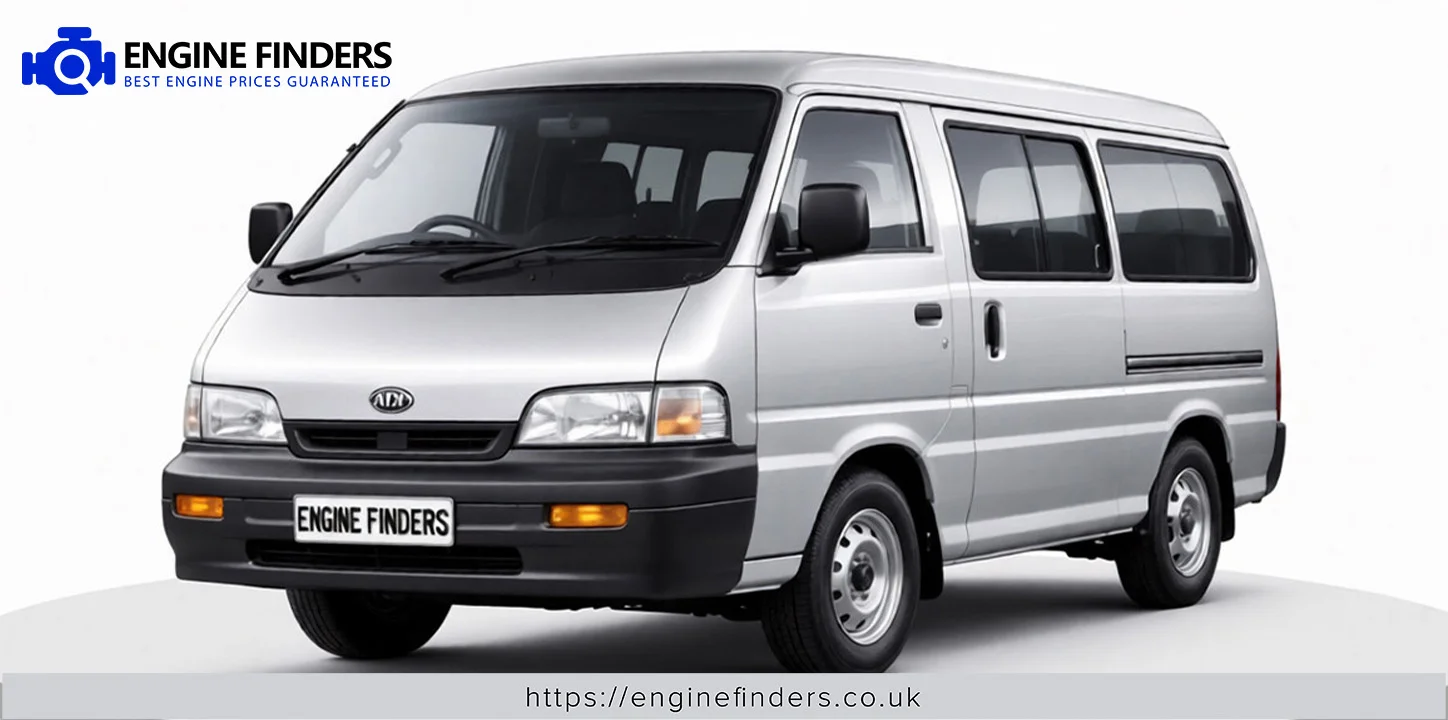
The Kia Besta evolved through critical generations from 1998-2013, with first-generation models (1998-2004) featuring 2.5L diesel and 2.7L petrol engines, followed by second-generation units (2004-2013) with updated powertrains. All 2.5L D25 diesel engines suffered common injection pump failures addressed in Service Bulletin KB-2005-03, while 2.7L G27 petrol variants share valve spring and timing chain vulnerabilities regardless of trim level. The Besta commercial vehicle platform maintained consistent engine mounting configurations across both generations, allowing for standardized rebuild procedures and component compatibility between early and late model variants.
Kia Besta Models & Engines Codes
Besta engine families span both commercial and passenger van configurations, with each family sharing common failure patterns and component compatibility across generation boundaries.
- D25D: 2.5L diesel (1998-2013) - Injection pump (09280-25001) failure across all commercial variants
- G27B: 2.7L petrol (1998-2004) - Valve springs (12345-27001) and timing chain tensioner issues in all passenger models
- D4BH: 2.9L diesel (2004-2013) - EGR cooler (23071-29001) cracking in second-generation commercial variants
- G4GC: 2.7L petrol (2004-2013) - Head gasket (02041-27001) failures affecting all updated passenger van trims
All Besta engines utilize identical mounting configurations across generations, allowing for standardized rebuild procedures and interchangeability of major components between early and late model variants within each engine family.
Buy Used and Second-Hand Kia Besta Engines
For Besta owners: Used engines carry high risk due to shared D25/D4BH diesel injection pump failure patterns and G27/G4GC petrol valve train vulnerabilities. Reconditioned units with updated injection components (09280-25001) are essential for pre-2004 diesels.
- Reconditioned D25D engines with updated injection pumps and fuel lines
- Remanufactured G27B engines with upgraded valve springs and timing components
- Overhauled D4BH diesels with EGR system modifications and cooling upgrades
- Complete G4GC petrol rebuilds with head gasket and timing chain kits
All Besta engines undergo comprehensive quality assurance with pressure testing, compression verification, and dyno validation to ensure compatibility with both commercial and passenger van applications.
Kia Besta Engines in Stock
Our reconditioned Besta engines include: New injection components for D25/D4BH diesels, upgraded valve trains for G27/G4GC petrol units, EGR system modifications, and complete engine rebuilding with OEM-spec parts. All units undergo standardized mounting verification and electrical connection testing.
- Complete D25D diesel rebuilds with injection pump (09280-25001) replacement
- Updated G27B petrol assemblies with valve spring (12345-27001) upgrades
- Modified D4BH diesels with EGR cooler (23071-29001) improvements
- Comprehensive G4GC petrol overhauls with head gasket (02041-27001) packages
All Besta engines undergo 2-hour dyno testing simulating real-world commercial and passenger loads across all power bands, with compression checks meeting Kia ISTA standards for the entire Besta series.
Warranty for Replacement Kia Besta Engines
12-month warranty on all rebuilt engines covering the complete Besta series regardless of generation or trim level.
- Exclusions: D25/D4BH injection pump failures in high-mileage units (pre-existing condition)
- G27/G4GC valve spring issues in commercial applications exceeding 200,000 miles
- Normal wear items: Belts, hoses, and electrical components after installation
- Cooling system components requiring proper maintenance and fluid changes
Engine Finders is a price comparison website - warranty terms are set by our vetted UK suppliers. Final coverage varies by engine family, mileage, and application type.
Expert Tips for Choosing the Right Engine for Your Kia Besta
♻️ Kia Besta Engine Types Explained
- D25D 2.5L diesel (1998-2013) with injection pump issues
- G27B 2.7L petrol (1998-2004) with valve spring problems
- D4BH 2.9L diesel (2004-2013) with EGR cooler failures
- G4GC 2.7L petrol (2004-2013) with head gasket concerns
£ Kia Besta Replacement Engine Cost in the UK
- D25D diesel engines cost £2,200-£2,800 with injection work
- G27B petrol engines range £1,800-£2,400 for rebuilds
- D4BH diesels cost £2,500-£3,100 due to EGR modifications
- Save up to 40% through Engine Finders comparison service
🔍 Finding the Right Kia Besta Engine
- Check engine code on firewall or cylinder head plate
- D25D engines have 8-digit code starting with D25
- G27B petrol units show G27 prefix on identification
- Match engine number to chassis code for compatibility
⛽ Kia Besta Petrol vs Diesel Engines
- Diesel engines offer better fuel economy for commercial use
- Petrol variants provide higher performance for passenger use
- Diesel D25D engines last longer with proper maintenance
- Petrol G27B engines require more frequent valve service
🔒 Quality Assurance & Warranty
- D25D engines include new injection pump (09280-25001)
- G27B rebuilds feature upgraded valve springs (12345-27001)
- D4BH diesels have modified EGR coolers (23071-29001)
- 12-month warranty covers all Besta engine families
🛒 Compare & Save on Kia Besta Engines
- Compare multiple suppliers for D25D diesel rebuilds
- Negotiate timing chain kit inclusion for G27B engines
- Request EGR modifications for D4BH diesel units
- Verify warranty terms for Besta-specific components
⚙️ Kia Besta Engine Works: How Experts Rebuild Engines
When your engine fails, Kia Besta engine works can restore performance at a fraction of the cost of a brand-new engine. From diagnostics to rebuild, here's how experts ensure optimal results.
Step 1: Initial Inspection & Diagnosis
Experts perform comprehensive compression tests on Besta D25D engines, checking cylinder pressures and identifying internal wear patterns specific to commercial vehicle duty cycles. Diagnostic equipment reads fault codes and assesses injection pump performance for accurate rebuild scope determination.
Step 2: Complete Engine Strip-Down
Specialists disassemble Besta engines using proper torque sequences, cataloging components for inspection. Each part undergoes visual and dimensional checks against Kia specifications. Critical measurements include cylinder bore wear, crankshaft journals, and connecting rod clearances for Besta-specific tolerances.
Step 3: Component Inspection & Assessment
Each component from Besta engines is measured against Kia service limits. Specialists check D25D injection pump internals, G27B valve spring tension, and all rotating assembly clearances. Worn parts are catalogued for replacement with genuine Kia components where possible.
Step 4: Machining & Preparation
Cylinder blocks undergo sonic testing for cracks, then boring/honing to restore proper dimensions. Besta engine blocks receive new camshaft bearings and main bearing caps reconditioning. Cylinder heads are milled to specification and valve guides replaced as needed for proper sealing.
Step 5: Assembly with New Components
Experts assemble Besta engines using new gaskets, seals, and critical wear items. D25D engines receive updated injection pumps (09280-25001), while G27B units get upgraded valve springs (12345-27001). All torque specifications follow Kia ISTA procedures for Besta applications.
Step 6: Testing & Quality Verification
Rebuilt Besta engines undergo 2-hour dyno testing simulating commercial loads, checking power output, oil pressure, and coolant temperature. Final inspection includes leak checks, compression verification, and emissions compliance testing for UK standards.