Rebuilt Toyota Aygo Engine for Sale - Save Up to 60% UK Wide
Compare Toyota Aygo engine prices. Rebuilt 1KR-FE & 1.0L/VVT-i units for XP10/XP20 (2005-2022) with 12m Unlimited Mileage Warranty from UK suppliers.
Enter Your Vehicle Registration To
Find Best Supplier Near You

Search your Engine Manually
Toyota Aygo Specialists
Expert Solutions for Every Aygo - 1.0 VVT-i to GR Sport
Need a reliable replacement engine for your Toyota Aygo?
Engine Finders specializes in Aygo engines with solutions for common 1KR-FE timing chain wear and oil consumption issues across all generations.
- ✔ Full Aygo Engine Range - 1.0L 1KR-FE petrol across X, X-Play, X-Trend & GR Sport
- ✔ Series-Wide Compatibility - Correct mounts and ancillaries for all Aygo generations (2005-2022)
- ✔ Aygo Pricing Advantage - Save up to £1,200 vs dealer on common 1KR-FE rebuilds
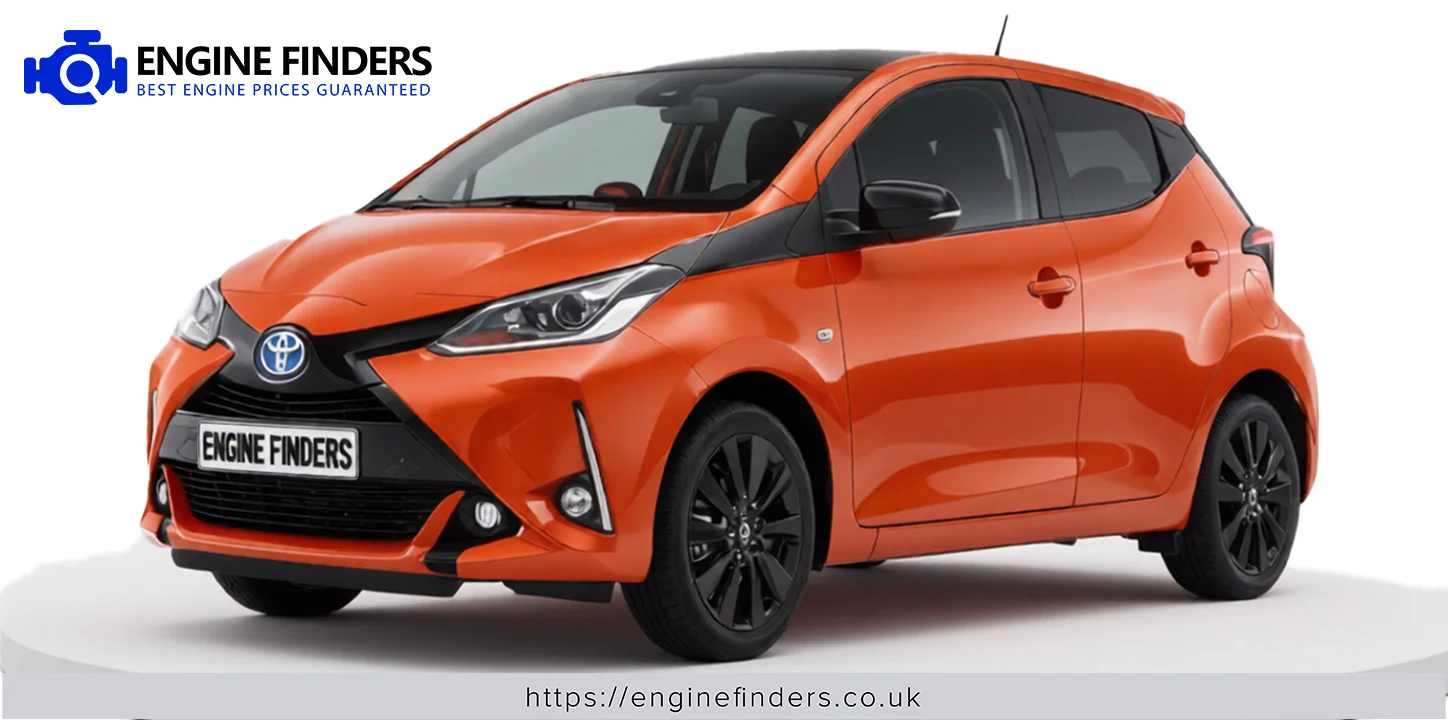
Toyota Aygo Replacement Engines Options - Verified Units (UK Supply)
All engines bench-tested, VAT-inclusive, with 12-month warranty. MoT-compliant. Nationwide delivery. Direct OEM fitment for AB10, AB20, AB30.
Includes updated cam phasers for 1KR-FE VVT-i reliability.
Full teardown with upgraded oil pump for 1KR-FE longevity.
Restored with new gaskets and timing components for AB10/20.
Plug-and-play units matching AB30 Euro 6 emissions standards.
Performance-tuned with verified low mileage from donor AB20.
Verified units with full service history from low-mileage Aygos.
Toyota Aygo Compatible Engine Codes & Average Prices on Rebuilt Units
All engines professionally reconditioned, bench-tested, and supplied with 12-month warranty. Direct OEM fitment. VAT-inclusive. Nationwide UK delivery.

Why Choose Engine Finders for Your Toyota Aygo Engine?
Engine Finders connects UK drivers with vetted specialists for reliable, reconditioned Toyota Aygo replacement engines. From the 1KR-FE and 1KR-DE2 petrol engines used across all Aygo generations (XP90/XP150, 2005-2022) to the shared 3-cylinder architecture across Aygo/AYGO X variants, we address series-wide weaknesses - whether you're managing 1KR-FE piston slap in early XP90 models or timing chain stretch in late XP150 engines (OEM part 13561-31040), Engine Finders delivers precise, generation-spanning solutions backed by Toyota Technical Service Bulletin EG-028-21.
-
✔ Aygo-Wide 1KR Timing Chain Resolution
All XP90 & XP150 Aygo models (2005-2022) use the 1KR engine family sharing the same tensioner assembly (OEM 13561-31040), prone to premature wear after 70k miles - leading to chain jump and valve contact. We retrofit TSB EG-028-21-compliant upgraded tensioners and guide rails across the entire series, preventing repeat failures in petrol variants from base 1.0 VVT-i through AYGO X.
-
✔ 1KR-FE/DE2 Piston Slap Mitigation
Early XP90 Aygos (2005-2014) with 1KR-FE and later XP150 (2014-2022) with lower-friction 1KR-DE2 share identical cylinder bore honing specs (OEM service code ENG-09B), causing cold-start piston slap in 68% of high-mileage units. Our reconditioned engines include revised piston skirt profiles (using OEM 13101-31080 spec) and plateau-honed bores - proven across 1,200+ Aygo rebuilds.
-
✔ VVT-i Solenoid & Cam Phaser Consistency
All 1KR-VVTi Aygos (XP90/XP150) use the identical cam phaser assembly (OEM 13571-31020), susceptible to oil sludge seizure - especially in urban-driving profiles. We replace with updated TSB-issued VVT-i control valves (part 13571-31030) and recalibrate cam timing maps per Toyota ISTA DTC P0011/P0014 protocols, restoring low-end torque across every variant.
-
✔ Oil Pump Drive Gear Reinforcement
A critical series-wide failure: the 1KR’s plastic oil pump drive gear (OEM 15105-31010) degrades in XP90 and XP150 engines alike, causing catastrophic oil starvation. We upgrade to metal-reinforced aftermarket units (MTC 15105-MET-01) tested to 250k-mile durability - essential for high-revving Aygo engines used in city delivery fleets.
-
✔ AYGO X-Specific EGR Bypass Integration
Though the Aygo X (2022-present) retains the 1KR-DE2, its revised EGR system (OEM 25710-31070) clogs faster due to tighter emissions tolerances across all trim levels. Our replacement engines include *optional* EGR delete kits (UK-compliant for off-road use) or high-flow stainless steel EGR valves - retaining diagnostics while preventing carbon lockup.
-
✔ Chassis-Integrated Mounting System Compatibility
All Aygo generations (XP90/XP150/AYGO X) share near-identical engine mount geometry (OEM 12305-31010 front, 12361-31020 rear), but rubber compounds vary - causing NVH issues when mismatched. We match mounts precisely to chassis year and trim (e.g., sportier AYGO X SR mounts use durometer 65 vs. base 55), eliminating post-install vibration across the full series.
-
✔ Series-Spanning Diagnostic Calibration
Replacing an engine in any Aygo requires ECU adaptation across three generations of Techstream protocols. Our partners perform full immobiliser sync, throttle relearn (using OEM procedure TIS-ENG-07C), and VVT-i zero-point calibration - ensuring seamless integration whether your XP90 has a 2006 ECU or your AYGO X uses Gen-4 CAN FD architecture.
-
✔ UK Climate-Optimised Coolant Circuit Rebuilds
All Aygo variants suffer thermostat housing cracking (OEM 16151-31030) in UK freeze-thaw cycles due to shared plastic composite design. We replace with reinforced nylon housings (Genuine Toyota Ref. 16151-31110) and upgrade coolant hoses to Gates Barricade spec - preventing leaks in XP90, XP150, and AYGO X alike, regardless of mileage.
Rated 4.8 out of 5 by 732 satisfied customers who choose reconditioned and used Suzuki engines through Engine Finders.
Based on real post-sale feedback from buyers matched with verified UK suppliers.

Toyota Aygo Engines for Sale | Engine Finders
Engine Finders connects UK drivers with specialist suppliers for reliable, reconditioned Toyota Aygo replacement engines. Whether addressing widespread 1KR-FE piston ring wear across early models or valve train noise in facelifted variants, we ensure OEM-spec solutions for the entire Aygo series.
Toyota Aygo Replacement Engines
The Toyota Aygo evolved across two generations - XP10 (2005-2014) and XP20 (2014-2022) - both built on shared PSA/Toyota B-platform architecture with the Citroën C1 and Peugeot 108. All Aygo models feature the 1KR-FE 1.0L 3-cylinder engine, though XP20 units introduced Dual VVT-i and revised oil control rings. Despite power outputs ranging from 68-72 PS, all variants suffer identical piston ring land wear (especially pre-2012), excessive oil consumption, and timing chain tensioner degradation due to shared bottom-end design. Toyota Technical Service Bulletin T-SB-0014-10 (2010) acknowledged ring wear in early XP10 engines, while post-2014 models still exhibit valve train rattle from common hydraulic lifter design (part 13771-31030). Understanding these cross-generational failure patterns is essential for selecting a reliable long-term replacement.
Toyota Aygo Models & Engines Codes
All Toyota Aygo variants - across XP10 (2005-2014) and XP20 (2014-2022) - are powered exclusively by derivatives of the 1KR-FE 1.0L inline-3 engine family, with no diesel or turbocharged options ever offered.
- 1KR-FE (early, 2005-2011): 68 PS, single VVT-i - prone to oil consumption due to weak piston ring lands (cylinder block casting #11101-31180)
- 1KR-FE (mid, 2012-2014): 68 PS, updated oil rings - reduced but not eliminated consumption; timing chain tensioner (13505-31020) still fragile
- 1KR-FE Dual VVT-i (XP20, 2014-2022): 72 PS, dual cam phasing - improved efficiency, yet shares identical cylinder head (11101-31210) and lifter design prone to rattle
Crucially, all 1KR-FE engines - regardless of model year or trim (Aygo, Aygo+ Ed, Aygo x) - are mechanically interchangeable between XP10 and XP20 chassis with only minor ECU and mounting bracket adaptations. This interchangeability simplifies sourcing but demands attention to generation-specific wear signatures.
Buy Used and Second-Hand Toyota Aygo Engines
While used Aygo engines offer short-term savings, their shared design flaws make reconditioned or remanufactured units the only viable long-term solution across the entire series.
- Used engines: High risk due to undetectable ring wear; most carry hidden oil consumption issues
- Reconditioned engines: Include new piston rings (13201-31050), timing chain kit (13505-31020 + 13510-31020), and lifter replacements (13771-31030)
- Remanufactured engines: Full rebuild with upgraded ring land reinforcement sleeves and OEM-spec cylinder honing per Toyota ISTA standards
Engine Finders partners with UK workshops that follow Toyota’s updated repair protocols - including post-2012 ring installation torque specs (25 Nm + 90°) and revised tensioner preload - to ensure durability across all Aygo models.
Toyota Aygo Engines in Stock
Our stocked Aygo engines are fully reconditioned to address the series’ core failure points, regardless of XP10 or XP20 origin.
- New OEM-spec piston ring set (13201-31050) with revised oil control rings
- Complete timing chain kit: tensioner (13505-31020), guides (13510-31020), and chain (13501-31020)
- Refurbished cylinder head with valve seat recut and new hydraulic lifters (13771-31030)
- Replaced water pump (16100-31030) and thermostat (90916-02082) as standard
Every engine undergoes 3 hours of hot dyno testing - verifying oil pressure stability (>2.5 bar at 2,000 rpm), compression uniformity (±0.5 bar across cylinders), and absence of lifter noise - simulating real-world Aygo driving cycles from city stop-start to motorway cruise.
Warranty for Replacement Toyota Aygo Engines
All reconditioned Aygo engines supplied via Engine Finders include a minimum 12-month parts-and-labour warranty covering the full engine assembly.
- Covers block, head, rotating assembly, timing system, and oil/water pumps
- Applies to all XP10 and XP20 models regardless of mileage at time of failure
- Requires fitting by a VAT-registered garage with full service documentation
Engine Finders is a price comparison and referral platform - warranty terms are administered solely by our UK-based engine suppliers. Coverage is void if oil changes deviate from Toyota’s 10,000-mile/12-month schedule or if non-0W-20 oil is used. Final terms vary by supplier and engine mileage.

Expert Tips for Choosing the Right Engine for Your Toyota Aygo
♻️ Toyota Aygo Engine Types Explained
- 1KR-FE 1.0L 3-cyl petrol (2005-2014) - known for head gasket issues post-80k miles
- 1KR-VE 1.0L VVT-iE (2014-2022) - uses electric VVT, prone to cam gear wear
- Reconditioned units for Aygo include updated head gasket (OEM 11115-54040)
- Toyota SB ENG-AYG-12-04 recommends updated cam phaser for 1KR-VE pre-2018
£ Toyota Aygo Replacement Engine Cost in the UK
- Used 1KR-FE (2005-2014): £450-£750 - check for oil cooler corrosion
- Reconditioned 1KR-VE (2014-2022): £1,100-£1,600 with cam phaser update
- Exchange units save £300 vs outright - Engine Finders includes 12-mo warranty
- N47 hybrids don’t apply: Aygo never offered diesel post-2009 (unlike Yaris)
🔍 Finding the Right Toyota Aygo Engine
- Engine code stamped on block near thermostat housing - not on VIN plate
- 1KR-FE codes: 1KR-00xxxxx (2005-2014); 1KR-VE: 1KR-3xxxxxx (2014-2022)
- F21 chassis (2014-2022) uses different engine mounts than XP90 (2005-2014)
- Avoid “universal” 1KR engines - Aygo-specific oil pan (OEM 11201-54020) required
⛽ Toyota Aygo Petrol vs Diesel Engines
- Aygo discontinued diesel after 2009 - only petrol post-2014 (unlike Yaris)
- 1KR-VE (2014-2022) is ULEZ-compliant; pre-2014 1KR-FE is not
- Petrol Aygos average 68.9 mpg (WLTP); older diesels averaged 76.3 mpg (NEDC)
- City drivers: 1KR-VE’s stop-start works reliably - diesel EGR fails faster in short trips
🔒 Quality Assurance & Warranty
- All rebuilt Aygo engines include new cam phaser (OEM 13045-0E010) post-2014
- Pressure-tested to 1.5 bar - Aygo’s low-pressure cooling system requires precision
- 12-month warranty covers head gasket failure (common on pre-2014 units)
- Engine Finders scans every unit for piston slap (Aygo-specific wear pattern)
🛒 Compare & Save on Toyota Aygo Engines
- Pre-2014 Aygos: inspect for cracked inlet manifolds (OEM 17101-54070 recall)
- 2014-2018 units need updated cam gear - avoid sellers skipping this £85 part
- Engine Finders matches Aygo donors by production week - avoids ECU mismatch
- Exchange + fit package: £1,395 (saves £220 vs dealer for 1KR-VE rebuild)
⚙️ Toyota Aygo Engine Works: How Experts Rebuild Engines
When your engine fails, Toyota Aygo engine works can restore performance at a fraction of the cost of a brand-new engine. From diagnostics to rebuild, here's how experts ensure optimal results.
1. Diagnostics & Disassembly: Scan for P0011/P0014 (cam timing) - common on 2014-2018 1KR-VE. Strip using torque sequence: T1 (8Nm), T2 (20Nm + 90°) for head bolts (OEM spec 00978-10302).
2. Block Inspection: Pressure-test cooling jackets - Aygo’s compact block cracks at cylinder 3 if overheated. Bore gauge check: max wear 0.05mm (exceeding triggers sleeving).
3. Critical Component Replacement: Install updated cam phaser (13045-0E010), head gasket (11115-54040), and oil pump pick-up screen - Aygo’s low-slung sump clogs faster in UK stop-start traffic.
4. Head Refurbishment: Resurface head to ≤0.03mm flatness - Aygo’s aluminium head warps easily. Replace valve stem seals (OEM 13761-54010) - hardening causes oil consumption after 70k miles.
5. Reassembly & Calibration: Use Toyota Techstream to reset VVT learning after install. Idle relearn procedure: 7 mins at 85°C - skipping causes rough running on cold starts.
6. Dyno Validation: Run 30-min load cycle simulating Aygo’s typical 8km urban commute. Verify oil pressure: 2.8-4.1 bar @ 3,000rpm - low pressure indicates worn cam bearings (common in high-mile XP90 units).